heating CHRYSLER 300 2019 User Guide
[x] Cancel search | Manufacturer: CHRYSLER, Model Year: 2019, Model line: 300, Model: CHRYSLER 300 2019Pages: 492, PDF Size: 4.85 MB
Page 366 of 492
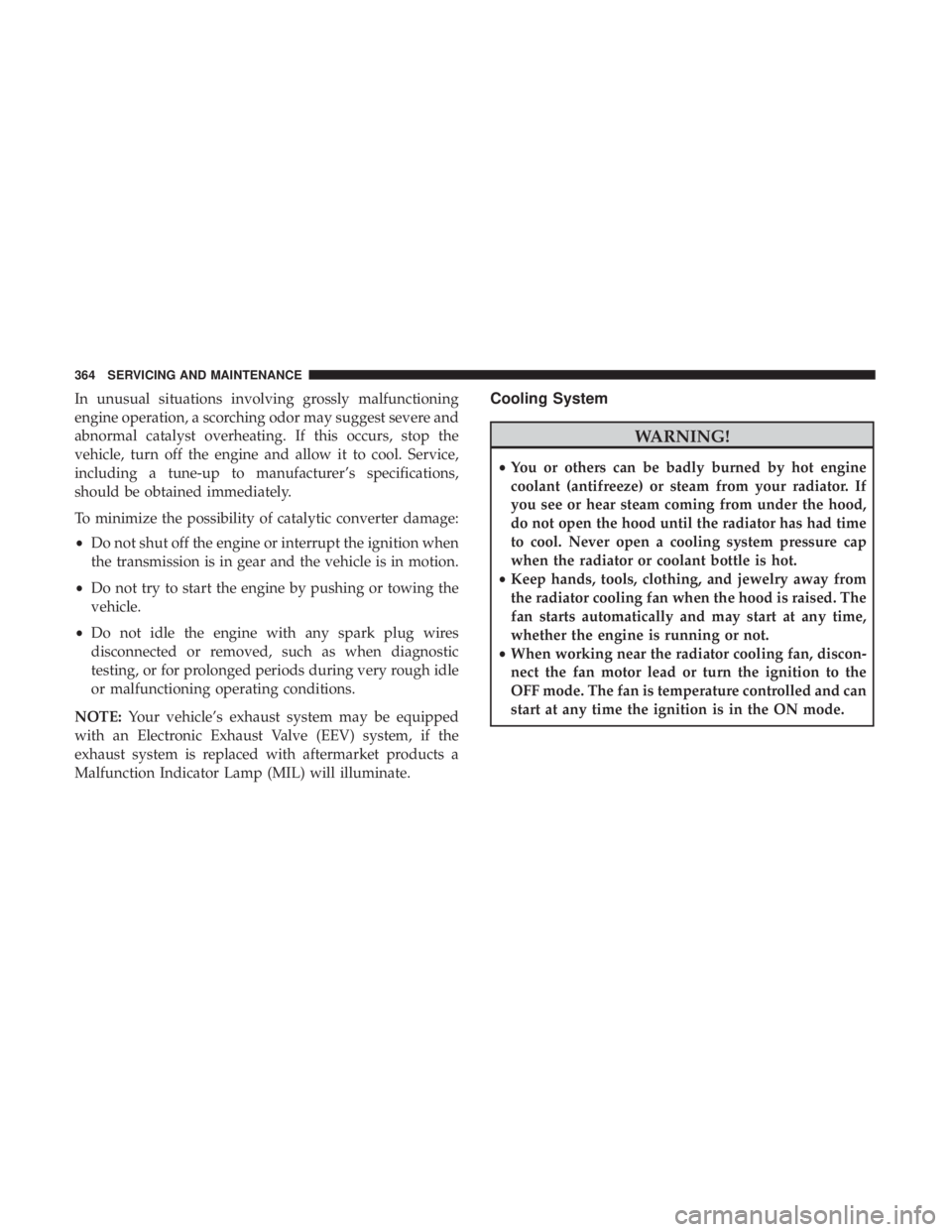
In unusual situations involving grossly malfunctioning
engine operation, a scorching odor may suggest severe and
abnormal catalyst overheating. If this occurs, stop the
vehicle, turn off the engine and allow it to cool. Service,
including a tune-up to manufacturer’s specifications,
should be obtained immediately.
To minimize the possibility of catalytic converter damage:
•Do not shut off the engine or interrupt the ignition when
the transmission is in gear and the vehicle is in motion.
• Do not try to start the engine by pushing or towing the
vehicle.
• Do not idle the engine with any spark plug wires
disconnected or removed, such as when diagnostic
testing, or for prolonged periods during very rough idle
or malfunctioning operating conditions.
NOTE: Your vehicle’s exhaust system may be equipped
with an Electronic Exhaust Valve (EEV) system, if the
exhaust system is replaced with aftermarket products a
Malfunction Indicator Lamp (MIL) will illuminate.Cooling System
WARNING!
• You or others can be badly burned by hot engine
coolant (antifreeze) or steam from your radiator. If
you see or hear steam coming from under the hood,
do not open the hood until the radiator has had time
to cool. Never open a cooling system pressure cap
when the radiator or coolant bottle is hot.
• Keep hands, tools, clothing, and jewelry away from
the radiator cooling fan when the hood is raised. The
fan starts automatically and may start at any time,
whether the engine is running or not.
• When working near the radiator cooling fan, discon-
nect the fan motor lead or turn the ignition to the
OFF mode. The fan is temperature controlled and can
start at any time the ignition is in the ON mode.
364 SERVICING AND MAINTENANCE
Page 385 of 492
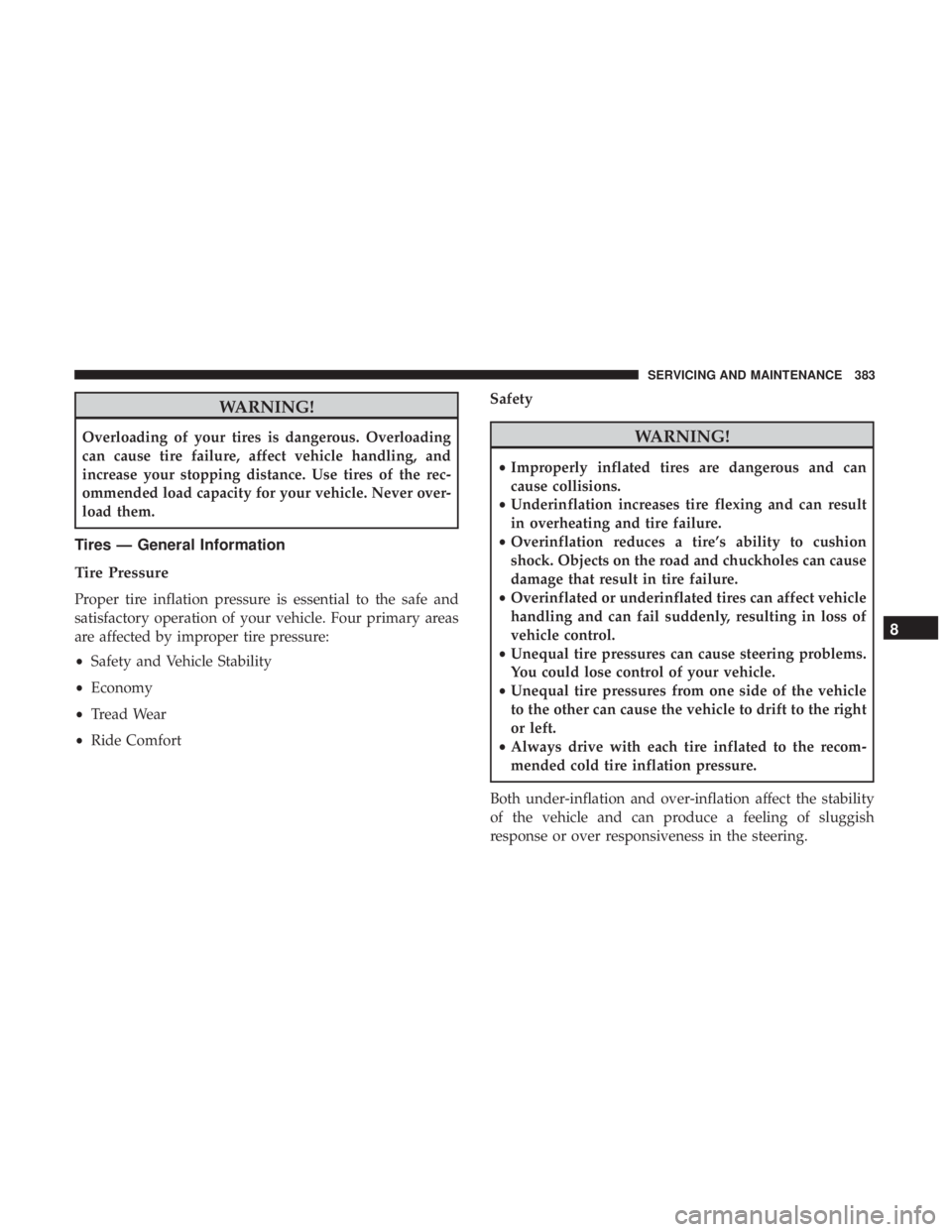
WARNING!
Overloading of your tires is dangerous. Overloading
can cause tire failure, affect vehicle handling, and
increase your stopping distance. Use tires of the rec-
ommended load capacity for your vehicle. Never over-
load them.
Tires — General Information
Tire Pressure
Proper tire inflation pressure is essential to the safe and
satisfactory operation of your vehicle. Four primary areas
are affected by improper tire pressure:
•Safety and Vehicle Stability
• Economy
• Tread Wear
• Ride Comfort Safety
WARNING!
•
Improperly inflated tires are dangerous and can
cause collisions.
• Underinflation increases tire flexing and can result
in overheating and tire failure.
• Overinflation reduces a tire’s ability to cushion
shock. Objects on the road and chuckholes can cause
damage that result in tire failure.
• Overinflated or underinflated tires can affect vehicle
handling and can fail suddenly, resulting in loss of
vehicle control.
• Unequal tire pressures can cause steering problems.
You could lose control of your vehicle.
• Unequal tire pressures from one side of the vehicle
to the other can cause the vehicle to drift to the right
or left.
• Always drive with each tire inflated to the recom-
mended cold tire inflation pressure.
Both under-inflation and over-inflation affect the stability
of the vehicle and can produce a feeling of sluggish
response or over responsiveness in the steering.
8
SERVICING AND MAINTENANCE 383
Page 478 of 492
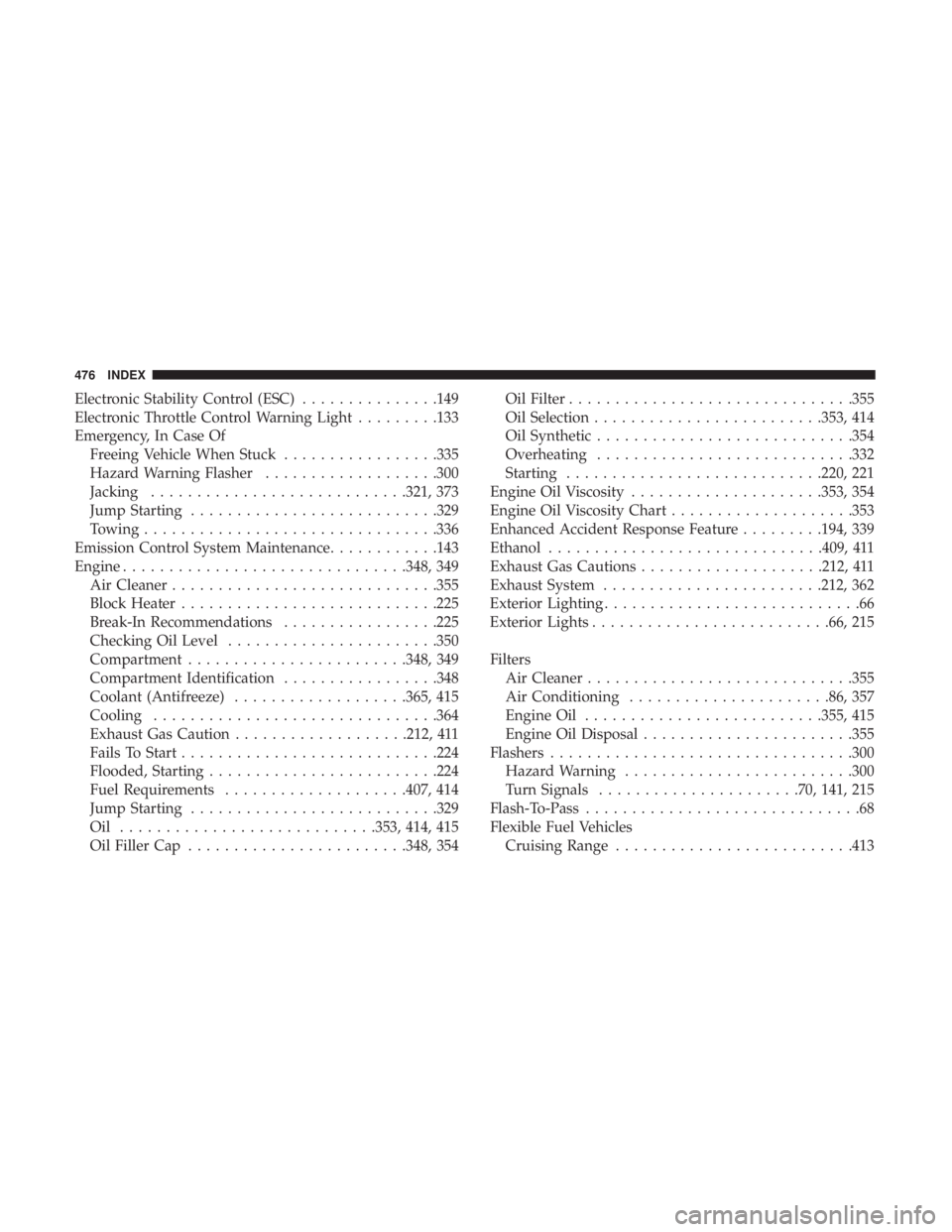
Electronic Stability Control (ESC)...............149
Electronic Throttle Control Warning Light .........133
Emergency, In Case Of Freeing Vehicle When Stuck .................335
Hazard Warning Flasher ...................300
Jacking ........................... .321, 373
Jump Starting .......................... .329
Towing ............................... .336
Emission Control System Maintenance ............143
Engine .............................. .348, 349
Air Cleaner ............................ .355
Block Heater ........................... .225
Break-In Recommendations .................225
Checking Oil Level ...................... .350
Compartment ....................... .348, 349
Compartment Identification .................348
Coolant (Antifreeze) ...................365, 415
Cooling .............................. .364
Exhaust Gas Caution ...................212, 411
Fails To Start ........................... .224
Flooded, Starting ........................ .224
Fuel Requirements ....................407, 414
Jump Starting .......................... .329
Oil ........................... .353, 414, 415
Oil Filler Cap ....................... .348, 354Oil Filter
.............................. .355
Oil Selection ........................ .353, 414
Oil Synthetic ........................... .354
Overheating ........................... .332
Starting ........................... .220, 221
Engine Oil Viscosity .....................353, 354
Engine Oil Viscosity Chart ....................353
Enhanced Accident Response Feature .........194, 339
Ethanol ............................. .409, 411
Exhaust Gas Cautions ................... .212, 411
Exhaust
System ....................... .212, 362
Exterior Lighting ............................66
Exterior Lights ......................... .66, 215
Filters Air Cleaner ............................ .355
Air Conditioning ..................... .86, 357
Engine Oil ......................... .355, 415
Engine Oil Disposal ...................... .355
Flashers ................................ .300
Hazard Warning ........................ .300
Turn Signals ..................... .70, 141, 215
Flash-To-Pass ..............................68
Flexible Fuel Vehicles Cruising Range ......................... .413
476 INDEX
Page 483 of 492
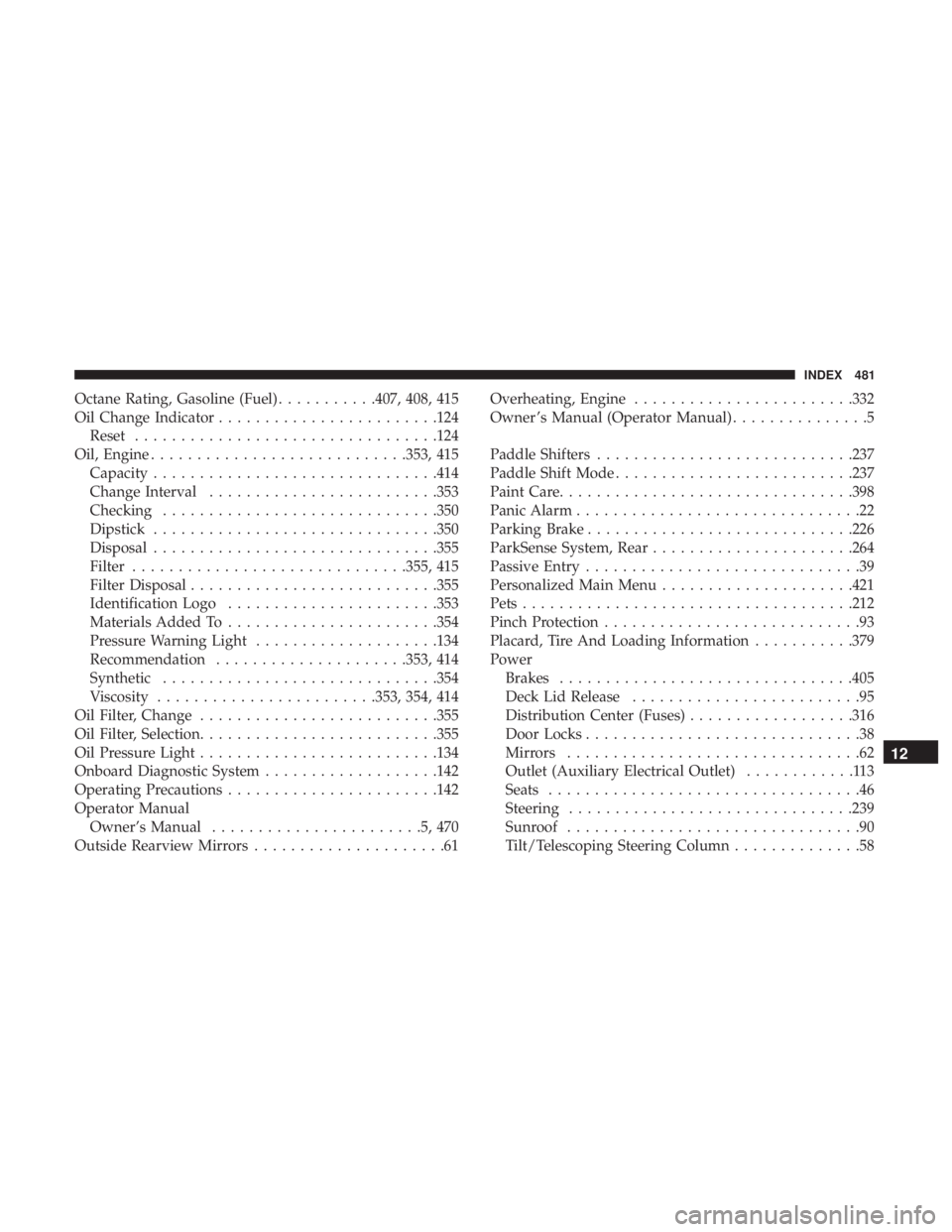
Octane Rating, Gasoline (Fuel)...........407, 408, 415
Oil Change Indicator ....................... .124
Reset ................................ .124
Oil, Engine ........................... .353, 415
Capacity .............................. .414
Change Interval ........................ .353
Checking ............................. .350
Dipstick .............................. .350
Disposal .............................. .355
Filter ............................. .355, 415
Filter Disposal .......................... .355
Identification Logo ...................... .353
Materials Added To ...................... .354
Pressure Warning Light ....................134
Recommendation .....................353, 414
Synthetic ............................. .354
Viscosity ....................... .353, 354, 414
Oil Filter, Change ......................... .355
Oil Filter, Selection ......................... .355
Oil Pressure Light ......................... .134
Onboard Diagnostic System ...................142
Operating Precautions ...................... .142
Operator Manual Owner’s Manual .......................5,470
Outside Rearview Mirrors .....................61 Overheating, Engine
....................... .332
Owner ’s Manual (Operator Manual) ...............5
Paddle Shifters ........................... .237
Paddle Shift Mode ......................... .237
Paint Care ............................... .398
Panic Alarm ...............................22
Parking Brake ............................ .226
ParkSense System, Rear ..................... .264
Passive Entry ..............................39
Personalized Main Menu .....................421
Pets ................................... .212
Pinch Protection ............................
93
Placard, Tire And Loading Information ...........379
Power Brakes ............................... .405
Deck Lid Release .........................95
Distribution Center (Fuses) ..................316
Door Locks ..............................38
Mirrors ................................62
Outlet (Auxiliary Electrical Outlet) ............113
Seats ..................................46
Steering .............................. .239
Sunroof ................................90
Tilt/Telescoping Steering Column ..............58
12
INDEX 481