air condition CHRYSLER 300 2019 Owner's Guide
[x] Cancel search | Manufacturer: CHRYSLER, Model Year: 2019, Model line: 300, Model: CHRYSLER 300 2019Pages: 492, PDF Size: 4.85 MB
Page 388 of 492
•The puncture is no greater thana¼ofaninch (6 mm).
Consult an authorized tire dealer for tire repairs and
additional information.
Damaged Run Flat tires, or Run Flat tires that have
experienced a loss of pressure should be replaced immedi-
ately with another Run Flat tire of identical size and service
description (Load Index and Speed Symbol). Replace the
tire pressure sensor as well as it is not designed to be
reused.
Run Flat Tires — If Equipped
Run Flat tires allow you the capability to drive 50 miles
(80 km) at 50 mph (80 km/h) after a rapid loss of inflation
pressure. This rapid loss of inflation is referred to as the
Run Flat mode. A Run Flat mode occurs when the tire
inflation pressure is of/or below 14 psi (96 kPa). Once a
Run Flat tire reaches the run flat mode it has limited
driving capabilities and needs to be replaced immediately.
A Run Flat tire is not repairable. When a run flat tire is
changed after driving with underinflated tire condition,
please replace the TPM sensor as it is not designed to be
reused when driven under run flat mode (14 psi (96 kPa))
condition. NOTE:
TPM Sensor must be replaced after driving the
vehicle on a flat tire condition.
It is not recommended driving a vehicle loaded at full
capacity or to tow a trailer while a tire is in the run flat
mode.
See the tire pressure monitoring section for more informa-
tion.
Tire Spinning
When stuck in mud, sand, snow, or ice conditions, do not
spin your vehicle’s wheels above 30 mph (48 km/h) or for
longer than 30 seconds continuously without stopping.
Refer to “Freeing A Stuck Vehicle” in “In Case Of Emer-
gency” for further information.
WARNING!
Fast spinning tires can be dangerous. Forces generated
by excessive wheel speeds may cause tire damage or
failure. A tire could explode and injure someone. Do
not spin your vehicle’s wheels faster than 30 mph
(48 km/h) for more than 30 seconds continuously when
you are stuck, and do not let anyone near a spinning
wheel, no matter what the speed.
386 SERVICING AND MAINTENANCE
Page 399 of 492
Traction Grades
The Traction grades, from highest to lowest, are AA, A,
B, and C. These grades represent the tire’s ability to stop
on wet pavement, as measured under controlled condi-
tions on specified government test surfaces of asphalt
and concrete. A tire marked C may have poor traction
performance.
WARNING!
The traction grade assigned to this tire is based on
straight-ahead braking traction tests, and does not
include acceleration, cornering, hydroplaning, or
peak traction characteristics.
Temperature Grades
The Temperature grades are A (the highest), B, and C,
representing the tire’s resistance to the generation of
heat and its ability to dissipate heat, when tested under
controlled conditions on a specified indoor laboratory
test wheel.
Sustained high temperature can cause the material of
the tire to degenerate and reduce tire life, and excessive
temperature can lead to sudden tire failure. The grade C
corresponds to a level of performance, which all pas-
senger vehicle tires must meet under the Federal Motor Vehicle Safety Standard No. 109. Grades B and A
represent higher levels of performance on the laboratory
test wheel, than the minimum required by law.
WARNING!
The temperature grade for this tire is established for
a tire that is properly inflated and not overloaded.
Excessive speed, under-inflation, or excessive load-
ing, either separately or in combination, can cause
heat buildup and possible tire failure.
VEHICLE STORAGE
If you are leaving your vehicle dormant for more than 21
days, you may want to take these steps to protect your
battery.
• Disconnect the negative cable from the battery.
• Anytime you store your vehicle, or keep it out of service
(e.g., vacation) for two weeks or more, run the air
conditioning system at idle for about five minutes in the
fresh air and high blower setting. This will ensure
adequate system lubrication to minimize the possibility
of compressor damage when the system is started again.8
SERVICING AND MAINTENANCE 397
Page 400 of 492
BODYWORK
Protection From Atmospheric Agents
Vehicle body care requirements vary according to geo-
graphic locations and usage. Chemicals that make roads
passable in snow and ice and those that are sprayed on
trees and road surfaces during other seasons are highly
corrosive to the metal in your vehicle. Outside parking,
which exposes your vehicle to airborne contaminants, road
surfaces on which the vehicle is operated, extreme hot or
cold weather and other extreme conditions will have an
adverse effect on paint, metal trim, and underbody protec-
tion.
The following maintenance recommendations will enable
you to obtain maximum benefit from the corrosion resis-
tance built into your vehicle.
What Causes Corrosion?
Corrosion is the result of deterioration or removal of paint
and protective coatings from your vehicle.
The most common causes are:
•Road salt, dirt and moisture accumulation.
• Stone and gravel impact.
• Insects, tree sap and tar. •
Salt in the air near seacoast localities.
• Atmospheric fallout/industrial pollutants.
Body And Underbody Maintenance
Cleaning Headlights
Your vehicle is equipped with plastic headlights and fog
lights that are lighter and less susceptible to stone breakage
than glass headlights.
Plastic is not as scratch resistant as glass and therefore
different lens cleaning procedures must be followed.
To minimize the possibility of scratching the lenses and
reducing light output, avoid wiping with a dry cloth. To
remove road dirt, wash with a mild soap solution followed
by rinsing.
Do not use abrasive cleaning components, solvents, steel
wool or other aggressive material to clean the lenses.
Preserving The Bodywork
Washing
•Wash your vehicle regularly. Always wash your vehicle
in the shade using Mopar Car Wash, or a mild car wash
soap, and rinse the panels completely with clear water.
398 SERVICING AND MAINTENANCE
Page 450 of 492
RADIO OPERATION AND MOBILE PHONES
Under certain conditions, the mobile phone being on in
your vehicle can cause erratic or noisy performance from
your radio. This condition may be lessened or eliminated
by relocating the mobile phone antenna. This condition is
not harmful to the radio. If your radio performance does
not satisfactorily “clear” by the repositioning of the an-
tenna, it is recommended that the radio volume be turned
down or off during mobile phone operation when not
using Uconnect (if equipped).
Regulatory And Safety Information
USA/CANADA
Exposure to Radio Frequency Radiation
The radiated output power of the internal wireless radio is
far below the FCC and IC radio frequency exposure limits.
Nevertheless, the wireless radio will be used in such a
manner that the radio is 8 in (20 cm) or further from the
human body.
The internal wireless radio operates within guidelines
found in radio frequency safety standards and recommen-
dations, which reflect the consensus of the scientific com-
munity.The radio manufacturer believes the internal wireless radio
is safe for use by consumers. The level of energy emitted is
far less than the electromagnetic energy emitted by wire-
less devices such as mobile phones. However, the use of
wireless radios may be restricted in some situations or
environments, such as aboard airplanes. If you are unsure
of restrictions, you are encouraged to ask for authorization
before turning on the wireless radio.
The following regulatory statement applies to all Radio
Frequency (RF) devices equipped in this vehicle:
This device complies with Part 15 of the FCC Rules and
with Industry Canada license-exempt RSS standard(s).
Operation is subject to the following two conditions:
1. This device may not cause harmful interference, and
2. This device must accept any interference received, in-
cluding interference that may cause undesired opera-
tion.
NOTE: Changes or modifications not expressly approved
by the party responsible for compliance could void the
user ’s authority to operate the equipment.
448 MULTIMEDIA
Page 474 of 492
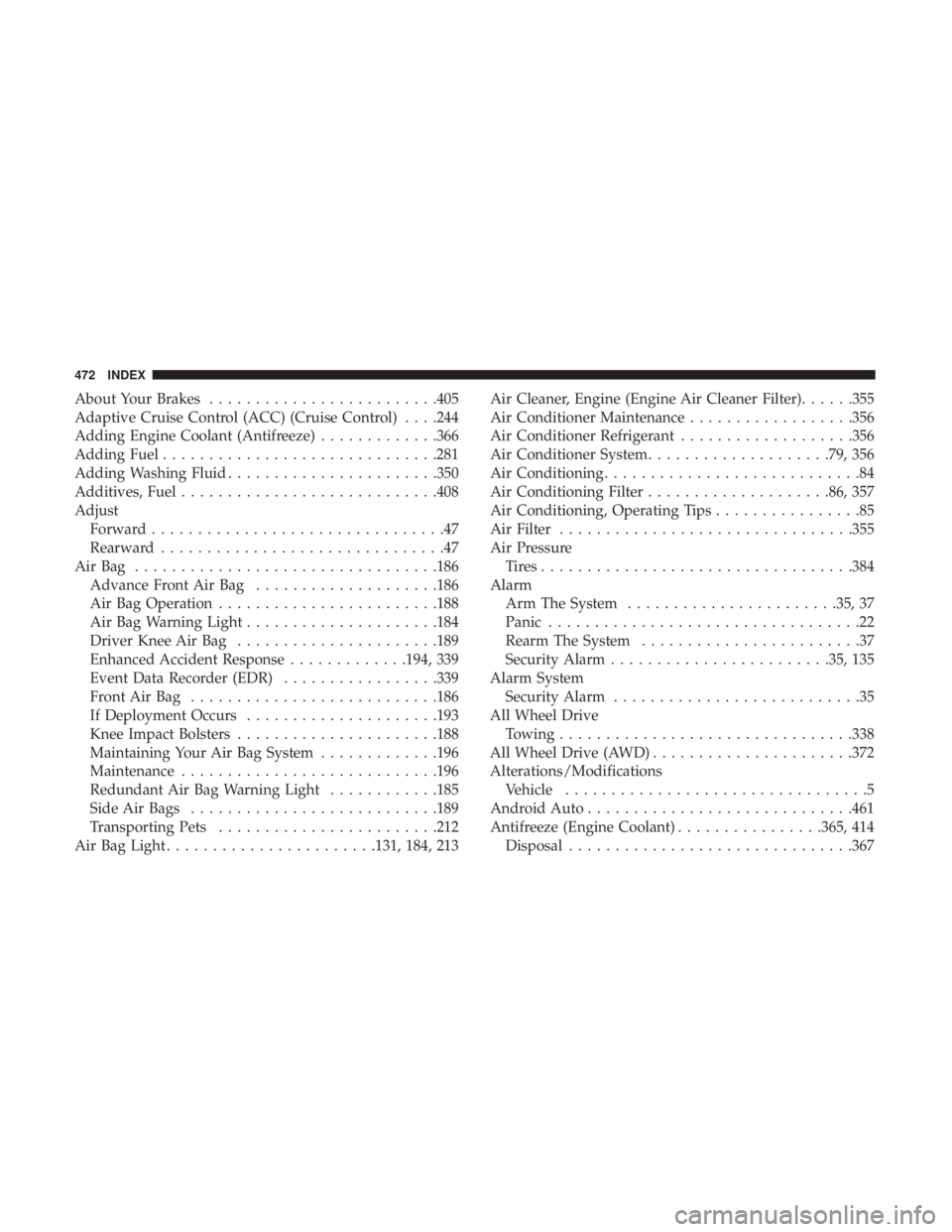
About Your Brakes........................ .405
Adaptive Cruise Control (ACC) (Cruise Control) . . . .244
Adding Engine Coolant (Antifreeze) .............366
Adding Fuel ............................. .281
Adding Washing Fluid ...................... .350
Additives, Fuel ........................... .408
Adjust Forward ................................47
Rearward ...............................47
AirBag ................................ .186
Advance Front Air Bag ....................186
Air Bag Operation ....................... .188
Air Bag Warning Light .....................184
Driver Knee Air Bag ..................... .189
Enhanced Accident Response .............194, 339
Event Data Recorder (EDR) .................339
FrontAirBag .......................... .186
If Deployment Occurs .....................193
Knee Impact Bolsters ..................... .188
Maintaining Your Air Bag System .............196
Maintenance ........................... .196
Redundant Air Bag Warning Light ............185
Side Air Bags .......................... .189
Transporting Pets ....................... .212
Air Bag Light ...................... .131, 184, 213Air Cleaner, Engine (Engine Air Cleaner Filter)
......355
Air Conditioner Maintenance ..................356
Air Conditioner Refrigerant ...................356
Air Conditioner System ....................79, 356
Air Conditioning ............................84
Air Conditioning Filter ....................86, 357
Air Conditioning, Operating Tips ................85
Air Filter ............................... .355
Air Pressure Tires................................. .384
Alarm Arm The System ...................... .35, 37
Panic ..................................22
Rearm The System ........................37
Security Alarm....................... .35,
135
Alarm System Security Alarm ...........................35
All Wheel Drive Towing ............................... .338
All Wheel Drive (AWD) ..................... .372
Alterations/Modifications Vehicle .................................5
Android Auto ............................ .461
Antifreeze (Engine Coolant) ................365, 414
Disposal .............................. .367
472 INDEX
Page 478 of 492
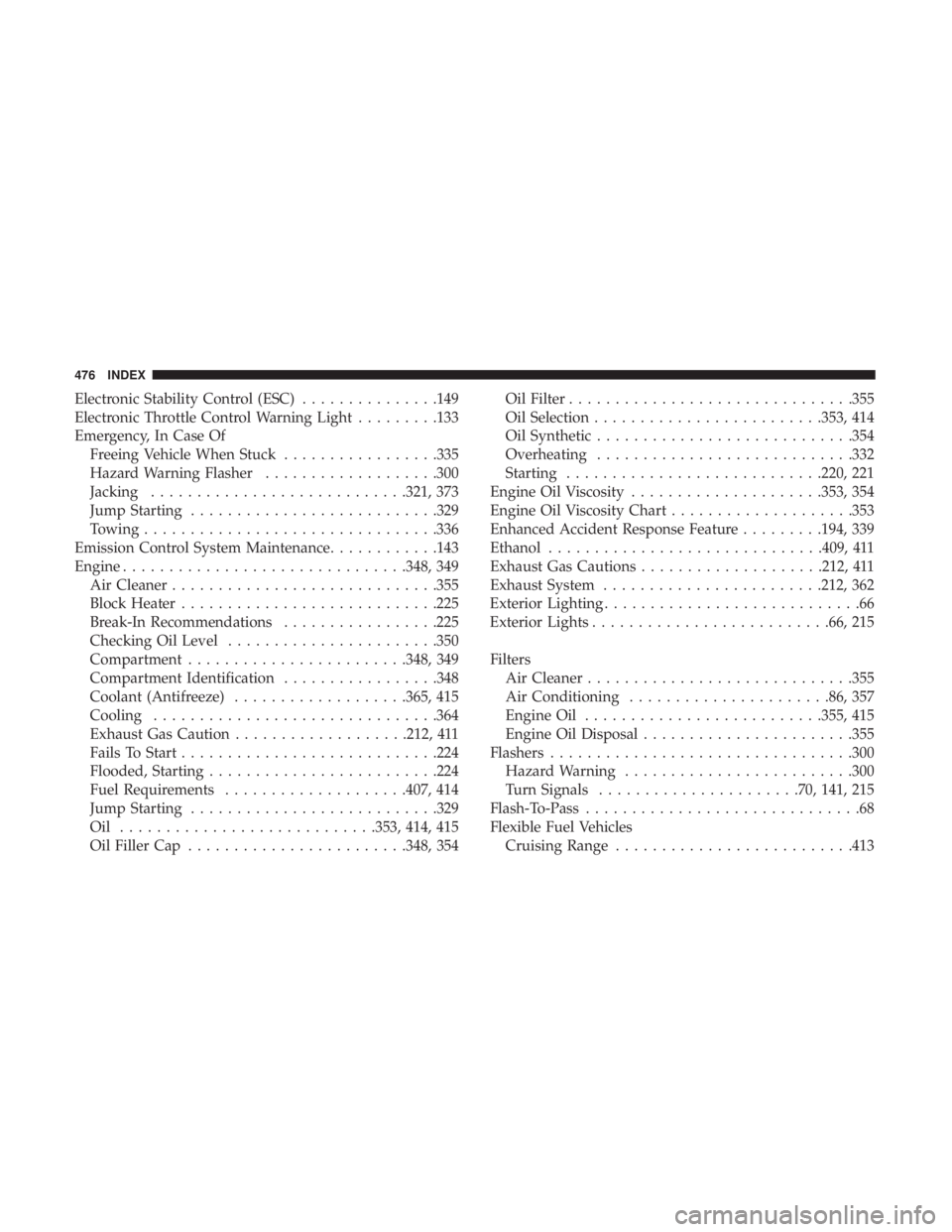
Electronic Stability Control (ESC)...............149
Electronic Throttle Control Warning Light .........133
Emergency, In Case Of Freeing Vehicle When Stuck .................335
Hazard Warning Flasher ...................300
Jacking ........................... .321, 373
Jump Starting .......................... .329
Towing ............................... .336
Emission Control System Maintenance ............143
Engine .............................. .348, 349
Air Cleaner ............................ .355
Block Heater ........................... .225
Break-In Recommendations .................225
Checking Oil Level ...................... .350
Compartment ....................... .348, 349
Compartment Identification .................348
Coolant (Antifreeze) ...................365, 415
Cooling .............................. .364
Exhaust Gas Caution ...................212, 411
Fails To Start ........................... .224
Flooded, Starting ........................ .224
Fuel Requirements ....................407, 414
Jump Starting .......................... .329
Oil ........................... .353, 414, 415
Oil Filler Cap ....................... .348, 354Oil Filter
.............................. .355
Oil Selection ........................ .353, 414
Oil Synthetic ........................... .354
Overheating ........................... .332
Starting ........................... .220, 221
Engine Oil Viscosity .....................353, 354
Engine Oil Viscosity Chart ....................353
Enhanced Accident Response Feature .........194, 339
Ethanol ............................. .409, 411
Exhaust Gas Cautions ................... .212, 411
Exhaust
System ....................... .212, 362
Exterior Lighting ............................66
Exterior Lights ......................... .66, 215
Filters Air Cleaner ............................ .355
Air Conditioning ..................... .86, 357
Engine Oil ......................... .355, 415
Engine Oil Disposal ...................... .355
Flashers ................................ .300
Hazard Warning ........................ .300
Turn Signals ..................... .70, 141, 215
Flash-To-Pass ..............................68
Flexible Fuel Vehicles Cruising Range ......................... .413
476 INDEX