flat tire CHRYSLER 300 2019 Vehicle Warranty
[x] Cancel search | Manufacturer: CHRYSLER, Model Year: 2019, Model line: 300, Model: CHRYSLER 300 2019Pages: 270, PDF Size: 2.52 MB
Page 230 of 270
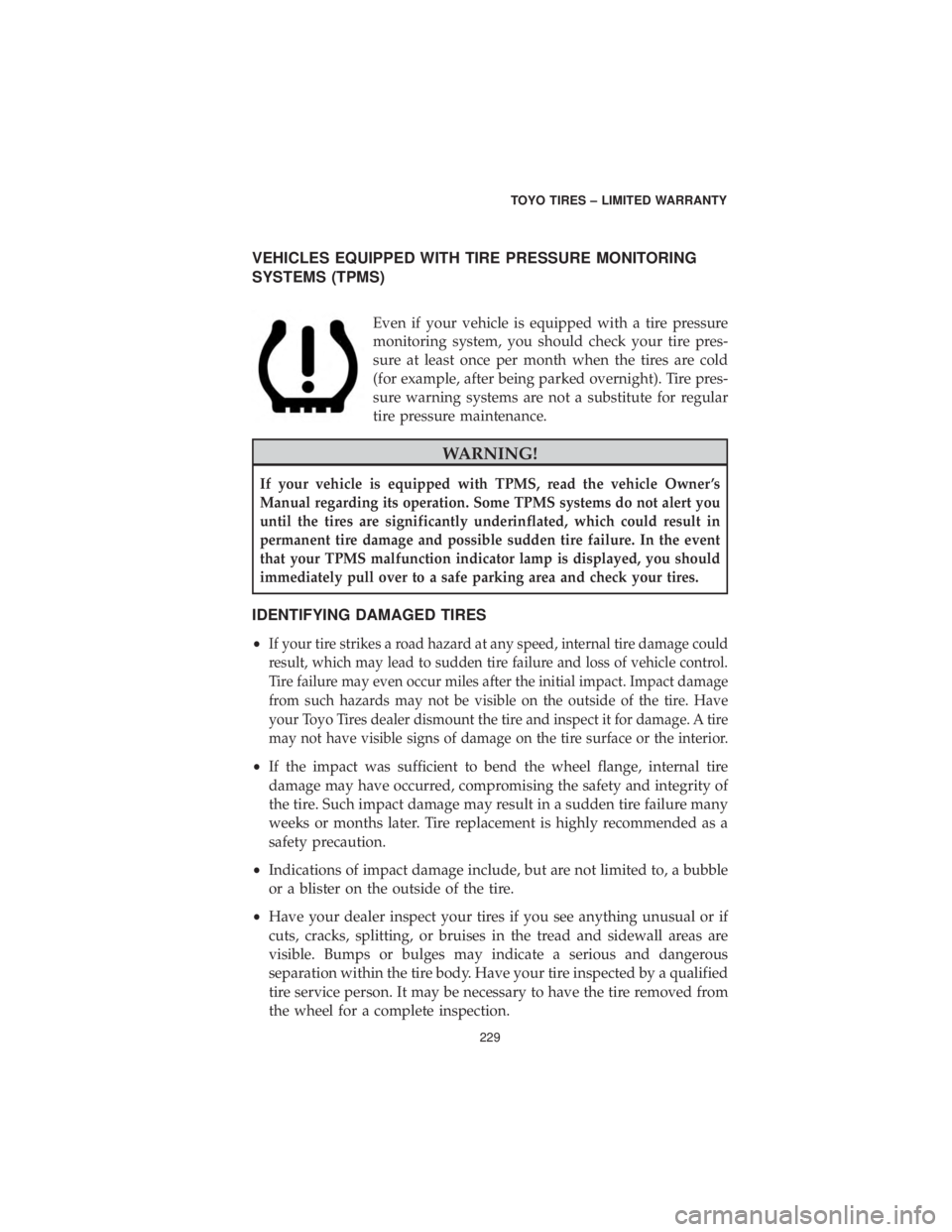
VEHICLES EQUIPPED WITH TIRE PRESSURE MONITORING
SYSTEMS (TPMS)
Even if your vehicle is equipped with a tire pressure
monitoring system, you should check your tire pres-
sure at least once per month when the tires are cold
(for example, after being parked overnight). Tire pres-
sure warning systems are not a substitute for regular
tire pressure maintenance.
WARNING!
If your vehicle is equipped with TPMS, read the vehicle Owner ’s
Manual regarding its operation. Some TPMS systems do not alert you
until the tires are significantly underinflated, which could result in
permanent tire damage and possible sudden tire failure. In the event
that your TPMS malfunction indicator lamp is displayed, you should
immediately pull over to a safe parking area and check your tires.
IDENTIFYING DAMAGED TIRES
•If your tire strikes a road hazard at any speed, internal tire damage could
result, which may lead to sudden tire failure and loss of vehicle control.
Tire failure may even occur miles after the initial impact. Impact damage
from such hazards may not be visible on the outside of the tire. Have
your Toyo Tires dealer dismount the tire and inspect it for damage. A tire
may not have visible signs of damage on the tire surface or the interior.
• If the impact was sufficient to bend the wheel flange, internal tire
damage may have occurred, compromising the safety and integrity of
the tire. Such impact damage may result in a sudden tire failure many
weeks or months later. Tire replacement is highly recommended as a
safety precaution.
• Indications of impact damage include, but are not limited to, a bubble
or a blister on the outside of the tire.
• Have your dealer inspect your tires if you see anything unusual or if
cuts, cracks, splitting, or bruises in the tread and sidewall areas are
visible. Bumps or bulges may indicate a serious and dangerous
separation within the tire body. Have your tire inspected by a qualified
tire service person. It may be necessary to have the tire removed from
the wheel for a complete inspection.
TOYO TIRES – LIMITED WARRANTY
229
Page 231 of 270
•Inspect your tires for adequate tread depth. When the tire is worn to
the built-in indicators at 2/32” (1.6 mm) or less tread groove depth, the
tire is worn out and must be replaced. Never drive on tires to the point
that the tire cord or the fabric is exposed.
• Inspect your tires for uneven wear. Wear on one side of the tread or flat
spots in the tread may indicate alignment or other problems with the
tires or the vehicle. Consult your authorized Toyo Tires dealer.
WARNING!
Never drive on a tire if there is any evidence of damage. Driving on
a damaged tire is dangerous. A damaged tire could suddenly fail,
which may result in loss of vehicle control and lead to serious
personal injury or death. Do not attempt to dismount, mount, or
repair a tire yourself. See your Toyo Tires dealer immediately if you
detect damage.
IDENTIFYING DAMAGED WHEELS
Periodically check to see if any of the following symptoms exist, in which
case the wheel must be replaced:
• If the flange is bent.
• If welds or rivets are leaking.
• If the stud holes are elongated and not round. (Improper lug nut
tightening could cause this.)
• If there are cracks in the wheel.
WORN OUT TIRES
Tires must be replaced when tread is worn to 2/32” (1.6 mm). Treadwear
indicators on Toyo tire treads show the 2/32” depth (1.6 mm). Most states
require that tires be replaced when the tread depth is worn to 2/32” (1.6
mm). Tires may lose sufficient wet and snow traction before reaching
2/32” (1.6 mm) of wear. Many wet weather accidents result from
skidding on worn out tires.
Excessively worn tires are more susceptible to penetrations. Consider
replacing your tires earlier if you drive in snow or wet conditions.
TOYO TIRES – LIMITED WARRANTY
230
Page 232 of 270
WARNING!
Continued operation of your vehicle with excessively worn tires
may lead to loss of vehicle control in adverse weather conditions,
tire failure, and serious personal injury or death.
Any retail tire dealer will be glad to measure your tire’s tread depth for you.
Toyo Tires recommends that tires be replaced in matched sets of four.
TIRE REPAIRS
If any tire has sustained a puncture, have the tire dismounted and
inspected internally by an authorized Toyo Tires dealer for possible
damage that may have occurred. Only specially trained personnel using
the proper tools and procedures should repair tires.
WARNING!
•Before having your tire repaired, tell your authorized Toyo Tires
dealer if you have used an aerosol puncture sealant to inflate/ seal
the tire. Aerosol puncture sealants could contain a highly flam-
mable, explosive gas.
• Driving on an improperly repaired tire is dangerous. An improper
repair can cause further damage to the tire. It could fail suddenly,
which can result in loss of vehicle control and lead to serious
personal injury or death. To insure safety, go to your authorized
Toyo Tires dealer for professional inspection and proper tire
repairs.
• Cosmetic Tire Alterations Can Be Dangerous! Remember — Do not
perform or allow anyone to perform any alterations to your tires.
Alterations may prevent proper performance, leading to tire dam-
age, which could result in sudden tire failure and loss of vehicle
control and lead to serious personal injury or death.
• Never repair a tire with 2/32” (1.6 mm) or less tread remaining. At this
tread depth, the tire is worn out and must be replaced.
• Never repair a tire with a puncture larger than 1/4” (6.4 mm) in
diameter. Such tires cannot be properly repaired and must be replaced.
• Repairs of all tires (radial and non-radial) must be of the plug and
inside patch type. Using plugs alone on any type of tire is not a safe
repair.
TOYO TIRES – LIMITED WARRANTY
231
Page 234 of 270
Toyo Tires speed-rated passenger car tires may be repaired and
returned to service under the following conditions:
•Proper repair materials and procedures have been used.
• The damage or puncture is not larger than 1/4” (6.4 mm) in diameter.
• The repair will be the first repair performed on that tire. (Only one
repair per tire is permitted in order to maintain a limited speed rating.)
• The tire must have more than 2/32” (1.6 mm) of tread remaining.
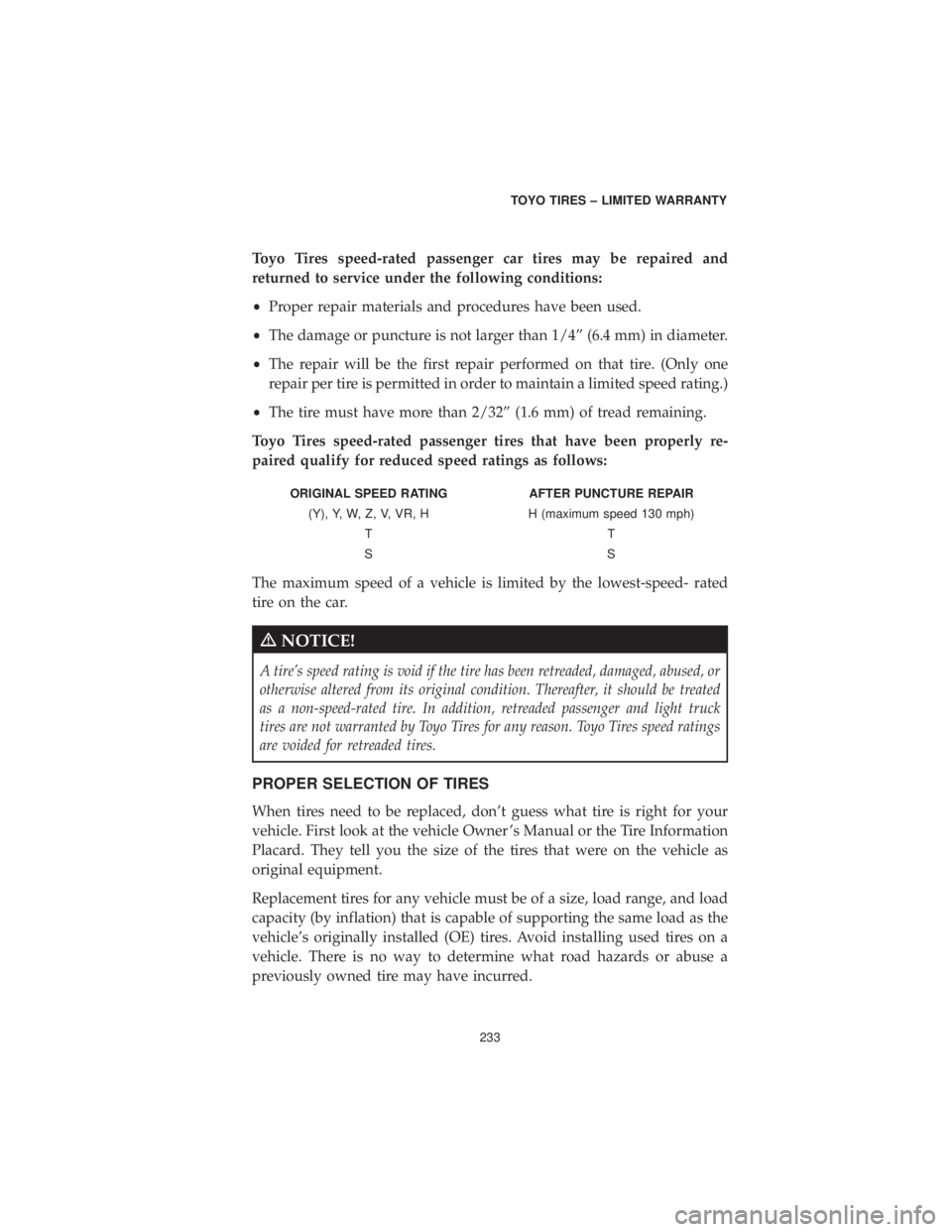
Toyo Tires speed-rated passenger tires that have been properly re-
paired qualify for reduced speed ratings as follows:
ORIGINAL SPEED RATING AFTER PUNCTURE REPAIR
(Y), Y, W, Z, V, VR, H H (maximum speed 130 mph)
TT
SS
The maximum speed of a vehicle is limited by the lowest-speed- rated
tire on the car.
m NOTICE!
A tire’s speed rating is void if the tire has been retreaded, damaged, abused, or
otherwise altered from its original condition. Thereafter, it should be treated
as a non-speed-rated tire. In addition, retreaded passenger and light truck
tires are not warranted by Toyo Tires for any reason. Toyo Tires speed ratings
are voided for retreaded tires.
PROPER SELECTION OF TIRES
When tires need to be replaced, don’t guess what tire is right for your
vehicle. First look at the vehicle Owner ’s Manual or the Tire Information
Placard. They tell you the size of the tires that were on the vehicle as
original equipment.
Replacement tires for any vehicle must be of a size, load range, and load
capacity (by inflation) that is capable of supporting the same load as the
vehicle’s originally installed (OE) tires. Avoid installing used tires on a
vehicle. There is no way to determine what road hazards or abuse a
previously owned tire may have incurred.
TOYO TIRES – LIMITED WARRANTY
233
Page 235 of 270
WARNING!
•Failure to install tires with adequate load capacity will result in tire
fatigue and sudden tire failure. This could lead to loss of vehicle
control, possibly resulting in personal injury or death.
• Certain vehicle performance parameters, including ride comfort
and handling, may be affected by substitute tire sizes. In some
cases, particularly for SUVs and light trucks, a failure to follow the
vehicle manufacturer ’s recommendations for tire replacement
could adversely affect the safe handling of the vehicle, possibly
resulting in a loss of vehicle control leading to personal injury or
death.
The following procedures concerning replacement tires must be fol-
lowed:
• Confirm that the load-carrying capacity is greater than or equal to the
loadcarrying capacity of the OE tire size at the pressure indicated on
the vehicle Tire Information Placard.
• Carefully note any differences between recommendations for front and
rear axle positions regarding the tire size and/ or inflation pressure.
• The speed rating must be equal to or greater than what is specified by
the vehicle manufacturer if the speed capability of the vehicle is to be
maintained.
• Tires should be mounted on approved wheel widths. If changing tire
sizes, check to make sure the wheel has adequate load and inflation
pressure capacity.
• Body and chassis clearance must be checked on the vehicle’s front and
rear axles.
In addition to the above, light truck tire replacements should take into
consideration the following:
• Proper spacing between dual tires is necessary for optimum tire
performance. If chains are used, particular care must be taken to assure
adequate clearance between loaded tires to avoid damage from the
chains. The allowable outside diameter difference between a tire and
its dual mate is 1/4” (6.4 mm) for light truck tires.
TOYO TIRES – LIMITED WARRANTY
234
Page 236 of 270
CONSIDERATIONS IN PLUS SIZING
Always refer to and follow the vehicle manufacturer ’s replacement tire
recommendations. In some cases, a vehicle manufacturer may specifically
advise against the application of replacement tires that are not of the
original size or type.
TIRE AND WHEEL MATCHING AND MOUNTING
WARNING!
Any attempt to mount a tire on a wheel with a different diameter
will result in an explosion of the tire/wheel assembly that could
cause severe personal injury or death.
Prior to mounting any tire, always check the wheel identification
stamp to verify the correct wheel diameter. Always check the tire
size molded onto the sidewall.
Never exceed 40 psi when seating the tire beads onto the wheel.
Always stand well clear of any tire mounting operation. This is
especially important when the service operator inflates the tire. If
the tire has been improperly mounted, it could burst with explosive
force causing serious personal injury or death.
A new valve stem must be installed on the wheel each time a worn
out passenger or light truck tire is replaced.
Removing and replacing tires on wheels can be dangerous.
Attempting to mount tires with improper tools or procedures could
result in a tire explosion, causing serious personal injury or death.
This is a job for your authorized Toyo Tires dealer or other qualified
tire service location only.
Serious personal injury or death can result from:
•Failure to select the proper tire and wheel. The tire must match the
width and diameter requirements of the wheel. When mounting
truck type radial tires use only wheels approved for radial tires.
• Failure to inspect both the tire and wheel. The wheel must be free
of cracks, dents, chips, and rust. The tire must be free of bead
damage, cuts, and punctures.
• Failure to follow proper procedures. For proper mounting proce-
dures, consult the Rubber Manufacturers Association’s publication
“Care and Service of Automobile and Light Truck Tires” (ref.:
www.rma.org).
(Continued)
TOYO TIRES – LIMITED WARRANTY
235
Page 237 of 270
WARNING!(Continued)
•Exceeding the maximum bead seating pressure of 40 psi. Be
absolutely certain beads are fully seated before adjusting the
inflation pressure to the level recommended for vehicle operation.
Never put flammable substances in the tire/wheel assemblies at any
time. Never put any flammable substance into a tire/wheel assembly
and attempt to ignite it in order to seat the beads.
TIRE MIXING
CAUTION!
Driving your vehicle with an improper mix of tire sizes,
constructions, and speed ratings can be dangerous. Your car ’s
handling characteristics can be adversely affected. You could have
an accident resulting in serious personal injury or death. Consult
your vehicle Owner ’s Manual or an authorized Toyo Tires dealer for
proper tire replacement.
• Toyo Tires recommends that all four tires be of the same size, speed
rating, and construction (radial or non-radial). In some cases the
vehicle manufacturer may require different sized tires for the front or
rear axles. Never mix P-metric or European Metric passenger tires with
LT-metric tires on the same vehicle.
• Match tire size designations in pairs on an axle, except during the
temporary use of a spare tire.
• If two radial tires and two non-radial tires are used on a vehicle, put
the radials on the rear axle. If radial and non-radial tires are used on a
vehicle equipped with dual rear tires, the radial tires may be used on
either axle.
SPEED-RATED TIRE
• If the vehicle Tire Information Placard and/or the vehicle Owner ’s
Manual specifies speed-rated tires, the replacement tires must have the
same or higher speed rating to maintain vehicle speed capability.
• If a replacement tire has a lower speed capability than that specified by
the vehicle manufacturer, the vehicle’s speed must be restricted to that
TOYO TIRES – LIMITED WARRANTY
236
Page 243 of 270
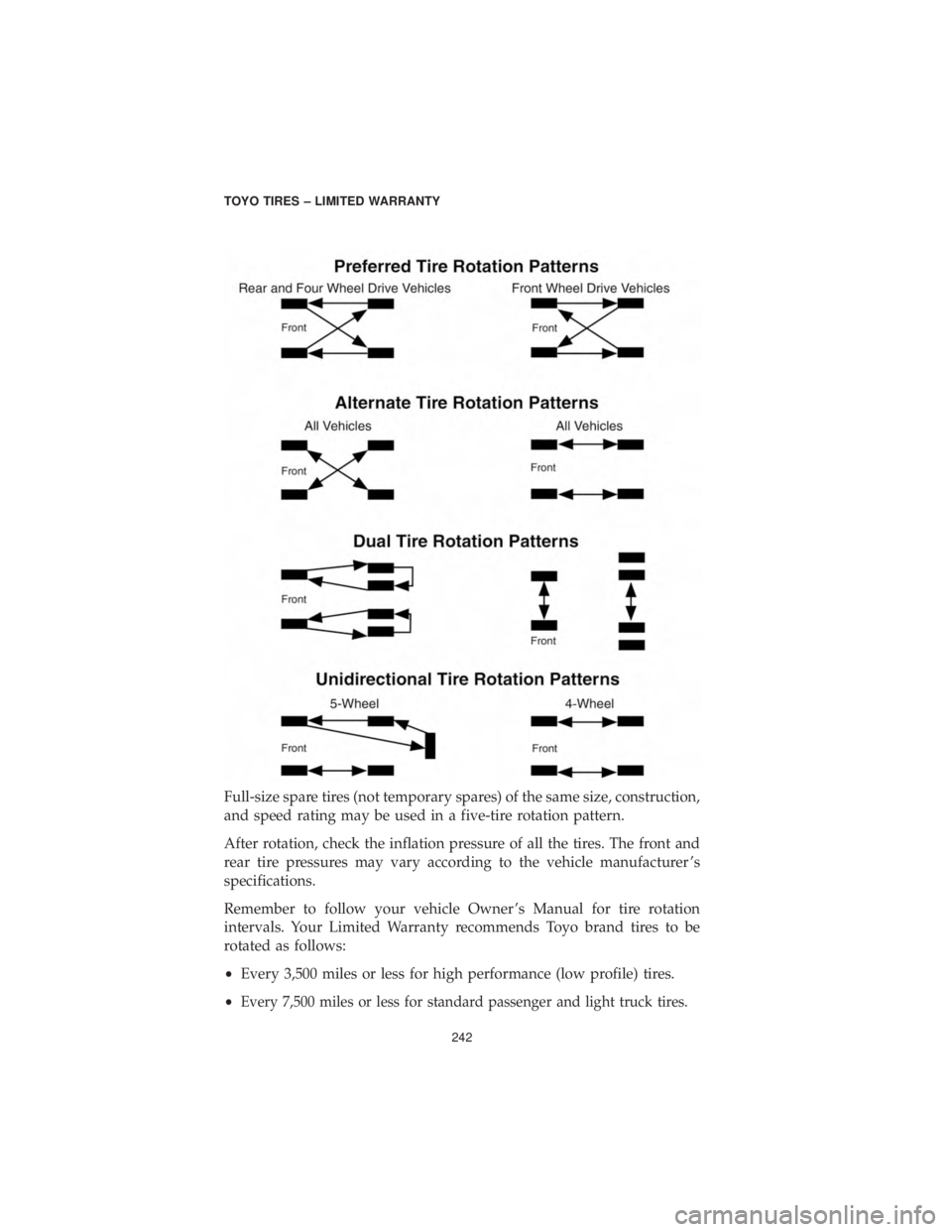
Full-size spare tires (not temporary spares) of the same size, construction,
and speed rating may be used in a five-tire rotation pattern.
After rotation, check the inflation pressure of all the tires. The front and
rear tire pressures may vary according to the vehicle manufacturer ’s
specifications.
Remember to follow your vehicle Owner ’s Manual for tire rotation
intervals. Your Limited Warranty recommends Toyo brand tires to be
rotated as follows:
•Every 3,500 miles or less for high performance (low profile) tires.
•
Every 7,500 miles or less for standard passenger and light truck tires.
TOYO TIRES – LIMITED WARRANTY
242
Page 244 of 270
More frequent rotation or a thorough vehicle inspection may be necessary
if, upon inspection, irregular or erratic treadwear is beginning to appear.
It is important to remember the following:
•These tire rotation recommendations do not take into account different
tire and construction types mixed on the vehicle.
• Some tires cannot be rotated in the manner described. Such tires
include unidirectional tires. Unidirectional tread patterns must be
rotated front-to-rear only so that the direction of revolution does not
change.
• Some vehicles are designed with different tire sizes on the front and
rear axles. Normally, such combinations will not allow rotation. Prior
to rotating, consult the vehicle Owner ’s Manual.
• For vehicles with dual rear wheels, see the vehicle Owner ’s Manual for
the vehicle manufacturer ’s procedures. If your vehicle Owner ’s
Manual is not available, please contact the vehicle manufacturer.
• Some vehicles are equipped with wheels that limit the choice of
rotation pattern. Consult the vehicle Owner ’s Manual.
• Do not include temporary spare tires in the rotation pattern. However,
if your spare tire is the same size and type as a road tire (for LT tires
of the same size, type, and load rating), it should be included in the tire
rotation process. The proper procedure is to use the vehicle manufac-
turer ’s recommended tire rotation procedures, or if not available, to
use the appropriate rotation pattern shown, inserting the spare in the
right rear position. Place the tire that would have gone to the right rear
in the spare tire storage position as the new spare.
• Important! After rotation, adjust the pressure of the individual tires to
the vehicle manufacturer ’s recommendation or the inflation pressure
recommended by Toyo Tires for an optional fitment according to the
tire’s new location on the vehicle.
• Do not mix speed-rated tires on the same axle. Higher speed-rated tires
must remain on the rear axle. Consult your authorized Toyo Tires
dealer.
TOYO TIRES – LIMITED WARRANTY
243
Page 245 of 270
TIRE SPEED RATING
All Toyo Tires passenger, light truck, and truck tires have a maximum
speed rating based on size and type. Tires must never be operated in
excess of their rated speed limit! Consult your tire dealer or contact Toyo
Tires at 1-800-442-8696 (Pacific Time) or 1-888-444-8696 (Eastern Time) if
you are not sure about the maximum speed rating of your tires.
WARNING!
No tire, regardless of its design or speed rating, has an unlimited
capacity for speed. Exceeding the tire’s speed capability could cause
overheating and sudden tire failure, possibly leading to loss of
vehicle control and serious personal injury or death.
Toyo Tires does not endorse the operation of any vehicle in an unsafe or
unlawful manner. Obey all local speed limits.
Tire speed ratings do not imply that a vehicle can be safely driven at the
speed for which the tire is rated. Speed ratings are based on laboratory
tests and relate to performance on the road, but are not applicable if tires
are underinflated, overloaded, worn out, damaged, or altered.
WARNING!
High-speed driving with underinflated or overloaded tires may
result in immediate tire failure, possibly leading to loss of vehicle
control, which could cause an accident, including serious personal
injury or death.
TOYO TIRES – LIMITED WARRANTY
244