tire type CHRYSLER 300 2021 User Guide
[x] Cancel search | Manufacturer: CHRYSLER, Model Year: 2021, Model line: 300, Model: CHRYSLER 300 2021Pages: 268, PDF Size: 15.24 MB
Page 237 of 268
SERVICING AND MAINTENANCE 235
NOTE:
Wheel valve stem must be replaced as well when
i n
stalling new tires due to wear and tear in existing
tires.
Keep dismounted tires in a cool, dry place with as
l i
ttle exposure to light as possible. Protect tires
from contact with oil, grease, and gasoline.
Replacement Tires
The tires on your new vehicle provide a balance of
many characteristics. They should be inspected
regularly for wear and correct cold tire inflation
pressures. The manufacturer strongly
recommends that you use tires equivalent to the
originals in size, quality and performance when
replacement is needed
Ú page 234. Refer to the
Tire and Loading Information placard or the
V e
hicle Certification Label for the size designation
of your tire. The Load Index and Speed Symbol for
your tire will be found on the original equipment
tire sidewall.
See the Tire Sizing Chart example found in the “Tire
S a
fety Information” section of this manual for
more information relating to the Load Index and
Speed Symbol of a tire
Ú page 225.
It is recommended to replace the two front tires or
t w
o rear tires as a pair. Replacing just one tire can
seriously affect your vehicle’s handling. If you ever
replace a wheel, make sure that the wheel’s
specifications match those of the original wheels. It is recommended you contact an authorized tire
d
e
aler or original equipment dealer with any
questions you may have on tire specifications or
capability. Failure to use equivalent replacement
tires may adversely affect the safety, handling, and
ride of your vehicle.
TIRE TYPES
All Season Tires — If Equipped
All Season tires provide traction for all seasons
(Spring, Summer, Autumn, and Winter). Traction
levels may vary between different all season tires.
All season tires can be identified by the M+S, M&S,
M/S or MS designation on the tire sidewall. Use all
season tires only in sets of four; failure to do so
may adversely affect the safety and handling of
your vehicle.
Summer Or Three Season Tires —
If Equipped
Summer tires provide traction in both wet and dry
conditions, and are not intended to be driven in
snow or on ice. If your vehicle is equipped with
Summer tires, be aware these tires are not
designed for Winter or cold driving conditions.
Install Winter tires on your vehicle when ambient
temperatures are less than 40°F (5°C) or if roads
are covered with ice or snow. For more
information, contact an authorized dealer.
WARNING!
Do not use a tire, wheel size, load rating, or
speed rating other than that specified for your
vehicle. Some combinations of unapproved
tires and wheels may change suspension
dimensions and performance characteristics,
resulting in changes to steering, handling, and
braking of your vehicle. This can cause unpre -
dictable handling and stress to steering and
s u
spension components. You could lose
control and have a collision resulting in
serious injury or death. Use only the tire and
wheel sizes with load ratings approved for
your vehicle.
Never use a tire with a smaller load index or
capacity, other than what was originally
equipped on your vehicle. Using a tire with a
smaller load index could result in tire over -
loading and failure. You could lose control and
h a
ve a collision.
Failure to equip your vehicle with tires having
adequate speed capability can result in
sudden tire failure and loss of vehicle control.
CAUTION!
Replacing original tires with tires of a different
size may result in false speedometer and
odometer readings.
8
Page 238 of 268
236 SERVICING AND MAINTENANCE
Summer tires do not contain the all season
designation or mountain/snowflake symbol on the
tire sidewall. Use Summer tires only in sets of four;
failure to do so may adversely affect the safety and
handling of your vehicle.
Snow Tires
Some areas of the country require the use of snow
tires during the Winter. Snow tires can be identified
by a “mountain/snowflake” symbol on the tire
sidewall.
If you need snow tires, select tires
equivalent in size and type to the original
eq
uipment tires. Use snow tires only in
sets of four; failure to do so may
adversely affect the safety and handling of your
vehicle.
Snow tires generally have lower speed ratings than
w h
at was originally equipped with your vehicle and
should not be operated at sustained speeds over
75 mph (120 km/h). For speeds above 75 mph
( 1
20 km/h) refer to original equipment or an a
u thorized tire dealer for recommended safe
operating speeds, loading and cold tire inflation
pressures.
While studded tires improve performance on ice,
s k
id and traction capability on wet or dry surfaces
may be poorer than that of non-studded tires.
Some states prohibit studded tires; therefore, local
laws should be checked before using these tire
types.
SPARE TIRES — IF EQUIPPED
For restrictions when towing with a spare tire
designated for temporary emergency use
Ú page 117.
Spare Tire Matching Original Equipped Tire
And Wheel — If Equipped
Your vehicle may be equipped with a spare tire and
wheel equivalent in look and function to the
original equipment tire and wheel found on the
front or rear axle of your vehicle. This spare tire
may be used in the tire rotation for your vehicle. If your vehicle has this option, refer to an authorized
tire dealer for the recommended tire rotation
pattern.
Compact Spare Tire — If Equipped
The compact spare is for temporary emergency
use only. You can identify if your vehicle is
equipped with a compact spare by looking at the
spare tire description on the Tire and Loading
Information Placard located on the driver’s side
door opening or on the sidewall of the tire.
Compact spare tire descriptions begin with the
letter “T” or “S” preceding the size designation.
Example: T145/80D18 103M.
T, S = Temporary Spare Tire
Since this tire has limited tread life, the original
e
q
uipment tire should be repaired (or replaced)
and reinstalled on your vehicle at the first
opportunity.
Do not install a wheel cover or attempt to mount a
con
ventional tire on the compact spare wheel,
since the wheel is designed specifically for the
compact spare tire. Do not install more than one
compact spare tire and wheel on the vehicle at any
given time.
WARNING!
Do not use Summer tires in snow/ice conditions.
You could lose vehicle control, resulting in
severe injury or death. Driving too fast for
conditions also creates the possibility of loss of
vehicle control.
CAUTION!
Because of the reduced ground clearance, do
not take your vehicle through an automatic car
wash with a compact or limited use temporary
spare installed. Damage to the vehicle may
result.
Page 242 of 268
240 SERVICING AND MAINTENANCE
(Continued)
TIRE ROTATION RECOMMENDATIONS
Tires on the front and rear axles of vehicles
operate at different loads and perform different
steering, driving, and braking functions. For these
reasons, they wear at unequal rates.
These effects can be reduced by timely rotation of
ti
res. The benefits of rotation are especially
worthwhile with aggressive tread designs such as
those on all season type tires. Rotation will
increase tread life, help to maintain mud, snow
and wet traction levels, and contribute to a
smooth, quiet ride. For the proper maintenance intervals. The reasons
f
or
any rapid or unusual wear should be corrected
prior to rotation being performed
Ú page 195.
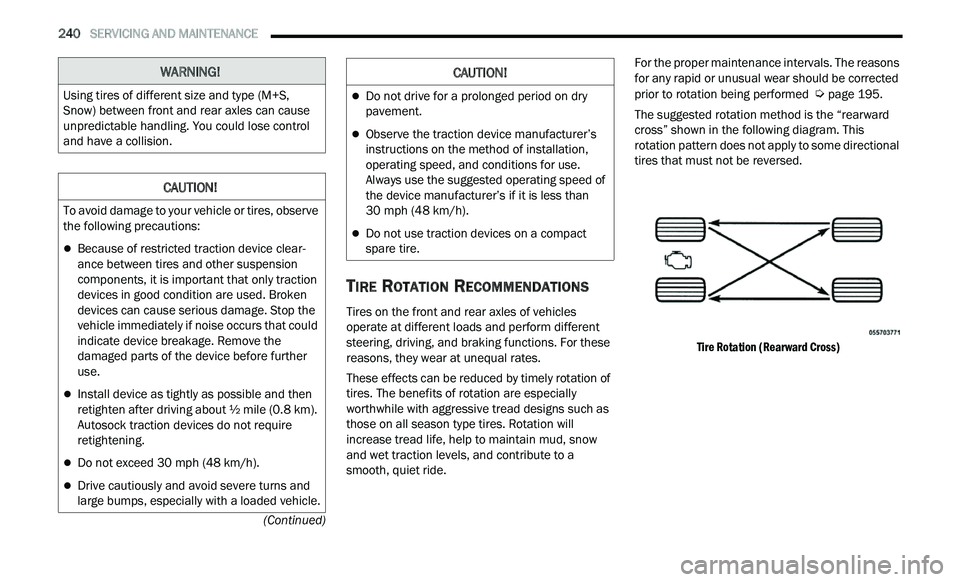
The suggested rotation method is the “rearward
c r
oss” shown in the following diagram. This
rotation pattern does not apply to some directional
tires that must not be reversed.
Tire Rotation (Rearward Cross)
WARNING!
Using tires of different size and type (M+S,
Snow) between front and rear axles can cause
unpredictable handling. You could lose control
and have a collision.
CAUTION!
To avoid damage to your vehicle or tires, observe
the following precautions:
Because of restricted traction device clear -
ance between tires and other suspension
c om
ponents, it is important that only traction
devices in good condition are used. Broken
devices can cause serious damage. Stop the
vehicle immediately if noise occurs that could
indicate device breakage. Remove the
damaged parts of the device before further
use.
Install device as tightly as possible and then
retighten after driving about ½ mile (0.8 km).
A u
tosock traction devices do not require
retightening.
Do not exceed 30 mph (48 km/h).
Drive cautiously and avoid severe turns and
large bumps, especially with a loaded vehicle.
Do not drive for a prolonged period on dry
pavement.
Observe the traction device manufacturer’s
instructions on the method of installation,
operating speed, and conditions for use.
Always use the suggested operating speed of
the device manufacturer’s if it is less than
30
mph (48 km/h).
Do not use traction devices on a compact
spare tire.
CAUTION!
Page 257 of 268
255
INDEX
A
About Your Brakes.........................................245Adaptive Cruise Control (ACC)
(Cruise Control)................................................94Adding Engine Coolant (Antifreeze)...............210Adding Fuel....................................................111Adding Washing Fluid....................................201Additives, Fuel...............................................246Adjust Forward.......................................................29Rearward.....................................................29Air Bag...........................................................159Advance Front Air Bag...............................159Air Bag Operation......................................160Air Bag Warning Light................................158Driver Knee Air Bag...................................161Enhanced Accident Response.........164, 194Event Data Recorder (EDR).......................194Front Air Bag.............................................159If Deployment Occurs................................164Knee Impact Bolsters................................161Maintaining Your Air Bag System..............165Maintenance.............................................165Redundant Air Bag Warning Light.............159Side Air Bags.............................................161Transporting Pets......................................176
Air Bag Light..................................72, 158, 176
Air Cleaner, Engine (Engine Air Cleaner Filter)..203
Air Conditioner Maintenance........................204Air Conditioner Refrigerant...........................204Air Conditioner System...........................47, 204Air Conditioning Filter..............................50, 204Air Conditioning, Operating Tips.......................50Air Filter........................................................203Air PressureTires.........................................................232AlarmArm The System...................................18, 19Rearm The System......................................19Security Alarm......................................18, 74Alarm SystemSecurity Alarm.............................................18All Wheel DriveTowing......................................................194All Wheel Drive (AWD)...................................213Alterations/ModificationsVehicle...........................................................8Antifreeze (Engine Coolant).................210, 248Disposal...................................................211Anti-Lock Brake System (ABS)......................137Anti-Lock Warning Light...................................74
Arming SystemSecurity Alarm.............................................18Assist, Hill Start.............................................141Audio Systems (Radio)..................................121Auto Down Power Windows..............................56Automatic Door Locks......................................22Automatic Headlights.......................................41Automatic High Beams.....................................41Automatic Temperature Control (ATC)..............49Automatic Transmission...................................87Adding Fluid.....................................213, 250Fluid And Filter Change.............................213Fluid Change.............................................213Fluid Level Check.............................212, 213Fluid Type........................................213, 250Special Additives......................................212
Automatic Transmission Limp Home Mode..22, 90
AutoPark..........................................................82AutostickOperation.....................................................90AUX Cord..........................................................53Auxiliary Electrical Outlet (Power Outlet)..........54AWDTowing......................................................194Axle Fluid.......................................................250Axle Lubrication............................................250
11