lights CHRYSLER 300 2022 Owners Manual
[x] Cancel search | Manufacturer: CHRYSLER, Model Year: 2022, Model line: 300, Model: CHRYSLER 300 2022Pages: 288, PDF Size: 13.34 MB
Page 5 of 288

3
UNIVERSAL GARAGE DOOR OPENER
(HOMELINK®) ....................................................... 40
Before You Begin Programming HomeLink® ... 40
Erasing All The HomeLink® Channels ............40
Identifying Whether You Have A Rolling Code
Or Non-Rolling Code Device.............................40
Programming HomeLink® To A Garage
Door Opener .....................................................41
Programming HomeLink® To A Miscellaneous
Device ...............................................................42
Reprogramming A Single HomeLink® Button .. 42
Canadian/Gate Operator Programming .........42
Security .............................................................43
Troubleshooting Tips ........................................43
EXTERIOR LIGHTS ................................................. 44
Headlight Switch...............................................44
Multifunction Lever ..........................................45
Daytime Running Lights (DRLs).......................45
High/Low Beam Switch....................................45
Automatic High Beam — If Equipped .............45
Flash-To-Pass....................................................46
Automatic Headlights ......................................46
Parking Lights ..................................................46
Headlights On With Wipers ..............................46 Adaptive Bi-Xenon High Intensity Discharge
Headlights — If Equipped .................................46
Headlight Time Delay ......................................46
Lights-On Reminder ........................................47
Fog Lights — If Equipped..................................47
Turn Signals .....................................................47
Lane Change Assist — If Equipped ..................47
Automatic Headlight Leveling —If Equipped ...48
INTERIOR LIGHTS ..................................................48
Interior Courtesy Lights ....................................48
WINDSHIELD WIPERS AND WASHERS............... 50
Windshield Wiper Operation ............................50
Rain Sensing Wipers — If Equipped ...............51
CLIMATE CONTROLS .............................................52
Automatic Climate Control Descriptions And
Functions ..........................................................52
Automatic Temperature Control (ATC) ...........54
Climate Voice Commands................................55
Operating Tips .................................................55
INTERIOR STORAGE AND EQUIPMENT ............... 56
Storage..............................................................56
USB/AUX Control ..............................................58
Lighted Cupholders — If Equipped ..................59
Power Sunshade — If Equipped ......................59
Power Outlets ...................................................60 WINDOWS ............................................................. 61
Power Window Controls ................................... 61
Automatic Window Features .......................... 62
Reset Auto-Up .................................................. 62
Window Lockout Switch ................................... 62
Wind Buffeting .................................................63
PANORAMIC SUNROOF — IF EQUIPPED ............. 63
Opening And Closing The Sunroof .................. 64
Pinch Protect Feature ...................................... 64
Opening And Closing The Power Shade..........64
Sunroof Maintenance ...................................... 65
Ignition Off Operation....................................... 65
HOOD....................................................................... 65
Opening The Hood ..........................................65
Closing The Hood ............................................. 65
TRUNK ..................................................................... 65
Opening The Trunk ........................................... 65
Closing The Trunk............................................. 66
Trunk Safety ..................................................... 66
Cargo Area Features ....................................... 67
22_LX_OM_EN_USC_t.book Page 3
Page 6 of 288

4
GETTING TO KNOW YOUR
INSTRUMENT PANEL
INSTRUMENT CLUSTER ........................................ 68
Instrument Cluster Descriptions ....................70
INSTRUMENT CLUSTER DISPLAY ........................ 70
Location And Controls ......................................71
Engine Oil Life Reset .......................................72
Instrument Cluster Display Selectable Menu
Items .................................................................73
Battery Saver On/Battery Saver Mode
Message — Electrical Load Reduction
Actions —If Equipped .......................................75
Programmable Features ..................................76
WARNING LIGHTS AND MESSAGES ................... 76
Red Warning Lights ..........................................77
Yellow Warning Lights ......................................79
Yellow Indicator Lights .....................................82
Green Indicator Lights......................................82
White Indicator Lights ......................................83
Blue Indicator Lights ........................................83
ONBOARD DIAGNOSTIC SYSTEM — OBD II ....... 84
Onboard Diagnostic System
(OBD II) Cybersecurity ......................................84
EMISSIONS INSPECTION AND MAINTENANCE
PROGRAMS ............................................................ 85
STARTING AND OPERATING
STARTING THE ENGINE ........................................86
Automatic Transmission .................................86
Keyless Enter ‘n Go™ — Ignition......................86
Normal Starting ...............................................86
AutoPark ...........................................................87
Extended Park Starting ....................................88
If Engine Fails To Start .....................................88
Cold Weather Operation
(Below –22°F Or −30°C) ...............................89
After Starting ....................................................89
ENGINE BLOCK HEATER — IF EQUIPPED ...........89
ENGINE BREAK-IN RECOMMENDATIONS ...........89
PARKING BRAKE ....................................................90
AUTOMATIC TRANSMISSION ................................91
Ignition Park Interlock ......................................92
Brake Transmission Shift Interlock (BTSI)
System ..............................................................92
8-Speed Automatic Transmission ...................92
SPORT MODE — IF EQUIPPED ..............................97
FUEL SAVER TECHNOLOGY 5.7L ONLY —
IF EQUIPPED ...........................................................97
POWER STEERING .................................................97
CRUISE CONTROL SYSTEMS — IF EQUIPPED ....98 Cruise Control ..................................................98
Adaptive Cruise Control (ACC) ...................... 100 PARKSENSE FRONT AND REAR PARK
ASSIST — IF EQUIPPED ....................................... 108
ParkSense Sensors ....................................... 109
ParkSense Display ........................................ 109
ParkSense Warning Display ......................... 112
Enabling And Disabling ParkSense.............. 112
Service The ParkSense Park Assist System ...112
Cleaning The ParkSense System ................. 113
ParkSense System Usage Precautions........ 113
LANESENSE — IF EQUIPPED ............................. 114
LaneSense Operation ................................... 114
Turning LaneSense On Or Off....................... 114
LaneSense Warning Message...................... 115
Changing LaneSense Status ........................ 116
PARKVIEW REAR BACK UP CAMERA ............... 116
REFUELING THE VEHICLE ................................... 118 Emergency Fuel Filler Door Release ............ 118
VEHICLE LOADING .............................................. 119
Vehicle Certification Label............................ 119
Gross Vehicle Weight Rating (GVWR) .......... 119
Gross Axle Weight Rating (GAWR) ............... 119
Overloading ................................................... 119
Loading ......................................................... 120
TRAILER TOWING ................................................ 120
Common Towing Definitions......................... 120
Trailer Hitch Classification............................ 122
Trailer Towing Weights (Maximum Trailer
Weight Ratings) ............................................ 122
Trailer And Tongue Weight .......................... 123
Towing Requirements ................................... 123
Towing Tips ................................................... 125
22_LX_OM_EN_USC_t.book Page 4
Page 10 of 288
8
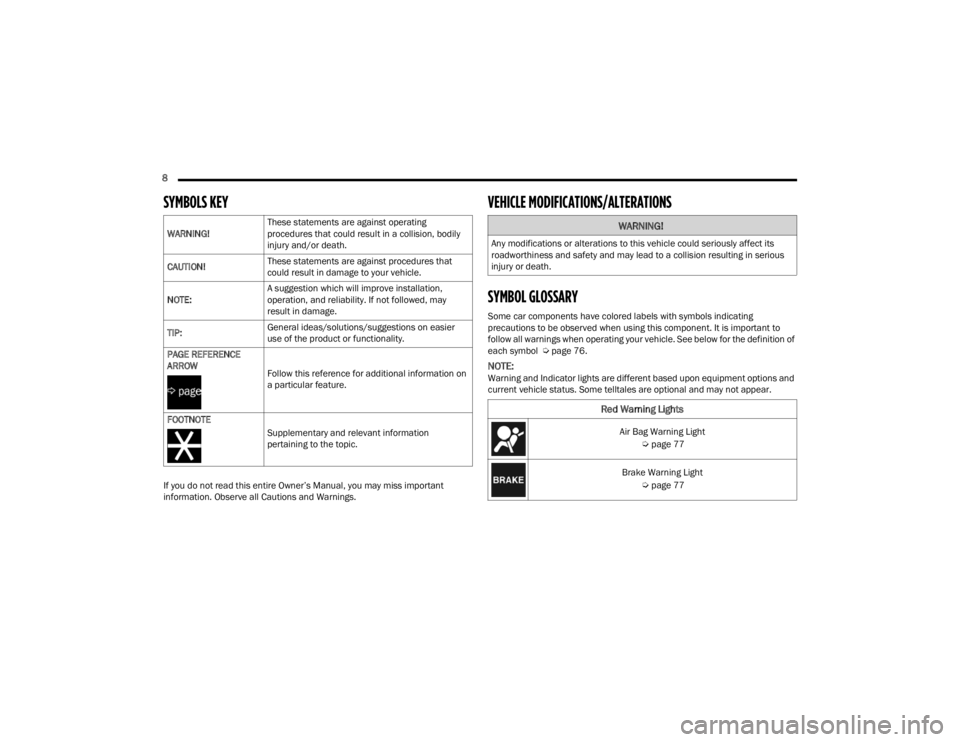
SYMBOLS KEY
If you do not read this entire Owner’s Manual, you may miss important
information. Observe all Cautions and Warnings.
VEHICLE MODIFICATIONS/ALTERATIONS
SYMBOL GLOSSARY
Some car components have colored labels with symbols indicating
precautions to be observed when using this component. It is important to
follow all warnings when operating your vehicle. See below for the definition of
each symbol Úpage 76.
NOTE:Warning and Indicator lights are different based upon equipment options and
current vehicle status. Some telltales are optional and may not appear.
WARNING!
These statements are against operating
procedures that could result in a collision, bodily
injury and/or death.
CAUTION! These statements are against procedures that
could result in damage to your vehicle.
NOTE: A suggestion which will improve installation,
operation, and reliability. If not followed, may
result in damage.
TIP: General ideas/solutions/suggestions on easier
use of the product or functionality.
PAGE REFERENCE
ARROW
Follow this reference for additional information on
a particular feature.
FOOTNOTE Supplementary and relevant information
pertaining to the topic.
WARNING!
Any modifications or alterations to this vehicle could seriously affect its
roadworthiness and safety and may lead to a collision resulting in serious
injury or death.
Red Warning Lights
Air Bag Warning Light Úpage 77
Brake Warning Light Úpage 77
22_LX_OM_EN_USC_t.book Page 8
Page 11 of 288
9
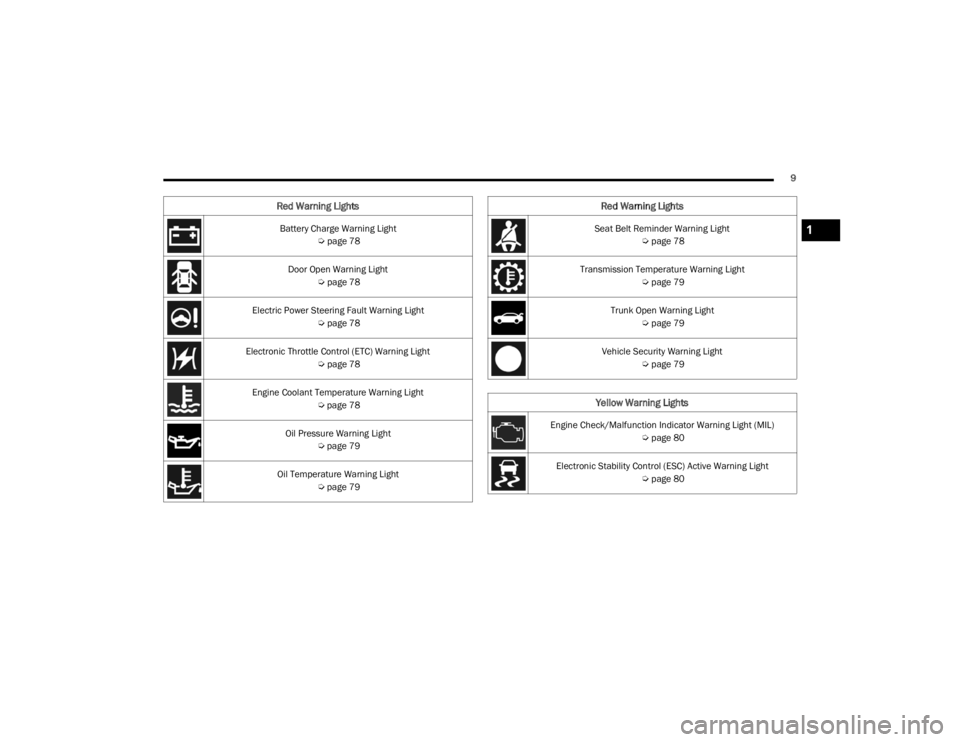
Battery Charge Warning Light Úpage 78
Door Open Warning Light Úpage 78
Electric Power Steering Fault Warning Light Úpage 78
Electronic Throttle Control (ETC) Warning Light Úpage 78
Engine Coolant Temperature Warning Light Úpage 78
Oil Pressure Warning Light Úpage 79
Oil Temperature Warning Light Úpage 79
Red Warning Lights
Seat Belt Reminder Warning Light
Úpage 78
Transmission Temperature Warning Light Úpage 79
Trunk Open Warning Light Úpage 79
Vehicle Security Warning Light Úpage 79
Yellow Warning Lights
Engine Check/Malfunction Indicator Warning Light (MIL)
Úpage 80
Electronic Stability Control (ESC) Active Warning Light Úpage 80
Red Warning Lights
1
22_LX_OM_EN_USC_t.book Page 9
Page 12 of 288
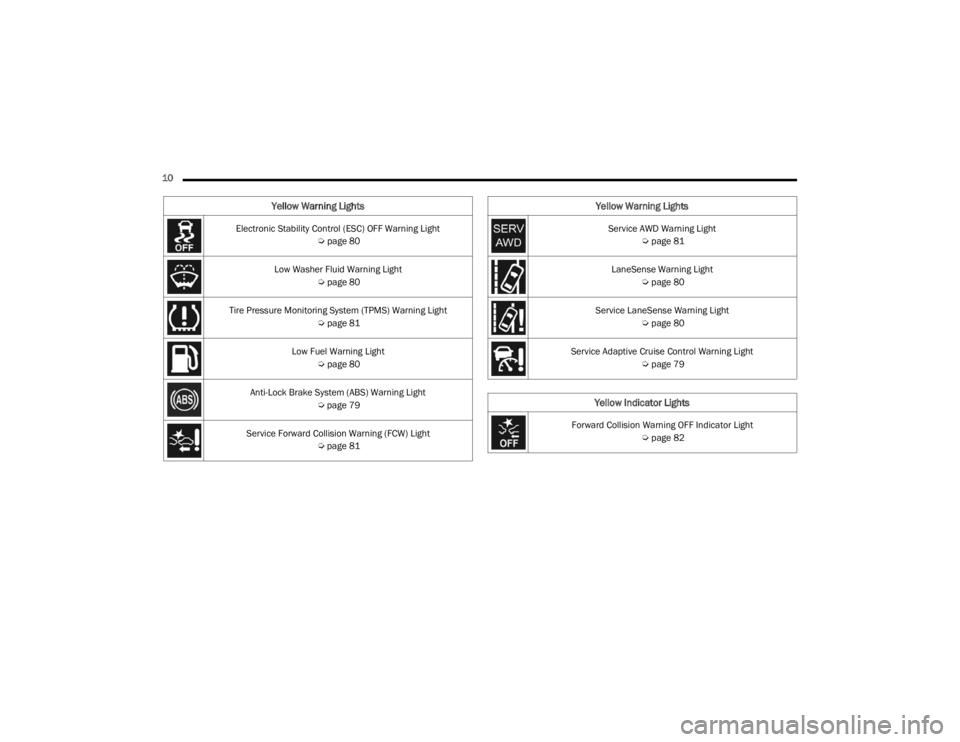
10 Electronic Stability Control (ESC) OFF Warning Light Úpage 80
Low Washer Fluid Warning Light Úpage 80
Tire Pressure Monitoring System (TPMS) Warning Light Úpage 81
Low Fuel Warning Light Úpage 80
Anti-Lock Brake System (ABS) Warning Light Úpage 79
Service Forward Collision Warning (FCW) Light Úpage 81
Yellow Warning Lights
Service AWD Warning Light
Úpage 81
LaneSense Warning Light Úpage 80
Service LaneSense Warning Light Úpage 80
Service Adaptive Cruise Control Warning Light Úpage 79
Yellow Indicator Lights
Forward Collision Warning OFF Indicator Light
Úpage 82
Yellow Warning Lights
22_LX_OM_EN_USC_t.book Page 10
Page 13 of 288
11
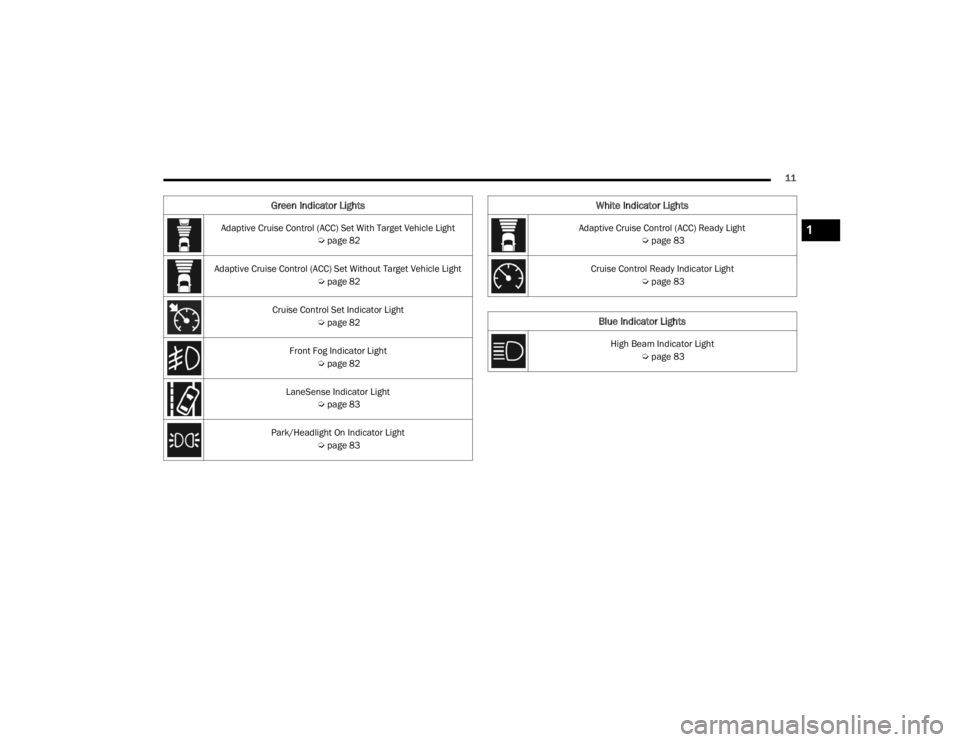
Green Indicator Lights
Adaptive Cruise Control (ACC) Set With Target Vehicle Light Úpage 82
Adaptive Cruise Control (ACC) Set Without Target Vehicle Light Úpage 82
Cruise Control Set Indicator Light Úpage 82
Front Fog Indicator Light Úpage 82
LaneSense Indicator Light Úpage 83
Park/Headlight On Indicator Light Úpage 83
White Indicator Lights
Adaptive Cruise Control (ACC) Ready Light
Úpage 83
Cruise Control Ready Indicator Light Úpage 83
Blue Indicator Lights
High Beam Indicator Light
Úpage 83
1
22_LX_OM_EN_USC_t.book Page 11
Page 15 of 288
GETTING TO KNOW YOUR VEHICLE13
All doors can be programmed to unlock on the first
push of the unlock button through Uconnect
Settings Ú page 129.
NOTE:When you use the key fob to open any door, the
courtesy lights, overhead lights, and approach
lighting in the outside mirrors (if equipped) will turn
on.
Key Left Vehicle Feature
If a valid key fob is no longer detected inside the
vehicle while the vehicle’s ignition system is in the
ON/RUN or START position, the message “Key Left
Vehicle” will be shown in the instrument cluster
display along with an interior chime. An exterior
audible and visual alert will also be activated to
warn the driver.
The vehicle’s horn will rapidly chirp three times
along with a single flash of the vehicle’s exterior
lights.
NOTE:
The doors have to be open and then closed in
order for the vehicle to check for the presence of
a key fob; the Key Left Vehicle feature will not
activate until all of the doors are closed.
These alerts will not be activated in situations
where the vehicle’s engine is left running with
the key fob inside.
To Unlatch The Trunk
Push the trunk button on the key fob two times
within five seconds to unlatch the trunk.
Replacing The Battery In The Key Fob
The recommended replacement battery is one
CR2032 battery.
NOTE:
Customers are recommended to use a battery
obtained from Mopar®. Aftermarket coin
battery dimensions may not meet the original
OEM coin battery dimensions.
Perchlorate Material — special handling may
apply. See www.dtsc.ca.gov/hazard -
ouswaste/perchlorate for further information.
Do not touch the battery terminals that are on
the back housing or the printed circuit board.
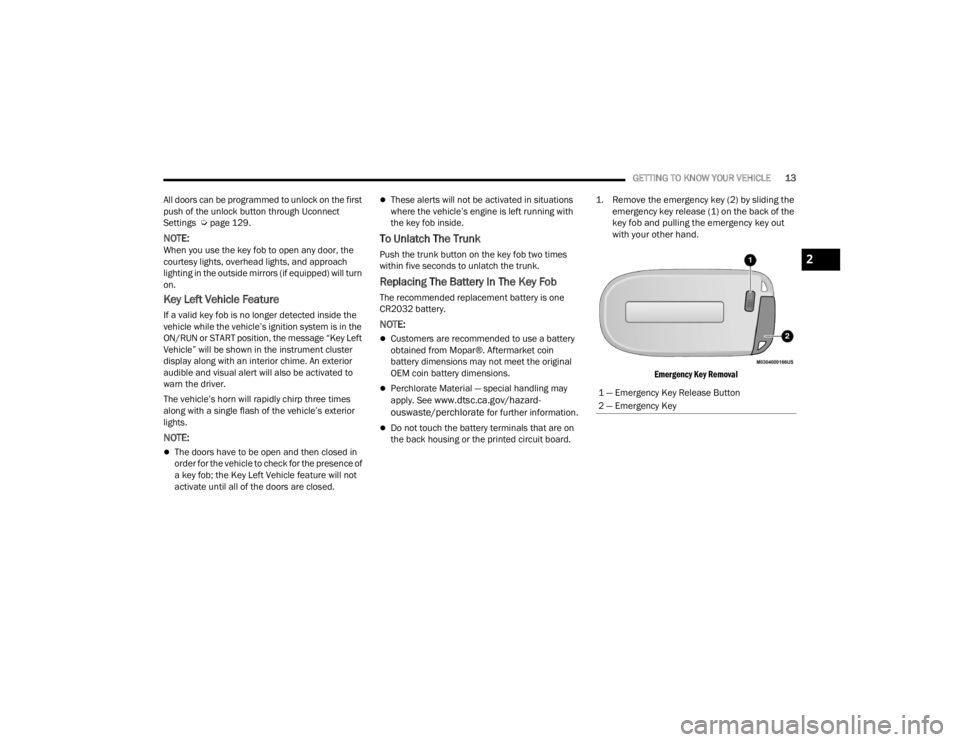
1. Remove the emergency key (2) by sliding the
emergency key release (1) on the back of the
key fob and pulling the emergency key out
with your other hand.
Emergency Key Removal
1 — Emergency Key Release Button
2 — Emergency Key
2
22_LX_OM_EN_USC_t.book Page 13
Page 19 of 288

GETTING TO KNOW YOUR VEHICLE17
(Continued)
REMOTE START — IF EQUIPPED
This system uses the key fob to start the
engine conveniently from outside the
vehicle while still maintaining security.
Remote Start is used to defrost windows
in cold weather, and to reach a comfortable
climate in all ambient conditions before the driver
enters the vehicle.
NOTE:
Obstructions between the vehicle and key fob may
reduce this range Ú page 273.
HOW TO USE REMOTE START
Push and release the Remote Start button on the
key fob twice within five seconds. The vehicle
doors will lock, the parking lights will flash, and the
horn will chirp twice (if programmed through the
Uconnect Settings). Then, the engine will start, and
the vehicle will remain in the Remote Start mode
for a 15 minute cycle. Pushing the Remote Start
button a third time shuts the engine off.
To drive the vehicle, push the unlock button, and
with a valid Keyless Enter ‘n Go™ key fob in the
vehicle, press the brake pedal and place the
ignition in the ON/RUN position.
NOTE:
With Remote Start, the engine will only run for
15 minutes.
If an engine fault is present or fuel level is low,
the vehicle will start and then shut down in 10
seconds.
The parking lights will turn on and remain on
during Remote Start mode.
For security, power window operation is
disabled when the vehicle is in the Remote Start
mode.
Remote Start can only be used twice. The igni -
tion must be placed in the ON/RUN position
before the Remote Start sequence can be
repeated for a third cycle. All of the following conditions must be met before
the engine will remote start:
Gear selector in PARK
Doors closed
Hood closed
Trunk closed
Hazard switch off
Brake switch inactive (brake pedal not pressed)
Battery at an acceptable charge level
PANIC button not pushed
System not disabled from previous Remote
Start event
Vehicle Security Light is flashing
Ignition in OFF position
Fuel level meets minimum requirement
Vehicle Security system is not signaling an intrusion
Malfunction Indicator Light is not illuminated
WARNING!
Do not start or run an engine in a closed
garage or confined area. Exhaust gas contains
Carbon Monoxide (CO) which is odorless and
colorless. Carbon Monoxide is poisonous and
can cause serious injury or death when
inhaled.
Keep key fobs away from children. Operation
of the Remote Start system, windows, door
locks or other controls could cause serious
injury or death.WARNING!
Do not start or run an engine in a closed garage
or confined area. Exhaust gas contains Carbon
Monoxide (CO) which is odorless and colorless.
Carbon Monoxide is poisonous and can cause
serious injury or death when inhaled.
2
22_LX_OM_EN_USC_t.book Page 17
Page 22 of 288

20GETTING TO KNOW YOUR VEHICLE
NOTE:
The driver's door key cylinder and the trunk
button on the key fob cannot arm or disarm the
Vehicle Security system. Use of the door key
cylinder when the system is armed will sound
the alarm when the door is opened.
If Passive Entry (if equipped) is used to unlock
the trunk, the Vehicle Security system is
disarmed and the rest of the vehicle doors will
remain locked unless all doors are set to unlock
on first press within Uconnect Settings.
When the Vehicle Security system is armed, the
interior power door lock switches will not unlock
the doors.
The Vehicle Security system is designed to protect
your vehicle. However, you can create conditions
where the system will give you a false alarm. If one
of the previously described arming sequences has
occurred, the Vehicle Security system will arm,
regardless of whether you are in the vehicle or not.
If you remain in the vehicle and open a door, the
alarm will sound. If this occurs, disarm the Vehicle
Security system.
If the Vehicle Security system is armed and the
battery becomes disconnected, the Vehicle
Security system will remain armed when the
battery is reconnected; the exterior lights will flash,
and the horn will sound. If this occurs, disarm the
Vehicle Security system.
REARMING OF THE SYSTEM
If something triggers the alarm and no action is
taken to disarm it, the Vehicle Security system will
turn the horn off after a 29 second cycle (with five
seconds between cycles and up to eight cycles if
the trigger remains active) and then rearm itself.
SECURITY SYSTEM MANUAL OVERRIDE
The Vehicle Security system will not arm if you lock
the doors using the manual door lock.
TAMPER ALERT
If something has triggered the Vehicle Security
system in your absence, the horn will sound three
times and the exterior lights will blink three times
when you disarm the Vehicle Security system.
DELUXE VEHICLE SECURITY SYSTEM —
IF EQUIPPED
The Deluxe Vehicle Security system monitors the
doors, hood latch, and trunk for unauthorized entry
and the ignition switch for unauthorized operation.
The system also includes a dual function intrusion
sensor and vehicle tilt sensor. The intrusion sensor
monitors the vehicle interior for motion. The
vehicle tilt sensor monitors the vehicle for any
tilting actions (tow away, tire removal, ferry
transport, etc.). If a perimeter violation triggers the security system,
the horn will sound for 29 seconds and the exterior
lights will flash followed by approximately five
seconds of no activity. This will continue for eight
cycles if no action is taken to disarm the system.
TO ARM THE SYSTEM
Follow these steps to arm the security system:
1. Make sure the vehicle ignition system is OFF.
2. Perform one of the following methods to lock
the vehicle:
Push lock on the interior power door lock
switch with the driver and/or passenger
door open.
Push the lock button on the exterior Passive
Entry door handle with a key fob available in
the same exterior zone Ú page 23.
Push the lock button on the key fob.
3. If any doors, windows, or the sunroof (if equipped) are open, close them.
NOTE:
When armed, the interior motion sensor detects
movement within the vehicle's interior,
including moving objects (i.e. people and pets)
and air currents through open windows or the
sunroof. The windows and sunroof should be
22_LX_OM_EN_USC_t.book Page 20
Page 23 of 288

GETTING TO KNOW YOUR VEHICLE21
closed, and moving objects should not be left in
the vehicle when the intrusion detection is
armed, otherwise false alarms can occur.
Once the security system is armed, it remains in
that state until you disarm it by following either
of the disarming procedures described. If a
power loss occurs after arming the system, you
must disarm the system after restoring power to
prevent alarm activation.
The ultrasonic intrusion sensor (motion
detector) actively monitors your vehicle every
time you arm the Vehicle Security system. If you
prefer, you can turn off the ultrasonic intrusion
sensor when arming the Vehicle Security
system. To do so, push the lock button on the
key fob three times within 15 seconds of arming
the system (while the Vehicle Security Light is
flashing rapidly). The vehicle will remain locked
but disable the alarm in the case of repeated
false alarms due to ambient conditions.
TO DISARM THE SYSTEM
The Vehicle Security system can be disarmed using
any of the following methods:
Push the unlock button on the key fob.
Grab the Passive Entry door handle to unlock
the door Ú page 23.
Cycle the vehicle ignition system out of the OFF
position by pushing the START/STOP ignition
button (requires at least one valid key fob in the
vehicle).
NOTE:
The driver's door key cylinder and the trunk
button on the key fob cannot arm or disarm the
Vehicle Security system.
The Vehicle Security system remains armed
during power trunk entry. If a valid key fob or key
fob passive entry is used to open the trunk, the
motion sensing will be suppressed until after
the trunk is closed. If someone enters the
vehicle through the trunk and opens any door,
the alarm will sound.
When the Vehicle Security system is armed, the
interior power door lock switches will not unlock
the doors.
The ultrasonic intrusion sensor (motion
detector) actively monitors your vehicle every
time you arm the Vehicle Security system. If you
prefer, you can turn off the ultrasonic intrusion
sensor when arming the Vehicle Security
system. To do so, push the lock button on the key fob three times within 15 seconds of arming
the system (while the Vehicle Security Light is
flashing rapidly). The vehicle will remain locked
but disable the alarm in the case of repeated
false alarms due to ambient conditions.
The Vehicle Security system is designed to protect
your vehicle; however, you can create conditions
where the system will give you a false alarm. If one
of the previously described arming sequences has
occurred, the Vehicle Security system will arm
regardless of whether you are in the vehicle or not.
If you remain in the vehicle and open a door, the
alarm will sound. If this occurs, disarm the Vehicle
Security system.
If the Vehicle Security system is armed and the
battery becomes disconnected, the Vehicle
Security system will remain armed when the
battery is reconnected; the exterior lights will flash
and the horn will sound. If this occurs, disarm the
Vehicle Security system.
SECURITY SYSTEM MANUAL OVERRIDE
The Vehicle Security system will not arm if you lock
the doors using the manual door lock.
2
22_LX_OM_EN_USC_t.book Page 21