washer fluid CHRYSLER 300 2022 Owners Manual
[x] Cancel search | Manufacturer: CHRYSLER, Model Year: 2022, Model line: 300, Model: CHRYSLER 300 2022Pages: 288, PDF Size: 13.34 MB
Page 7 of 288
5
RECREATIONAL TOWING
(BEHIND MOTORHOME) ..................................... 126
DRIVING TIPS ....................................................... 126 Driving On Slippery Surfaces ........................ 126
Driving Through Water ................................. 127
MULTIMEDIA
UCONNECT SYSTEMS ......................................... 128
CYBERSECURITY ................................................. 128
UCONNECT SETTINGS ........................................ 129Customer Programmable Features —
Uconnect 4C/4C NAV Settings .................... 129
RADIO OPERATION AND MOBILE PHONES...... 144
Regulatory And Safety Information .............. 144
SAFETY
SAFETY FEATURES .............................................. 145 Anti-Lock Brake System (ABS) ..................... 145
Electronic Brake Control (EBC) System ....... 146
AUXILIARY DRIVING SYSTEMS .......................... 151
Blind Spot Monitoring (BSM) —
If Equipped..................................................... 151
Forward Collision Warning (FCW) With Mitigation
Operation —
If Equipped..................................................... 155
Tire Pressure Monitoring System (TPMS) .... 157 OCCUPANT RESTRAINT SYSTEMS ................... 160
Occupant Restraint Systems Features ....... 160
Important Safety Precautions ...................... 160Seat Belt Systems ........................................ 161Supplemental Restraint Systems (SRS) ...... 167Child Restraints ............................................. 176
SAFETY TIPS ....................................................... 189
Transporting Passengers .............................. 189Transporting Pets ......................................... 189
Safety Checks You Should Make Inside
The Vehicle ................................................... 189
Periodic Safety Checks You Should Make
Outside The Vehicle ...................................... 191
Exhaust Gas................................................... 191
Carbon Monoxide Warnings ......................... 192IN CASE OF EMERGENCY
HAZARD WARNING FLASHERS ........................ 193
ASSIST AND SOS MIRROR — IF EQUIPPED ..... 193
JACKING AND TIRE CHANGING ......................... 197 Preparations For Jacking ............................. 197
Jack Location/Spare Tire Stowage .............. 198Jacking And Changing A Tire ....................... 198
JUMP STARTING ................................................. 201
Preparations For Jump Start ........................ 201
Jump Starting Procedure .............................. 202 REFUELING IN AN EMERGENCY –
IF EQUIPPED ........................................................ 203
IF YOUR ENGINE OVERHEATS ........................... 204
MANUAL PARK RELEASE .................................. 205
FREEING A STUCK VEHICLE ............................... 206
TOWING A DISABLED VEHICLE .......................... 208 All Wheel Drive (AWD) Models...................... 209
Rear Wheel Drive (RWD) Models ................. 209
ENHANCED ACCIDENT RESPONSE SYSTEM
(EARS) .................................................................. 209
EVENT DATA RECORDER (EDR) ......................... 209
SERVICING AND MAINTENANCE
SCHEDULED SERVICING .................................... 210
Maintenance Plan ......................................... 211
ENGINE COMPARTMENT .................................... 214
3.6L Engine .................................................. 2145.7L Engine ................................................... 215
Checking Oil Level ........................................ 216
Adding Washer Fluid ..................................... 216Maintenance-Free Battery ........................... 216
Pressure Washing ......................................... 217
22_LX_OM_EN_USC_t.book Page 5
Page 12 of 288
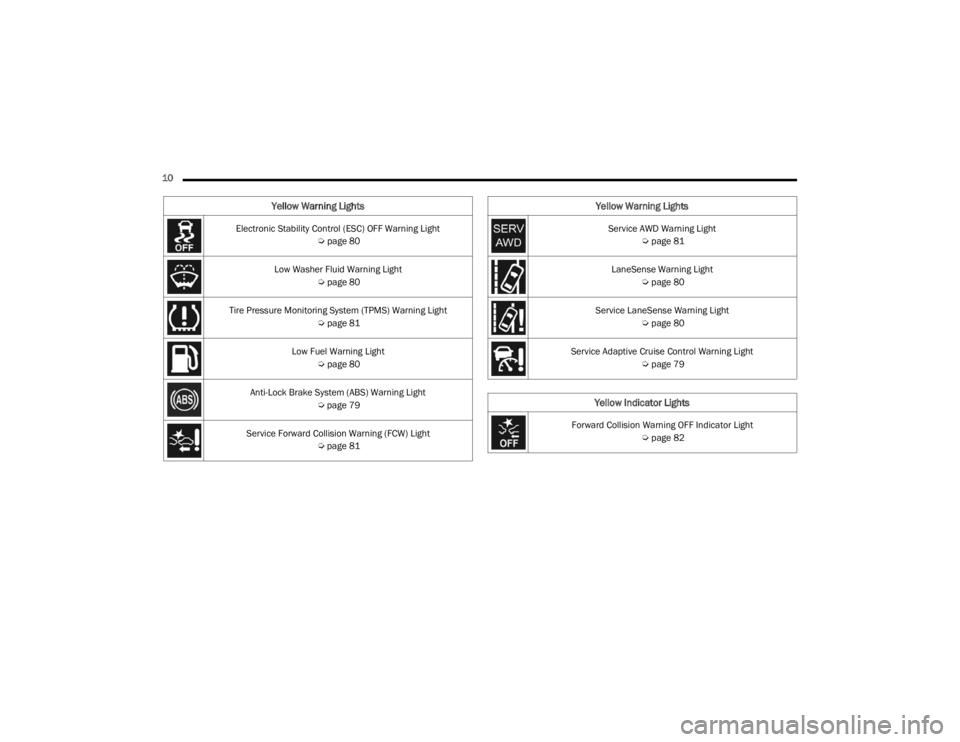
10 Electronic Stability Control (ESC) OFF Warning Light Úpage 80
Low Washer Fluid Warning Light Úpage 80
Tire Pressure Monitoring System (TPMS) Warning Light Úpage 81
Low Fuel Warning Light Úpage 80
Anti-Lock Brake System (ABS) Warning Light Úpage 79
Service Forward Collision Warning (FCW) Light Úpage 81
Yellow Warning Lights
Service AWD Warning Light
Úpage 81
LaneSense Warning Light Úpage 80
Service LaneSense Warning Light Úpage 80
Service Adaptive Cruise Control Warning Light Úpage 79
Yellow Indicator Lights
Forward Collision Warning OFF Indicator Light
Úpage 82
Yellow Warning Lights
22_LX_OM_EN_USC_t.book Page 10
Page 52 of 288
50GETTING TO KNOW YOUR VEHICLE
WINDSHIELD WIPERS AND WASHERS
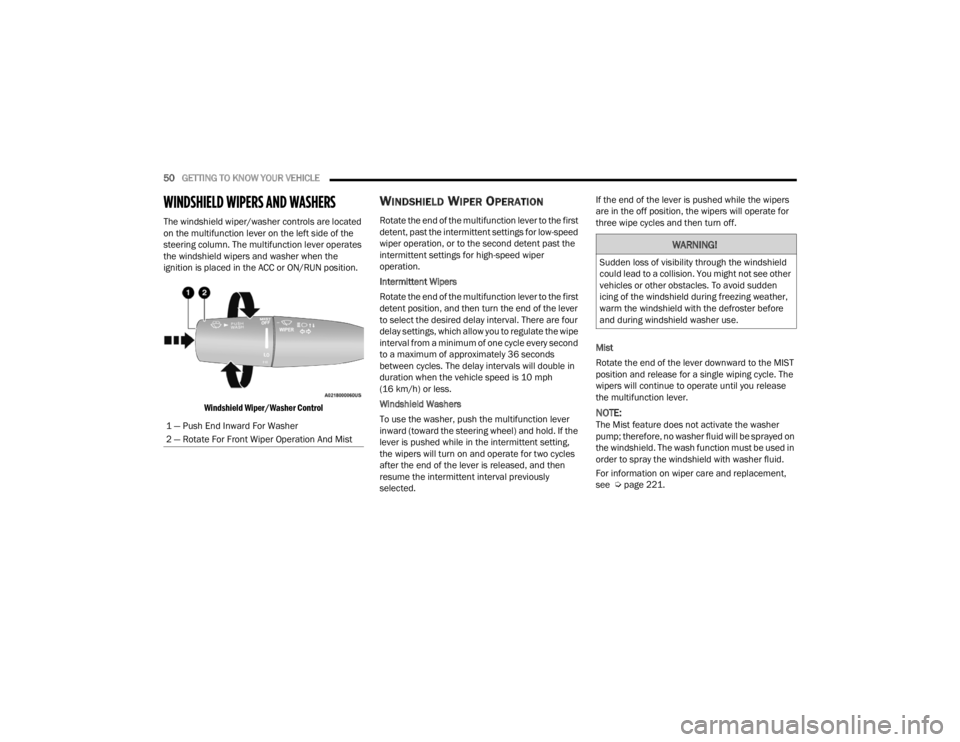
The windshield wiper/washer controls are located
on the multifunction lever on the left side of the
steering column. The multifunction lever operates
the windshield wipers and washer when the
ignition is placed in the ACC or ON/RUN position.
Windshield Wiper/Washer Control
WINDSHIELD WIPER OPERATION
Rotate the end of the multifunction lever to the first
detent, past the intermittent settings for low-speed
wiper operation, or to the second detent past the
intermittent settings for high-speed wiper
operation.
Intermittent Wipers
Rotate the end of the multifunction lever to the first
detent position, and then turn the end of the lever
to select the desired delay interval. There are four
delay settings, which allow you to regulate the wipe
interval from a minimum of one cycle every second
to a maximum of approximately 36 seconds
between cycles. The delay intervals will double in
duration when the vehicle speed is 10 mph
(16 km/h) or less.
Windshield Washers
To use the washer, push the multifunction lever
inward (toward the steering wheel) and hold. If the
lever is pushed while in the intermittent setting,
the wipers will turn on and operate for two cycles
after the end of the lever is released, and then
resume the intermittent interval previously
selected. If the end of the lever is pushed while the wipers
are in the off position, the wipers will operate for
three wipe cycles and then turn off.
Mist
Rotate the end of the lever downward to the MIST
position and release for a single wiping cycle. The
wipers will continue to operate until you release
the multifunction lever.
NOTE:The Mist feature does not activate the washer
pump; therefore, no washer fluid will be sprayed on
the windshield. The wash function must be used in
order to spray the windshield with washer fluid.
For information on wiper care and replacement,
see Ú
page 221.
1 — Push End Inward For Washer
2 — Rotate For Front Wiper Operation And Mist
WARNING!
Sudden loss of visibility through the windshield
could lead to a collision. You might not see other
vehicles or other obstacles. To avoid sudden
icing of the windshield during freezing weather,
warm the windshield with the defroster before
and during windshield washer use.
22_LX_OM_EN_USC_t.book Page 50
Page 82 of 288
80GETTING TO KNOW YOUR INSTRUMENT PANEL
If the ABS light does not turn on when the ignition
is placed in the ON/RUN or ACC/ON/RUN position,
have the brake system inspected by an authorized
dealer.
Electronic Stability Control (ESC) Active
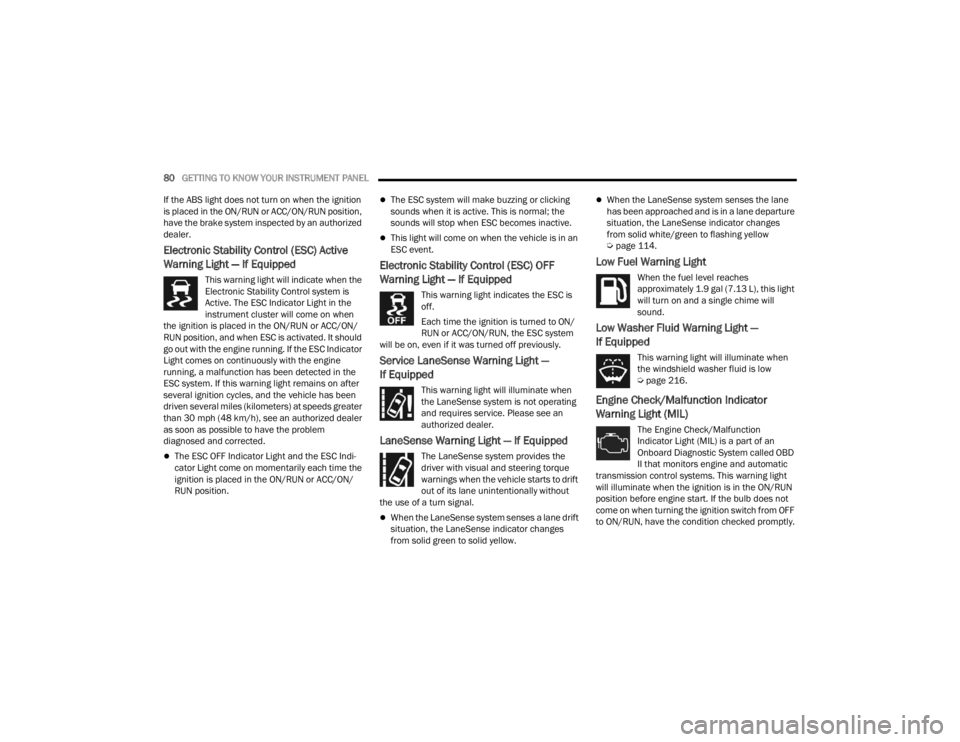
Warning Light — If Equipped
This warning light will indicate when the
Electronic Stability Control system is
Active. The ESC Indicator Light in the
instrument cluster will come on when
the ignition is placed in the ON/RUN or ACC/ON/
RUN position, and when ESC is activated. It should
go out with the engine running. If the ESC Indicator
Light comes on continuously with the engine
running, a malfunction has been detected in the
ESC system. If this warning light remains on after
several ignition cycles, and the vehicle has been
driven several miles (kilometers) at speeds greater
than 30 mph (48 km/h), see an authorized dealer
as soon as possible to have the problem
diagnosed and corrected.
The ESC OFF Indicator Light and the ESC Indi -
cator Light come on momentarily each time the
ignition is placed in the ON/RUN or ACC/ON/
RUN position.
The ESC system will make buzzing or clicking
sounds when it is active. This is normal; the
sounds will stop when ESC becomes inactive.
This light will come on when the vehicle is in an
ESC event.
Electronic Stability Control (ESC) OFF
Warning Light — If Equipped
This warning light indicates the ESC is
off.
Each time the ignition is turned to ON/
RUN or ACC/ON/RUN, the ESC system
will be on, even if it was turned off previously.
Service LaneSense Warning Light —
If Equipped
This warning light will illuminate when
the LaneSense system is not operating
and requires service. Please see an
authorized dealer.
LaneSense Warning Light — If Equipped
The LaneSense system provides the
driver with visual and steering torque
warnings when the vehicle starts to drift
out of its lane unintentionally without
the use of a turn signal.
When the LaneSense system senses a lane drift
situation, the LaneSense indicator changes
from solid green to solid yellow.
When the LaneSense system senses the lane
has been approached and is in a lane departure
situation, the LaneSense indicator changes
from solid white/green to flashing yellow
Ú page 114.
Low Fuel Warning Light
When the fuel level reaches
approximately 1.9 gal (7.13 L), this light
will turn on and a single chime will
sound.
Low Washer Fluid Warning Light —
If Equipped
This warning light will illuminate when
the windshield washer fluid is low
Úpage 216.
Engine Check/Malfunction Indicator
Warning Light (MIL)
The Engine Check/Malfunction
Indicator Light (MIL) is a part of an
Onboard Diagnostic System called OBD
II that monitors engine and automatic
transmission control systems. This warning light
will illuminate when the ignition is in the ON/RUN
position before engine start. If the bulb does not
come on when turning the ignition switch from OFF
to ON/RUN, have the condition checked promptly.
22_LX_OM_EN_USC_t.book Page 80
Page 212 of 288
210
SERVICING AND MAINTENANCE
SCHEDULED SERVICING
This vehicle is equipped with an automatic oil
change indicator system. The oil change indicator
system will remind you that it is time to take your
vehicle in for scheduled maintenance.
Based on engine operation conditions, the oil
change indicator message will illuminate. This
means that service is required for the vehicle.
Operating conditions such as frequent short-trips,
trailer tow, and extremely hot or cold ambient
temperatures will influence when the “Change Oil”
or “Oil Change Required” message is displayed.
Have your vehicle serviced as soon as possible,
within the next 500 miles (805 km).The “Oil Change Required” message will be
displayed in the instrument cluster and a single
chime will sound, indicating that an oil change is
necessary.
An authorized dealer will reset the oil change
indicator message after completing the scheduled
oil change.
NOTE:Under no circumstances should oil change
intervals exceed 10,000 miles (16,000 km),
12 months or 350 hours of engine run time,
whichever comes first. The 350 hours of engine
run or idle time is generally only a concern for fleet
customers.
Once A Month Or Before A Long Trip:
Check engine oil level.
Check windshield washer fluid level.
Check tire pressure and look for unusual wear
or damage. Rotate tires at the first sign of irreg
-
ular wear, even if it occurs before your next
scheduled service.
Check the fluid levels of the coolant reservoir,
brake master cylinder, and power steering (if
equipped) and fill as needed.
Check function of all interior and exterior lights.
22_LX_OM_EN_USC_t.book Page 210
Page 216 of 288
214SERVICING AND MAINTENANCE
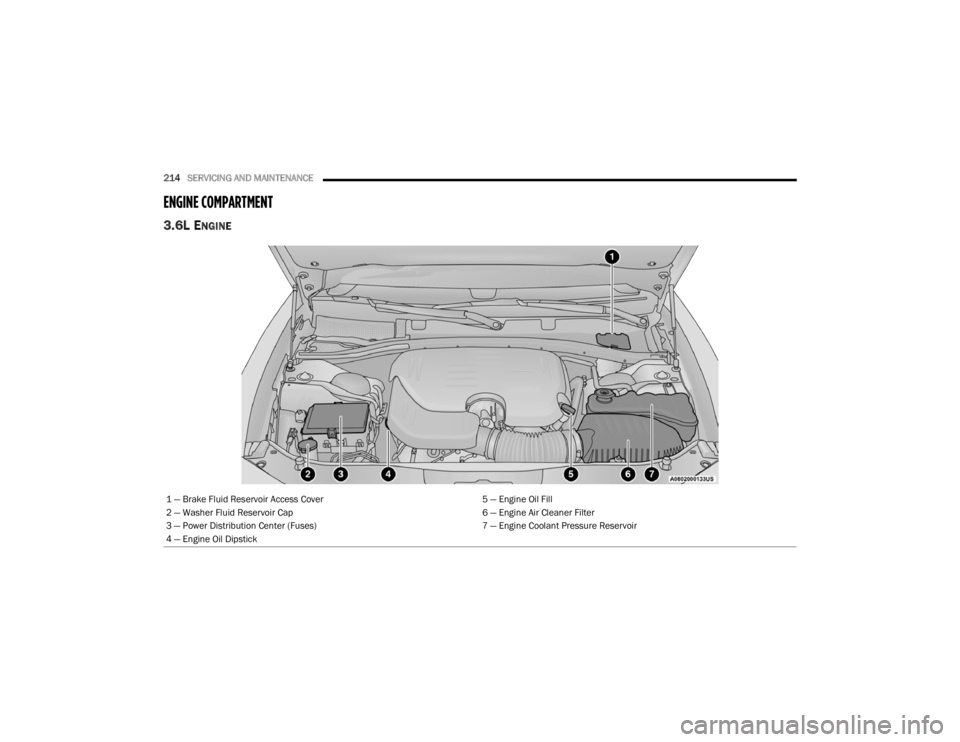
ENGINE COMPARTMENT
3.6L ENGINE
1 — Brake Fluid Reservoir Access Cover 5 — Engine Oil Fill
2 — Washer Fluid Reservoir Cap 6 — Engine Air Cleaner Filter
3 — Power Distribution Center (Fuses) 7 — Engine Coolant Pressure Reservoir
4 — Engine Oil Dipstick
22_LX_OM_EN_USC_t.book Page 214
Page 217 of 288
SERVICING AND MAINTENANCE215
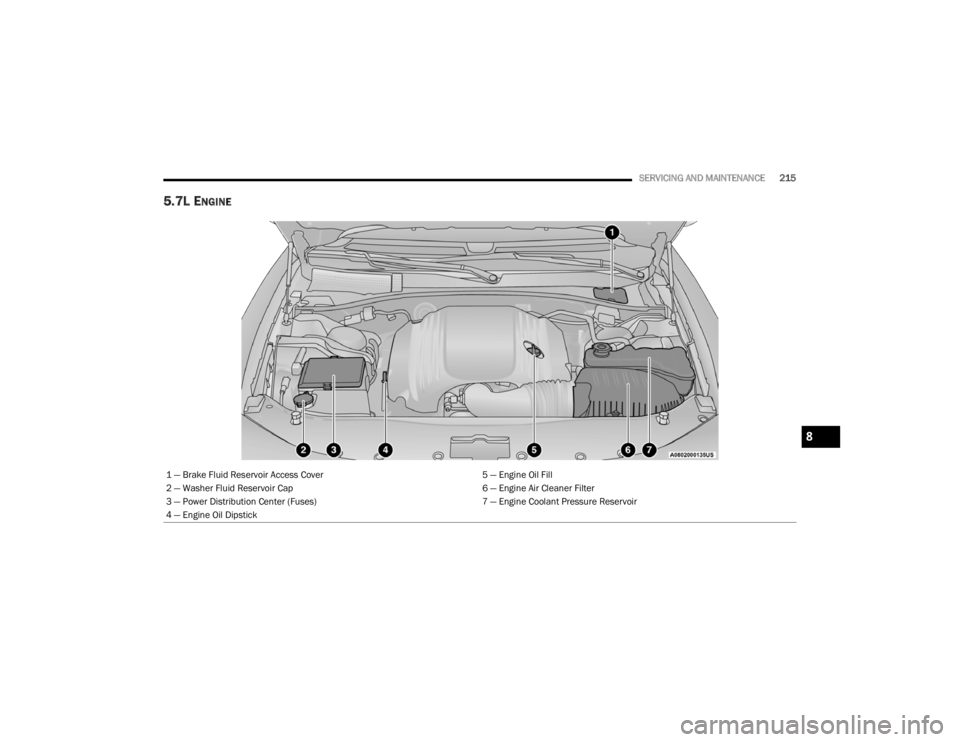
5.7L ENGINE
1 — Brake Fluid Reservoir Access Cover 5 — Engine Oil Fill
2 — Washer Fluid Reservoir Cap 6 — Engine Air Cleaner Filter
3 — Power Distribution Center (Fuses) 7 — Engine Coolant Pressure Reservoir
4 — Engine Oil Dipstick
8
22_LX_OM_EN_USC_t.book Page 215
Page 218 of 288
216SERVICING AND MAINTENANCE
(Continued)
CHECKING OIL LEVEL
To ensure proper engine lubrication, the engine
oil must be maintained at the correct level. Check
the oil level at regular intervals, such as every
month. The best time to check the engine oil level
is about five minutes after a fully warmed up
engine is shut off.
Checking the oil while the vehicle is on level ground
will improve the accuracy of the oil level readings.
There are four possible dipstick types:
Crosshatched zone.
Crosshatched zone marked SAFE.
Crosshatched zone marked with MIN at the low
end of the range and MAX at the high end of the
range.
Crosshatched zone marked with dimples at the
MIN and the MAX ends of the range.
NOTE:Always maintain the oil level within the crosshatch
markings on the dipstick.
Adding 1 quart (1.0 liters) of oil when the reading
is at the low end of the dipstick range will raise the
oil level to the high end of the range marking.
ADDING WASHER FLUID
The windshield washer fluid reservoir is located in
the front of the engine compartment. Be sure to
check the fluid level at regular intervals. Fill the
reservoir with windshield washer solvent (not
radiator antifreeze) and operate the system for a
few seconds to flush out the residual water.
When refilling the washer fluid reservoir, apply
some washer fluid to a cloth or towel and wipe the
wiper blades clean. This will help blade
performance.
To prevent freeze-up of your windshield washer
system in cold weather, select a solution or mixture
that meets or exceeds the temperature range of
your climate. This rating information can be found
on most washer fluid containers.
The fluid reservoir will hold nearly 1 gallon (4 liters)
of washer fluid when the message “Low Washer
Fluid” appears in the instrument cluster.MAINTENANCE-FREE BATTERY
Your vehicle is equipped with a maintenance-free
battery. You will never have to add water, nor is
periodic maintenance required.
NOTE:
The battery is stored under an access cover in the
trunk. Remote battery terminals are located in the
engine compartment for jump starting
Úpage 201.
CAUTION!
Overfilling or underfilling the crankcase will
cause aeration or loss of oil pressure. This could
damage your engine.
WARNING!
Commercially available windshield washer
solvents are flammable. They could ignite and
burn you. Care must be exercised when filling or
working around the washer solution.
WARNING!
Battery fluid is a corrosive acid solution and
can burn or even blind you. Do not allow
battery fluid to contact your eyes, skin, or
clothing. Do not lean over a battery when
attaching clamps. If acid splashes in eyes or
on skin, flush the area immediately with large
amounts of water Ú page 201.
22_LX_OM_EN_USC_t.book Page 216
Page 219 of 288
SERVICING AND MAINTENANCE217
(Continued)
PRESSURE WASHING
Cleaning the engine compartment with a high
pressure washer is not recommended.
VEHICLE MAINTENANCE
An authorized dealer has the qualified service
personnel, special tools, and equipment to
perform all service operations in an expert
manner. Service Manuals are available which
include detailed service information for your
vehicle. Refer to these Service Manuals before
attempting any procedure yourself.
NOTE:Intentional tampering with emission control
systems may void your warranty and could result in
civil penalties being assessed against you.
ENGINE OIL
Engine Oil Selection — 3.6L/5.7L Engine
Use only the manufacturer's recommended fluids
Ú page 268.
NOTE:
Hemi engines at times can tick right after startup and
then quiet down after approximately 30 seconds. This
is normal and will not harm the engine. This character -
istic can be caused by short drive cycles. For example,
if the vehicle is started then shut off after driving a short
distance. Upon restarting, you may experience a ticking
sound. Other causes could be if the vehicle is unused
for an extended period of time, incorrect oil, extended
oil changes or extended idling. If the engine continues
to tick or if the Malfunction Indicator Light (MIL) comes
on, see the nearest authorized dealer.
Battery gas is flammable and explosive. Keep
flame or sparks away from the battery. Do not
use a booster battery or any other booster
source with an output greater than 12 Volts.
Do not allow cable clamps to touch each
other.
Battery posts, terminals, and related accesso -
ries contain lead and lead compounds. Wash
hands after handling.
The battery in this vehicle has a vent hose that
should not be disconnected and should only
be replaced with a battery of the same type
(vented).
CAUTION!
It is essential when replacing the cables on
the battery that the positive cable is attached
to the positive post and the negative cable is
attached to the negative post. Battery posts
are marked positive (+) and negative (-) and
are identified on the battery case. Cable
clamps should be tight on the terminal posts
and free of corrosion.
WARNING!
If a “fast charger” is used while the battery is
in the vehicle, disconnect both vehicle battery
cables before connecting the charger to the
battery. Do not use a “fast charger” to provide
starting voltage.
CAUTION!
Precautions have been taken to safeguard all
parts and connections however, the pressures
generated by these machines is such that
complete protection against water ingress
cannot be guaranteed.
CAUTION!
WARNING!
You can be badly injured working on or around a
motor vehicle. Only do service work for which
you have the knowledge and the proper
equipment. If you have any doubt about your
ability to perform a service job, take your vehicle
to a competent mechanic.
8
22_LX_OM_EN_USC_t.book Page 217
Page 223 of 288
SERVICING AND MAINTENANCE221
Some conditions can be caused by a faulty
component such as a belt pulley. Belt pulleys
should be carefully inspected for damage and
proper alignment.
Belt replacement on some models requires the
use of special tools, we recommend having your
vehicle serviced at an authorized dealer.
BODY LUBRICATION
Locks and all body pivot points, including such
items as seat tracks, door hinge pivot points and
rollers, liftgate, tailgate, decklid, sliding doors and
hood hinges, should be lubricated periodically with
a lithium-based grease, such as Mopar® Spray
White Lube to ensure quiet, easy operation and to
protect against rust and wear. Prior to the
application of any lubricant, the parts concerned
should be wiped clean to remove dust and grit;
after lubricating, excess oil and grease should be
removed. Particular attention should also be given
to hood latching components to ensure proper
function. When performing other underhood
services, the hood latch, release mechanism and
safety catch should be cleaned and lubricated.
The external lock cylinders should be lubricated
twice a year, preferably in the Autumn and Spring.
Apply a small amount of a high quality lubricant,
such as Mopar® Lock Cylinder Lubricant directly
into the lock cylinder.
WINDSHIELD WIPER BLADES
Clean the rubber edges of the wiper blades and the
windshield periodically with a sponge or soft cloth
and a mild nonabrasive cleaner. This will remove
accumulations of salt or road film.
Operation of the wipers on dry glass for long
periods may cause deterioration of the wiper
blades. Always use washer fluid when using the
wipers to remove salt or dirt from a dry windshield.
Avoid using the wiper blades to remove frost or ice
from the windshield. Keep the blade rubber out of
contact with petroleum products such as engine
oil, gasoline, etc.
NOTE:Life expectancy of wiper blades varies depending
on geographical area and frequency of use. Poor
performance of blades may be present with chat -
tering, marks, water lines or wet spots. If any of
these conditions are present, clean the wiper
blades or replace as necessary.
Wiper Blade Removal/Installation
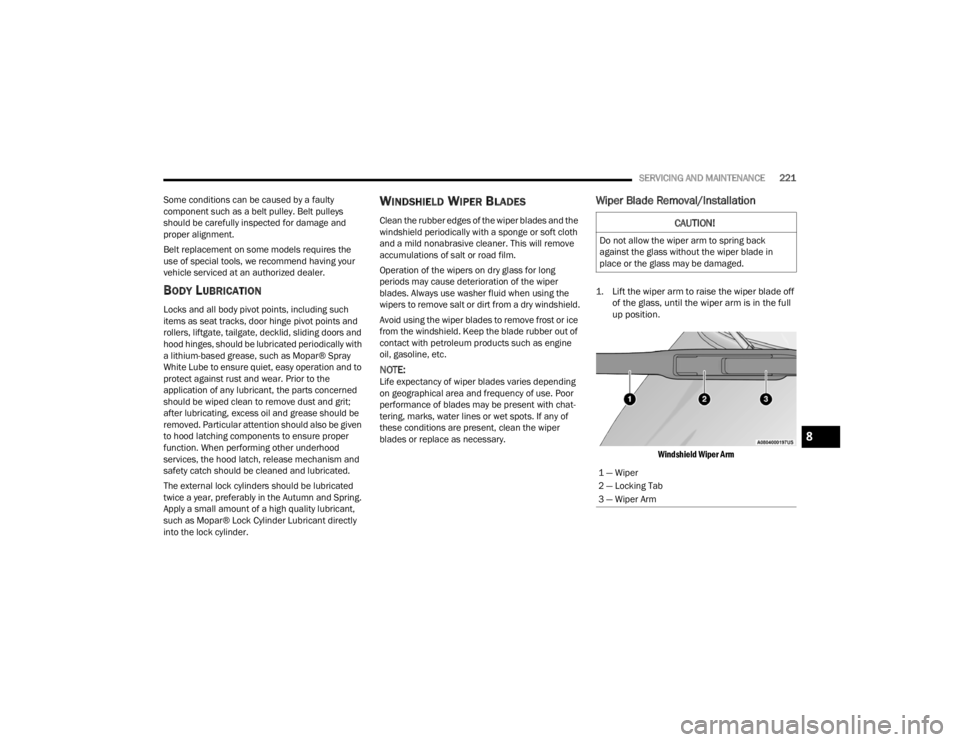
1. Lift the wiper arm to raise the wiper blade off of the glass, until the wiper arm is in the full
up position.
Windshield Wiper Arm
CAUTION!
Do not allow the wiper arm to spring back
against the glass without the wiper blade in
place or the glass may be damaged.
1 — Wiper
2 — Locking Tab
3 — Wiper Arm
8
22_LX_OM_EN_USC_t.book Page 221