cooling CHRYSLER 300 C 2008 1.G User Guide
[x] Cancel search | Manufacturer: CHRYSLER, Model Year: 2008, Model line: 300 C, Model: CHRYSLER 300 C 2008 1.GPages: 520, PDF Size: 5.43 MB
Page 436 of 520
vehicle, or when the underside or rear of the vehicle is
damaged, have a competent mechanic inspect the com-
plete exhaust system and adjacent body areas for broken,
damaged, deteriorated, or mispositioned parts. Open
seams or loose connections could permit exhaust fumes
to seep into the passenger compartment. In addition,
inspect the exhaust system each time the vehicle is raised
for lubrication or oil change. Replace as required.
WARNING!
Exhaust gases can injure or kill. They contain carbon
monoxide (CO) which is colorless and odorless.
Breathing it can make you unconscious and can
eventually poison you. To avoid breathing CO, refer
to “Exhaust Gas” in the “Safety Tips” section of this
manual.
Cooling System
WARNING!
•When working near the radiator cooling fan, dis-
connect the fan motor lead or turn the ignition
switch to the LOCK position. The fan is tempera-
ture controlled and can start at any time the
ignition switch is in the ON position.
•You or others can be badly burned by hot coolant
or steam from your radiator. If you see or hear
steam coming from under the hood, don’t open the
hood until the radiator has had time to cool. Never
try to open a cooling system pressure cap when the
radiator is hot.
MAINTAINING YOUR VEHICLE 435
7
Page 437 of 520
Coolant Checks
Check engine coolant (antifreeze) protection every 12
months (before the onset of freezing weather, where
applicable). If coolant is dirty or rusty in appearance, the
system should be drained, flushed, and refilled with
fresh coolant. Check the front of the A/C condenser for
any accumulation of bugs, leaves, etc. If dirty, clean by
gently spraying water from a garden hose vertically
down the face of the condenser.
Check the coolant recovery bottle tubing for brittle rub-
ber, cracking, tears, cuts, and tightness of the connection
at the bottle and radiator. Inspect the entire system for
leaks.
With the engine at normal operating temperature (but
not running), check the cooling system pressure cap for
proper vacuum sealing by draining a small amount of
coolant from the radiator drain cock. If the cap is sealing
properly, the engine coolant (antifreeze) will begin todrain from the coolant recovery bottle. DO NOT RE-
MOVE THE COOLANT PRESSURE CAP WHEN THE
COOLING SYSTEM IS HOT.
Cooling System — Drain, Flush, and Refill
The system should be drained, flushed, and refilled at the
intervals shown in the “Maintenance Schedule” in Sec-
tion 8 of this manual.
If the solution is dirty or contains a considerable amount
of sediment, clean and flush with a reliable cooling
system cleaner. Follow with a thorough rinsing to remove
all deposits and chemicals. Properly dispose of old
antifreeze solution.
Selection of Coolant
Use only the manufacturer’s recommended coolant. Re-
fer to “Fluids, Lubricants, and Genuine Parts” for the
correct coolant type.
436 MAINTAINING YOUR VEHICLE
Page 438 of 520
CAUTION!
•Mixing of coolants other than specified HOAT
engine coolants, may result in engine damage and
may decrease corrosion protection. If a non-HOAT
coolant is introduced into the cooling system in an
emergency, it should be replaced with the speci-
fied coolant as soon as possible.
•Do not use plain water alone or alcohol-base
engine coolant (antifreeze) products. Do not use
additional rust inhibitors or antirust products, as
they may not be compatible with the radiator
engine coolant and may plug the radiator.
•This vehicle has not been designed for use with
Propylene Glycol based coolants. Use of Propy-
lene Glycol based coolants is not recommended.
Adding Coolant
Your vehicle has been built with an improved engine
coolant that allows extended maintenance intervals. This
coolant can be used up to 5 Years or 100,000 miles (160
000 km) before replacement. To prevent reducing this
extended maintenance period, it is important that you
use the same coolant throughout the life of your vehicle.
Please review these recommendations for using Hybrid
Organic Additive Technology (HOAT) coolant.
When adding coolant:
•The manufacturer recommends using Mopar\2
Antifreeze/Coolant 5 Year/100,000 Mile Formula
HOAT (Hybrid Organic Additive Technology).
•Mix a minimum solution of 50% HOAT engine coolant
and distilled water. Use higher concentrations (not to
exceed 70%) if temperatures below\134°F (\137°C) are
anticipated.
MAINTAINING YOUR VEHICLE 437
7
Page 439 of 520
•Use only high purity water such as distilled or deion-
ized water when mixing the water/engine coolant
solution. The use of lower quality water will reduce
the amount of corrosion protection in the engine
cooling system.
Please note that it is the owner’s responsibility to main-
tain the proper level of protection against freezing ac-
cording to the temperatures occurring in the area where
the vehicle is operated.
NOTE:Mixing coolant types will decrease the life of the
engine coolant and will require more frequent coolant
changes.
Cooling System Pressure Cap
The cap must be fully tightened to prevent loss of
coolant, and to insure that coolant will return to the
radiator from the coolant recovery bottle.The cap should be inspected and cleaned if there is any
accumulation of foreign material on the sealing surfaces.
WARNING!
•The warning words “DO NOT OPEN HOT” on
the cooling system pressure cap are a safety pre-
caution. Never add coolant when the engine is
overheated. Do not loosen or remove the cap to
cool an overheated engine. Heat causes pressure to
build up in the cooling system. To prevent scald-
ing or injury, do not remove the pressure cap while
the system is hot or under pressure.
•Do not use a pressure cap other than the one
specified for your vehicle. Personal injury or en-
gine damage may result.
438 MAINTAINING YOUR VEHICLE
Page 441 of 520

•Do not overfill the coolant recovery bottle.
•Check coolant freeze point in the radiator and in the
coolant recovery bottle. If antifreeze needs to be
added, contents of coolant recovery bottle must also be
protected against freezing.
•If frequent coolant additions are required, or if the
level in the coolant recovery bottle does not drop when
the engine cools, the cooling system should be pres-
sure tested for leaks.
•Maintain coolant concentration at 50% HOAT engine
coolant (minimum) and distilled water for proper
corrosion protection of your engine, which contains
aluminum components.
•Make sure that the radiator and coolant recovery
bottle overflow hoses are not kinked or obstructed.
•Keep the front of the radiator clean. If your vehicle is
equipped with air conditioning, keep the front of the
condenser clean, also.
•Do not change the thermostat for summer or winter
operation. If replacement is ever necessary, install
ONLY the correct type thermostat. Other designs may
result in unsatisfactory coolant performance, poor gas
mileage, and increased emissions.
Hoses and Vacuum/Vapor Harnesses
Inspect surfaces of hoses and nylon tubing for evidence
of heat and mechanical damage. Hard or soft spots,
brittle rubber, cracking, tears, cuts, abrasions, and exces-
sive swelling indicate deterioration of the rubber.
Pay particular attention to those hoses nearest to high
heat sources such as the exhaust manifold. Inspect hose
routing to be sure hoses do not come in contact with any
heat source or moving component, which may cause heat
damage or mechanical wear.
440 MAINTAINING YOUR VEHICLE
Page 474 of 520
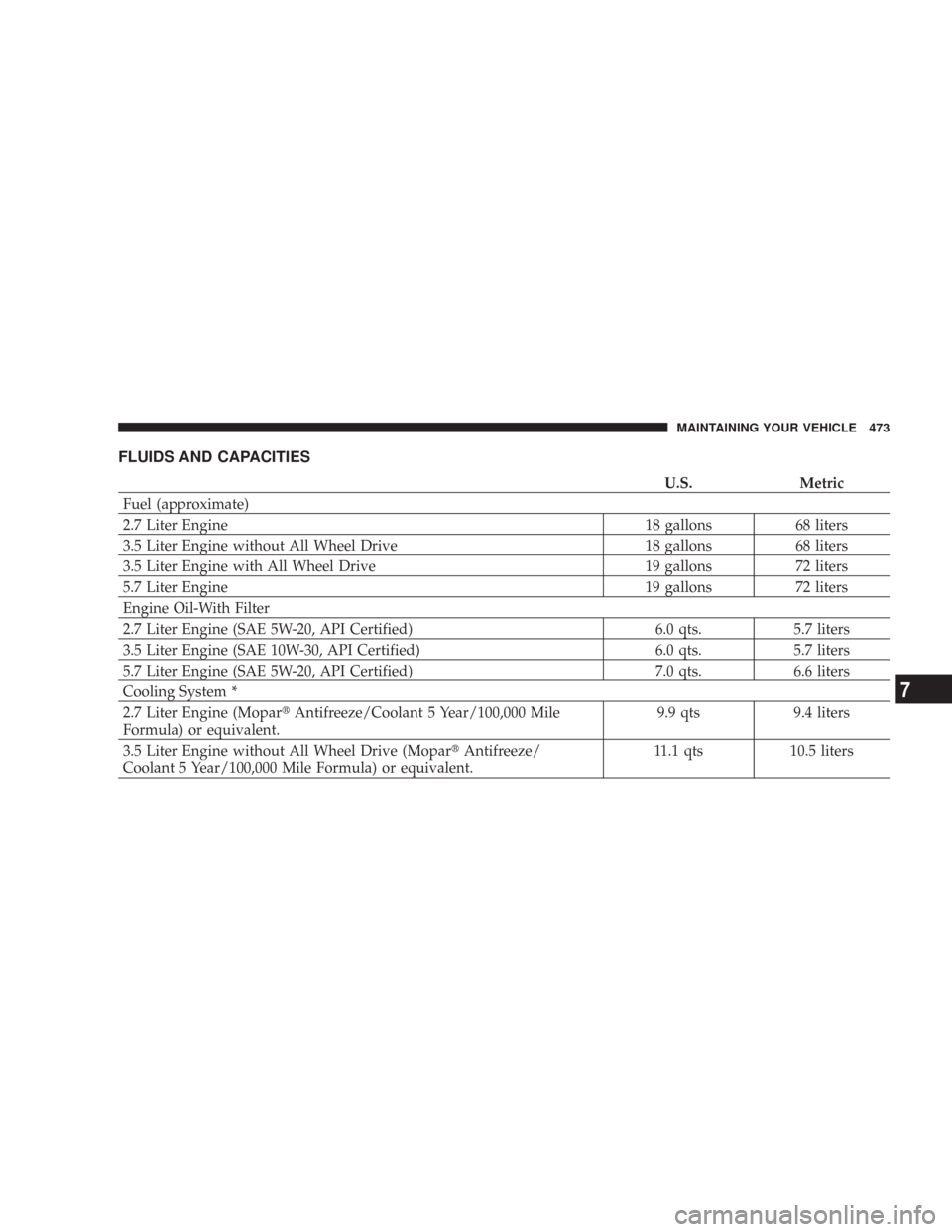
FLUIDS AND CAPACITIES
U.S. Metric
Fuel (approximate)
2.7 Liter Engine 18 gallons 68 liters
3.5 Liter Engine without All Wheel Drive 18 gallons 68 liters
3.5 Liter Engine with All Wheel Drive 19 gallons 72 liters
5.7 Liter Engine 19 gallons 72 liters
Engine Oil-With Filter
2.7 Liter Engine (SAE 5W-20, API Certified) 6.0 qts. 5.7 liters
3.5 Liter Engine (SAE 10W-30, API Certified) 6.0 qts. 5.7 liters
5.7 Liter Engine (SAE 5W-20, API Certified) 7.0 qts. 6.6 liters
Cooling System *
2.7 Liter Engine (Mopar\2Antifreeze/Coolant 5 Year/100,000 Mile
Formula) or equivalent.9.9 qts 9.4 liters
3.5 Liter Engine without All Wheel Drive (Mopar\2Antifreeze/
Coolant 5 Year/100,000 Mile Formula) or equivalent.11.1 qts 10.5 liters
MAINTAINING YOUR VEHICLE 473
7
Page 475 of 520
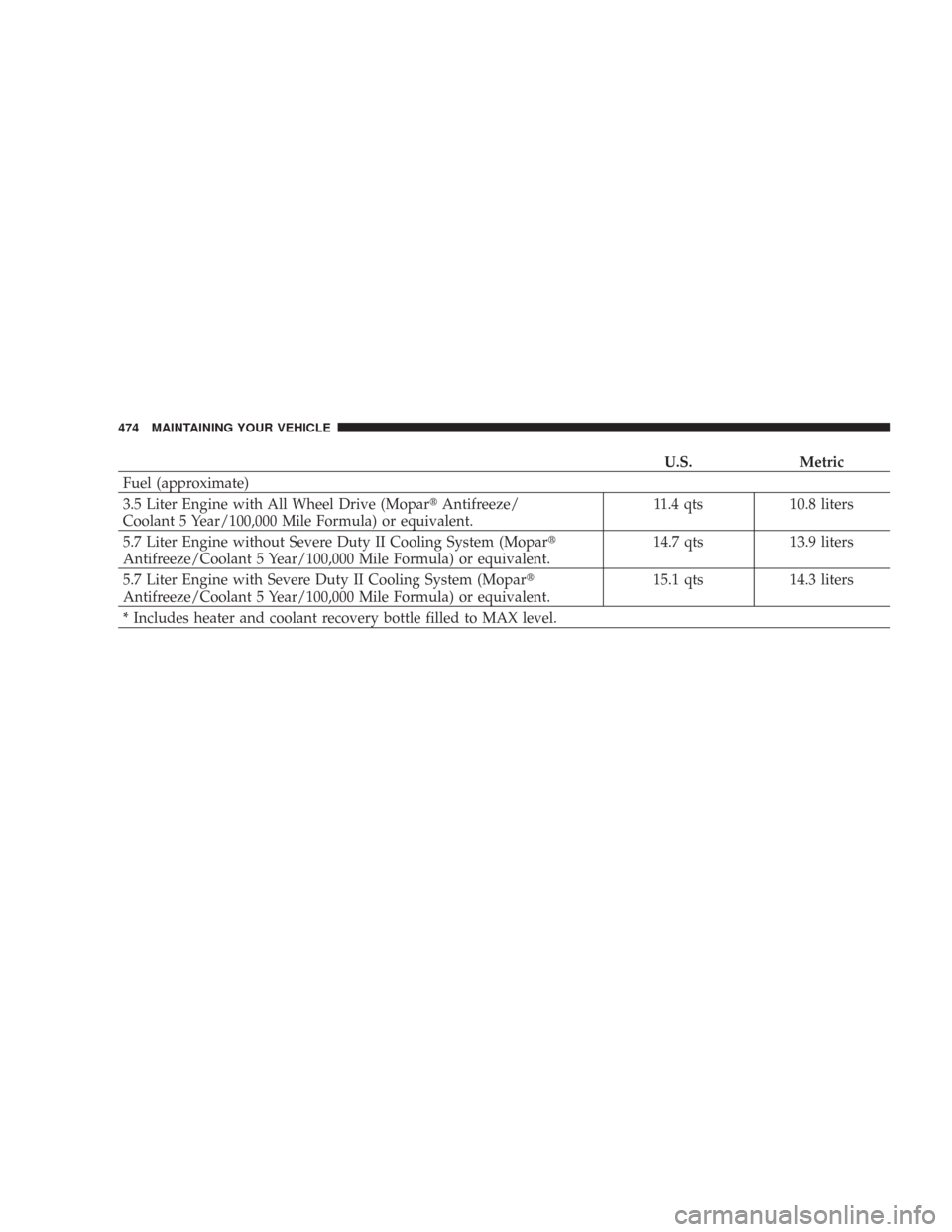
U.S. Metric
Fuel (approximate)
3.5 Liter Engine with All Wheel Drive (Mopar\2Antifreeze/
Coolant 5 Year/100,000 Mile Formula) or equivalent.11.4 qts 10.8 liters
5.7 Liter Engine without Severe Duty II Cooling System (Mopar\2
Antifreeze/Coolant 5 Year/100,000 Mile Formula) or equivalent.14.7 qts 13.9 liters
5.7 Liter Engine with Severe Duty II Cooling System (Mopar\2
Antifreeze/Coolant 5 Year/100,000 Mile Formula) or equivalent.15.1 qts 14.3 liters
* Includes heater and coolant recovery bottle filled to MAX level.
474 MAINTAINING YOUR VEHICLE
Page 500 of 520

Checks, Safety........................... 77
Child Restraint..................67,68,69,72,74
Child Restraint Tether Anchors.............71,72
Child Safety Locks........................ 33
Clean Air Gasoline....................... 366
Cleaning
Wheels............................. 448
Windshield Wiper Blades................. 433
Climate Control......................... 281
Clock.....................232,235,238,253,258
Coin Holder........................... 190
Cold Weather Operation................... 301
Compact Disc (CD) Maintenance............. 281
Compact Spare Tire...................... 348
Compass.............................. 222
Compass Calibration..................... 222
Compass Variance....................... 223
Computer, Trip/Travel.................... 219Connector
UCI ................................ 275
Universal Consumer Interface (UCI)......... 275
Conserving Fuel........................ 219
Console, Floor.......................... 190
Console, Overhead....................... 176
Contract, Service........................ 488
Converter, Catalytic...................... 427
Coolant Pressure Cap (Radiator Cap).......... 438
Cooling System......................... 435
Adding Coolant (Antifreeze).............. 437
Coolant Capacity...................... 473
Coolant Level......................436,439
Disposal of Used Coolant................ 439
Drain, Flush, and Refill.................. 436
Inspection........................... 439
Points to Remember.................... 439
Pressure Cap......................... 438
Radiator Cap......................... 438
INDEX 499
10
Page 502 of 520
Electrical Power Outlets................... 187
Electronic Brake Control System
Brake Assist System.................... 330
Electronic Stability Program............... 331
Traction Control System................. 328
Electronic Power Distribution Center (Fuses).... 451
Electronic Speed Control (Cruise Control)....148,152
Electronic Stability Program (ESP)............ 331
Electronic Throttle Control Warning Light...... 209
Electronic Vehicle Information Center (EVIC).... 213
Emergency Deck Lid Release................ 41
Emergency, In Case of
Freeing Vehicle When Stuck............... 407
Hazard Warning Flasher................. 392
Jacking............................. 394
Jump Starting......................... 404
Overheating.......................... 393
Towing............................. 408
Emergency Trunk Release................... 41Emission Control System Maintenance......418,478
Engine........................76,414,415,416
Air Cleaner.......................... 426
Block Heater......................... 303
Break-In Recommendations................ 76
Checking Oil Level..................421,422
Compartment...................414,415,416
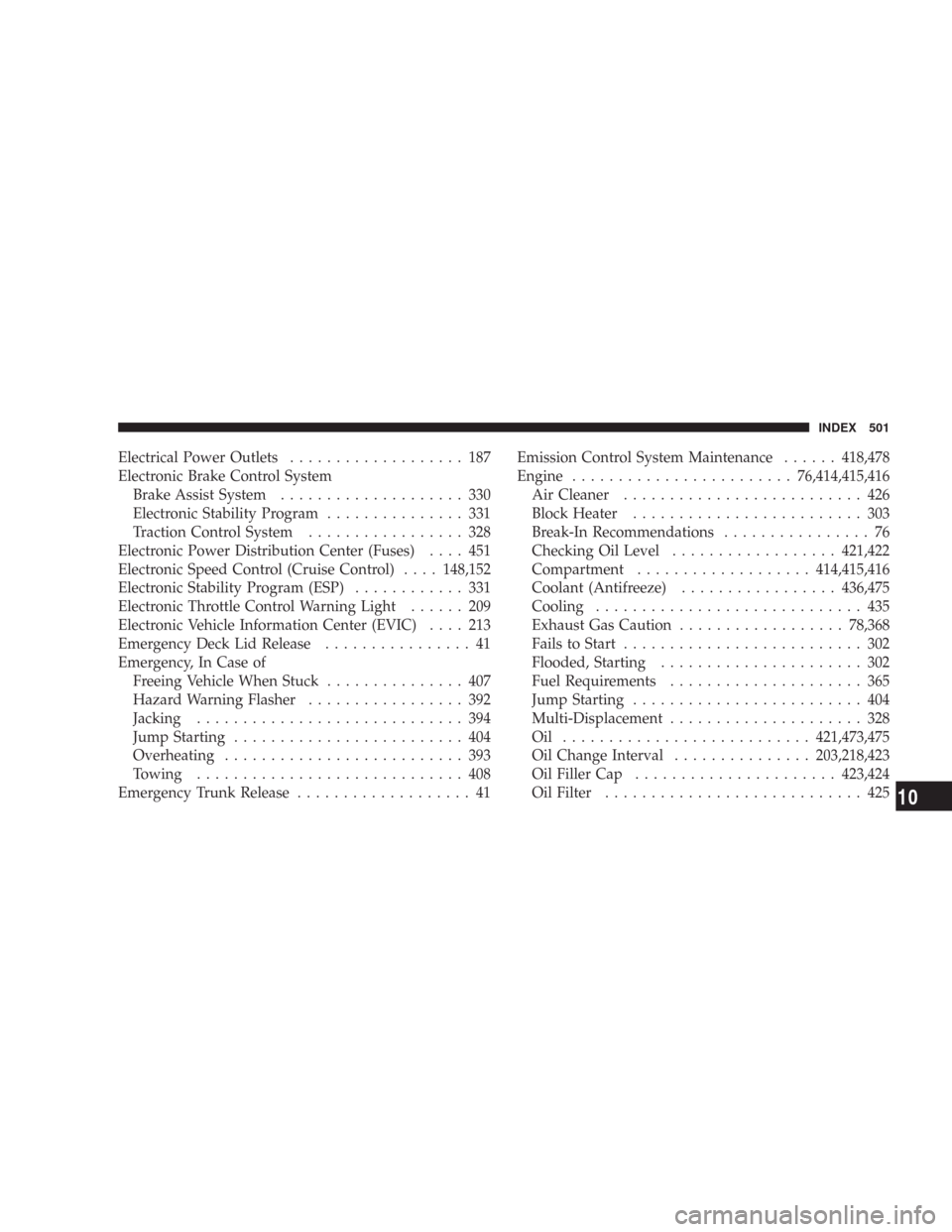
Coolant (Antifreeze).................436,475
Cooling............................. 435
Exhaust Gas Caution..................78,368
Fails to Start.......................... 302
Flooded, Starting...................... 302
Fuel Requirements..................... 365
Jump Starting......................... 404
Multi-Displacement..................... 328
Oil ...........................421,473,475
Oil Change Interval...............203,218,423
Oil Filler Cap......................423,424
Oil Filter............................ 425
INDEX 501
10
Page 504 of 520
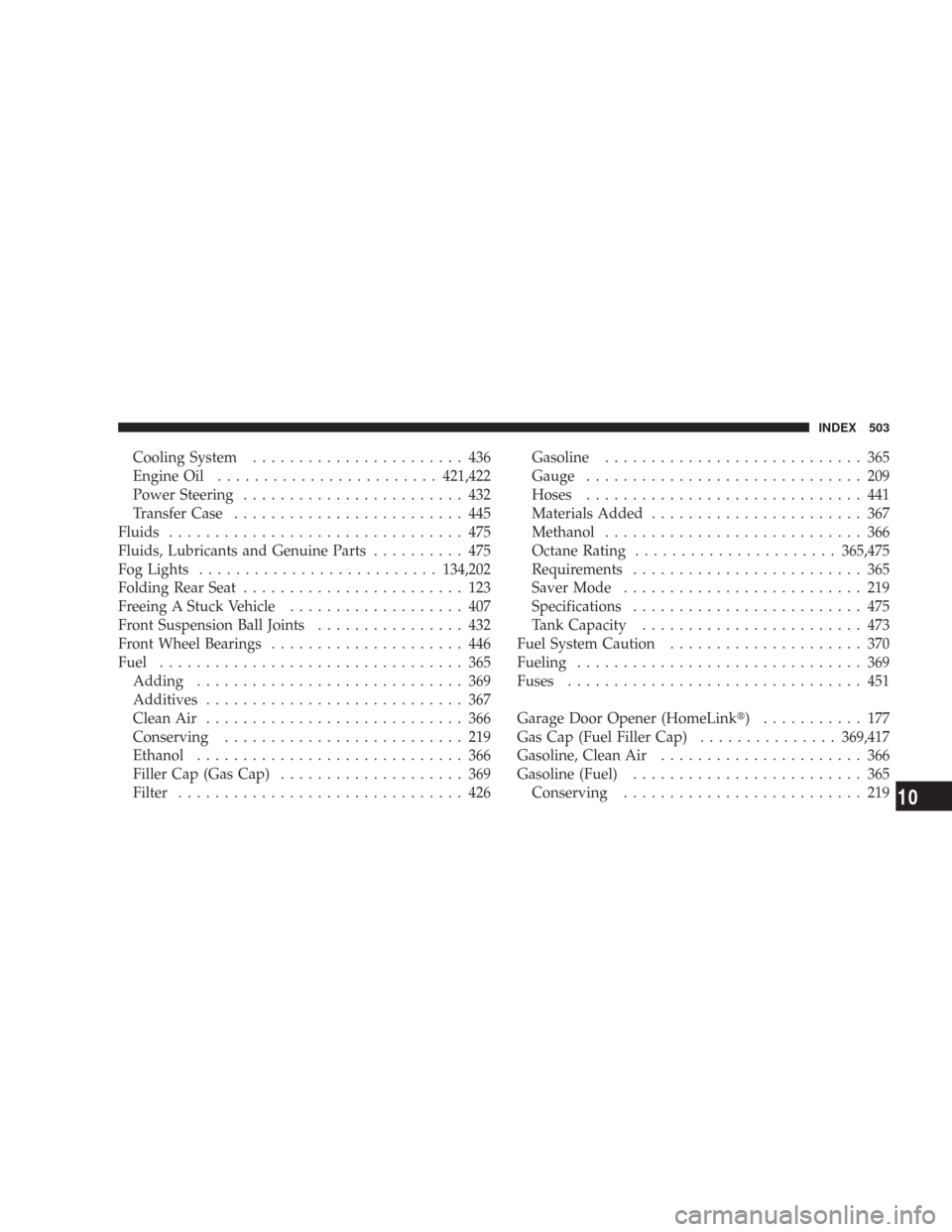
Cooling System....................... 436
Engine Oil........................421,422
Power Steering........................ 432
Transfer Case......................... 445
Fluids................................ 475
Fluids, Lubricants and Genuine Parts.......... 475
Fog Lights..........................134,202
Folding Rear Seat........................ 123
Freeing A Stuck Vehicle................... 407
Front Suspension Ball Joints................ 432
Front Wheel Bearings..................... 446
Fuel................................. 365
Adding............................. 369
Additives............................ 367
Clean Air............................ 366
Conserving.......................... 219
Ethanol............................. 366
Filler Cap (Gas Cap).................... 369
Filter............................... 426Gasoline............................ 365
Gauge.............................. 209
Hoses.............................. 441
Materials Added....................... 367
Methanol............................ 366
Octane Rating......................365,475
Requirements......................... 365
Saver Mode.......................... 219
Specifications......................... 475
Tank Capacity........................ 473
Fuel System Caution..................... 370
Fueling............................... 369
Fuses................................ 451
Garage Door Opener (HomeLink\2) ........... 177
Gas Cap (Fuel Filler Cap)...............369,417
Gasoline, Clean Air...................... 366
Gasoline (Fuel)......................... 365
Conserving.......................... 219
INDEX 503
10