engine oil CHRYSLER 300 C 2008 1.G User Guide
[x] Cancel search | Manufacturer: CHRYSLER, Model Year: 2008, Model line: 300 C, Model: CHRYSLER 300 C 2008 1.GPages: 520, PDF Size: 5.43 MB
Page 322 of 520
Shallow Standing Water
Although your vehicle is capable of driving through
shallow standing water, consider the following before
doing so:CAUTION!
•Always check the depth of the standing water before driving
through it. Never drive through standing water that is deeper
than the bottom of the tire rims mounted on the vehicle.
•Determine the condition of the road or the path that is under
water and if there are any obstacles in the way before driving
through the standing water.
•Do not exceed 5 mph (8 km/h) when driving through
standing water. This will minimize wave effects.
•Driving through standing water may cause damage to your
vehicle’s drivetrain components. Always inspect your vehi-
cle’s fluids (i.e. engine oil, transmission, axle, etc.) for signs
of contamination (i.e. fluid that is milky or foamy in appear-
ance) after driving through standing water. Do not continue
to operate the vehicle if any fluid appears contaminated, as
this may result in further damage. Such damage is not
covered by the new vehicle limited warranty.
•Getting water inside your vehicle’s engine can cause it to
lockup and stall out and cause serious internal damage to the
engine. Such damage is not covered by the new vehicle
limited warranty.STARTING AND OPERATING 321
5
Page 395 of 520
WARNING!
A hot engine cooling system is dangerous. You or
others could be badly burned by steam or boiling
coolant. You may want to call a service center if your
vehicle overheats. If you decide to look under the
hood yourself, see Section 7, Maintenance, of this
manual. Follow the warnings under the Cooling
System Pressure Cap paragraph.
JACKING AND TIRE CHANGING
WARNING!
•Do not attempt to change a tire on the side of the
vehicle close to moving traffic. Pull far enough off
the road to avoid the danger of being hit when
operating the jack or changing the wheel.
•Getting under a jacked-up vehicle is dangerous.
The vehicle could slip off the jack and fall on you.
You could be crushed. Never get any part of your
body under a vehicle that is on a jack. Never start
or run the engine while the vehicle is on a jack. If
you need to get under a raised vehicle, take it to a
service center where it can be raised on a lift.
•The jack is designed to use as a tool for changing
tires only. The jack should not be used to lift the
vehicle for service purposes. The vehicle should
be jacked on a firm level surface only. Avoid ice or
slippery areas.
394 WHAT TO DO IN EMERGENCIES
Page 412 of 520

MAINTAINING YOUR VEHICLE
CONTENTS
\12.7L Engine Compartment................414
\13.5L Engine Compartment................415
\15.7L Engine Compartment................416
\1Onboard Diagnostic System — OBD II........417
\3Loose Fuel Filler Cap..................417
\1Emissions Inspection And Maintenance
Programs............................418
\1Replacement Parts......................419
\1Dealer Service.........................420\1Maintenance Procedures..................420
\3Engine Oil..........................421
\3Engine Oil Filter......................425
\3Drive Belts — Check Condition And Tension . . 425
\3Spark Plugs.........................426
\3Engine Air Cleaner Filter................426
\3Fuel Filter..........................426
\3Catalytic Converter....................427
\3Maintenance-Free Battery................428
7
Page 415 of 520
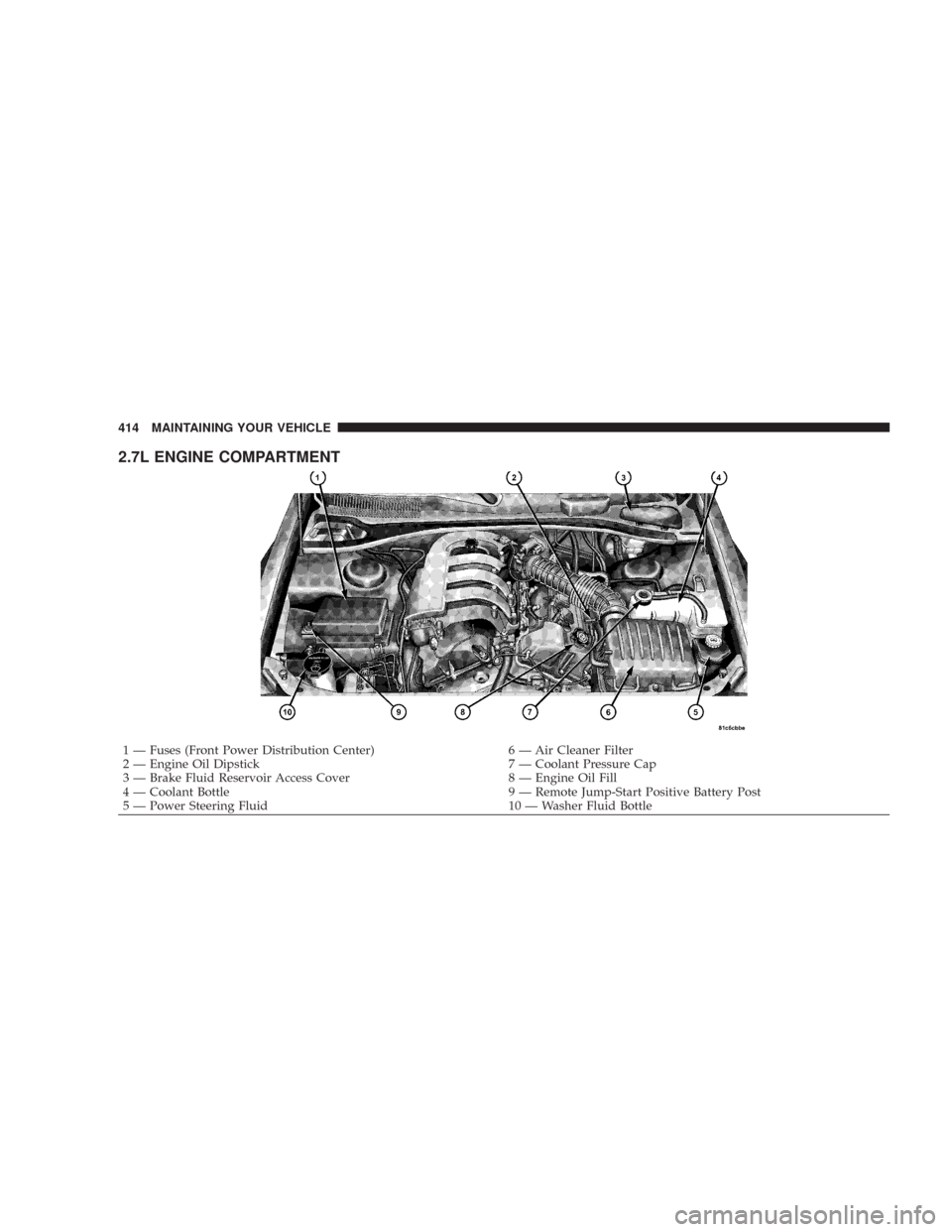
2.7L ENGINE COMPARTMENT
1 — Fuses (Front Power Distribution Center) 6 — Air Cleaner Filter
2 — Engine Oil Dipstick 7 — Coolant Pressure Cap
3 — Brake Fluid Reservoir Access Cover 8 — Engine Oil Fill
4 — Coolant Bottle 9 — Remote Jump-Start Positive Battery Post
5 — Power Steering Fluid 10 — Washer Fluid Bottle 414 MAINTAINING YOUR VEHICLE
Page 416 of 520
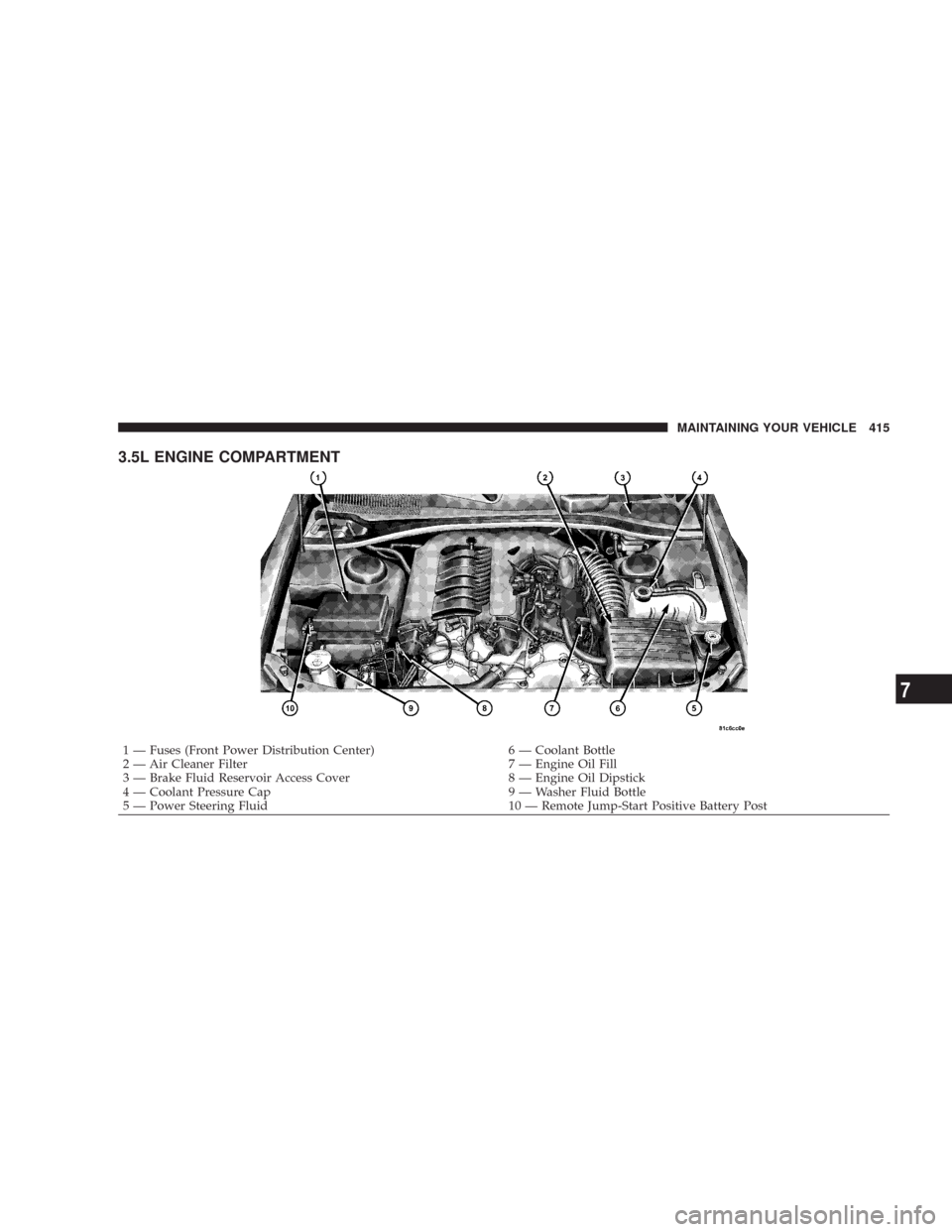
3.5L ENGINE COMPARTMENT
1 — Fuses (Front Power Distribution Center) 6 — Coolant Bottle
2 — Air Cleaner Filter 7 — Engine Oil Fill
3 — Brake Fluid Reservoir Access Cover 8 — Engine Oil Dipstick
4 — Coolant Pressure Cap 9 — Washer Fluid Bottle
5 — Power Steering Fluid 10 — Remote Jump-Start Positive Battery PostMAINTAINING YOUR VEHICLE 415
7
Page 417 of 520
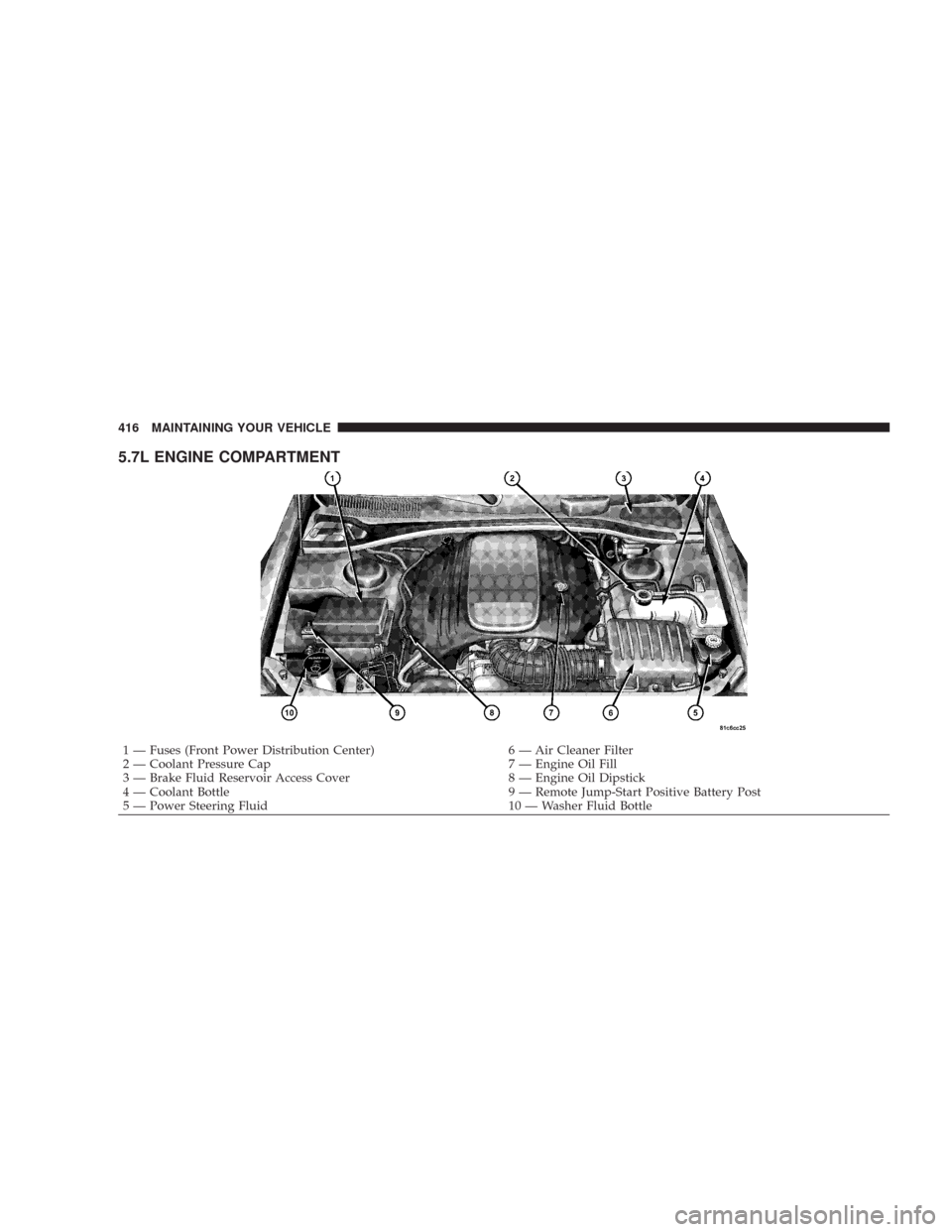
5.7L ENGINE COMPARTMENT
1 — Fuses (Front Power Distribution Center) 6 — Air Cleaner Filter
2 — Coolant Pressure Cap 7 — Engine Oil Fill
3 — Brake Fluid Reservoir Access Cover 8 — Engine Oil Dipstick
4 — Coolant Bottle 9 — Remote Jump-Start Positive Battery Post
5 — Power Steering Fluid 10 — Washer Fluid Bottle 416 MAINTAINING YOUR VEHICLE
Page 422 of 520
These items should be inspected if a malfunction is
observed or suspected.
Engine Oil
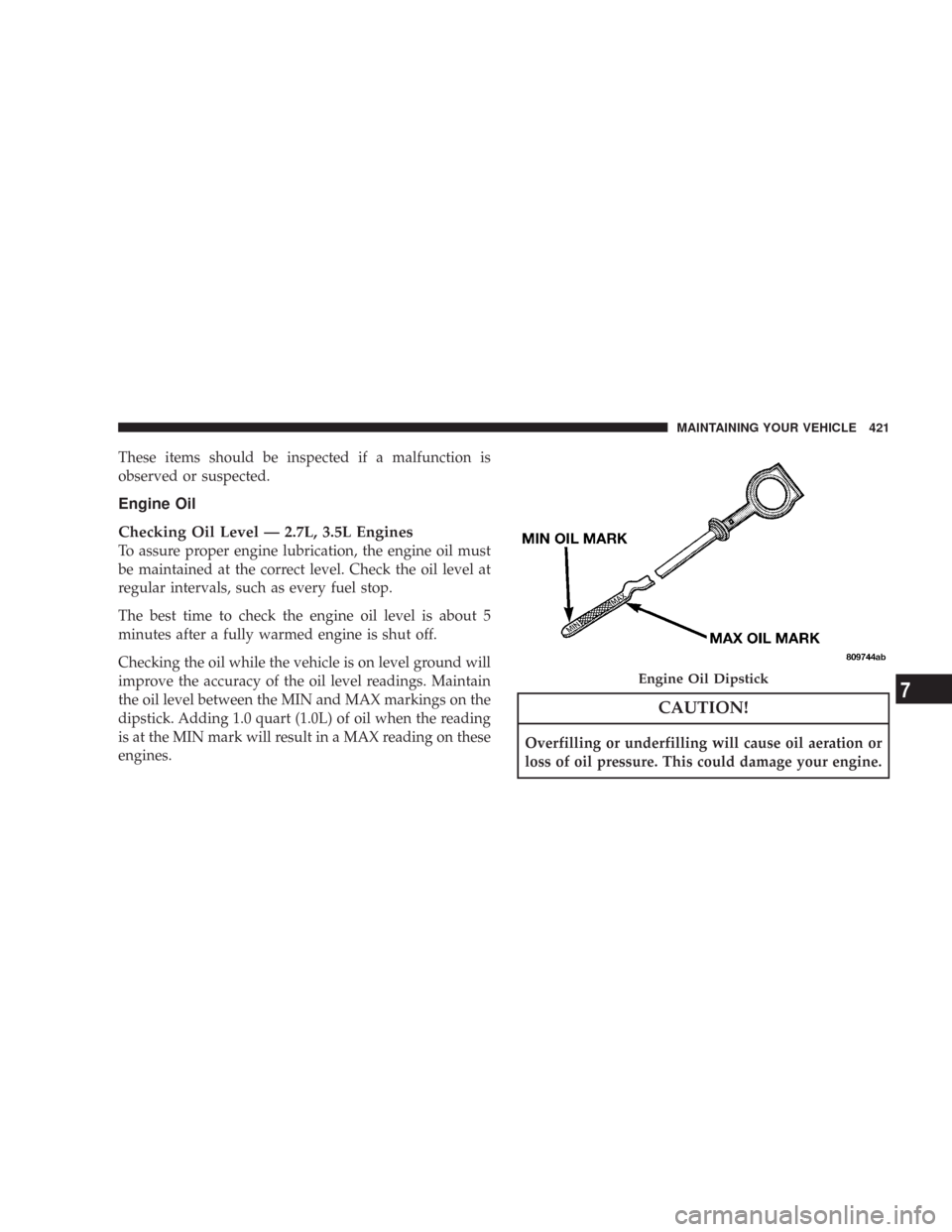
Checking Oil Level — 2.7L, 3.5L Engines
To assure proper engine lubrication, the engine oil must
be maintained at the correct level. Check the oil level at
regular intervals, such as every fuel stop.
The best time to check the engine oil level is about 5
minutes after a fully warmed engine is shut off.
Checking the oil while the vehicle is on level ground will
improve the accuracy of the oil level readings. Maintain
the oil level between the MIN and MAX markings on the
dipstick. Adding 1.0 quart (1.0L) of oil when the reading
is at the MIN mark will result in a MAX reading on these
engines.
CAUTION!
Overfilling or underfilling will cause oil aeration or
loss of oil pressure. This could damage your engine.
Engine Oil Dipstick
MAINTAINING YOUR VEHICLE 421
7
Page 423 of 520
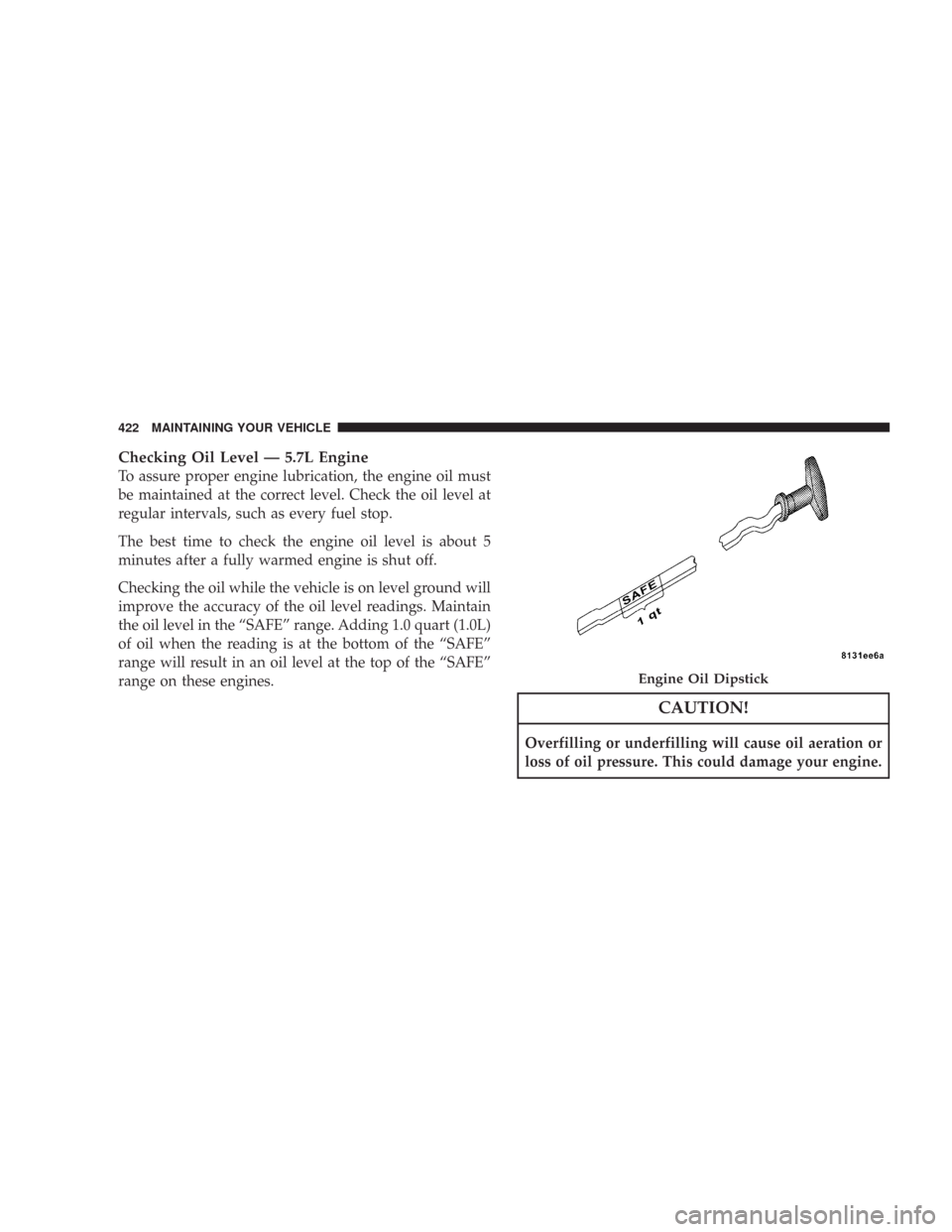
Checking Oil Level — 5.7L Engine
To assure proper engine lubrication, the engine oil must
be maintained at the correct level. Check the oil level at
regular intervals, such as every fuel stop.
The best time to check the engine oil level is about 5
minutes after a fully warmed engine is shut off.
Checking the oil while the vehicle is on level ground will
improve the accuracy of the oil level readings. Maintain
the oil level in the “SAFE” range. Adding 1.0 quart (1.0L)
of oil when the reading is at the bottom of the “SAFE”
range will result in an oil level at the top of the “SAFE”
range on these engines.
CAUTION!
Overfilling or underfilling will cause oil aeration or
loss of oil pressure. This could damage your engine.
Engine Oil Dipstick
422 MAINTAINING YOUR VEHICLE
Page 424 of 520

Change Engine Oil
The oil change indicator system will remind you that it is
time to take your vehicle in for scheduled maintenance.
Refer to “Maintenance Schedule” in Section 8 of this
manual for information on this system.
NOTE: Under no circumstances should oil change
intervals exceed 6,000 miles (10 000 km) or 6 months,
whichever occurs first.
Engine Oil Selection
For best performance and maximum protection under all
types of operating conditions, the manufacture only
recommends engine oils that are API certified and meet
the requirements of DaimlerChrysler Material Standard
MS-6395.
American Petroleum Institute (API) Engine Oil
Identification Symbol
This symbol means that the oil has
been certified by the American
Petroleum Institute (API). The
manufacture only recommends
API Certified engine oils.
Engine Oil Viscosity (SAE Grade) — 2.7L and 5.7L
Engines
SAE 5W-20 engine oil is recommended for all operating
temperatures. This engine oil improves low temperature
starting and vehicle fuel economy.
MAINTAINING YOUR VEHICLE 423
7
Page 425 of 520

The engine oil filler cap also shows the recommended
engine oil viscosity for your engine. For information on
engine oil filler cap location, refer to the “Engine Com-
partment” illustration in this section.
NOTE:Vehicles equipped with a 5.7L engine must use
SAE 5W-20 oil. Failure to do so may result in improper
operation of the Multiple Displacement System (MDS).
Refer to “Multi Displacement System” under “Starting
and Operating” for more details.
Lubricants, which do not have both, the engine oil
certification mark and the correct SAE viscosity grade
number should not be used.
Engine Oil Viscosity (SAE Grade) — 3.5L Engine
SAE 10W-30 engine oil is preferred for use in 3.5L
Engines for all operating temperatures.The engine oil filler cap also shows the recommended
engine oil viscosity for your engine. For information on
engine oil filler cap location, refer to the “Engine Com-
partment” illustration in this section.
Lubricants, which do not have both, the engine oil
certification mark and the correct SAE viscosity grade
number should not be used.
Synthetic Engine Oils
You may use synthetic engine oils provided the recom-
mended oil quality requirements are met, and the recom-
mended maintenance intervals for oil and filter changes
are followed.
Materials Added to Engine Oil
The manufacturer strongly recommends against the ad-
dition of any additives (other than leak detection dyes) to
the engine oil. Engine oil is an engineered product and its
performance may be impaired by supplemental addi-
tives.
424 MAINTAINING YOUR VEHICLE