heating CHRYSLER 300 C 2008 1.G User Guide
[x] Cancel search | Manufacturer: CHRYSLER, Model Year: 2008, Model line: 300 C, Model: CHRYSLER 300 C 2008 1.GPages: 520, PDF Size: 5.43 MB
Page 312 of 520
CAUTION!
Never race the engine with the brakes on and the
vehicle in gear, and never hold the vehicle on an
incline without applying the brakes. These practices
can cause overheating and damage to the
transmission.
Torque Converter Clutch
A feature designed to improve fuel economy has been
added to the automatic transmission of this vehicle. A
clutch within the torque converter engages automatically
at calibrated speeds. This may result in a slightly differ-
ent feeling or response during normal operation in high
gear. When the vehicle speed drops, or during accelera-
tion, the clutch automatically and smoothly disengages.NOTE:
•The torque converter clutch will not engage until the
transmission fluid and engine coolant is warm (usu-
ally after 1–3 miles [1.6–4.8 km] of driving). Because
engine speed is higher when the torque converter
clutch is not engaged, it may seem as if the transmis-
sion is not shifting into “Overdrive” when cold. This is
considered a normal condition. Pulling the selector
lever into the “3” position will show that the transmis-
sion is able to shift into and out of “Overdrive.”
•If the vehicle has not been driven for several days, the
first few seconds of operation after shifting the trans-
mission into gear may seem sluggish. This is due to the
transmission fluid partially draining from the torque
converter into the transmission. This is considered a
normal condition and it will not cause damage to the
transmission. The torque converter will refill within 5
seconds of shifting from “P” (Park) into any other gear
position.
STARTING AND OPERATING 311
5
Page 390 of 520

\25Extended driving at high RPM should be avoided to
prevent excess heat generation. A reduction in vehicle
speed may be required to avoid extended driving at
high RPM. Return to a higher gear range or vehicle
speed when road conditions and RPM level allows.
Towing Tips — Cooling System
To reduce potential for engine and transmission over-
heating, take the following actions:
\25City Driving
When stopped for short periods, put transmission in “N”
(Neutral) and increase engine idle speed.
\25Highway Driving
Reduce speed.
\25Air Conditioning
Turn off temporarily.
\25Refer to “Cooling System” under “Maintenance Pro-
cedures” in Section 7 of this manual for more informa-
tion.
RECREATIONAL TOWING (BEHIND
MOTORHOME, ETC.)
TOWING THIS VEHICLE BEHIND ANOTHER
VEHICLE (Flat towing with all four wheels on the
ground)
Recreational towing for this vehicle is not recommended.
NOTE:If the vehicle requires towing, make sure all four
wheels are off the ground.
STARTING AND OPERATING 389
5
Page 394 of 520

IF YOUR ENGINE OVERHEATS
In any of the following situations, you can reduce the
potential for overheating by taking the appropriate ac-
tion.
•On the highways — Slow down.
•In city traffic — While stopped, put transmission in
“N” (Neutral), but do not increase engine idle speed.
NOTE:There are steps that you can take to slow down
an impending overheat condition. If your air conditioner
is on, turn it off. The air conditioning system adds heat to
the engine cooling system and turning off the A/C
removes this heat. You can also turn the Temperature
control to maximum heat, the Mode control to floor, and
the fan control to HI. This allows the heater core to act as
a supplement to the radiator and aids in removing heat
from the engine cooling system.
CAUTION!
Driving with a hot cooling system could damage
your vehicle. If temperature gauge reads “H,” pull
over and stop the vehicle. Idle the vehicle with the air
conditioner turned off until the pointer drops back
into the normal range. If the pointer remains on the
“H,” turn the engine off immediately, and call for
service.
WHAT TO DO IN EMERGENCIES 393
6
Page 409 of 520

CAUTION!
•When “rocking” a stuck vehicle by moving be-
tween “First” and R (Reverse), do not spin the
wheels faster than 15 mph (24 km/h), or drivetrain
damage may result.
•Racing the engine or spinning the wheels too fast
may lead to transmission overheating and failure.
It can also damage the tires. Do not spin the
wheels above 35 mph (55 km/h).
WARNING!
Fast spinning tires can be dangerous. Forces gener-
ated by excessive wheel speeds may cause tire dam-
age or failure. A tire could explode and injure some-
one. Do not spin your vehicle’s wheels faster than 35
mph (55 km/h) when you are stuck, and don’t let
anyone near a spinning wheel, no matter what the
speed.
TOWING A DISABLED VEHICLE
WITHOUT THE IGNITION KEY
Special care must be taken when the vehicle is towed
with the ignition in the LOCK position. The only ap-
proved method of towing without the ignition key is
with a flat bed truck. Proper towing equipment is neces-
sary to prevent damage to the vehicle.
408 WHAT TO DO IN EMERGENCIES
Page 429 of 520
WARNING!
A hot exhaust system can start a fire if you park over
materials that can burn. Such materials might be
grass or leaves coming into contact with your exhaust
system. Do not park or operate your vehicle in areas
where your exhaust system can contact anything that
can burn.
In unusual situations involving grossly malfunctioning
engine operation, a scorching odor may indicate severe
and abnormal catalyst overheating. If this should occur,
safely bring the vehicle to a complete stop, shut the
engine off, and allow the vehicle to cool. Thereafter,
obtain service, including a tune-up to manufacturer’s
specifications immediately.To minimize the possibility of catalyst damage:•Do not shut off the engine or interrupt the ignition
when the transmission is in gear and the vehicle is in
motion.
•Do not try to start engine by pushing or towing the
vehicle.
•Do not idle the engine with any spark plug wires
disconnected or removed, such as when diagnostic
testing, or for prolonged periods during very rough
idling or malfunctioning operating conditions.
Maintenance-Free Battery
The top of the MAINTENANCE-FREE battery is perma-
nently sealed. You will never have to add water, nor is
periodic maintenance required.
NOTE:The battery is stored under an access cover in
the trunk. Remote battery terminals are located in the
engine compartment for jump-starting.
428 MAINTAINING YOUR VEHICLE
Page 502 of 520
Electrical Power Outlets................... 187
Electronic Brake Control System
Brake Assist System.................... 330
Electronic Stability Program............... 331
Traction Control System................. 328
Electronic Power Distribution Center (Fuses).... 451
Electronic Speed Control (Cruise Control)....148,152
Electronic Stability Program (ESP)............ 331
Electronic Throttle Control Warning Light...... 209
Electronic Vehicle Information Center (EVIC).... 213
Emergency Deck Lid Release................ 41
Emergency, In Case of
Freeing Vehicle When Stuck............... 407
Hazard Warning Flasher................. 392
Jacking............................. 394
Jump Starting......................... 404
Overheating.......................... 393
Towing............................. 408
Emergency Trunk Release................... 41Emission Control System Maintenance......418,478
Engine........................76,414,415,416
Air Cleaner.......................... 426
Block Heater......................... 303
Break-In Recommendations................ 76
Checking Oil Level..................421,422
Compartment...................414,415,416
Coolant (Antifreeze).................436,475
Cooling............................. 435
Exhaust Gas Caution..................78,368
Fails to Start.......................... 302
Flooded, Starting...................... 302
Fuel Requirements..................... 365
Jump Starting......................... 404
Multi-Displacement..................... 328
Oil ...........................421,473,475
Oil Change Interval...............203,218,423
Oil Filler Cap......................423,424
Oil Filter............................ 425
INDEX 501
10
Page 503 of 520
Oil Filter Disposal...................... 425
Oil Selection.......................423,473
Oil Synthetic......................... 424
Operation............................ 76
Overheating.......................... 393
Starting............................. 299
Temperature Gauge..................... 207
Engine Oil Viscosity...................423,424
Enhanced Accident Response Feature.......... 63
Entry System, Illuminated.................. 20
Ethanol............................... 366
Event Data Recorder...................... 65
Exhaust Gas Caution................78,368,435
Exhaust System.......................78,434
Exterior Folding Mirrors................... 88
Exterior Lighting........................ 130
Exterior Lights.......................... 79
Filler Location Fuel...................... 369Filters
Air Cleaner.......................... 426
Air Conditioning....................291,431
Engine Fuel.......................... 426
Engine Oil........................425,475
Engine Oil Disposal.................... 425
Flashers
Hazard Warning....................... 392
Turn Signal......................79,135,202
Flash-To-Pass........................... 136
Flat Tire Changing....................... 394
Flooded Engine Starting................... 302
Floor Console.......................... 190
Fluid, Brake........................... 476
Fluid Capacities......................... 473
Fluid Leaks............................. 80
Fluid Level Checks
Automatic Transmission................. 444
Brake............................... 443
502 INDEX
Page 510 of 520
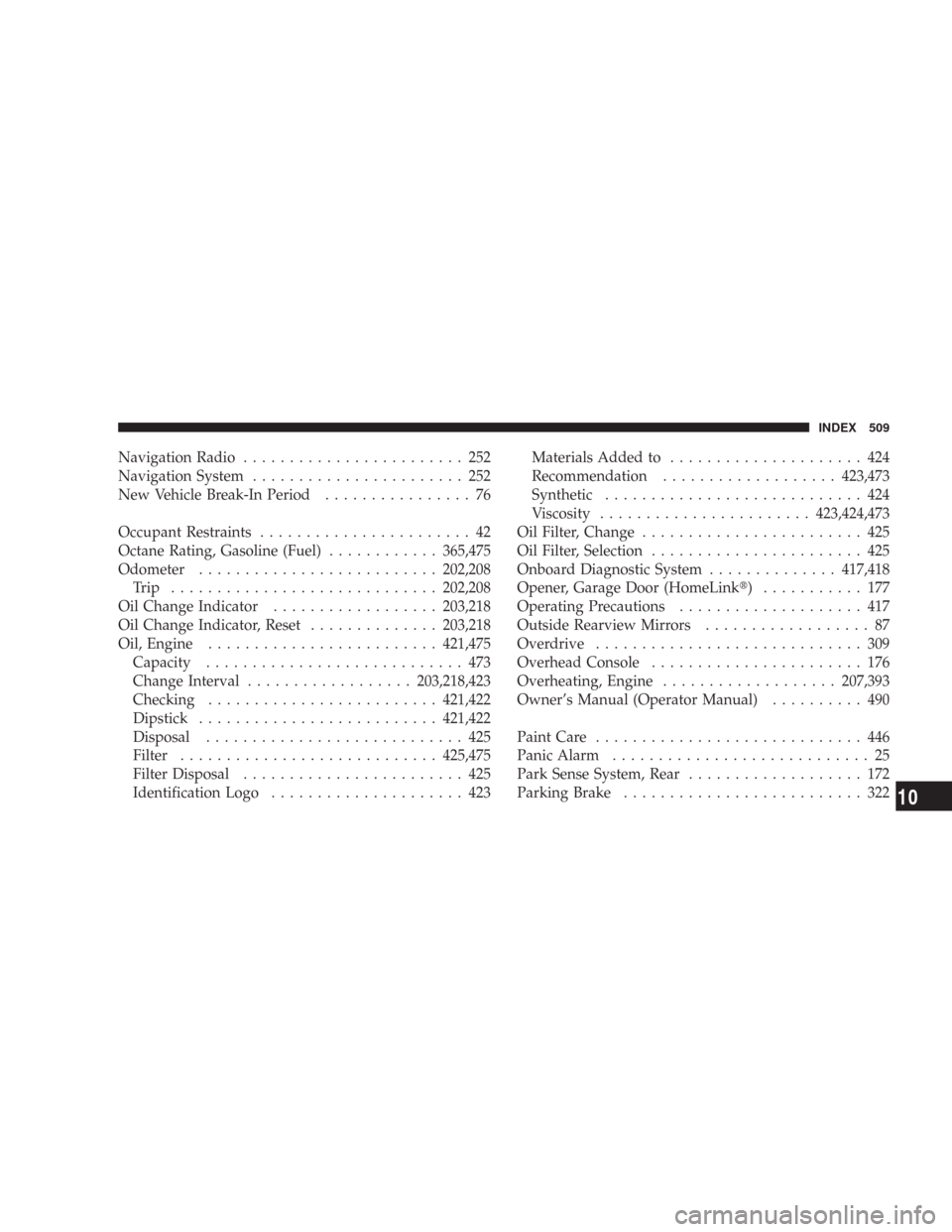
Navigation Radio........................ 252
Navigation System....................... 252
New Vehicle Break-In Period................ 76
Occupant Restraints....................... 42
Octane Rating, Gasoline (Fuel)............365,475
Odometer..........................202,208
Trip .............................202,208
Oil Change Indicator..................203,218
Oil Change Indicator, Reset..............203,218
Oil, Engine.........................421,475
Capacity............................ 473
Change Interval..................203,218,423
Checking.........................421,422
Dipstick..........................421,422
Disposal............................ 425
Filter............................425,475
Filter Disposal........................ 425
Identification Logo..................... 423Materials Added to..................... 424
Recommendation...................423,473
Synthetic............................ 424
Viscosity.......................423,424,473
Oil Filter, Change........................ 425
Oil Filter, Selection....................... 425
Onboard Diagnostic System..............417,418
Opener, Garage Door (HomeLink\2) ........... 177
Operating Precautions.................... 417
Outside Rearview Mirrors.................. 87
Overdrive............................. 309
Overhead Console....................... 176
Overheating, Engine...................207,393
Owner’s Manual (Operator Manual).......... 490
Paint Care............................. 446
Panic Alarm............................ 25
Park Sense System, Rear................... 172
Parking Brake.......................... 322
INDEX 509
10