automatic transmission CHRYSLER 300 C 2008 1.G Owner's Manual
[x] Cancel search | Manufacturer: CHRYSLER, Model Year: 2008, Model line: 300 C, Model: CHRYSLER 300 C 2008 1.GPages: 520, PDF Size: 5.43 MB
Page 381 of 520

Trailer Towing Weights (Maximum Trailer Weight
Ratings)
The following chart provides the maximum trailer
weight ratings towable for your given drivetrain.
Engine/Transmission Frontal Area Max. GTW
(Gross Trailer Wt.)Max. Tongue Wt.
2.7L & 3.5L Rear Wheel
Drive (RWD) Automatic22 SQ. FT.
(2.04 square meters)Up to 2 persons & Luggage
1,000 lbs (454 kg)100 lbs (45 kg)
22 SQ. FT.
(2.04 square meters)Up to 3 persons & Luggage
1,000 lbs (454 kg)100 lbs (45 kg)
22 SQ. FT.
(2.04 square meters)Up to 4 persons & Luggage
1,000 lbs (454 kg)100 lbs (45 kg)
22 SQ. FT.
(2.04 square meters)Up to 5 persons & NO Luggage
1,000 lbs (454 kg)100 lbs (45 kg)
380 STARTING AND OPERATING
Page 382 of 520

Engine/Transmission Frontal Area Max. GTW
(Gross Trailer Wt.)Max. Tongue Wt.
3.5L All Wheel Drive
(AWD) & 5.7L Automatic32 SQ. FT.
(2.97 square meters)Up to 2 persons & Luggage
2,000 lbs (907 kg)200 lbs (91 kg)
32 SQ. FT.
(2.97 square meters)Up to 3 persons & Luggage
2,000 lbs (907 kg)200 lbs (91 kg)
32 SQ. FT.
(2.97 square meters)Up to 4 persons & Luggage
1,500 lbs (680 kg)150 lbs (68 kg)
32 SQ. FT.
(2.97 square meters)Up to 5 persons & NO Luggage
1,000 lbs (454 kg)100 lbs (45 kg)
Refer to local laws for maximum trailer towing speeds.
NOTE:The trailer tongue weight must be considered as
part of the combined weight of occupants and cargo, and
it should never exceed the weight referenced on the “Tire
and Loading Information” placard. Refer to “Tire–Safety
Information” in this section.
Trailer and Tongue Weight
Always load a trailer with 60% to 65% of the weight in
the front of the trailer. This places 10% to 15% of the
Gross Trailer Weight (GTW) on the tow hitch of your
vehicle. Loads balanced over the wheels or heavier in the
rear can cause the trailer to swayseverelyside to side
STARTING AND OPERATING 381
5
Page 385 of 520

•Safety chains must always be used between your
vehicle and trailer. Always connect the chains to the
frame or hook retainers of the vehicle hitch. Cross the
chains under the trailer tongue and allow enough
slack for turning corners.
•Vehicles with trailers should not be parked on a grade.
When parking, apply the parking brake on the tow
vehicle. Put the tow vehicle automatic transmission in
P for Park. Always, block or\4chock\4the trailer wheels.
•GCWR must not be exceeded.
•Total weight must be distributed between the tow
vehicle and the trailer such that the following four
ratings are not exceeded:
1. GVWR
2. GTW
3. GAWR4. Tongue weight rating for the trailer hitch utilized
(This requirement may limit the ability to always
achieve the 10% to 15% range of tongue weight as a
percentage of total trailer weight).
Towing Requirements — Tires
\25
Do not attempt to tow a trailer while using a compact
spare tire.
\25Proper tire inflation pressures are essential to the safe
and satisfactory operation of your vehicle. Refer to
“Tires–General Information” in this section for infor-
mation on tire pressures and for proper tire inflation
procedures.
\25Also, check the trailer tires for proper tire inflation
pressures before trailer usage.
384 STARTING AND OPERATING
Page 389 of 520

Towing Tips
Before setting out on a trip, practice turning, stopping,
and backing the trailer in an area located away from
heavy traffic.
Towing Tips — Automatic Transmission
The “D” range can be selected when towing. However, if
frequent shifting occurs while in this range, the “3” range
should be selected.
NOTE:Using the “3” range while operating the vehicle
under heavy operating conditions will improve perfor-
mance and extend transmission life by reducing exces-
sive shifting and heat build up. This action will also
provide better engine braking.
If you REGULARLY tow a trailer for more than 45
minutes of continuous operation, then change the auto-
matic transamission fluid and filter according to the
interval specified for “police, taxi, fleet, or frequent trailer
towing” in the “Maintenance Schedule” in this manual.
Towing Tips — Electronic Speed Control (If
Equipped)
\25
Don’t use in hilly terrain or with heavy loads.
\25When using the speed control, if you experience speed
drops greater than 10 mph (16 km/h), disengage until
you can get back to cruising speed.
\25Use speed control in flat terrain and with light loads to
maximize fuel efficiency.
Towing Tips — Autostick\2(If Equipped)
\25
For vehicles equipped with Autostick.\2By using the
Autostick\2modes, and selecting a specific gear range,
frequent shifting can be avoided. The highest gear
range should be selected that allows for adequate
performance. For example, choose “4” if the desired
speed can be maintained. Choose “3” or “2” if needed
to maintain the desired speed.
388 STARTING AND OPERATING
Page 405 of 520

correct tightness of each lug nut is 100 ft/lb. (135 N. m).
If in doubt about the correct tightness, have them
checked with a torque wrench by your dealer or at a
service station.
7. For vehicles equipped with center caps, install the
center cap by hand. Do not use a hammer or excessive
force to install the center cap.
8. Stow the jack, tools, and spare tire. Make sure the base
of the jack faces the rear of the vehicle before tightening
down the fastener.
WARNING!
A loose tire or jack thrown forward in a collision or
hard stop could endanger the occupants of the ve-
hicle. Always stow the jack parts and the spare tire in
the places provided.
JUMP-STARTING PROCEDURES
WARNING!
•Take care to avoid the radiator cooling fan whenever the hood is
raised. It can start anytime the ignition switch is on. You can be hurt
by the fan.
•Do not attempt to push or tow your vehicle to get it started. Vehicles
equipped with an automatic transmission cannot be started this
way. Unburned fuel could enter the catalytic converter and once the
engine has started, ignite and damage the converter and vehicle. If
the vehicle has a discharged battery, booster cables may be used to
obtain a start from another vehicle. This type of start can be
dangerous if done improperly, so follow this procedure carefully.
•Battery fluid is a corrosive acid solution; do not allow battery fluid
to contact eyes, skin, or clothing. Don’t lean over battery when
attaching clamps or allow the clamps to touch each other. If acid
splashes in eyes or on skin, flush contaminated area immediately
with large quantities of water.
•A battery generates hydrogen gas, which is flammable and explo-
sive. Keep flame or spark away from the vent holes.
•Do not use a booster battery or any other booster source with an
output that exceeds 12 volts.
•The battery in this vehicle has a vent hose that should not be
disconnected and should only be replaced with a battery of the
same type (vented).
404 WHAT TO DO IN EMERGENCIES
Page 410 of 520

TOWING THIS VEHICLE BEHIND ANOTHER
VEHICLE (Flat towing with all four wheels on the
ground)
Flat towing of vehicles equipped with an automatic
transmission, is only permitted within the following
limitations:
With The Ignition Key
Your vehicle may be towed under the following condi-
tions: The gear selector must be in “N” (Neutral), the
distance to be traveled must not exceed 30 miles (48 km),
and the towing speed must not exceed 30 mph (48
km/h). Exceeding these towing limits may cause a trans-
mission geartrain failure. If the transmission is not op-
erative, or if the vehicle is to be towed more than 30 miles
(48 km), the vehicle must be transported using a flat bed
truck.
CAUTION!
•Do not attempt to tow this vehicle from the front
with sling type towing equipment. Damage to the
front fascia will result.
•If the transmission is not operative, or if the
vehicle is to be towed more than 30 miles (48 km),
then the only approved method of towing is with
a flat bed truck. Damage to the transmission may
result.
•Do not tow the vehicle from the rear. Damage to
the rear sheet metal, and fascia will occur.
•Do not push or tow this vehicle with another
vehicle as damage to the bumper fascia and trans-
mission may result.
WHAT TO DO IN EMERGENCIES 409
6
Page 413 of 520
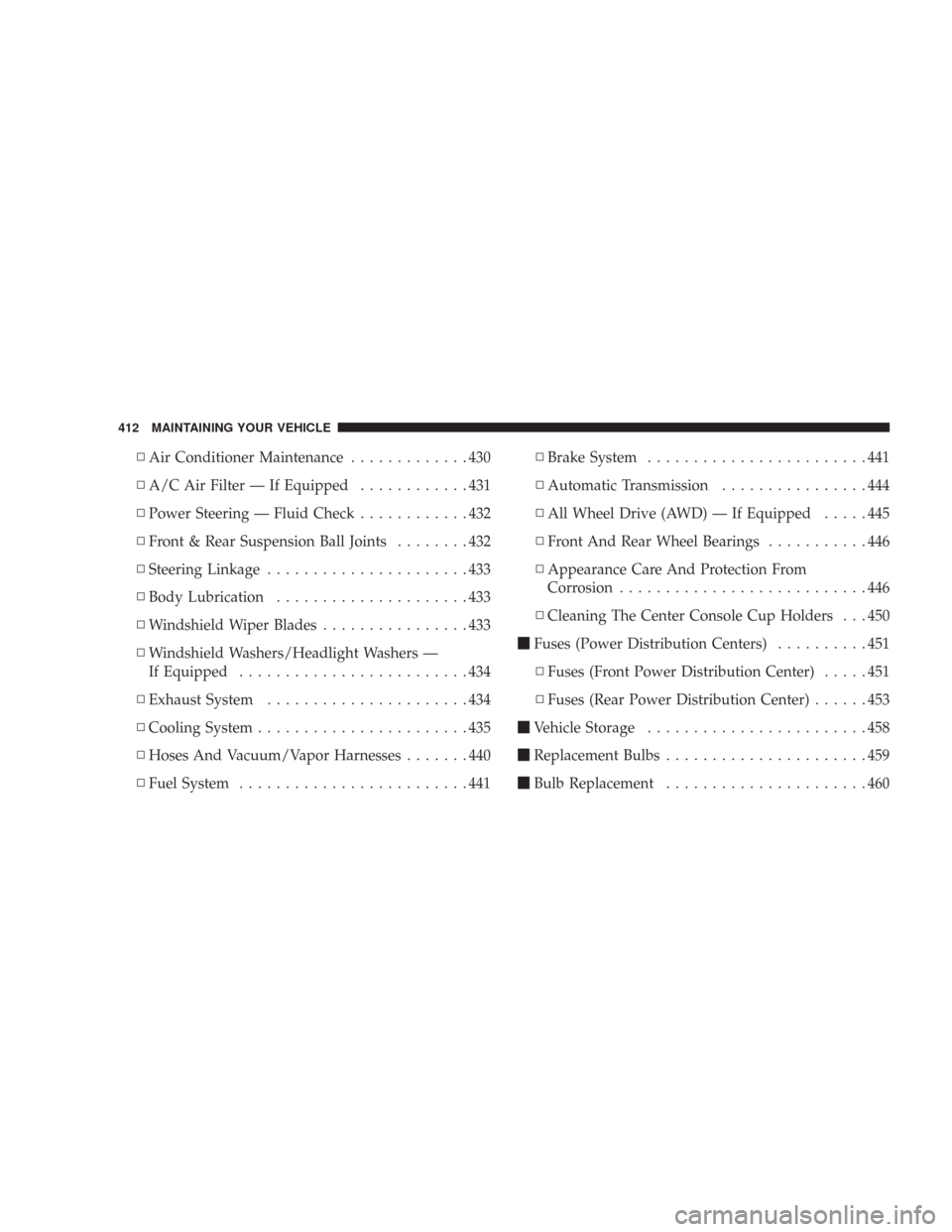
\3Air Conditioner Maintenance.............430
\3A/C Air Filter — If Equipped............431
\3Power Steering — Fluid Check............432
\3Front & Rear Suspension Ball Joints........432
\3Steering Linkage......................433
\3Body Lubrication.....................433
\3Windshield Wiper Blades................433
\3Windshield Washers/Headlight Washers —
If Equipped.........................434
\3Exhaust System......................434
\3Cooling System.......................435
\3Hoses And Vacuum/Vapor Harnesses.......440
\3Fuel System.........................441\3Brake System........................441
\3Automatic Transmission................444
\3All Wheel Drive (AWD) — If Equipped.....445
\3Front And Rear Wheel Bearings...........446
\3Appearance Care And Protection From
Corrosion...........................446
\3Cleaning The Center Console Cup Holders . . . 450
\1Fuses (Power Distribution Centers)..........451
\3Fuses (Front Power Distribution Center).....451
\3Fuses (Rear Power Distribution Center)......453
\1Vehicle Storage........................458
\1Replacement Bulbs......................459
\1Bulb Replacement......................460
412 MAINTAINING YOUR VEHICLE
Page 418 of 520

ONBOARD DIAGNOSTIC SYSTEM — OBD II
Your vehicle is equipped with a sophisticated onboard
diagnostic system called OBD II. This system monitors
the performance of the emissions, engine, and automatic
transmission control systems. When these systems are
operating properly, your vehicle will provide excellent
performance and fuel economy, as well as engine emis-
sions well within current government regulations.
If any of these systems require service, the OBD II system
will turn on the “Malfunction Indicator Light.” It will
also store diagnostic codes and other information to
assist your service technician in making repairs. Al-
though your vehicle will usually be drivable and not
need towing, see your dealer for service as soon as
possible.CAUTION!
Prolonged driving with the “Malfunction Indicator
Light” on could cause further damage to the emission
control system. It could also affect fuel economy and
driveability. The vehicle must be serviced before any
emissions tests can be performed.
If the “Malfunction Indicator Light” is flashing
while the engine is running, severe catalytic con-
verter damage and power loss will soon occur. Im-
mediate service is required.
Loose Fuel Filler Cap
If the vehicle diagnostic system determines that the fuel
filler cap is loose, improperly installed, or damaged, a
“Check Gascap” message will display in the Electronic
Vehicle Information Center (EVIC) — if equipped. If this
occurs, tighten the fuel filler cap properly and press the
MAINTAINING YOUR VEHICLE 417
7
Page 445 of 520

CAUTION!
Do not allow petroleum-base fluid to contaminate
the brake fluid. Seal damage may result.
Automatic Transmission
Fluid Level Check
Regular automatic transmission fluid level checks are not
required. For this reason, the dipstick is omitted.
If you notice fluid loss or gear shift malfunction, have
your authorized dealer check the transmission fluid level.
CAUTION!
•Using a transmission fluid other than the manu-
facturer’s recommended fluid may cause deterio-
ration in transmission shift quality and/or torque
converter shudder. Using a transmission fluid
other than that recommended by the manufacturer
will result in more frequent fluid and filter
changes. Refer to “Fluids, Lubricants, and Genu-
ine Parts” for the correct fluid type.
•The fluid level is preset at the factory and it does
not require adjustment under normal operating
conditions. If a transmission fluid leak occurs,
visit your authorized dealer immediately. Severe
damage to the transmission may occur. Your au-
thorized dealer has the proper tools to adjust the
fluid level accurately.
444 MAINTAINING YOUR VEHICLE
Page 446 of 520

Fluid and Filter Changes
Refer to the “Maintenance Schedule” in Section 8 of this
manual for the recommended transmission fluid and
filter change intervals.
If the transmission is disassembled for any reason, the
fluid and filter should be changed.
Special Additives
Automatic Transmission Fluid (ATF) is an engineered
product and its performance may be impaired by supple-
mental additives. Therefore, do not add any fluid addi-
tives to the transmission. The only exception to this
policy is the use of special dyes to aid in detecting fluid
leaks. In addition, avoid using transmission sealers as
they may adversely affect seals.
All Wheel Drive (AWD) — If Equipped
The all wheel drive system consists of a Transfer Case
and Front Differential. The exterior surface of these
components should be inspected for evidence of fluid
leaks. Confirmed leaks should be repaired as soon as
possible.
The transfer case fluid inspection plug is located in the
middle of the rear housing. To inspect the transfer case
fluid level, remove the inspection plug. The fluid level
should be even with the bottom of the hole. The transfer
case fill plug is located on the rear housing near the
output shaft.
The front differential fill plug is located on the outer
cover near the halfshaft attachment. To inspect the differ-
ential fluid level, remove the fill plug. The fluid level
should be even with or slightly below the bottom of the
hole.
MAINTAINING YOUR VEHICLE 445
7