maintenance CHRYSLER 300 C 2008 1.G Owner's Manual
[x] Cancel search | Manufacturer: CHRYSLER, Model Year: 2008, Model line: 300 C, Model: CHRYSLER 300 C 2008 1.GPages: 520, PDF Size: 5.43 MB
Page 412 of 520

MAINTAINING YOUR VEHICLE
CONTENTS
\12.7L Engine Compartment................414
\13.5L Engine Compartment................415
\15.7L Engine Compartment................416
\1Onboard Diagnostic System — OBD II........417
\3Loose Fuel Filler Cap..................417
\1Emissions Inspection And Maintenance
Programs............................418
\1Replacement Parts......................419
\1Dealer Service.........................420\1Maintenance Procedures..................420
\3Engine Oil..........................421
\3Engine Oil Filter......................425
\3Drive Belts — Check Condition And Tension . . 425
\3Spark Plugs.........................426
\3Engine Air Cleaner Filter................426
\3Fuel Filter..........................426
\3Catalytic Converter....................427
\3Maintenance-Free Battery................428
7
Page 413 of 520
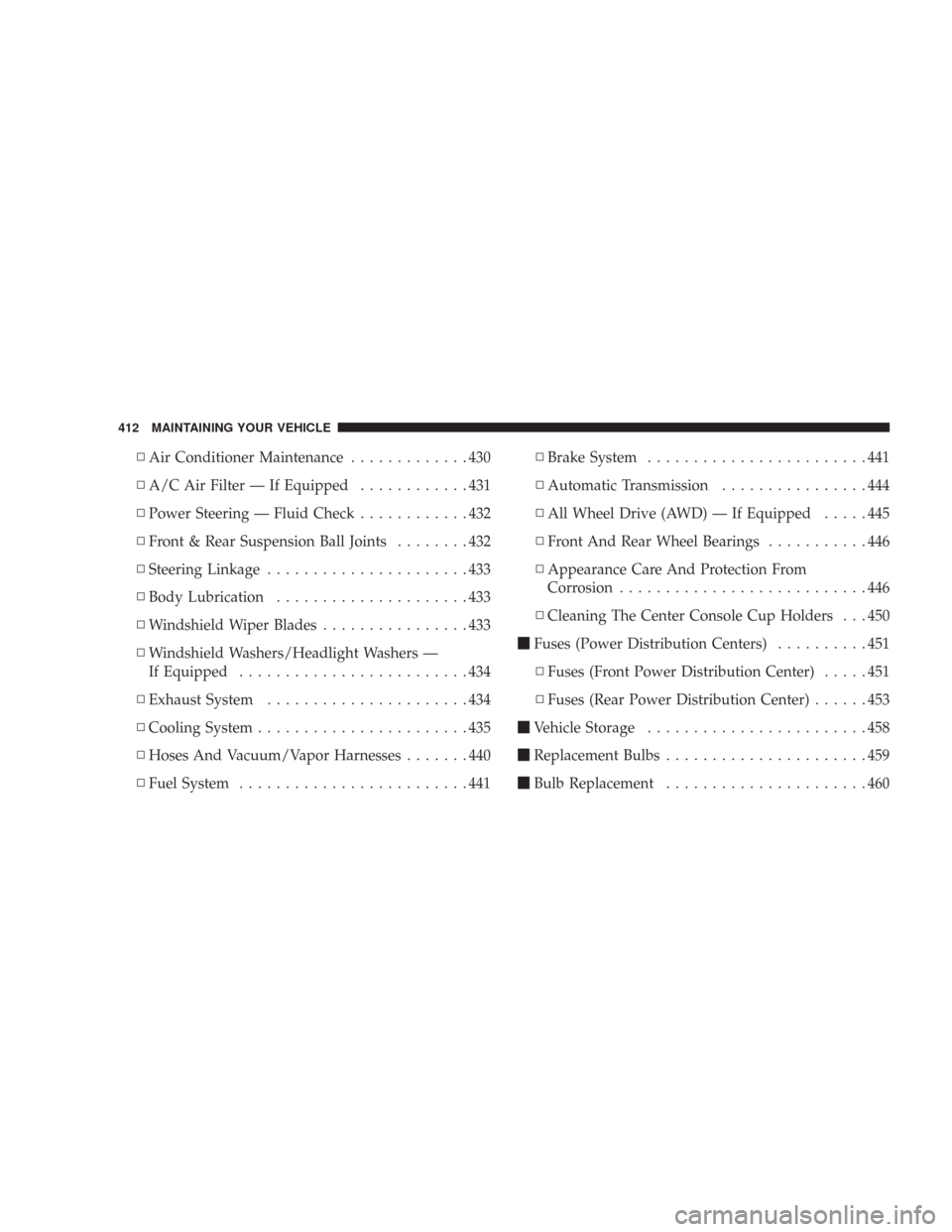
\3Air Conditioner Maintenance.............430
\3A/C Air Filter — If Equipped............431
\3Power Steering — Fluid Check............432
\3Front & Rear Suspension Ball Joints........432
\3Steering Linkage......................433
\3Body Lubrication.....................433
\3Windshield Wiper Blades................433
\3Windshield Washers/Headlight Washers —
If Equipped.........................434
\3Exhaust System......................434
\3Cooling System.......................435
\3Hoses And Vacuum/Vapor Harnesses.......440
\3Fuel System.........................441\3Brake System........................441
\3Automatic Transmission................444
\3All Wheel Drive (AWD) — If Equipped.....445
\3Front And Rear Wheel Bearings...........446
\3Appearance Care And Protection From
Corrosion...........................446
\3Cleaning The Center Console Cup Holders . . . 450
\1Fuses (Power Distribution Centers)..........451
\3Fuses (Front Power Distribution Center).....451
\3Fuses (Rear Power Distribution Center)......453
\1Vehicle Storage........................458
\1Replacement Bulbs......................459
\1Bulb Replacement......................460
412 MAINTAINING YOUR VEHICLE
Page 419 of 520

odometer reset button to turn off the message. If the
problem continues, the message will appear the next time
the vehicle is started.
A loose, improperly installed, or damaged fuel filler cap
may also turn on the Malfunction Indicator Light (MIL).
EMISSIONS INSPECTION AND MAINTENANCE
PROGRAMS
In some localities, it may be a legal requirement to pass
an inspection of your vehicle’s emissions control system.
Failure to pass could prevent vehicle registration.
For states, which have an I/M (Inspection and
Maintenance) requirement, this check verifies the
following: the MIL (Malfunction Indicator Light)
is functioning and is not on when the engine is running,
and that the OBD (On Board Diagnostic) system is ready
for testing.Normally, the OBD system will be ready. The OBD
system maynotbe ready if your vehicle was recently
serviced, if you recently had a dead battery, or a battery
replacement. If the OBD system should be determined
not ready for the I/M test, your vehicle may fail the test.
Your vehicle has a simple ignition key actuated test,
which you can use prior to going to the test station. To
check if your vehicle’s OBD system is ready, you must do
the following:
1. Insert your ignition key into the ignition switch.
2. Turn the ignition to the ON position, but do not crank
or start the engine.
3. If you crank or start the engine, you will have to start
this test over.
4. As soon as you turn your key to the ON position, you
will see your MIL symbol come on as part of a normal
bulb check.
418 MAINTAINING YOUR VEHICLE
Page 420 of 520

5. Approximately 15 seconds later, one of two things will
happen:
a. The MIL will flash for about 10 seconds and then
return to being fully illuminated until you turn off the
ignition key or start the engine. This means that your
vehicle’s OBD system isnot readyand you shouldnot
proceed to the I/M station.
b. The MIL will not flash at all and will remain fully
illuminated until you turn off the ignition key or start
the engine. This means that your vehicle’s OBD system
isreadyand you can proceed to the I/M station.
If your OBD system isnot ready,you should see your
authorized dealer or repair facility. If your vehicle was
recently serviced or had a battery failure or replacement,
you may need to do nothing more than drive your
vehicle as you normally would in order for your OBD
system to update. A recheck with the above test routine
may then indicate that the system is now ready.Regardless of whether your vehicle’s OBD system is
ready or not ready, if the MIL symbol is illuminated
during normal vehicle operation, you should have your
vehicle serviced before going to the I/M station. The I/M
station can fail your vehicle because the MIL symbol is on
with the engine running.
REPLACEMENT PARTS
Use of genuine Mopar\2parts for normal/scheduled
maintenance and repairs is highly recommended to in-
sure the designed performance. Damage or failures
caused by the use of non-Mopar\2parts for maintenance
and repairs will not be covered by the manufacturer’s
warranty.
MAINTAINING YOUR VEHICLE 419
7
Page 421 of 520

DEALER SERVICE
Your dealer has the qualified service personnel, special
tools, and equipment to perform all service operations in
an expert manner. Service Manuals are available which
include detailed service information for your vehicle.
Refer to these manuals before attempting any procedure
yourself.
NOTE:Intentional tampering with emissions control
systems can result in civil penalties being assessed
against you.WARNING!
You can be badly injured working on or around a
motor vehicle. Only do service work for which you
have the knowledge and the proper equipment. If
you have any doubt about your ability to perform a
service job, take your vehicle to a competent
mechanic.
MAINTENANCE PROCEDURES
The pages that follow contain therequiredmaintenance
services determined by the engineers who designed your
vehicle.
Besides the maintenance items for which there are fixed
maintenance intervals, there are other items that should
operate satisfactorily without periodic maintenance.
However, if a malfunction of these items does occur, it
could adversely affect the engine or vehicle performance.
420 MAINTAINING YOUR VEHICLE
Page 424 of 520

Change Engine Oil
The oil change indicator system will remind you that it is
time to take your vehicle in for scheduled maintenance.
Refer to “Maintenance Schedule” in Section 8 of this
manual for information on this system.
NOTE: Under no circumstances should oil change
intervals exceed 6,000 miles (10 000 km) or 6 months,
whichever occurs first.
Engine Oil Selection
For best performance and maximum protection under all
types of operating conditions, the manufacture only
recommends engine oils that are API certified and meet
the requirements of DaimlerChrysler Material Standard
MS-6395.
American Petroleum Institute (API) Engine Oil
Identification Symbol
This symbol means that the oil has
been certified by the American
Petroleum Institute (API). The
manufacture only recommends
API Certified engine oils.
Engine Oil Viscosity (SAE Grade) — 2.7L and 5.7L
Engines
SAE 5W-20 engine oil is recommended for all operating
temperatures. This engine oil improves low temperature
starting and vehicle fuel economy.
MAINTAINING YOUR VEHICLE 423
7
Page 425 of 520

The engine oil filler cap also shows the recommended
engine oil viscosity for your engine. For information on
engine oil filler cap location, refer to the “Engine Com-
partment” illustration in this section.
NOTE:Vehicles equipped with a 5.7L engine must use
SAE 5W-20 oil. Failure to do so may result in improper
operation of the Multiple Displacement System (MDS).
Refer to “Multi Displacement System” under “Starting
and Operating” for more details.
Lubricants, which do not have both, the engine oil
certification mark and the correct SAE viscosity grade
number should not be used.
Engine Oil Viscosity (SAE Grade) — 3.5L Engine
SAE 10W-30 engine oil is preferred for use in 3.5L
Engines for all operating temperatures.The engine oil filler cap also shows the recommended
engine oil viscosity for your engine. For information on
engine oil filler cap location, refer to the “Engine Com-
partment” illustration in this section.
Lubricants, which do not have both, the engine oil
certification mark and the correct SAE viscosity grade
number should not be used.
Synthetic Engine Oils
You may use synthetic engine oils provided the recom-
mended oil quality requirements are met, and the recom-
mended maintenance intervals for oil and filter changes
are followed.
Materials Added to Engine Oil
The manufacturer strongly recommends against the ad-
dition of any additives (other than leak detection dyes) to
the engine oil. Engine oil is an engineered product and its
performance may be impaired by supplemental addi-
tives.
424 MAINTAINING YOUR VEHICLE
Page 427 of 520

Spark Plugs
Spark plugs must fire properly to assure engine perfor-
mance and emission control. New plugs should be in-
stalled at the specified mileage. The entire set should be
replaced if there is any malfunction due to a faulty spark
plug. Malfunctioning spark plugs can damage the cata-
lytic converter. Refer to “Fluids, Lubricants, and Genuine
Parts” in this section for the proper type of spark plug for
use in your vehicle.
Engine Air Cleaner Filter
Refer to the “Maintenance Schedule” in Section 8 of this
manual for engine air cleaner filter maintenance inter-
vals.
NOTE:Be sure to follow the “dusty or off-road condi-
tions” maintenance interval if applicable.
WARNING!
The air induction system (air cleaner, hoses, etc) can
provide a measure of protection in the case of engine
backfire. Do not remove the air induction system (air
cleaner, hoses, etc) unless such removal is necessary
for repair or maintenance. Make sure that no one is
near the engine compartment before starting the
vehicle with the air induction system (air cleaner,
hoses, etc) removed. Failure to do so can result in
serious personal injury.
Fuel Filter
A plugged fuel filter can cause stalling, limit the speed at
which a vehicle can be driven or cause hard starting.
Should an excessive amount of dirt accumulate in the
fuel tank, filter replacement may be necessary. See your
authorized dealer for service.
426 MAINTAINING YOUR VEHICLE
Page 428 of 520

Catalytic Converter
The catalytic converter requires the use of unleaded fuel
only. Leaded gasoline will destroy the effectiveness of the
catalyst as an emission control device.
Under normal operating conditions, the catalytic con-
verter will not require maintenance. However, it is im-
portant to keep the engine properly tuned to assure
proper catalyst operation and prevent possible catalyst
damage.CAUTION!
Damage to the catalytic converter can result if your
vehicle is not kept in proper operating condition. In
the event of engine malfunction, particularly involv-
ing engine misfire or other apparent loss of perfor-
mance, have your vehicle serviced promptly. Contin-
ued operation of your vehicle with a severe
malfunction could cause the converter to overheat,
resulting in possible damage to the converter and the
vehicle.
NOTE:Intentional tampering with emissions control
systems can result in civil penalties being assessed
against you.
MAINTAINING YOUR VEHICLE 427
7
Page 429 of 520
WARNING!
A hot exhaust system can start a fire if you park over
materials that can burn. Such materials might be
grass or leaves coming into contact with your exhaust
system. Do not park or operate your vehicle in areas
where your exhaust system can contact anything that
can burn.
In unusual situations involving grossly malfunctioning
engine operation, a scorching odor may indicate severe
and abnormal catalyst overheating. If this should occur,
safely bring the vehicle to a complete stop, shut the
engine off, and allow the vehicle to cool. Thereafter,
obtain service, including a tune-up to manufacturer’s
specifications immediately.To minimize the possibility of catalyst damage:•Do not shut off the engine or interrupt the ignition
when the transmission is in gear and the vehicle is in
motion.
•Do not try to start engine by pushing or towing the
vehicle.
•Do not idle the engine with any spark plug wires
disconnected or removed, such as when diagnostic
testing, or for prolonged periods during very rough
idling or malfunctioning operating conditions.
Maintenance-Free Battery
The top of the MAINTENANCE-FREE battery is perma-
nently sealed. You will never have to add water, nor is
periodic maintenance required.
NOTE:The battery is stored under an access cover in
the trunk. Remote battery terminals are located in the
engine compartment for jump-starting.
428 MAINTAINING YOUR VEHICLE