radio CHRYSLER 300 C 2008 1.G Manual PDF
[x] Cancel search | Manufacturer: CHRYSLER, Model Year: 2008, Model line: 300 C, Model: CHRYSLER 300 C 2008 1.GPages: 520, PDF Size: 5.43 MB
Page 281 of 520
Vehicles equipped with steering wheel mounted buttons
are also equipped with the Electronic Vehicle Information
Center (EVIC). The EVIC features a driver-interactive
display. This is located in the upper part of the instru-
ment cluster between the speedometer and tachometer.
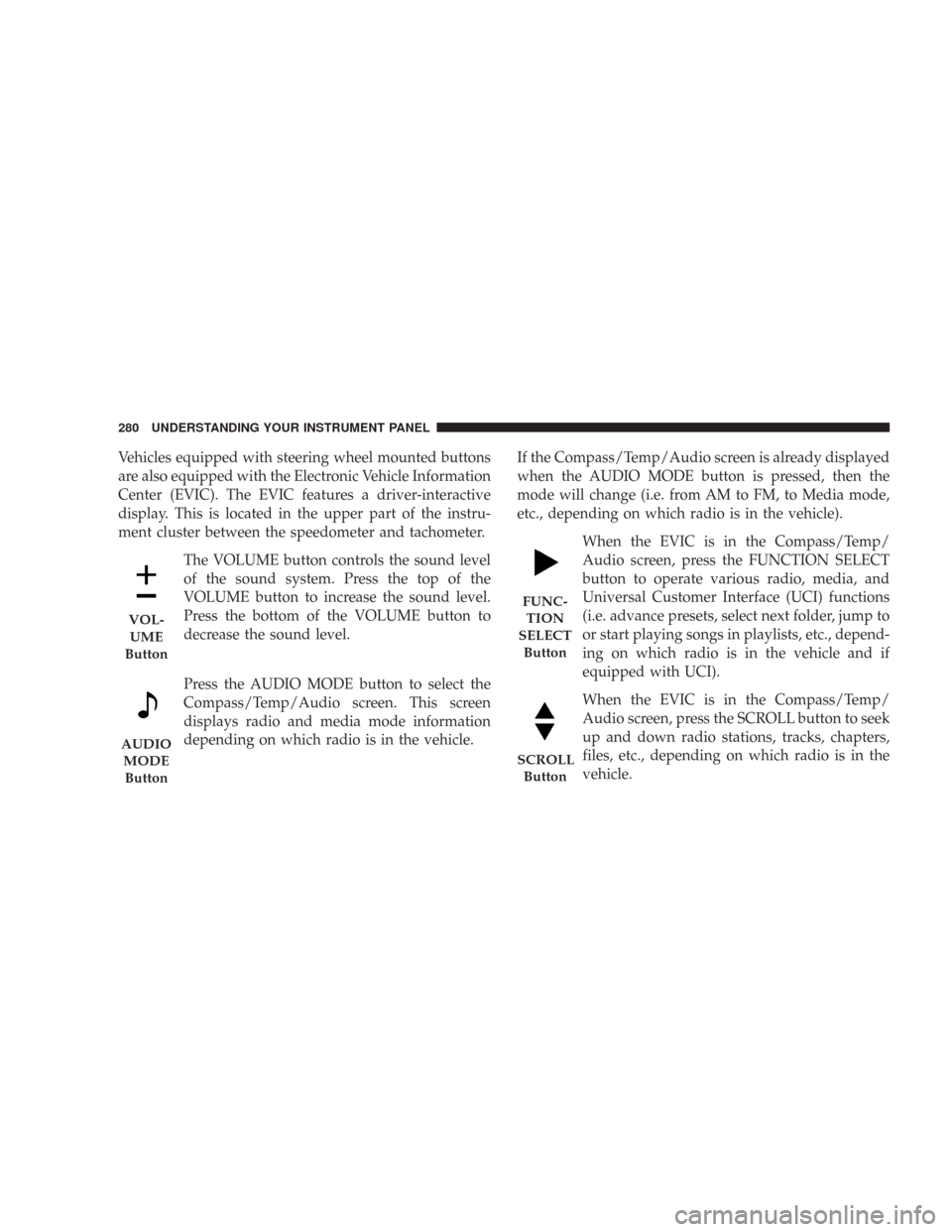
The VOLUME button controls the sound level
of the sound system. Press the top of the
VOLUME button to increase the sound level.
Press the bottom of the VOLUME button to
decrease the sound level.
Press the AUDIO MODE button to select the
Compass/Temp/Audio screen. This screen
displays radio and media mode information
depending on which radio is in the vehicle.If the Compass/Temp/Audio screen is already displayed
when the AUDIO MODE button is pressed, then the
mode will change (i.e. from AM to FM, to Media mode,
etc., depending on which radio is in the vehicle).
When the EVIC is in the Compass/Temp/
Audio screen, press the FUNCTION SELECT
button to operate various radio, media, and
Universal Customer Interface (UCI) functions
(i.e. advance presets, select next folder, jump to
or start playing songs in playlists, etc., depend-
ing on which radio is in the vehicle and if
equipped with UCI).
When the EVIC is in the Compass/Temp/
Audio screen, press the SCROLL button to seek
up and down radio stations, tracks, chapters,
files, etc., depending on which radio is in the
vehicle.
VOL-
UME
Button
AUDIO
MODE
Button
FUNC-
TION
SELECT
Button
SCROLL
Button
280 UNDERSTANDING YOUR INSTRUMENT PANEL
Page 282 of 520
CD/DVD DISC MAINTENANCE
To keep the CD/DVD discs in good condition, take the
following precautions:
1. Handle the disc by its edge; avoid touching the
surface.
2. If the disc is stained, clean the surface with a soft cloth,
wiping from center to edge.
3. Do not apply paper, paper CD labels, or tape to the
disc; avoid scratching the disc.
4. Do not use solvents such as benzine, thinner, cleaners,
or antistatic sprays.
5. Store the disc in its case after playing.
6. Do not expose the disc to direct sunlight.
7. Do not store the disc where temperatures may become
too high.
RADIO OPERATION AND CELLULAR PHONES
Under certain conditions, the cellular phone being On in
your vehicle can cause erratic or noisy performance from
your radio. This condition may be lessened or eliminated
by relocating the cellular phone antenna. This condition
is not harmful to the radio. If your radio performance
does not satisfactorily “clear” by the repositioning of the
antenna, it is recommended that the radio volume be
turned down or off during cellular phone operation.
CLIMATE CONTROLS
The Air Conditioning and Heating System is designed to
make you comfortable in all types of weather.
UNDERSTANDING YOUR INSTRUMENT PANEL 281
4
Page 327 of 520
WARNING!
•The Anti-Lock Brake System contains sophisticated electronic
equipment that may be susceptible to interference caused by
improperly installed or high output radio transmitting equip-
ment. This interference can cause possible loss of anti-lock
braking capability. Installation of such equipment should be
performed by qualified professionals.
•Pumping of the Anti-Lock Brakes will diminish their effective-
ness and may lead to an accident. Pumping makes the stopping
distance longer. Just press firmly on your brake pedal when you
need to slow down or stop.
•Anti-lock system (ABS) cannot prevent the natural laws of
physics from acting on the vehicle, nor can it increase braking or
steering efficiency beyond that afforded by the condition of the
vehicle brakes and tires or the traction afforded.
•The ABS cannot prevent accidents, including those resulting
from excessive speed in turns, following another vehicle too
closely, or hydroplaning. Only a safe, attentive, and skillful
driver can prevent accidents.
•The capabilities of an ABS equipped vehicle must never be
exploited in a reckless or dangerous manner, which could jeop-
ardize the user’s safety or the safety of others.
All vehicle wheels and tires must be the same size and
type and tires must be properly inflated to produce
accurate signals for the computer.
Anti-Lock Brake Light
The ABS light monitors the Anti-Lock Brake Sys-
tem. The light will come on when the ignition
switch is turned to the ON position and may stay on for
as long as four seconds.
If the ABS light remains on or comes on while driving, it
indicates that the Anti-Lock portion of the brake system
is not functioning and that service is required. However,
the conventional brake system will continue to operate
normally if the BRAKE warning light is not on.
If the ABS light is on, the brake system should be serviced
as soon as possible to restore the benefits of Anti-Lock
brakes. If the ABS light does not come on when the
Ignition switch is turned to the ON position, have the
bulb repaired as soon as possible.
326 STARTING AND OPERATING
Page 360 of 520

vehicle may need to be driven for up to 10 minutes above
15 mph (25 km/h) in order for the TPMS to receive this
information.
Check TPMS Warning
If a system fault is detected, the Tire Pressure Monitoring
Telltale Light will flash on and off for 75 seconds and then
remain on solid. The system fault will also sound a
chime. If the ignition key is cycled, this sequence will
repeat, providing the system fault still exists. The Tire
Pressure Monitoring Telltale Light will turn off when the
fault condition no longer exists. A system fault can occur
due to any of the following:
1. Signal interference due to electronic devices or driving
next to facilities emitting the same Radio Frequencies as
the TPM sensors.
2. Installing aftermarket window tinting that contains
materials, which may block radio wave signals.3. Accumulation of snow or ice around the wheels or
wheel housings.
4. Using tire chains on the vehicle.
5. Using wheels/tires not equipped with TPM sensors.
NOTE:
Vehicles with Full Size Spare
1. The matching full size spare wheel and tire assembly
has a tire pressure monitoring sensor that can be moni-
tored by the TPMS.
2. If you install the full size spare in place of a road tire
that has a pressure below the low-pressure warning limit,
upon the next ignition key cycle, a chime will sound and
the TPM Telltale Light will turn ON.
3. Driving the vehicle for up to 10 minutes above 15 mph
(25 km/h) will turn off the TPM Telltale Light, as long as
no tire pressure is below the low-pressure warning limit
in any of the four active road tires.
STARTING AND OPERATING 359
5
Page 364 of 520

1. Signal interference due to electronic devices or driving
next to facilities emitting the same Radio Frequencies as
the TPM sensors.
2. Installing aftermarket window tinting that contains
materials, which may block radio wave signals.
3. Accumulation of snow or ice around the wheels or
wheel housings.
4. Using tire chains on the vehicle.
5. Using wheels/tires not equipped with TPM sensors.
NOTE:
Vehicles with Full Size Spare
1. The matching full size spare wheel and tire assembly
has a tire pressure monitoring sensor that can be moni-
tored by the TPMS.
2. If you install the full size spare in place of a road tire
that has a pressure below the low-pressure warning limit,upon the next ignition key cycle, a chime will sound and
the TPM Telltale Light will turn ON. In addition, the
EVIC will display a Low Pressure message and a graphic
showing the low tire pressure value flashing.
3. After driving the vehicle for up to 10 minutes above 15
mph (25 km/h) the TPM Telltale Light will turn OFF, as
long as no tire pressure is below the low-pressure warn-
ing limit in any of the four active road tires.
NOTE:
Vehicles with Compact Spare
1. The compact spare tire does not have a tire pressure
monitoring sensor. Therefore, the TPMS will not monitor
the pressure in the compact spare tire.
2. If you install the compact spare tire in place of a road
tire that has a pressure below the low-pressure warning
limit, upon the next ignition key cycle, the TPM Telltale
STARTING AND OPERATING 363
5
Page 406 of 520

NOTE:The battery is stored under an access cover in
the trunk. Remote battery terminals are located in the
engine compartment for jump-starting.
1. Wear eye protection and remove any metal jewelry
such as watchbands or bracelets that might make an
inadvertent electrical contact.
2. When boost is provided by a battery in another
vehicle, park that vehicle within booster cable reach, but
do not allow the vehicles to touch one another.
WARNING!
Do not permit vehicles to touch each other as this
could establish a ground connection and personal
injury could result.3. Set the parking brake, place the automatic transmis-
sion in “P” (Park), and turn the ignition switch to the
LOCK position on both vehicles.
4. Turn off the heater, radio, and all unnecessary electri-
cal loads.
5. Connect one end of the jumper cable to the remote
jump-start positive battery post(+)in the engine com-
partment. Connect the other end of the same cable to the
positive terminal of the booster battery. Refer to the
following illustration for jump-starting connections.
6. Connect the other cable, first to the negative terminal
of the booster battery andthen to the engine ground (-)
of the vehicle with the discharged battery.Make sure
you have a good contact on the engine ground. Refer to
the following illustration for jump-starting connections.
WHAT TO DO IN EMERGENCIES 405
6
Page 451 of 520
quarter window equipped with the radio antenna. Do
not use scrapers or other sharp instruments, which may
scratch the elements.
When cleaning the rear view mirror, spray cleaner on the
towel or rag that you are using. Do not spray cleaner
directly on the mirror.
Cleaning Plastic Instrument Cluster Lenses
The lenses in front of the instruments in this vehicle are
molded in clear plastic. When cleaning the lenses, care
must be taken to avoid scratching the plastic.
1. Clean with a wet soft rag or micro-fiber towel. A mild
soap solution may be used, but do not use high alcohol
content or abrasive cleaners. If soap is used, wipe clean
with a clean damp rag.
2. Dry with a soft tissue.
Seat Belt Maintenance
Do not bleach, dye, or clean the belts with chemical
solvents or abrasive cleaners. This will weaken the fabric.
Sun damage can also weaken the fabric.
If the belts need cleaning, use Mopar\2Total Clean, a mild
soap solution, or lukewarm water. Do not remove the
belts from the vehicle to wash them.
Replace the belts if they appear frayed or worn or if the
buckles do not work properly.
Cleaning the Center Console Cup Holders
Clean with a damp cloth or towel using a mild detergent
with the cup holder in the center console.
NOTE:The cup holder cannot be removed.
450 MAINTAINING YOUR VEHICLE
Page 457 of 520

Cavity Car-
tridge
FuseMini
FuseDescription
29 — 5 Amp
OrangeAdaptive Cruise Control
(ACC) - if equipped/
Cluster/Electronic Sta-
bility Program (ESP) - if
equipped/Powertrain
Control Module (PCM)/
Stop Light Switch
30 — 10 Amp
RedDoor Modules/Power
Mirrors/Steering Con-
trol Module (SCM)
31———
32———
33———
34———Cavity Car-
tridge
FuseMini
FuseDescription
35 — 5 Amp
OrangeAntenna Module - if
equipped/Power
Mirrors/Rain Sensor - if
equipped
36 — 20 Amp
YellowHands Free Phone - if
equipped/Video Moni-
tor - if equipped/Radio
37 — 15 Amp
BlueTransmission
38 — 10 Amp
RedAnalog Clock/Cargo
Light/Satellite Receiver
(SDARS) Video - if
equipped/Vehicle Infor-
mation Module - if
equipped
456 MAINTAINING YOUR VEHICLE
Page 497 of 520

About Your Brakes....................322,324
ABS (Anti-Lock Brake System).............. 325
Adaptive Cruise Control (ACC) (Cruise Control) . . 152
Adding Engine Coolant (Antifreeze).......... 437
Adding Fuel........................... 369
Adding Washer Fluid...............141,143,434
Additives, Fuel......................... 367
Adjustable Pedals....................... 147
Air Cleaner, Engine (Engine Air Cleaner Filter) . . . 426
Air Conditioner Maintenance............... 430
Air Conditioning.....................282,284
Air Conditioning Controls................. 282
Air Conditioning Filter.................291,431
Air Conditioning, Operating Tips............ 292
Air Conditioning Refrigerant.............430,431
Air Conditioning System.............282,284,430
Air Pressure, Tires....................210,345
Airbag................................ 52
Airbag Deployment.....................58,62Airbag Light.....................59,64,79,205
Airbag Maintenance....................... 64
Airbag, Side..........................53,60
Airbag, Window (Side Curtain).............53,60
Alarm, Panic............................ 25
Alarm (Security Alarm).................18,209
Alarm System (Security Alarm)............... 18
Alignment and Balance................... 352
All Wheel Drive (AWD)................319,445
Alterations/Modifications, Vehicle............. 7
Antenna, Satellite Radio................... 269
Antifreeze (Engine Coolant)...........436,437,473
Disposal............................ 439
Anti-Lock Brake System (ABS).............. 325
Anti-Lock Warning Light...............204,326
Anti-Theft Security Alarm (Theft Alarm)........ 18
Anti-Theft System....................... 209
Appearance Care........................ 446
Arming Theft System (Security Alarm)......... 18
496 INDEX
Page 498 of 520
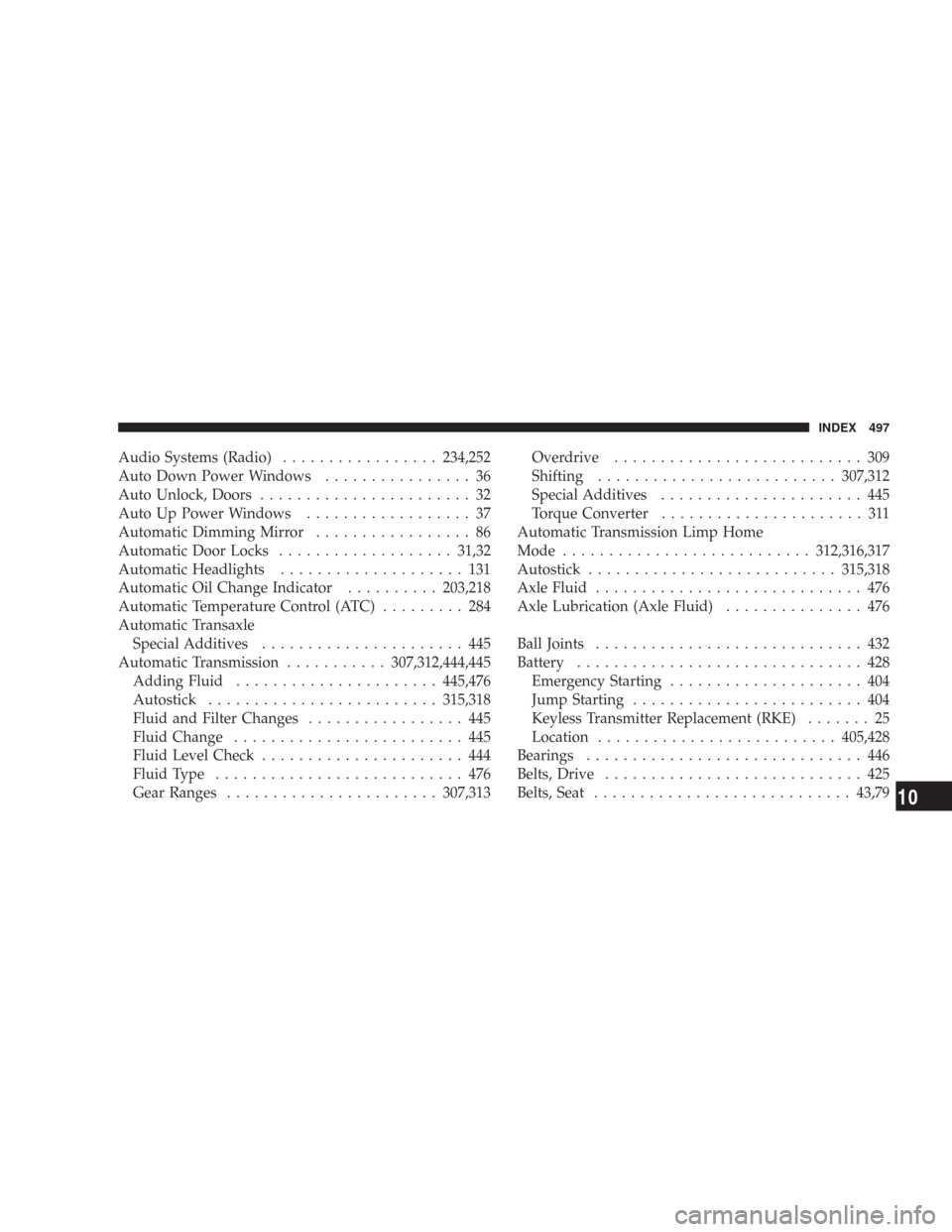
Audio Systems (Radio).................234,252
Auto Down Power Windows................ 36
Auto Unlock, Doors....................... 32
Auto Up Power Windows.................. 37
Automatic Dimming Mirror................. 86
Automatic Door Locks...................31,32
Automatic Headlights.................... 131
Automatic Oil Change Indicator..........203,218
Automatic Temperature Control (ATC)......... 284
Automatic Transaxle
Special Additives...................... 445
Automatic Transmission...........307,312,444,445
Adding Fluid......................445,476
Autostick.........................315,318
Fluid and Filter Changes................. 445
Fluid Change......................... 445
Fluid Level Check...................... 444
Fluid Type........................... 476
Gear Ranges.......................307,313Overdrive........................... 309
Shifting..........................307,312
Special Additives...................... 445
Torque Converter...................... 311
Automatic Transmission Limp Home
Mode...........................312,316,317
Autostick...........................315,318
Axle Fluid............................. 476
Axle Lubrication (Axle Fluid)............... 476
Ball Joints............................. 432
Battery............................... 428
Emergency Starting..................... 404
Jump Starting......................... 404
Keyless Transmitter Replacement (RKE)....... 25
Location..........................405,428
Bearings.............................. 446
Belts, Drive............................ 425
Belts, Seat............................43,79
INDEX 497
10