warning CHRYSLER 300 LX 2005 Owners Manual
[x] Cancel search | Manufacturer: CHRYSLER, Model Year: 2005, Model line: 300 LX, Model: CHRYSLER 300 LX 2005Pages: 374, PDF Size: 7.09 MB
Page 308 of 374
WARNING!
Riding the brakes can lead to brake failure and
possibly an accident. Driving with your foot resting
or riding on the brake pedal can result in abnormally
high brake temperatures, excessive lining wear, and
possible brake damage. You wouldn't have your full
braking capacity in an emergency.
Brake And Power Steering Hoses
When the vehicle is serviced for scheduled maintenance,
inspect surface of hoses and nylon tubing for evidence of
heat and mechanical damage. Hard and brittle rubber,
cracking, tears, cuts, abrasion, and excessive swelling
indicate deterioration of the rubber. Particular attention
should be made to examining those hose surfaces nearest
to high heat sources, such as the exhaust manifold.
Insure nylon tubing in these areas has not melted or
collapsed.Inspect all hose connections such as clamps and cou-
plings to make sure they are secure and no leaks are
present.
NOTE:Often, fluid such as oil, power steering fluid,
and brake fluid are used during assembly plant opera-
tions to facilitate the assembly of hoses to couplings.
Therefore, oil wetness at the hose-coupling area is not
necessarily an indication of leakage. Actual dripping of
hot fluid when systems are under pressure (during
vehicle operation), should be noted before a hose is
replaced based on leakage.
NOTE:Inspection of brake hoses should be performed
whenever the brake system is serviced and at every
engine oil change. Inspect hydraulic brake hoses for
surface cracking, scuffing, or worn spots. If there is any
evidence of cracking, scuffing, or worn spots, the hose
should be replaced immediately! Eventual deterioration
of the hose can take place resulting in a possibility of a
burst failure.
308 MAINTAINING YOUR VEHICLE
ProCarManuals.com
Page 309 of 374
WARNING!
Worn brake hoses can burst and cause brake failure.
You could have an accident. If you see any signs of
cracking, scuffing, or worn spots, have the brake
hoses replaced immediately.
Brake Fluid Level Check
The fluid level in the master cylinder should be checked
when performing underhood services, or immediately if
the brake system warning light indicates system failure.
Clean the top of the master cylinder area before removing
the cap. Add fluid to bring the level up to the top of the
ªFULLº mark on the side of the master cylinder reservoir.
Overfilling of fluid is not recommended because it may
cause leaking in the system.
Add enough fluid to bring the level up to the require-
ments described on the brake fluid reservoir. With disc
brakes, fluid level can be expected to fall as the brake
pads wear. However, low fluid level may be caused by a
leak and a checkup may be needed.Use only manufacturers recommended brake fluid, refer
to Recommended Fluids, Lubricants and Genuine Parts
for correct fluid type.
WARNING!
²Overfilling the brake fluid reservoir can result in
spilling brake fluid on hot engine parts and the
brake fluid catching fire.
²Use of a brake fluid that has a lower initial boiling
point than the recommended MOPAR DOT 3
product or a brake fluid that is unidentified as to
FMVSS specification may result in sudden brake
failure during hard prolonged braking. You could
have an accident.
Use only brake fluid that has been in a tightly closed
container to avoid contamination from foreign matter or
moisture.
MAINTAINING YOUR VEHICLE 309
7
ProCarManuals.com
Page 314 of 374
do not use polishes, oils, cleaning fluids, solvents, deter-
gents, or ammonia based cleaners to clean your leather
upholstery. Application of a leather conditioner is not
required to maintain the original condition.
WARNING!
Do not use volatile solvents for cleaning purposes.
Many are potentially flammable, and if used in
closed areas they may cause respiratory harm.
Glass Surfaces
All glass surfaces should be cleaned on a regular basis
with any commercial household-type glass cleaner.
Never use an abrasive type cleaner. Use caution when
cleaning the inside rear window equipped with electric
defrosters or the right rear quarter window equipped
with the radio antenna. Do not use scrapers or other
sharp instruments which may scratch the elements.
When cleaning the rear view mirror, spray cleaner on the
towel or rag that you are using. Do not spray cleaner
directly on the mirror.
Cleaning Plastic Instrument Cluster Lenses
The lenses in front of the instruments in this vehicle are
molded in clear plastic. When cleaning the lenses, care
must be taken to avoid scratching the plastic.
1. Clean with a wet soft rag. A mild soap solution may be
used, but do not use high alcohol content or abrasive
cleaners. If soap is used, wipe clean with a clean damp
rag.
2. Dry with a soft tissue.
Seat Belt Maintenance
Do not bleach, dye or clean the belts with chemical
solvents or abrasive cleaners. This will weaken the fabric.
Sun damage can also weaken the fabric.
If the belts need cleaning, use a mild soap solution or
lukewarm water. Do not remove the belts from the car to
wash them.
Replace the belts if they appear frayed or worn or if the
buckles do not work properly.
314 MAINTAINING YOUR VEHICLE
ProCarManuals.com
Page 324 of 374
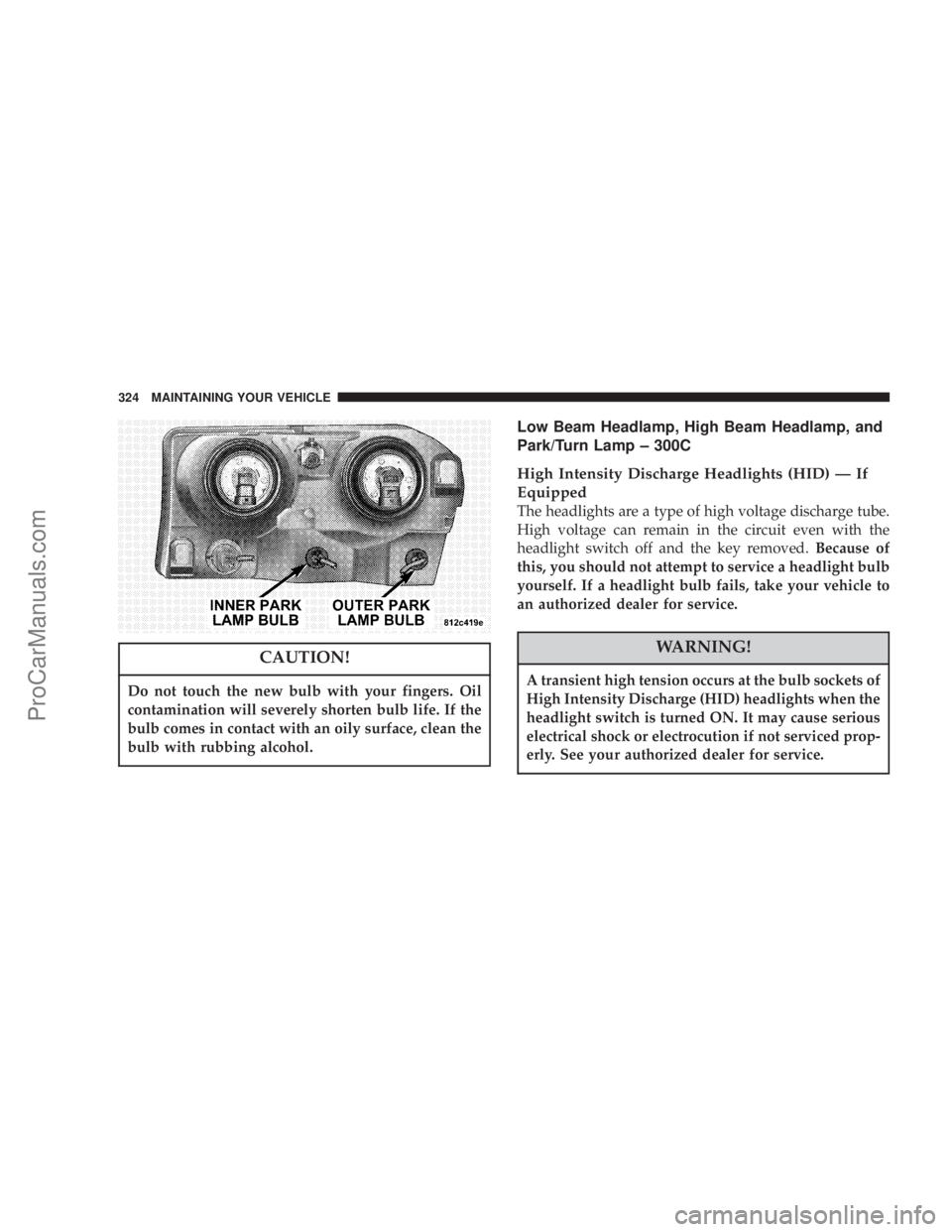
CAUTION!
Do not touch the new bulb with your fingers. Oil
contamination will severely shorten bulb life. If the
bulb comes in contact with an oily surface, clean the
bulb with rubbing alcohol.
Low Beam Headlamp, High Beam Headlamp, and
Park/Turn Lamp ± 300C
High Intensity Discharge Headlights (HID) Ð If
Equipped
The headlights are a type of high voltage discharge tube.
High voltage can remain in the circuit even with the
headlight switch off and the key removed.Because of
this, you should not attempt to service a headlight bulb
yourself. If a headlight bulb fails, take your vehicle to
an authorized dealer for service.
WARNING!
A transient high tension occurs at the bulb sockets of
High Intensity Discharge (HID) headlights when the
headlight switch is turned ON. It may cause serious
electrical shock or electrocution if not serviced prop-
erly. See your authorized dealer for service.
324 MAINTAINING YOUR VEHICLE
ProCarManuals.com
Page 350 of 374
![CHRYSLER 300 LX 2005 Owners Manual Miles 78,000 84,000 90,000 96,000 100,000 102,000
(Kilometers) (125 000) (134 000) (144 000) (154 000) (160 000) (163 000)
[Months] [78] [84] [90] [96] [102]
Flush and replace the engine coolant at 60](/img/25/57726/w960_57726-349.png "CHRYSLER 300 LX 2005 Owners Manual Miles 78,000 84,000 90,000 96,000 100,000 102,000
(Kilometers) (125 000) (134 000) (144 000) (154 000) (160 000) (163 000)
[Months] [78] [84] [90] [96] [102]
Flush and replace the engine coolant at 60")
Miles 78,000 84,000 90,000 96,000 100,000 102,000
(Kilometers) (125 000) (134 000) (144 000) (154 000) (160 000) (163 000)
[Months] [78] [84] [90] [96] [102]
Flush and replace the engine coolant at 60
months or 102,000 miles.X
Replace the air conditioning filter. X X
Rotate the tires. X X X X X
* This maintenance is recommended by the manufacture
to the owner but is not required to maintain the emis-
sions warranty.
³ This maintenance is not required if previously replaced.
Inspection and service should also be performed anytime
a malfunction is observed or suspected. Retain all re-
ceipts.
WARNING!
You can be badly injured working on or around a
motor vehicle. Do only that service work for which
you have the knowledge and the right equipment. If
you have any doubt about your ability to perform a
service job, take your vehicle to a competent me-
chanic.
350 SCHEDULE ªAº
8
M
A
I
N
T
E
N
A
N
C
E
S
C
H
E
D
U
L
E
S
ProCarManuals.com
Page 358 of 374

DEPARTMENT OF TRANSPORTATION UNIFORM
TIRE QUALITY GRADES
The following describes the tire grading categories estab-
lished by the National highway Traffic Safety Adminis-
tration. The specific grade rating assigned by the tire's
manufacturer in each category is shown on the sidewall
of the tires on your car.
All Passenger Car Tires Must Conform to Federal Safety
Requirements in Addition to These Grades.
Treadwear
The treadwear grade is a comparative rating based on the
wear rate of the tire when tested under controlled con-
ditions on a specified government test course. For ex-
ample, a tire graded 150 would wear one and a half (1
1/2) times as well on the government course as a tire
graded 100. The relative performance of tires depends
upon the actual conditions of their use, however, and
may depart significantly from the norm due to variations
in driving habits, service practices and differences in road
characteristics and climate.
Traction Grades
The traction grades, from highest to lowest, are A, B, and
C, and they represent the tire's ability to stop on wet
pavement as measured under controlled conditions on
specified government test surfaces of asphalt and con-
crete. A tire marked C may have poor traction perfor-
mance.
WARNING!
The traction grade is based on braking (straight-
ahead) traction tests and does not include cornering
(turning) performance.
358 IF YOU NEED CONSUMER ASSISTANCE
ProCarManuals.com
Page 359 of 374
Temperature Grades
The temperature grades are A (highest), B, and C, repre-
senting the tire's resistance to the generation of heat and
its ability to dissipate heat when tested under controlled
conditions on a specified indoor laboratory test wheel.
Sustained high temperature can cause the material of the
tire to degenerate and reduce tire life, and excessive
temperature can lead to sudden tire failure. The grade C
corresponds to a level of performance which all passen-
ger car tires must meet under the Federal Motor Vehicle
Safety Standard No. 109. Grades B and A represent
higher levels of performance on the laboratory test wheel
than the minimum required by law.WARNING!
The temperature grade is established for a tire that is
properly inflated and not overloaded. Excessive
speed, underinflation, or excessive loading, either
separately or in combination, can cause heat buildup
and possible tire failure.
IF YOU NEED CONSUMER ASSISTANCE 359
9
ProCarManuals.com
Page 362 of 374

Adding Fuel.......................... 254
Adding Washer Fluid.................108,302
Additives, Fuel........................ 253
Adjustable Pedals....................... 98
Air Conditioner Maintenance.............. 299
Air Conditioning....................... 194
Air Conditioning Filter................203,300
Air Conditioning, Operating Tips........... 204
Air Conditioning Refrigerant.............. 299
Air Conditioning System................. 194
Air Pressure, Tires...................... 237
Airbag................................ 37
Airbag Deployment....................41,42
Airbag Light....................41,48,58,142
Airbag Maintenance...................... 44
Airbag, Side........................... 43
Airbag, Window......................37,43
Alarm System.......................... 24
Alignment and Balance.................. 242
Alterations/Modifications, Vehicle............ 7
Antenna, Satellite Radio.................. 189
Antifreeze Disposal..................... 306
Antifreeze (Engine Coolant).........304,305,332Anti-Lock Brake System.................. 225
Anti-Lock Warning Light................. 141
Anti-Theft Security Alarm................. 24
Appearance Care....................... 311
Auto Down Power Windows............... 26
Auto Up Power Windows................. 26
Automatic Dimming Mirror................ 65
Automatic Door Locks..................17,18
Automatic Headlights................... 104
Automatic Temperature Control............ 197
Automatic Transaxle..................... 310
Adding Fluid........................ 334
Selection Of Lubricant................. 334
Automatic Transmission............209,214,311
Adding Fluid........................ 311
Fluid and Filter Changes................ 311
Fluid Change........................ 311
Fluid Level Check..................... 310
Gear Ranges......................... 210
Torque Converter..................... 212
Automatic Transmission Limp Home Mode . . . 213
Autostick..........................216,222
362 INDEX
ProCarManuals.com
Page 363 of 374

Ball Joints............................ 301
Battery............................... 297
Jump Starting........................ 273
Keyless Transmitter Replacement.......... 23
Location.........................274,298
Bearings.............................. 311
Belts, Drive........................... 295
Body Mechanism Lubrication.............. 301
B-Pillar Location....................... 232
Brake Assist System..................... 112
Brake, Parking......................... 222
Brake System.......................224,307
Anti-Lock........................... 225
Fluid Check......................309,334
Hoses.............................. 308
Warning Light....................... 142
Brake/Transmission Interlock.............. 221
Break-In Recommendations, New Vehicle...... 57
Bulb Replacement...................... 323
Bulbs, Light........................... 322
Calibration, Compass.................... 151
Capacities, Fluid....................... 332Caps, Filler
Fuel............................... 254
Radiator............................ 305
Car Washes........................... 312
Carbon Monoxide Warning............... 253
Cargo Tie-Downs....................... 131
Cassette Tape and Player Maintenance....... 192
Catalytic Converter..................... 296
CD Player......................159,164,175
Cellular Phone.......................... 68
Chains, Tire........................... 248
Changing A Flat Tire.................... 265
Chart, Tire Sizing....................... 229
Child Restraint...................50,52,54,55
Child Restraint Tether Anchors............. 54
Child Safety Locks....................... 19
Clean Air Gasoline...................... 251
Climate Control........................ 194
Clock................................ 158
Compact Disc Maintenance............... 193
Compact Spare Tire..................... 239
Compass............................. 150
Compass Calibration.................... 151
INDEX 363
10
ProCarManuals.com
Page 365 of 374

Emergency, In Case of
Overheating......................... 264
Emission Control System Maintenance....288,336
Engine............................285,286
Air Cleaner.......................... 296
Air Cleaner Filter..................... 295
Block Heater......................... 209
Break-In Recommendations............... 57
Checking Oil Level.................290,291
Compartment.....................285,286
Coolant............................ 333
Cooling............................ 303
Exhaust Gas Caution.................. 253
Fails to Start......................... 208
Fuel Requirements.................250,332
Oil ..........................290,332,333
Oil Change Interval................... 292
Oil Selection......................292,332
Oil Synthetic......................... 294
Overheating......................... 264
Temperature Gauge................... 143
Enhanced Accident Response Feature......... 43
Event Data Recorder..................... 48Exhaust Gas Caution...............58,253,303
Exhaust System........................ 302
Exterior Folding Mirrors.................. 66
Filters
Air Cleaner.......................... 295
Air Conditioning..................203,300
Engine Fuel......................... 296
Engine Oil.......................295,333
Engine Oil Disposal................... 294
Flashers
Hazard Warning...................... 264
Turn Signal.......................... 140
Flash-To-Pass.......................... 106
Flat Tire Changing...................... 265
Floor Console.......................... 130
Fluid Capacities........................ 332
Fluid Leaks............................ 59
Fluid Level Checks
Brake.............................. 334
Power Steering....................300,334
Fog Lights.........................105,140
Folding Rear Seat....................... 97
INDEX 365
10
ProCarManuals.com