engine oil CHRYSLER 300 LX 2005 User Guide
[x] Cancel search | Manufacturer: CHRYSLER, Model Year: 2005, Model line: 300 LX, Model: CHRYSLER 300 LX 2005Pages: 374, PDF Size: 7.09 MB
Page 292 of 374
CAUTION!
Operating the engine with the oil levels below the
safe zone, or operating with oil levels that exceed the
top of the safe zone by 25% may cause engine
damage.
Change Engine Oil
Road conditions and your kind of driving affects the
interval at which your oil should be changed. Check the
following list to see if any apply to you.
²Day or night temperatures are below 32ÉF (0ÉC).
²Stop and Go driving.
²Extensive engine idling.
²Driving in dusty conditions.
²Short trips of less than 10 miles (16 km).
²More than 50% of your driving is at sustained high
speeds during hot weather, above 90ÉF (32ÉC).
²Trailer towing.
²Taxi, Police or delivery service (commercial service).
²Off-Road or desert operation.
NOTE:IfANYof these apply to you then change your
engine oil every 3,000 miles (5 000 km) or 3 months,
whichever comes first and follow schedule ªBº of the
9Maintenance Schedules9section of this manual.
If none of these apply to you, then change your engine oil
at every interval shown on schedule9A9of the9Mainte-
nance Schedules9section of this manual.
NOTE:Under no circumstances should oil change
intervals exceed 6000 miles (10 000 km) or 6 months
whichever comes first.
Engine Oil Selection
For best performance and maximum protection under all
types of operating conditions, the manufacture only
recommends engine oils that are API certified and meet
the requirements of DaimlerChrysler Material Standard
MS-6395. Use Mopar or an equivalent oil meeting the
specification MS-6395.
292 MAINTAINING YOUR VEHICLE
ProCarManuals.com
Page 293 of 374
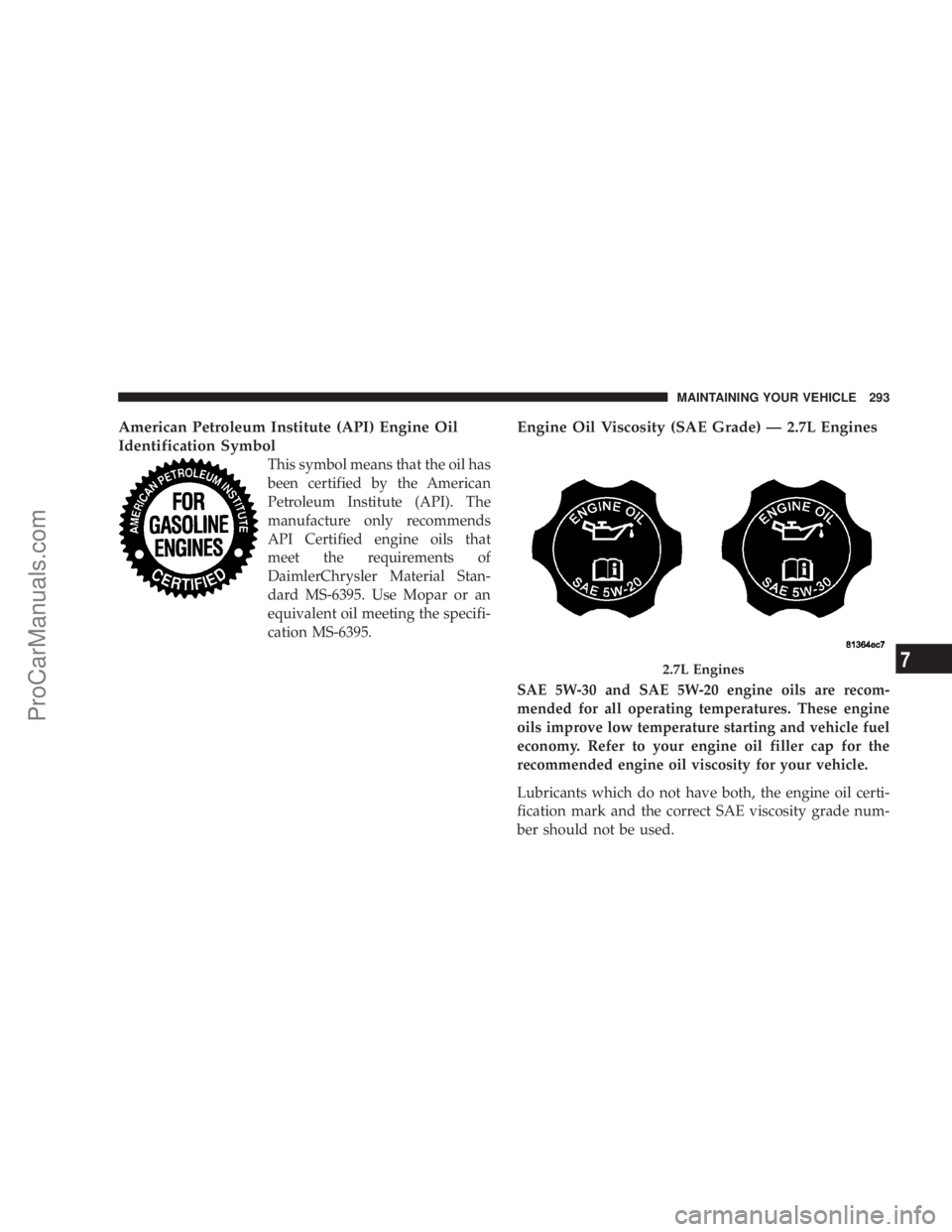
American Petroleum Institute (API) Engine Oil
Identification Symbol
This symbol means that the oil has
been certified by the American
Petroleum Institute (API). The
manufacture only recommends
API Certified engine oils that
meet the requirements of
DaimlerChrysler Material Stan-
dard MS-6395. Use Mopar or an
equivalent oil meeting the specifi-
cation MS-6395.
Engine Oil Viscosity (SAE Grade) Ð 2.7L Engines
SAE 5W-30 and SAE 5W-20 engine oils are recom-
mended for all operating temperatures. These engine
oils improve low temperature starting and vehicle fuel
economy. Refer to your engine oil filler cap for the
recommended engine oil viscosity for your vehicle.
Lubricants which do not have both, the engine oil certi-
fication mark and the correct SAE viscosity grade num-
ber should not be used.
2.7L Engines
MAINTAINING YOUR VEHICLE 293
7
ProCarManuals.com
Page 294 of 374

Engine Oil Viscosity Chart Ð 3.5L Engines
SAE 10W-30 engine oil is preferred for use in 3.5L
Engines within the operating temperatures shown in the
engine oil viscosity chart. SAE 5W-30 Engine Oil is
allowed for use in the 3.5L Engine during cold weather
only to improve cold weather starting.
Lubricants which do not have both, the engine oil certi-
fication mark and the correct SAE viscosity grade num-
ber should not be used.
Engine Oil Viscosity (SAE Grade) Ð 5.7L Engines
The recommended engine oil viscosity for vehicles
equipped with the 5.7L engine is SAE 5W-20.
NOTE:Engine oils higher in viscosity may reduce fuel
economy in vehicles equipped with 5.7L engines.
Synthetic Engine Oils
You may use synthetic engine oils provided that the
recommended oil quality requirements are met and the
recommended maintenance intervals for oil and filter
changes are followed.
Materials Added to Engine Oil
The manufacture strongly recommends against the addi-
tion of any additives (other than leak detection dyes) to
the engine oil. Engine oil is an engineered product and
it's performance may be impaired by supplemental ad-
ditives.
Disposing of Used Engine Oil And Oil Filters
Care should be taken in disposing of used engine oil and
oil filters from your vehicle. Used oil and oil filters,
indiscriminately discarded, can present a problem to the
environment. Contact your dealer, service station, or
3.5L Engines
294 MAINTAINING YOUR VEHICLE
ProCarManuals.com
Page 295 of 374

governmental agency for advice on how and where used
oil and oil filters can be safely discarded in your area.
Engine Oil Filter
The engine oil filter should be replaced at every engine
oil change.
Engine Oil Filter Selection
This manufacture's engines have a full-flow type oil filter.
Use a filter of this type for replacement. The quality of
replacement filters varies considerably. Only high quality
filters should be used to assure most efficient service.
Mopar Engine Oil Filters are a high quality oil filter and
are recommended.
Drive Belts Ð Check Condition and Tensioner
Belt tension is controlled by means of an automatic
tensioner. No belt tension adjustments are required.
However, belt and belt tensioner condition should be
inspected at the specified intervals, and replaced if re-
quired. See your authorized dealer for service.
At the mileage indicated in the maintenance schedule, all
belts and tensioner should be checked for condition.
Improper belt tension can cause belt slippage and failure.Belts should be inspected for evidence of cuts, cracks,
glazing, or frayed cords and replaced if there is indication
of damage which could result in belt failure. Low gen-
erator belt tension can cause battery failure.
Also check belt routing to make sure there is no interfer-
ence between the belts and other engine components.
Spark Plugs
Spark plugs must fire properly to assure engine perfor-
mance and emission control. New plugs should be in-
stalled at the specified mileage. The entire set should be
replaced if there is any malfunction due to a faulty spark
plug. Malfunctioning spark plugs can damage the cata-
lytic converter. For proper type of replacement spark
plugs, refer to the ªVehicle Emission Control Informa-
tionº label in the engine compartment.
Engine Air Cleaner Filter
Under normal driving conditions, replace the air filter at
the intervals shown on Schedule ªAº. If, however, you
drive the vehicle frequently under dusty or severe con-
ditions, the filter element should be inspected periodi-
cally and replaced if necessary at the intervals shown on
Schedule ªBº.
MAINTAINING YOUR VEHICLE 295
7
ProCarManuals.com
Page 300 of 374
NOTE:NOTE: Air Conditioning systems found to be
contaminated with A/C System Sealers, Stop Leak Prod-
ucts, Seal Conditioners, Compressor Oil, or Refrigerants
not approved by the manufacturer, voids the warranty
for the Air Conditioning system.
A/C Air Filter
The filter is located in the fresh air inlet under the hood,
behind a removable panel in the cowl on the passenger
side of the vehicle, next to the windshield wipers. When
installing a new filter, ensure its proper orientation. To
replace the filter remove the access door in the cowl
screen by pressing the retaining clips. Slide the lid on the
filter adapter forward and down and remove used filter.
Install new filter with arrows pointing in the direction of
airflow, which is toward the rear of the vehicle (text and
arrows on the filter indicate this).
Refer to the ªMaintenance Schedulesº section of this
manual for the recommended air conditioning filter
replacement intervals.
Power Steering Ð Fluid Check
Checking the power steering fluid level at a defined
service interval is not required. The fluid should only be
checked if a leak is suspected, abnormal noises are
apparent, and/or the system is not functioning as antici-
pated. Coordinate inspection efforts through a certified
DaimlerChrysler Dealership.9
WARNING!
Fluid level should be checked on a level surface and
with the engine off to prevent injury from moving
parts and to insure accurate fluid level reading. Do
not overfill. Use only manufacturers recommended
power steering fluid.
If necessary, add fluid to restore to the proper indicated
level. With a clean cloth, wipe any spilled fluid from all
surfaces. Refer to Recommended Fluids, Lubricants, and
Genuine Parts for correct fluid type.
300 MAINTAINING YOUR VEHICLE
ProCarManuals.com
Page 302 of 374
Operation of the wipers on dry glass for long periods
may cause deterioration of the wiper blades. Always use
washer fluid when using the wipers to remove salt or dirt
from a dry windshield.
Avoid using the wiper blades to remove frost or ice from
the windshield. Keep the blade rubber out of contact with
petroleum products such as engine oil, gasoline, etc.
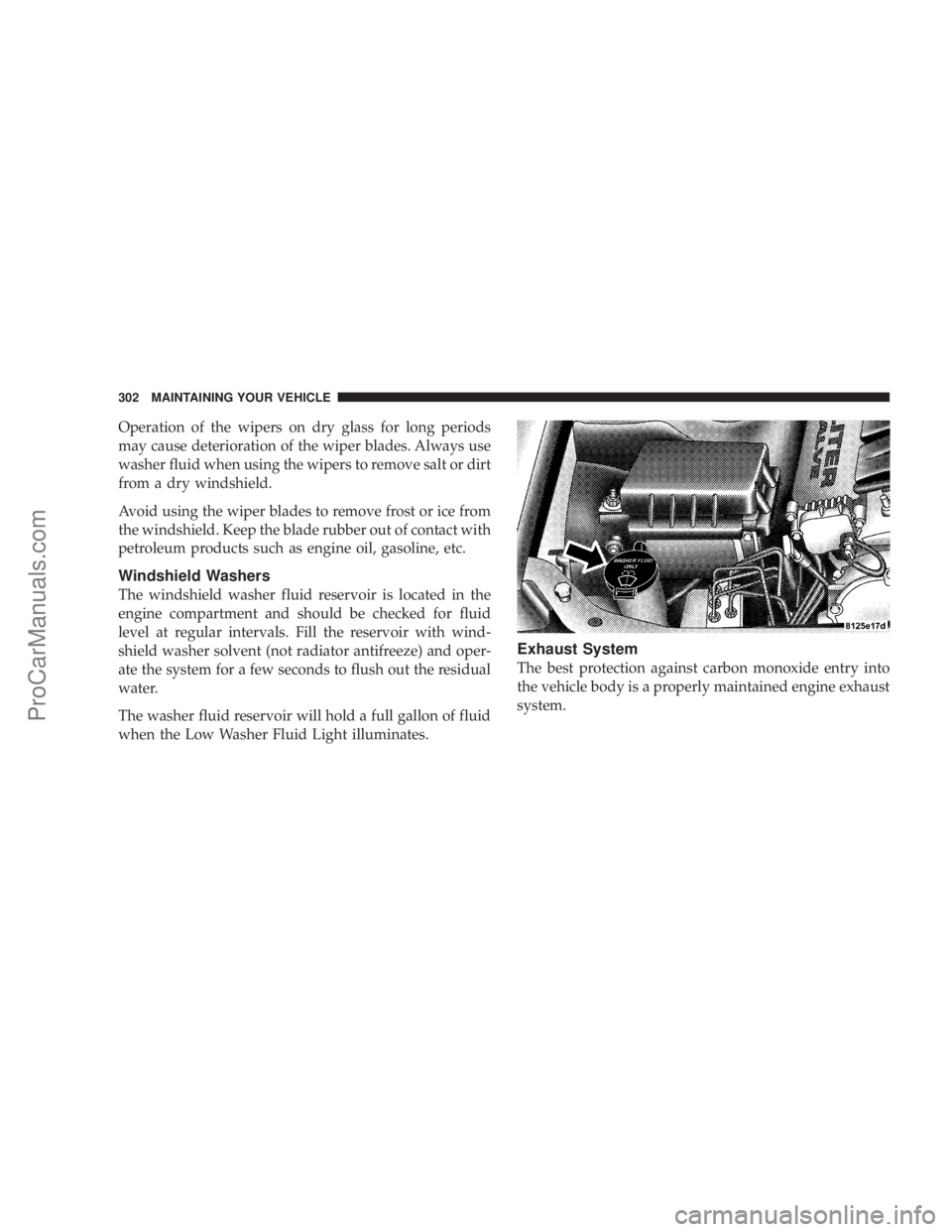
Windshield Washers
The windshield washer fluid reservoir is located in the
engine compartment and should be checked for fluid
level at regular intervals. Fill the reservoir with wind-
shield washer solvent (not radiator antifreeze) and oper-
ate the system for a few seconds to flush out the residual
water.
The washer fluid reservoir will hold a full gallon of fluid
when the Low Washer Fluid Light illuminates.
Exhaust System
The best protection against carbon monoxide entry into
the vehicle body is a properly maintained engine exhaust
system.
302 MAINTAINING YOUR VEHICLE
ProCarManuals.com
Page 308 of 374
WARNING!
Riding the brakes can lead to brake failure and
possibly an accident. Driving with your foot resting
or riding on the brake pedal can result in abnormally
high brake temperatures, excessive lining wear, and
possible brake damage. You wouldn't have your full
braking capacity in an emergency.
Brake And Power Steering Hoses
When the vehicle is serviced for scheduled maintenance,
inspect surface of hoses and nylon tubing for evidence of
heat and mechanical damage. Hard and brittle rubber,
cracking, tears, cuts, abrasion, and excessive swelling
indicate deterioration of the rubber. Particular attention
should be made to examining those hose surfaces nearest
to high heat sources, such as the exhaust manifold.
Insure nylon tubing in these areas has not melted or
collapsed.Inspect all hose connections such as clamps and cou-
plings to make sure they are secure and no leaks are
present.
NOTE:Often, fluid such as oil, power steering fluid,
and brake fluid are used during assembly plant opera-
tions to facilitate the assembly of hoses to couplings.
Therefore, oil wetness at the hose-coupling area is not
necessarily an indication of leakage. Actual dripping of
hot fluid when systems are under pressure (during
vehicle operation), should be noted before a hose is
replaced based on leakage.
NOTE:Inspection of brake hoses should be performed
whenever the brake system is serviced and at every
engine oil change. Inspect hydraulic brake hoses for
surface cracking, scuffing, or worn spots. If there is any
evidence of cracking, scuffing, or worn spots, the hose
should be replaced immediately! Eventual deterioration
of the hose can take place resulting in a possibility of a
burst failure.
308 MAINTAINING YOUR VEHICLE
ProCarManuals.com
Page 309 of 374
WARNING!
Worn brake hoses can burst and cause brake failure.
You could have an accident. If you see any signs of
cracking, scuffing, or worn spots, have the brake
hoses replaced immediately.
Brake Fluid Level Check
The fluid level in the master cylinder should be checked
when performing underhood services, or immediately if
the brake system warning light indicates system failure.
Clean the top of the master cylinder area before removing
the cap. Add fluid to bring the level up to the top of the
ªFULLº mark on the side of the master cylinder reservoir.
Overfilling of fluid is not recommended because it may
cause leaking in the system.
Add enough fluid to bring the level up to the require-
ments described on the brake fluid reservoir. With disc
brakes, fluid level can be expected to fall as the brake
pads wear. However, low fluid level may be caused by a
leak and a checkup may be needed.Use only manufacturers recommended brake fluid, refer
to Recommended Fluids, Lubricants and Genuine Parts
for correct fluid type.
WARNING!
²Overfilling the brake fluid reservoir can result in
spilling brake fluid on hot engine parts and the
brake fluid catching fire.
²Use of a brake fluid that has a lower initial boiling
point than the recommended MOPAR DOT 3
product or a brake fluid that is unidentified as to
FMVSS specification may result in sudden brake
failure during hard prolonged braking. You could
have an accident.
Use only brake fluid that has been in a tightly closed
container to avoid contamination from foreign matter or
moisture.
MAINTAINING YOUR VEHICLE 309
7
ProCarManuals.com
Page 332 of 374

FLUIDS AND CAPACITIES
U.S. Metric
Fuel (approximate)
2.7 Liter Engines (87 Octane) 18 gal-
lons68 liters
3.5 Liter Engines (89 Octane) 18 gal-
lons68 liters
5.7 Liter Engines (89 Octane) 19 gal-
lons71 liters
Engine Oil-With Filter
2.7 Liter Engines (SAE 5W-30,
API Certified)6.0 qts. 5.7 liters
3.5 Liter Engines (SAE 10W-30,
API Certified)6.0 qts. 5.7 liters
5.7 Liter Engines (SAE 5W-20,
API Certified)7.0 qts. 6.6 liters
Cooling System *
2.7 Liter Engines (Mopart
Antifreeze/Coolant 5 Year/
100,000 Mile Formula)9.5 qts 9.0 liters
3.5 Liter Engines (Mopart
Antifreeze/Coolant 5 Year/
100,000 Mile Formula)10.3 qts 9.75
liters
5.7 Liter Engines (Mopart
Antifreeze/Coolant 5 Year/
100,000 Mile Formula)14.0 qts 13.3
liters
* Includes heater and coolant recovery bottle filled to
MAX level.
332 MAINTAINING YOUR VEHICLE
ProCarManuals.com
Page 333 of 374

RECOMMENDED FLUIDS, LUBRICANTS AND GENUINE PARTS
Engine
Component Fluids, Lubricants and Genuine Parts
Engine Coolant MopartAntifreeze/Coolant 5 Year/100,000 Mile Formula HOAT (Hybrid Or-
ganic Additive Technology)
Engine Oil (2.7 Liter) Use API Certified engine oil. SAE 5W-30 is recommended. Refer to the en-
gine oil viscosity chart for the correct SAE grade meeting DaimlerChrysler
Material Standard MS-6395.
Engine Oil (3.5 Liter) Use API Certified engine oil. SAE 10W-30 is recommended. Refer to the en-
gine oil viscosity chart for the correct SAE grade meeting DaimlerChrysler
Material Standard MS-6395.
Engine Oil (5.7 Liter) Use API Certified engine oil. SAE 5W-20 is recommended. Refer to the en-
gine oil viscosity chart for the correct SAE grade meeting DaimlerChrysler
Material Standard MS-6395.
Spark Plugs Refer to the Vehicle Emission Control Information label in the engine com-
partment.
Oil Filter (2.7 Liter) Mopart05281090 or equiv.
Oil Filter (3.5 Liter) Mopart05281090 or equiv.
Oil Filter (5.7 Liter) Mopart05281090 or equiv.
Fuel Selection (2.7 Liter) 87 Octane
Fuel Selection (3.5 Liter) 89 Octane
Fuel Selection (5.7 Liter) 89 Octane
MAINTAINING YOUR VEHICLE 333
7
ProCarManuals.com