fuel CHRYSLER 300 LX 2005 Owner's Manual
[x] Cancel search | Manufacturer: CHRYSLER, Model Year: 2005, Model line: 300 LX, Model: CHRYSLER 300 LX 2005Pages: 374, PDF Size: 7.09 MB
Page 281 of 374

MAINTAINING YOUR VEHICLE
CONTENTS
m2.7L Engine..........................284
m3.5L Engine..........................285
m5.7L Engine..........................286
mOnboard Diagnostic System Ð OBD II......287
mEmissions Inspection And Maintenance
Programs
............................288
mReplacement Parts.....................289
mDealer Service........................289
mMaintenance Procedures.................290
NEngine Oil..........................290
NEngine Oil Filter......................295NDrive Belts Ð Check Condition And
Tensioner...........................295
NSpark Plugs.........................295
NEngine Air Cleaner Filter................295
NFuel Filter..........................296
NCatalytic Converter....................296
NMaintenance-Free Battery................297
NAir Conditioner Maintenance.............299
NA/C Air Filter.......................300
NPower Steering Ð Fluid Check............300
NFront & Rear Suspension Ball Joints........301
7
ProCarManuals.com
Page 282 of 374
NSteering Linkage......................301
NDrive Shaft Universal Joints..............301
NBody Lubrication.....................301
NWindshield Wiper Blades................301
NWindshield Washers...................302
NExhaust System......................302
NCooling System.......................303
NHoses And Vacuum/Vapor Harnesses.......307
NBrakes.............................307
NBrake Fluid Level Check................309
NFuel System Hoses....................310
NAutomatic Transmission................310
NFront And Rear Wheel Bearings...........311
NAppearance Care And Protection From
Corrosion...........................311NCleaning The Center Console Cup
Holders Ð 300.......................315
NCleaning The Center Console Cup Holders Ð
300C, 300 Touring.....................315
mPower Distribution Centers...............315
NFront Power Distribution Center...........315
NRear Power Distribution Center...........318
mVehicle Storage........................321
mReplacement Light Bulbs................322
mBulb Replacement......................323
NLow Beam Headlamp, High Beam Headlamp,
Park/Turn Lamp, Inner Park Lamp, And Outer
Park Lamp ± 300......................323
NLow Beam Headlamp, High Beam Headlamp,
And Park/Turn Lamp ± 300C.............324
NBackup Lamp, Side Marker Lamp, And
Tail/Stop Turn Lamp Ð 300..............326
282 MAINTAINING YOUR VEHICLE
ProCarManuals.com
Page 287 of 374
ONBOARD DIAGNOSTIC SYSTEM Ð OBD II
Your vehicle is equipped with a sophisticated onboard
diagnostic system called OBD II. This system monitors
the performance of the emissions, engine, and automatic
transmission control systems. When these systems are
operating properly, your vehicle will provide excellent
performance and fuel economy, as well as engine emis-
sions well within current government regulations.
If any of these systems require service, the OBD II system
will turn on the ªMalfunction Indicator Light.º It will
also store diagnostic codes and other information to
assist your service technician in making repairs. Al-
though your vehicle will usually be drivable and not
need towing, see your dealer for service as soon as
possible.CAUTION!
Prolonged driving with the ªMalfunction Indicator
Lightº on could cause further damage to the emis-
sion control system. It could also affect fuel economy
and driveability. The vehicle must be serviced before
any emissions tests can be performed.
If the ªMalfunction Indicator Lightº is flashing
while the engine is running, severe catalytic con-
verter damage and power loss will soon occur. Im-
mediate service is required.
MAINTAINING YOUR VEHICLE 287
7
ProCarManuals.com
Page 290 of 374
MAINTENANCE PROCEDURES
The pages that follow contain therequiredmaintenance
services determined by the engineers who designed your
vehicle.
Besides the maintenance items for which there are fixed
maintenance intervals, there are other items that should
operate satisfactorily without periodic maintenance.
However, if a malfunction of these items does occur, it
could adversely affect the engine or vehicle performance.
These items should be inspected if a malfunction is
observed or suspected.
Engine Oil
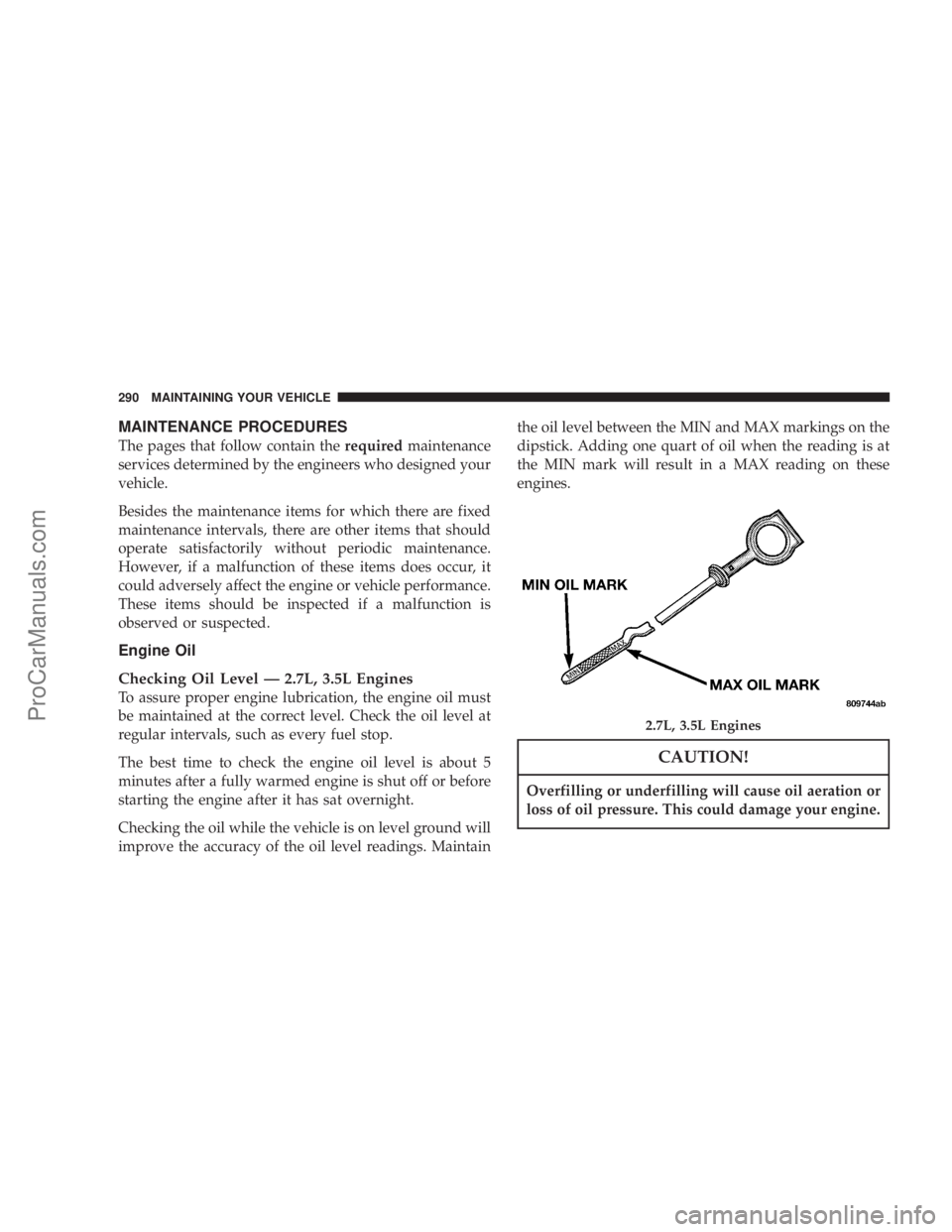
Checking Oil Level Ð 2.7L, 3.5L Engines
To assure proper engine lubrication, the engine oil must
be maintained at the correct level. Check the oil level at
regular intervals, such as every fuel stop.
The best time to check the engine oil level is about 5
minutes after a fully warmed engine is shut off or before
starting the engine after it has sat overnight.
Checking the oil while the vehicle is on level ground will
improve the accuracy of the oil level readings. Maintainthe oil level between the MIN and MAX markings on the
dipstick. Adding one quart of oil when the reading is at
the MIN mark will result in a MAX reading on these
engines.
CAUTION!
Overfilling or underfilling will cause oil aeration or
loss of oil pressure. This could damage your engine.
2.7L, 3.5L Engines
290 MAINTAINING YOUR VEHICLE
ProCarManuals.com
Page 291 of 374
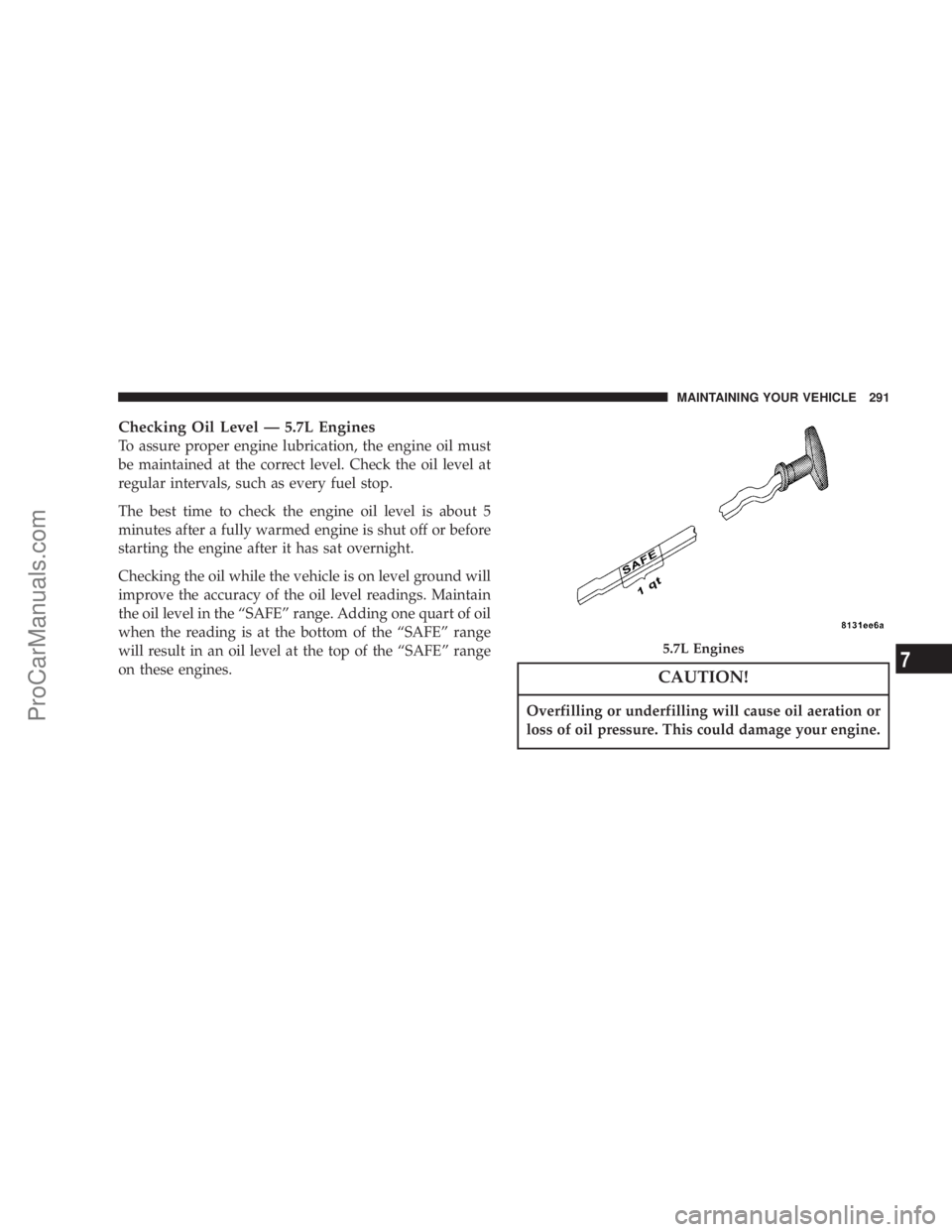
Checking Oil Level Ð 5.7L Engines
To assure proper engine lubrication, the engine oil must
be maintained at the correct level. Check the oil level at
regular intervals, such as every fuel stop.
The best time to check the engine oil level is about 5
minutes after a fully warmed engine is shut off or before
starting the engine after it has sat overnight.
Checking the oil while the vehicle is on level ground will
improve the accuracy of the oil level readings. Maintain
the oil level in the ªSAFEº range. Adding one quart of oil
when the reading is at the bottom of the ªSAFEº range
will result in an oil level at the top of the ªSAFEº range
on these engines.
CAUTION!
Overfilling or underfilling will cause oil aeration or
loss of oil pressure. This could damage your engine.
5.7L Engines
MAINTAINING YOUR VEHICLE 291
7
ProCarManuals.com
Page 293 of 374
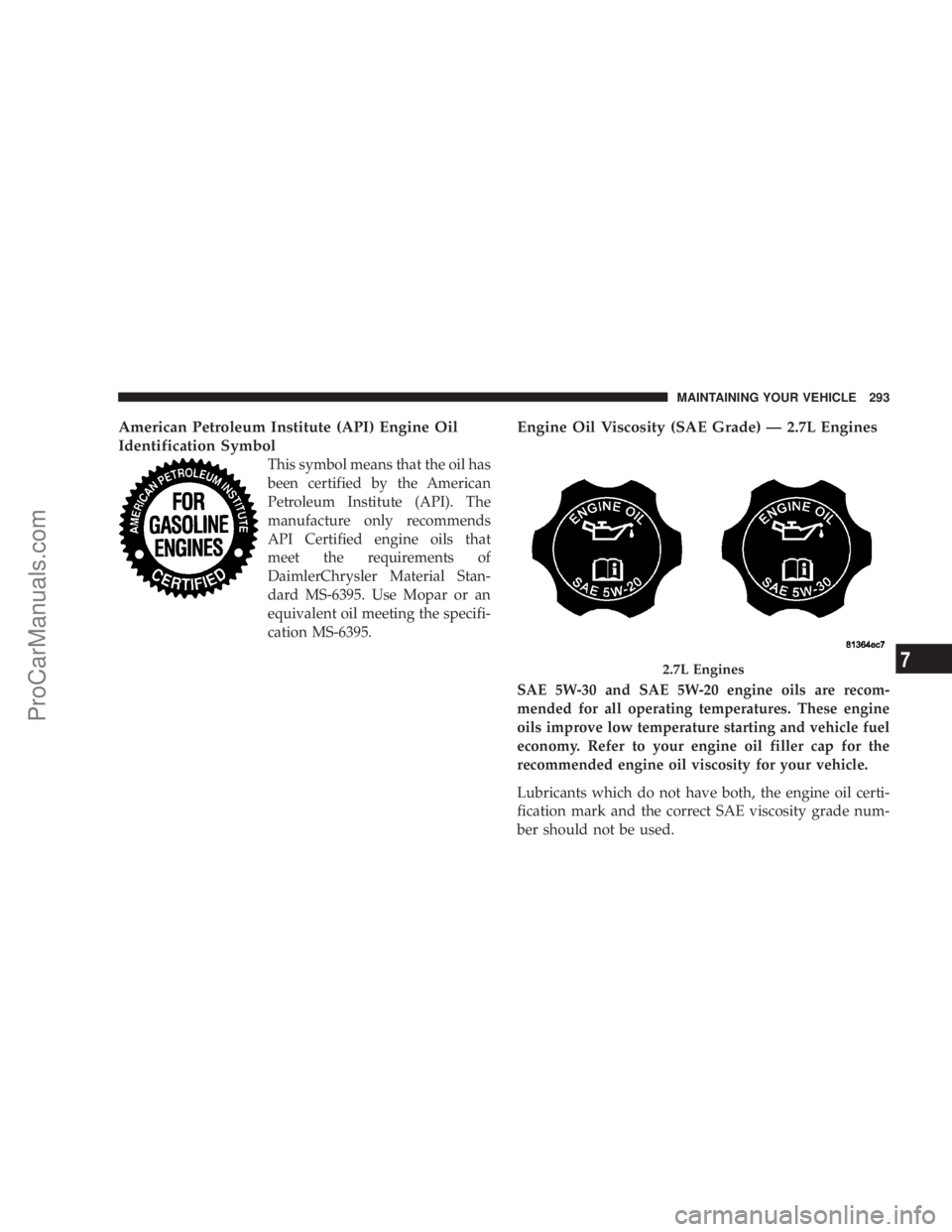
American Petroleum Institute (API) Engine Oil
Identification Symbol
This symbol means that the oil has
been certified by the American
Petroleum Institute (API). The
manufacture only recommends
API Certified engine oils that
meet the requirements of
DaimlerChrysler Material Stan-
dard MS-6395. Use Mopar or an
equivalent oil meeting the specifi-
cation MS-6395.
Engine Oil Viscosity (SAE Grade) Ð 2.7L Engines
SAE 5W-30 and SAE 5W-20 engine oils are recom-
mended for all operating temperatures. These engine
oils improve low temperature starting and vehicle fuel
economy. Refer to your engine oil filler cap for the
recommended engine oil viscosity for your vehicle.
Lubricants which do not have both, the engine oil certi-
fication mark and the correct SAE viscosity grade num-
ber should not be used.
2.7L Engines
MAINTAINING YOUR VEHICLE 293
7
ProCarManuals.com
Page 294 of 374

Engine Oil Viscosity Chart Ð 3.5L Engines
SAE 10W-30 engine oil is preferred for use in 3.5L
Engines within the operating temperatures shown in the
engine oil viscosity chart. SAE 5W-30 Engine Oil is
allowed for use in the 3.5L Engine during cold weather
only to improve cold weather starting.
Lubricants which do not have both, the engine oil certi-
fication mark and the correct SAE viscosity grade num-
ber should not be used.
Engine Oil Viscosity (SAE Grade) Ð 5.7L Engines
The recommended engine oil viscosity for vehicles
equipped with the 5.7L engine is SAE 5W-20.
NOTE:Engine oils higher in viscosity may reduce fuel
economy in vehicles equipped with 5.7L engines.
Synthetic Engine Oils
You may use synthetic engine oils provided that the
recommended oil quality requirements are met and the
recommended maintenance intervals for oil and filter
changes are followed.
Materials Added to Engine Oil
The manufacture strongly recommends against the addi-
tion of any additives (other than leak detection dyes) to
the engine oil. Engine oil is an engineered product and
it's performance may be impaired by supplemental ad-
ditives.
Disposing of Used Engine Oil And Oil Filters
Care should be taken in disposing of used engine oil and
oil filters from your vehicle. Used oil and oil filters,
indiscriminately discarded, can present a problem to the
environment. Contact your dealer, service station, or
3.5L Engines
294 MAINTAINING YOUR VEHICLE
ProCarManuals.com
Page 296 of 374

WARNING!
The air cleaner can provide a measure of protection
in the case of engine backfire. Do not remove the air
cleaner unless such removal is necessary for repair or
maintenance. Make sure that no one is near the
engine compartment before starting the vehicle with
the air cleaner removed. Failure to do so can result in
serious personal injury.
Fuel Filter
A plugged fuel filter can cause stalling, limit the speed at
which a vehicle can be driven or cause hard starting.
Should an excessive amount of dirt accumulate in the
fuel tank, filter replacement may be necessary. See your
local dealer for service.
Catalytic Converter
The catalytic converter requires the use of unleaded fuel
only. Leaded gasoline will destroy the effectiveness of the
catalyst as an emission control device.Under normal operating conditions, the catalytic con-
verter will not require maintenance. However, it is im-
portant to keep the engine properly tuned to assure
proper catalyst operation and prevent possible catalyst
damage.
CAUTION!
Damage to the catalytic converter can result if your
vehicle is not kept in proper operating condition. In
the event of engine malfunction, particularly involv-
ing engine misfire or other apparent loss of perfor-
mance, have your vehicle serviced promptly. Contin-
ued operation of your vehicle with a severe
malfunction could cause the converter to overheat,
resulting in possible damage to the converter and the
vehicle.
NOTE:Intentional tampering with emissions control
systems can result in civil penalties being assessed
against you.
296 MAINTAINING YOUR VEHICLE
ProCarManuals.com
Page 310 of 374

CAUTION!
Do not allow petroleum base fluid to contaminate
the brake fluid, all brake seal components could be
damaged causing partial or complete brake failure.
Fuel System Hoses
Electronic Fuel Injection high pressure fuel systems are
designed with hoses and quick connect fittings which
have unique material characteristics to provide adequate
sealing and resist attack by deteriorated gasoline.
You are urged to use only the manufacture specified
hoses with quick connect fittings, or their equivalent in
material and specification, in any fuel system servicing. It
is mandatory to replace any damaged hoses or quick
connect fittings that have been removed during service.
Care should be taken in installing quick connect fittings
to insure they are properly installed and fully connected.
See your authorized dealer for service.
Automatic Transmission
Fluid Level Check
Regular automatic transmission fluid level checks are not
required. For this reason the dipstick is omitted.
If you notice fluid loss or gear shift malfunction, have
your authorized dealer check the transmission fluid level.
CAUTION!
Using a transmission fluid other than the manufac-
turer's recommended fluid may cause deterioration
in transmission shift quality and/or torque converter
shudder. Using a transmission fluid other than that
recommended by the manufacturer will result in
more frequent fluid and filter changes. Refer to the
Recommended Fluids, Lubricants and Genuine Parts
section for correct fluid type.
310 MAINTAINING YOUR VEHICLE
ProCarManuals.com
Page 319 of 374
CAUTION!
²When installing the Power Distribution Center
cover, it is important to ensure the cover is prop-
erly positioned and fully latched. Failure to do so
may allow water to get into the Power Distribu-
tion Center, and possibly result in a electrical
system failure.
²When replacing a blown fuse, it is important to
use only a fuse having the correct amperage
rating. The use of a fuse with a rating other than
indicated may result in a dangerous electrical
system overload. If a properly rated fuse contin-
ues to blow, it indicates a problem in the circuit
that must be corrected.
Rear Power Distribution Center Fuses
Cavity Fuse Circuits
1 60 Amp
ClearIgnition Off Draw
2 40 Amp
GreenBattery
Cavity Fuse Circuits
3ÐÐ
4 40 Amp
GreenBattery
5 30 Amp
PinkHeated Seat/Steering Column
6 20 Amp
YellowFuel Pump
7ÐÐ
8 15 Amp
Dk. BlueIgnition Start/Run - Start
9 20 Amp
YellowConsole Power Outlet
10 10 Amp
RedRear Fog Lamp Ð If Equipped
11 25 Amp
C/BRKRMemory Module/Door Locks
12 25 Amp
C/BRKRPassenger Power Seat
13 30 Amp
C/BRKRDoor Module Run/Acc/Delay
MAINTAINING YOUR VEHICLE 319
7
ProCarManuals.com