ESP CHRYSLER 300 M 2004 1.G User Guide
[x] Cancel search | Manufacturer: CHRYSLER, Model Year: 2004, Model line: 300 M, Model: CHRYSLER 300 M 2004 1.GPages: 277, PDF Size: 5.69 MB
Page 165 of 277
2. Economy—
Improper inflation pressures can cause uneven wear
patterns to develop across the tire tread. These abnormal
wear patterns will reduce tread life resulting in a need for
earlier tire replacement. Under inflation also increases
tire rolling resistance and results in higher fuel consump-
tion.
3. Ride Comfort and Vehicle Stability—
Proper tire inflation contributes to a comfortable ride.
Over inflation produces a jarring and uncomfortable ride.
Both under-inflation and over inflation affect the stability
of the vehicle and can produce a feeling of sluggish
response or over-responsiveness in the steering.
Unequal tire pressures can cause erratic and unpredict-
able steering response.
Unequal tire pressure from side to side may cause the
vehicle to drift left or right.
Tire Inflation Pressures
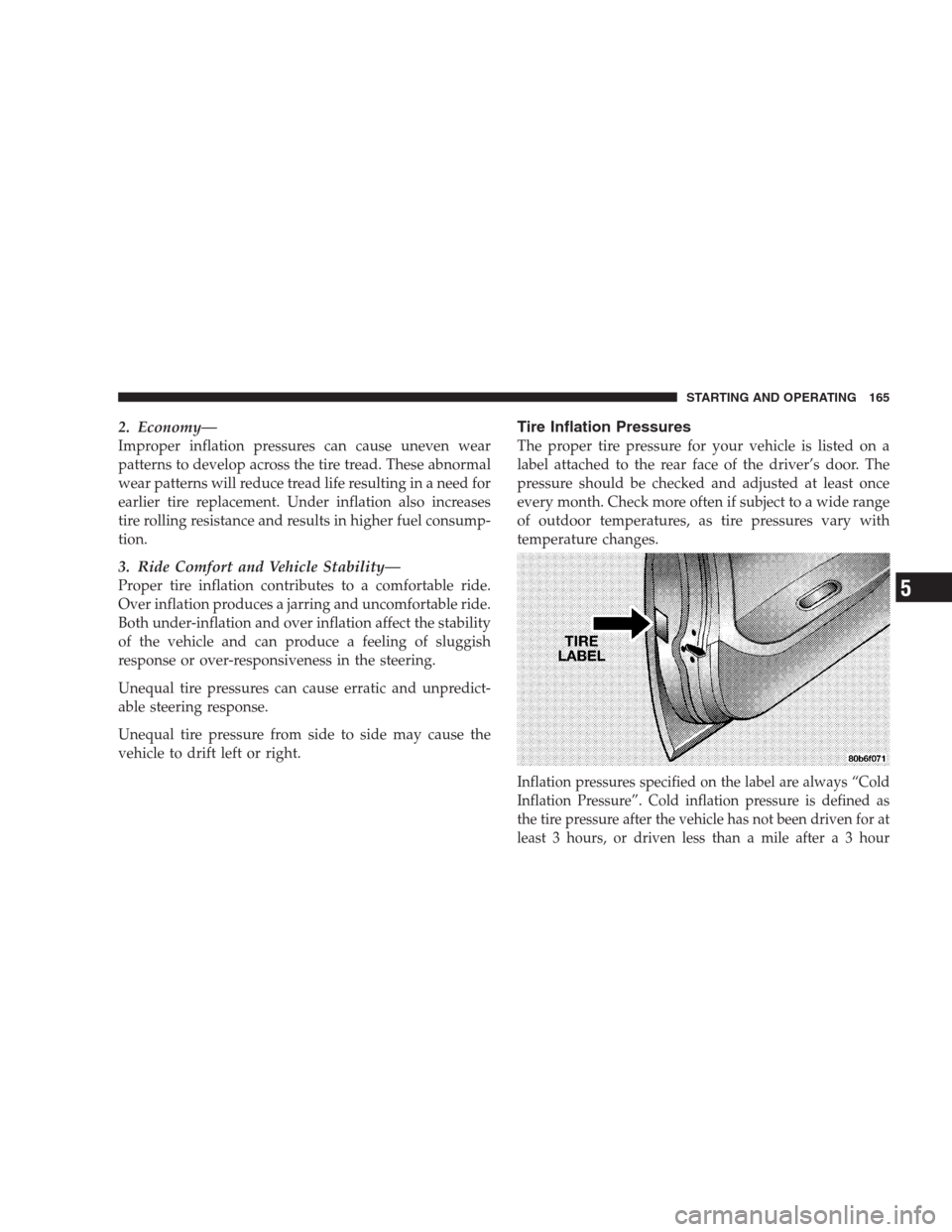
The proper tire pressure for your vehicle is listed on a
label attached to the rear face of the driver’s door. The
pressure should be checked and adjusted at least once
every month. Check more often if subject to a wide range
of outdoor temperatures, as tire pressures vary with
temperature changes.
Inflation pressures specified on the label are always “Cold
Inflation Pressure”. Cold inflation pressure is defined as
the tire pressure after the vehicle has not been driven for at
least 3 hours, or driven less than a mile after a 3 hour
STARTING AND OPERATING 165
5
Page 173 of 277
CAUTION!
Replacing original tires with tires of a different size
may result in false speedometer and odometer read-
ings. Check with your dealer before replacing tires
with a different size.
Tire Rotation Recommendations
Tires on the front and rear axles of vehicles operate at
different loads and perform different steering, driving
and braking functions. For these reasons, they wear at
unequal rates, and tend to develop irregular wear pat-
terns.
These effects can be reduced by timely rotation of tires.
The benefits of rotation are especially worthwhile with
aggressive tread designs such as those on all season type
tires. Rotation will increase tread life, help to maintain
mud, snow and wet traction levels, and contribute to a
smooth, quiet ride.Rotate your tires at intervals shown on the maintenance
schedules. More frequent rotation is permissible if de-
sired. The reasons for any rapid or unusual wear should
be corrected before rotating.
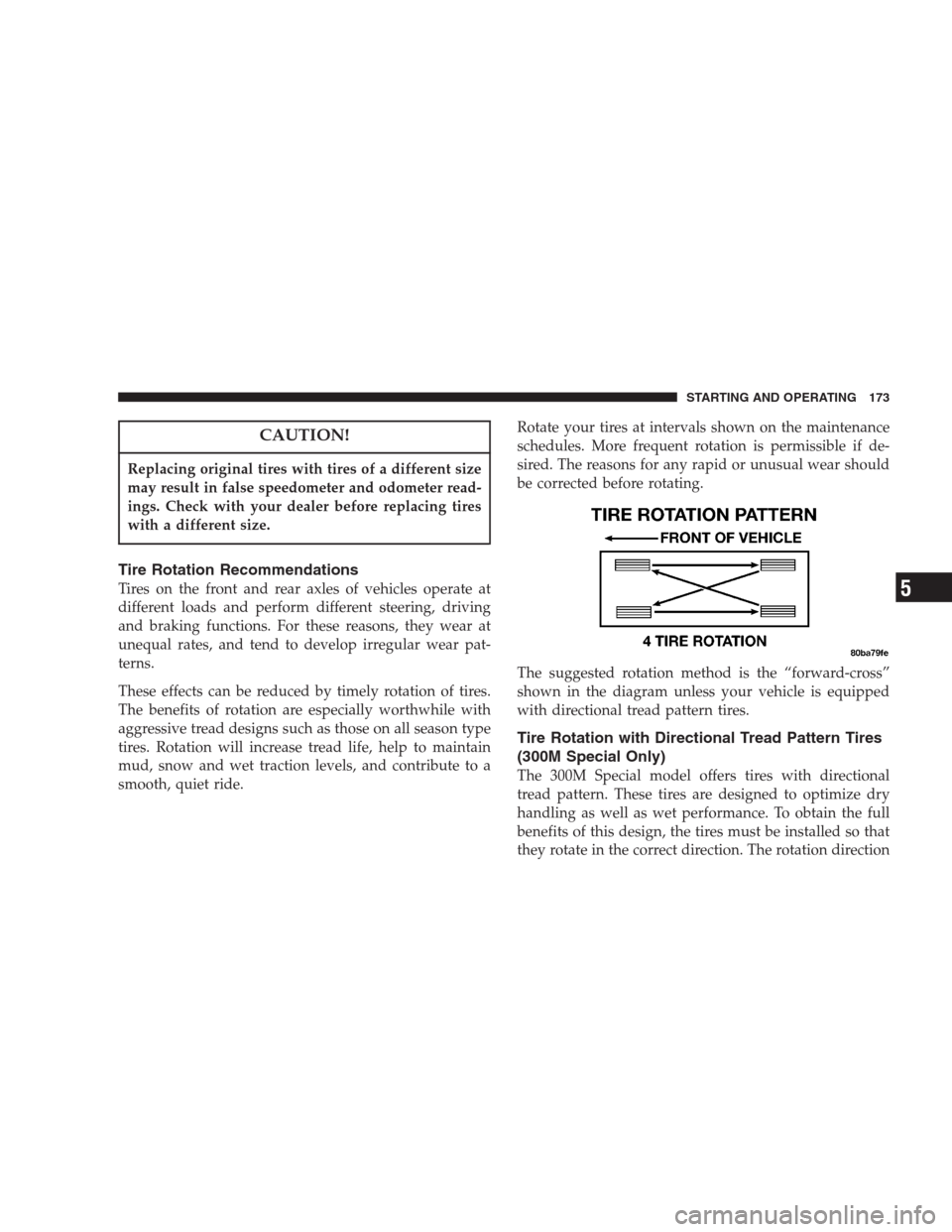
The suggested rotation method is the “forward-cross”
shown in the diagram unless your vehicle is equipped
with directional tread pattern tires.
Tire Rotation with Directional Tread Pattern Tires
(300M Special Only)
The 300M Special model offers tires with directional
tread pattern. These tires are designed to optimize dry
handling as well as wet performance. To obtain the full
benefits of this design, the tires must be installed so that
they rotate in the correct direction. The rotation direction
STARTING AND OPERATING 173
5
Page 176 of 277
Gasoline/Oxygenate Blends
Some fuel suppliers blend unleaded gasoline with mate-
rials called oxygenates such as 10% ethanol, MTBE and
ETBE. Oxygenates are required in some areas of the
country during the winter months to reduce carbon
monoxide emissions. Fuels blended with these oxygen-
ates may be used in your vehicle.
CAUTION!
DO NOT use gasolines containing Methanol. Use of
these blends may result in starting and driveability
problems and may damage critical fuel system com-
ponents.
Problems that result from using methanol/gasoline
blends are not the responsibility of the manufacturer and
may not be covered by the vehicle warranty. While MTBE
is an oxygenate made from Methanol, it does not have
the negative effects of Methanol.
MMT in Gasoline
MMT is a manganese containing metallic additive that is
blended into some gasoline to increase the octane num-
ber. Gasolines blended with MMT offer no performance
advantage beyond gasolines of the same octane number
without MMT. Gasolines blended with MMT have shown
to reduce spark plug life and reduce emission system
performance in some vehicles. The manufacturer recom-
mends using gasolines without MMT. Since the MMT
content of gasoline may not be indicated on the pump,
you should ask your gasoline retailer whether or not
his/her gasoline contains MMT.
MMT is prohibited in both Federal and California refor-
mulated gasolines.
In Canada, MMT can be used at levels higher than those
allowed in the United States. For this reason, it is even
more important to look for gasolines without MMT in
Canada.
176 STARTING AND OPERATING
Page 212 of 277
then proceed as described above, to distribute the lubri-
cant within the lock cylinder. Pay attention to trunk
hinges, especially during cold weather, to ensure ease of
trunk operation.
Other Body Mechanisms
The following body mechanisms should be inspected
and, if necessary, all pivot and sliding contact areas of
these components should be lubricated with the lubricant
specified as follows:
Engine Oil
•
Door hinges
•Hood hinges
•Trunk hinges
Smooth White Body Lubricant - Such as Mopar
Spray White Lube:
•
Hood hinge springs and links
•Lock cylinders
•Parking brake mechanism
•Trunk latches
•Ash tray
•Door check straps
Windshield Wiper Blades
Clean the rubber edges of the wiper blades and the
windshield periodically with a sponge or soft cloth and a
mild non abrasive cleaner. This will remove accumula-
tions of salt or road film.
Operation of the wipers on dry glass for long periods
may cause deterioration of the wiper blades. Always use
washer fluid when using the wipers to remove salt or dirt
from a dry windshield. Avoid using the wiper blades to
remove frost or ice from the windshield. Keep the blade
rubber out of contact with petroleum products such as
engine oil, gasoline, etc.
212 MAINTAINING YOUR VEHICLE
Page 216 of 277
Higher concentrations (not to exceed 70%) may be used if
temperatures below -37°F (-38°C) are anticipated.
Use only high purity water such as distilled or deionized
water when mixing the water/antifreeze solution. The
use of lower quality water will reduce the amount of
corrosion protection in the engine cooling system.
NOTE:Mixing coolant types will decrease the life of the
engine coolant and will require more frequent engine
coolant changes.
Please note that it is the owner’s responsibility to main-
tain the proper level of protection against freezing ac-
cording to the temperatures occurring in the area where
the vehicle is operated.
Cooling System Pressure Cap
The cap must be fully tightened to prevent loss of
coolant, and to insure that coolant will return to the
radiator from the coolant reserve tank.
The cap should be inspected and cleaned if there is any
accumulation of foreign material on the sealing surfaces.
WARNING!
The warning words “DO NOT OPEN HOT” on the
cooling system pressure cap are a safety precaution.
Never add coolant when the engine is overheated.
Do not loosen or remove the cap to cool an over-
heated engine. Heat causes pressure to build up in
the cooling system. To prevent scalding or injury, do
not remove the pressure cap while the system is hot
or under pressure.
WARNING!
Do not use a pressure cap other than the one speci-
fied for your vehicle. Personal injury or engine
damage may result.
216 MAINTAINING YOUR VEHICLE
Page 225 of 277
•It is important that the drain holes in the lower edges
of the doors, rocker panels and rear deck lid be kept
clear and open.
•If you detect any stone chips or scratches in the paint,
touch them up immediately. The cost of such repairs is
considered the responsibility of the owner.
•Use Mopar touch up paint on scratches or chips as
soon as possible. Your dealer has touch up paint to
match the color of your vehicle.
•If your vehicle is damaged due to an accident or
similar cause which destroys the paint and protective
coating have your vehicle repaired as soon as possible.
The cost of such repairs is considered the responsibil-
ity of the owner.
•Aluminum and chrome wheels should be cleaned
regularly with mild soap and water to prevent corro-
sion. To remove heavy soil, select a non abrasive,
non-acidic cleaner. Do not use scouring pads or metal
polishes. Avoid automatic car washes that use acidic
solutions or harsh brushes that may damage the
wheels’ protective finish.
•If you carry special cargo such as chemicals, fertilizers,
deicer salt, etc., be sure that such materials are well
packaged and sealed.
•If a lot of driving is done on gravel roads, consider
mud or stone shields behind each wheel.
Interior Care
Use Mopar Fabric Cleaner to clean fabric upholstery and
carpeting.
Use a mild soap and warm water solution to clean vinyl
or leather upholstery. For stubborn stains, use Mopar
Vinyl Cleaner.
Mopar Vinyl Cleaner is specifically recommended for
vinyl trim.
WARNING!
Do not use volatile solvents for cleaning purposes.
Many are potentially flammable, and if used in
closed areas they may cause respiratory harm.
MAINTAINING YOUR VEHICLE 225
7
Page 249 of 277
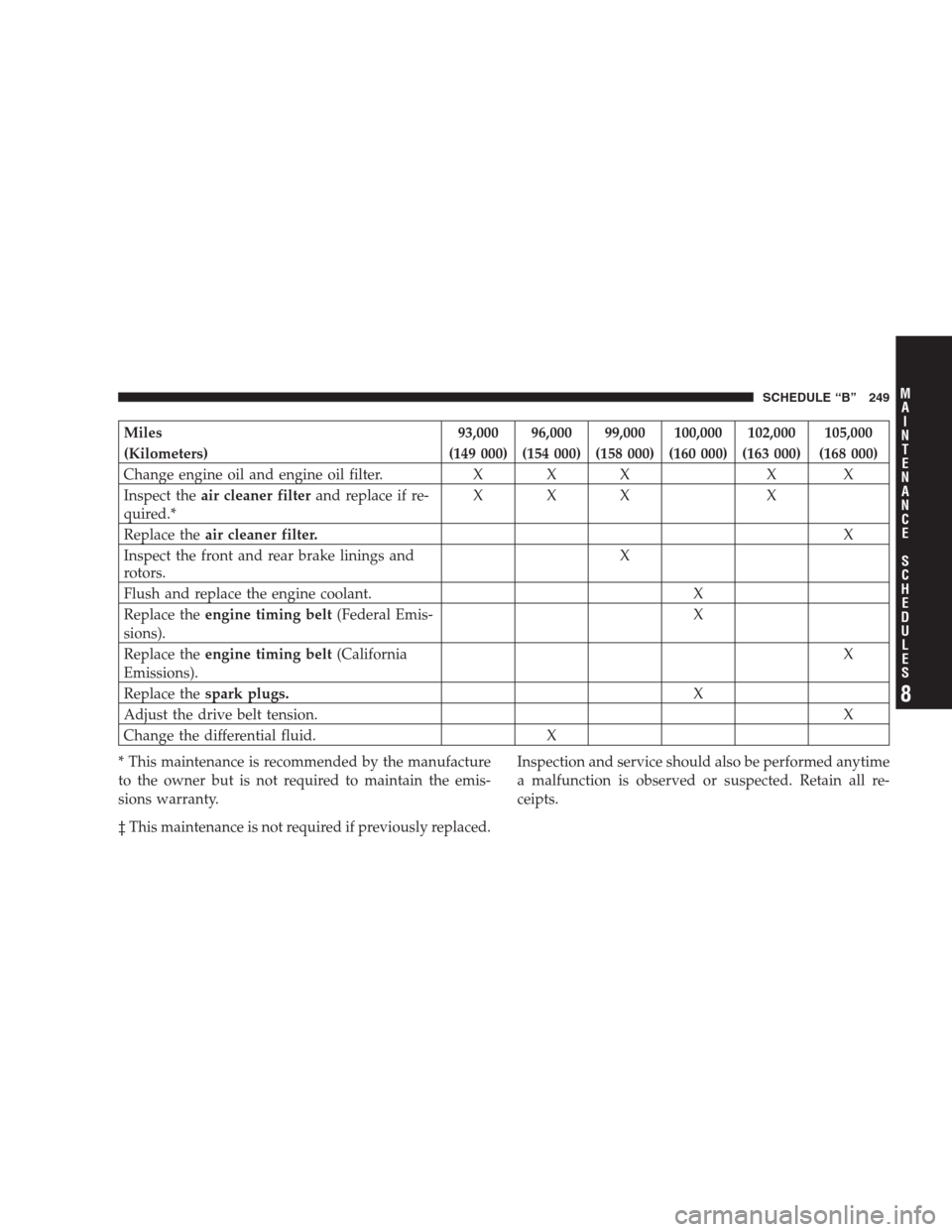
Miles 93,000 96,000 99,000 100,000 102,000 105,000
(Kilometers) (149 000) (154 000) (158 000) (160 000) (163 000) (168 000)
Change engine oil and engine oil filter. X X X X X
Inspect theair cleaner filterand replace if re-
quired.*XXX X
Replace theair cleaner filter.X
Inspect the front and rear brake linings and
rotors.X
Flush and replace the engine coolant. X
Replace theengine timing belt(Federal Emis-
sions).X
Replace theengine timing belt(California
Emissions).X
Replace thespark plugs.X
Adjust the drive belt tension.X
Change the differential fluid. X
* This maintenance is recommended by the manufacture
to the owner but is not required to maintain the emis-
sions warranty.
‡ This maintenance is not required if previously replaced.Inspection and service should also be performed anytime
a malfunction is observed or suspected. Retain all re-
ceipts.
SCHEDULE “B” 249
8
M
A
I
N
T
E
N
A
N
C
E
S
C
H
E
D
U
L
E
S
Page 252 of 277
![CHRYSLER 300 M 2004 1.G User Guide Miles 78,000 84,000 90,000 96,000 102,000
(Kilometers) (125 000) (134 000) (144 000) (154 000) (163 000)
[Months] [78] [84] [90] [96] [102]
Change engine oil and engine oil filter. X X X X X
Inspect t](/img/25/8462/w960_8462-251.png "CHRYSLER 300 M 2004 1.G User Guide Miles 78,000 84,000 90,000 96,000 102,000
(Kilometers) (125 000) (134 000) (144 000) (154 000) (163 000)
[Months] [78] [84] [90] [96] [102]
Change engine oil and engine oil filter. X X X X X
Inspect t")
Miles 78,000 84,000 90,000 96,000 102,000
(Kilometers) (125 000) (134 000) (144 000) (154 000) (163 000)
[Months] [78] [84] [90] [96] [102]
Change engine oil and engine oil filter. X X X X X
Inspect theair cleaner filterand replace if re-
quired.*XX XX
Replace theair cleaner filter.*X
Adjust the drive belt tension. X
Inspect the front and rear brake linings and rotors. X
Replace thespark plugs.X
Check and replace, if necessary, thePCV valve.*‡ X
Replace theengine timing belt(Federal Emissions
equipped vehicles only).X
Replace theengine timing belt(California Emis-
sions equipped vehicles only).X
Flush and replace the engine coolant at 60 months
or 100,000 miles.X
* This maintenance is recommended by the manufacture
to the owner but is not required to maintain the emis-
sions warranty.
‡ This maintenance is not required if previously replaced.Inspection and service should also be performed anytime
a malfunction is observed or suspected. Retain all re-
ceipts.
252 SCHEDULE “A”
8
M
A
I
N
T
E
N
A
N
C
E
S
C
H
E
D
U
L
E
S
Page 258 of 277
Service Contract
You may have purchased a service contract for your
vehicle to help protect you from the high cost of unex-
pected repairs after your manufacturer’s new vehicle
limited warranty expires. The manufacturer stands be-
hind only the manufacturer’s Service Contracts. If you
purchased a manufacturer’s Service Contract, you will
receive Plan Provisions and an Owner Identification Card
in the mail within three weeks of your vehicle delivery
date. If you have any questions about your service
contract, call the manufacturer’s Service Contract Na-
tional Customer Hotline at 1-800-521-9922.
The manufacturer will not stand behind any service
contract that is not the manufacturer’s Service Contract. It
is not responsible for any service contract other than the
manufacturer’s Service Contract. If you purchased a
service contract that is not a manufacturer’s Service
Contract, and you require service after your manufactur-
er’s new vehicle limited warranty expires, please refer to
your contract documents, and contact the person listed in
those documents.We appreciate that you have made a major investment
when you purchased your new vehicle. Your dealer has
also made a major investment in facilities, tools, and
training to assure that you are absolutely delighted with
your ownership experience. You’ll be pleased with their
sincere efforts to resolve any warranty issues or related
concerns.
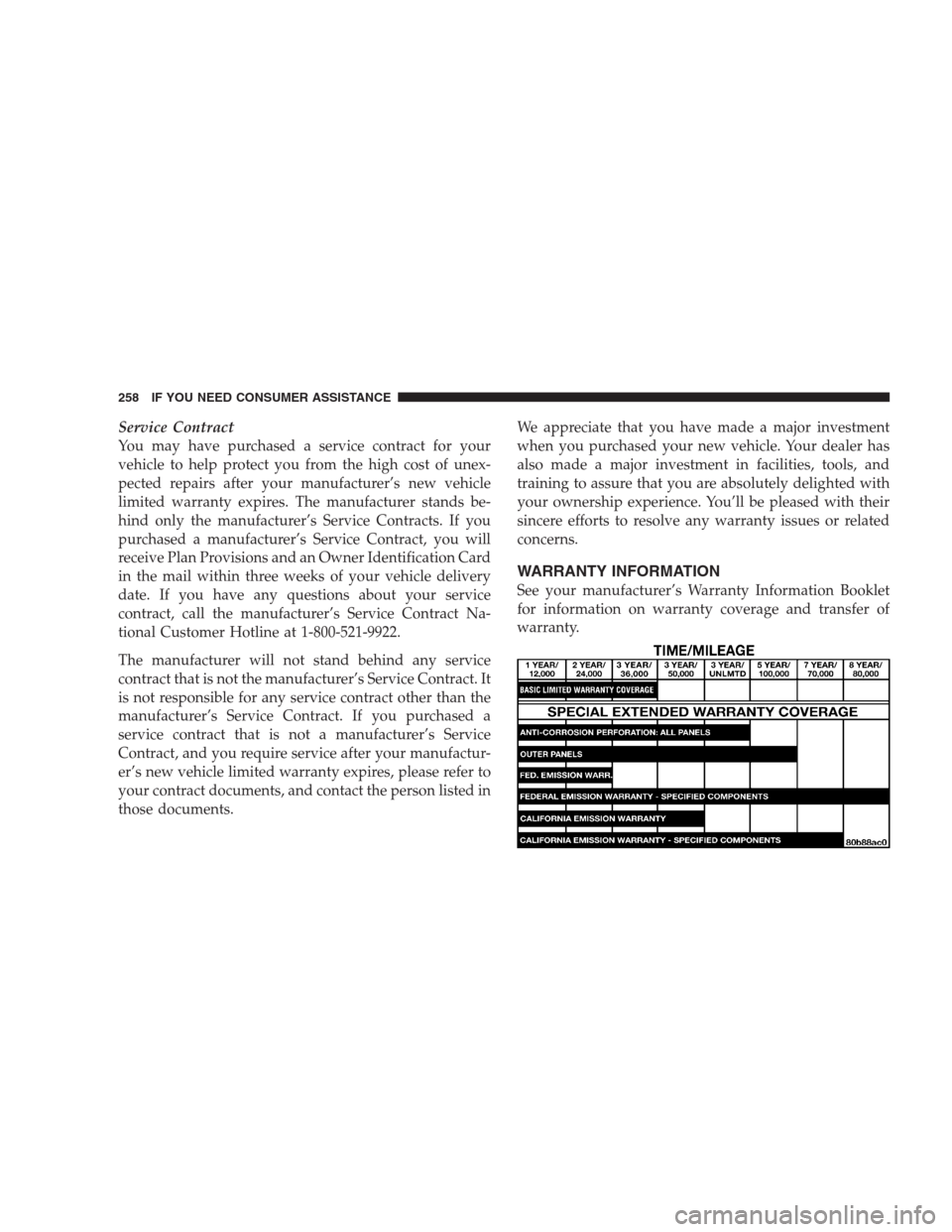
WARRANTY INFORMATION
See your manufacturer’s Warranty Information Booklet
for information on warranty coverage and transfer of
warranty.
258 IF YOU NEED CONSUMER ASSISTANCE
Page 264 of 277
Temperature Grades
The temperature grades are A (highest), B, and C, repre-
senting the tire’s resistance to the generation of heat and
its ability to dissipate heat when tested under controlled
conditions on a specified indoor laboratory test wheel.
Sustained high temperature can cause the material of the
tire to degenerate and reduce tire life, and excessive
temperature can lead to sudden tire failure. The grade C
corresponds to a level of performance which all passen-
ger car tires must meet under the Federal Motor Vehicle
Safety Standard No. 109. Grades B and A represent
higher levels of performance on the laboratory test wheel
than the minimum required by law.WARNING!
The temperature grade is established for a tire that is
properly inflated and not overloaded. Excessive
speed, underinflation, or excessive loading, either
separately or in combination, can cause heat buildup
and possible tire failure.
264 IF YOU NEED CONSUMER ASSISTANCE