display CHRYSLER 300 SRT 2009 1.G User Guide
[x] Cancel search | Manufacturer: CHRYSLER, Model Year: 2009, Model line: 300 SRT, Model: CHRYSLER 300 SRT 2009 1.GPages: 493, PDF Size: 7.53 MB
Page 143 of 493
because a door is open. This includes the glove box light,
but not the trunk light. To restore interior light operation,
either turn the ignition switch ON or cycle the light
switch.
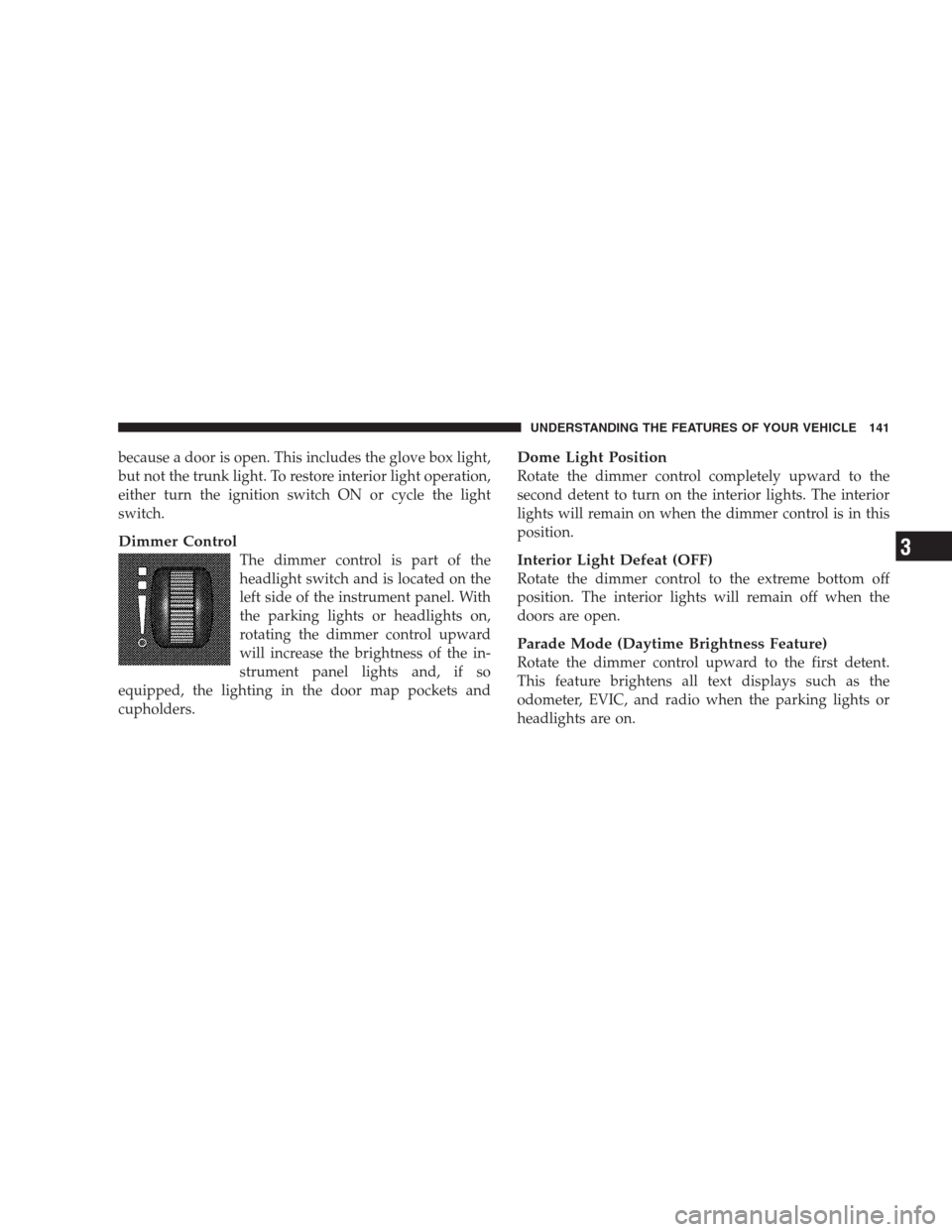
Dimmer Control
The dimmer control is part of the
headlight switch and is located on the
left side of the instrument panel. With
the parking lights or headlights on,
rotating the dimmer control upward
will increase the brightness of the in-
strument panel lights and, if so
equipped, the lighting in the door map pockets and
cupholders.
Dome Light Position
Rotate the dimmer control completely upward to the
second detent to turn on the interior lights. The interior
lights will remain on when the dimmer control is in this
position.
Interior Light Defeat (OFF)
Rotate the dimmer control to the extreme bottom off
position. The interior lights will remain off when the
doors are open.
Parade Mode (Daytime Brightness Feature)
Rotate the dimmer control upward to the first detent.
This feature brightens all text displays such as the
odometer, EVIC, and radio when the parking lights or
headlights are on.
UNDERSTANDING THE FEATURES OF YOUR VEHICLE 141
3
Page 150 of 493
Press the switch rearward to move the pedals rearward
(toward the driver).
•The pedals can be adjusted with the ignition OFF.
•The pedals can be adjusted while driving.
•The pedalscannotbe adjusted when the vehicle is in
REVERSE or when the Electronic Speed Control is on.
One of the following messages will display in the
Electronic Vehicle Information Center (EVIC) if a pedal
adjustment is attempted when the system is locked
out: “Adjustable Pedal Disabled — Cruise Control
Engaged” or “Adjustable Pedal Disabled — Vehicle In
Reverse.”
NOTE:For vehicles equipped with Driver Memory
Seat, you can use your Remote Keyless Entry (RKE)
transmitter or the memory switch on the driver’s door
trim panel to return the adjustable pedals to pre-
programmed positions. Refer to “Driver Memory Seat”
in this section.
CAUTION!
Do not place any article under the adjustable pedals
or impede its ability to move as it may cause damage
to the pedal controls. Pedal travel may become lim-
ited if movement is stopped by an obstruction in the
adjustable pedal’s path.
ELECTRONIC SPEED CONTROL
When engaged, Electronic Speed Control takes over the
accelerator operation at speeds greater than 25 mph
(40 km/h).
The Electronic Speed Control lever located on the right
side of the steering wheel operates the system.
148 UNDERSTANDING THE FEATURES OF YOUR VEHICLE
Page 157 of 493
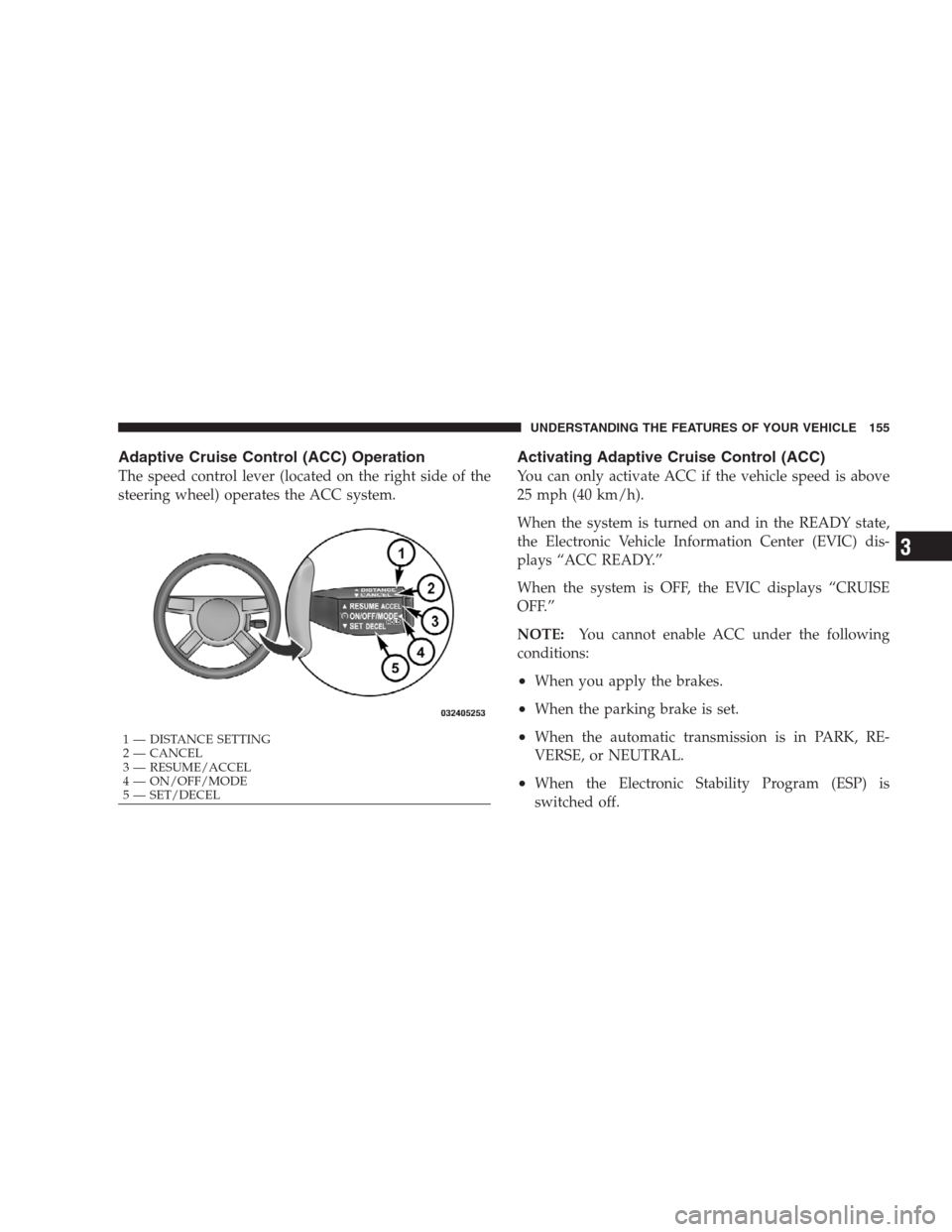
Adaptive Cruise Control (ACC) Operation
The speed control lever (located on the right side of the
steering wheel) operates the ACC system.
Activating Adaptive Cruise Control (ACC)
You can only activate ACC if the vehicle speed is above
25 mph (40 km/h).
When the system is turned on and in the READY state,
the Electronic Vehicle Information Center (EVIC) dis-
plays “ACC READY.”
When the system is OFF, the EVIC displays “CRUISE
OFF.”
NOTE:You cannot enable ACC under the following
conditions:
•When you apply the brakes.
•When the parking brake is set.
•When the automatic transmission is in PARK, RE-
VERSE, or NEUTRAL.
•When the Electronic Stability Program (ESP) is
switched off.
1 — DISTANCE SETTING
2 — CANCEL
3 — RESUME/ACCEL
4 — ON/OFF/MODE
5 — SET/DECELUNDERSTANDING THE FEATURES OF YOUR VEHICLE 155
3
Page 158 of 493
•When pushing the RESUME/ACCEL switch without a
previously set speed in memory.
To Activate
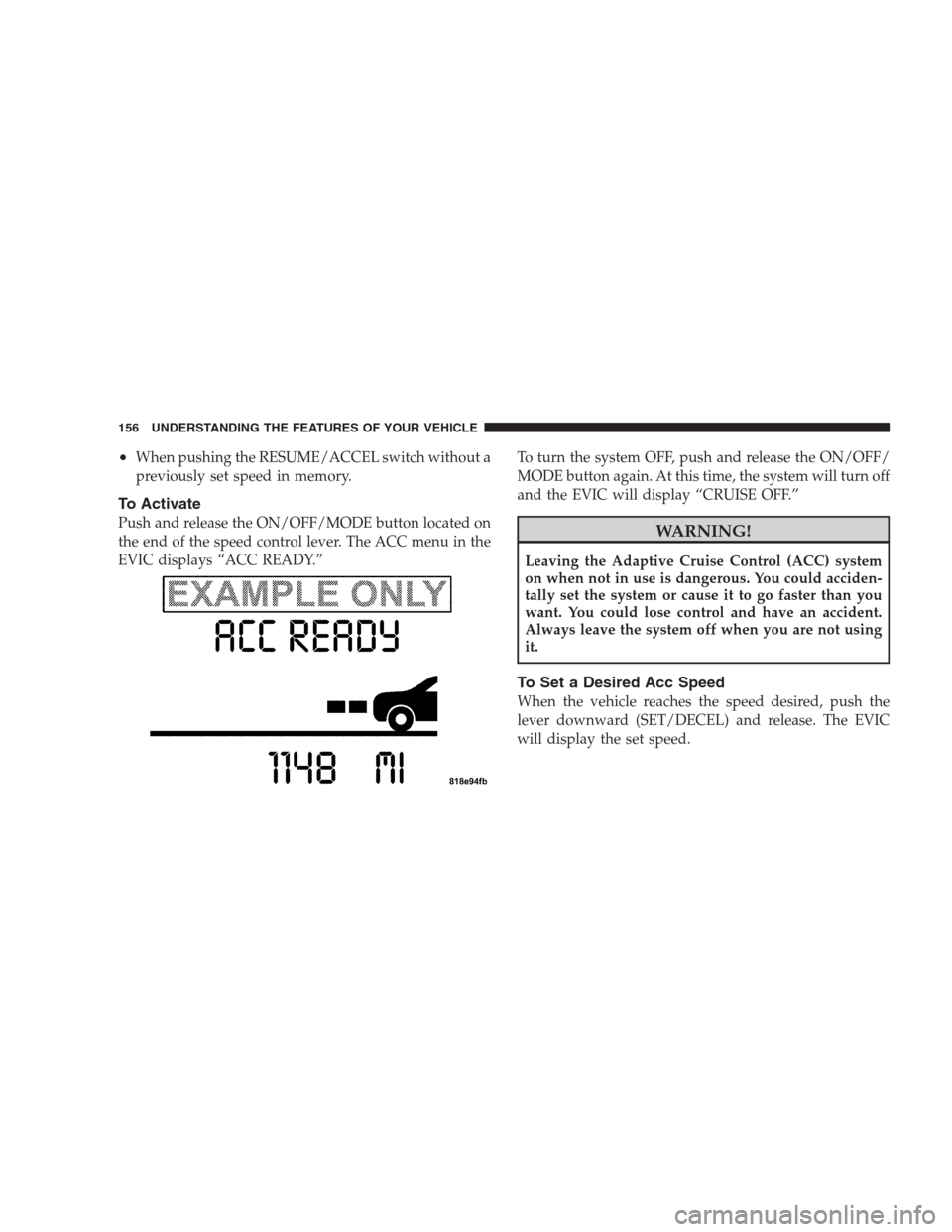
Push and release the ON/OFF/MODE button located on
the end of the speed control lever. The ACC menu in the
EVIC displays “ACC READY.”To turn the system OFF, push and release the ON/OFF/
MODE button again. At this time, the system will turn off
and the EVIC will display “CRUISE OFF.”WARNING!
Leaving the Adaptive Cruise Control (ACC) system
on when not in use is dangerous. You could acciden-
tally set the system or cause it to go faster than you
want. You could lose control and have an accident.
Always leave the system off when you are not using
it.
To Set a Desired Acc Speed
When the vehicle reaches the speed desired, push the
lever downward (SET/DECEL) and release. The EVIC
will display the set speed.
156 UNDERSTANDING THE FEATURES OF YOUR VEHICLE
Page 159 of 493
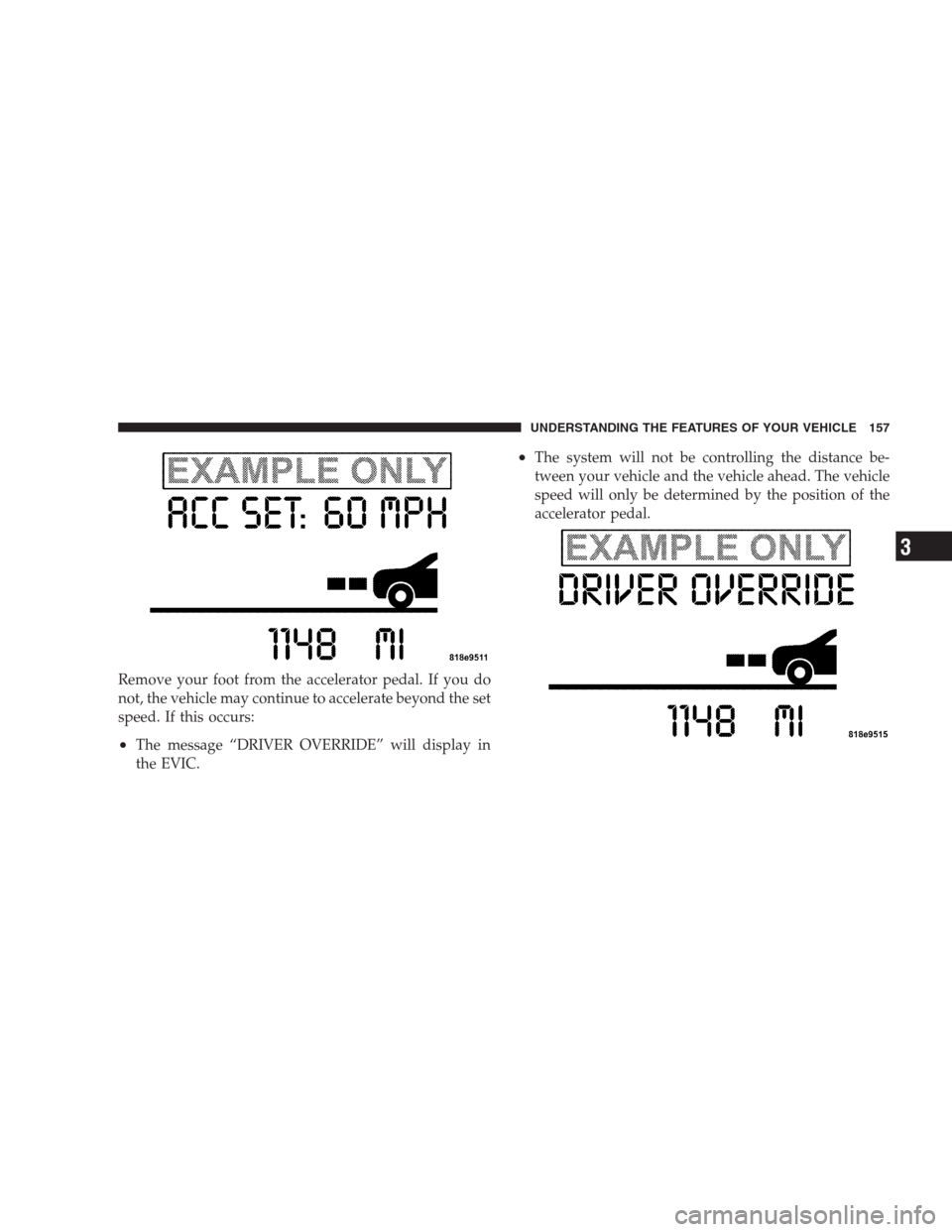
Remove your foot from the accelerator pedal. If you do
not, the vehicle may continue to accelerate beyond the set
speed. If this occurs:
•The message “DRIVER OVERRIDE” will display in
the EVIC.
•The system will not be controlling the distance be-
tween your vehicle and the vehicle ahead. The vehicle
speed will only be determined by the position of the
accelerator pedal.
UNDERSTANDING THE FEATURES OF YOUR VEHICLE 157
3
Page 161 of 493
To Resume Speed
Push the lever upward (RESUME/ACCEL) and release.
Then remove your foot from the accelerator pedal. The
EVIC will display the last set speed.
WARNING!
The Resume function should only be used if traffic
and road conditions permit. Resuming a set speed
that is too high or too low for prevailing traffic and
road conditions could cause the vehicle to accelerate
or decelerate too sharply for safe operation. This
could cause an accident and/or serious injury.
To Vary the Speed Setting
While ACC is set, you can increase the set speed by lifting
and holding the lever up (RESUME/ACCEL). If the lever
is continually held, the set speed will continue to increase
in 5 mph (10 km/h) increments until the lever is released.
The increase in set speed is reflected in the EVIC display.Tapping the lever up once will result in a 1 mph (1 km/h)
increase in set speed. Each subsequent tap of the lever
results in an increase of 1 mph (1 km/h).
While ACC is set, the set speed can be decreased by
pushing and holding the lever down (SET/DECEL). If
the lever is continually held, the set speed will continue
to decrease in 5 mph (10 km/h) increments until the lever
is released. The decrease in set speed is reflected in the
EVIC display.
Tapping the lever down once will result ina1mph
(1 km/h) decrease in set speed. Each subsequent tap of
the lever results in a decrease of 1 mph (1 km/h).
NOTE:•When you use the lever to decelerate, if the engine’s
braking power does not slow the vehicle sufficiently to
reach the set speed, the brake system will automati-
cally slow the vehicle.
UNDERSTANDING THE FEATURES OF YOUR VEHICLE 159
3
Page 162 of 493
•The ACC system maintains set speed when driving up
hill and down hill. However, a slight speed change on
moderate hills is normal. In addition, downshifting
may occur while climbing uphill or descending down-
hill. This is normal operation and necessary to main-
tain set speed.
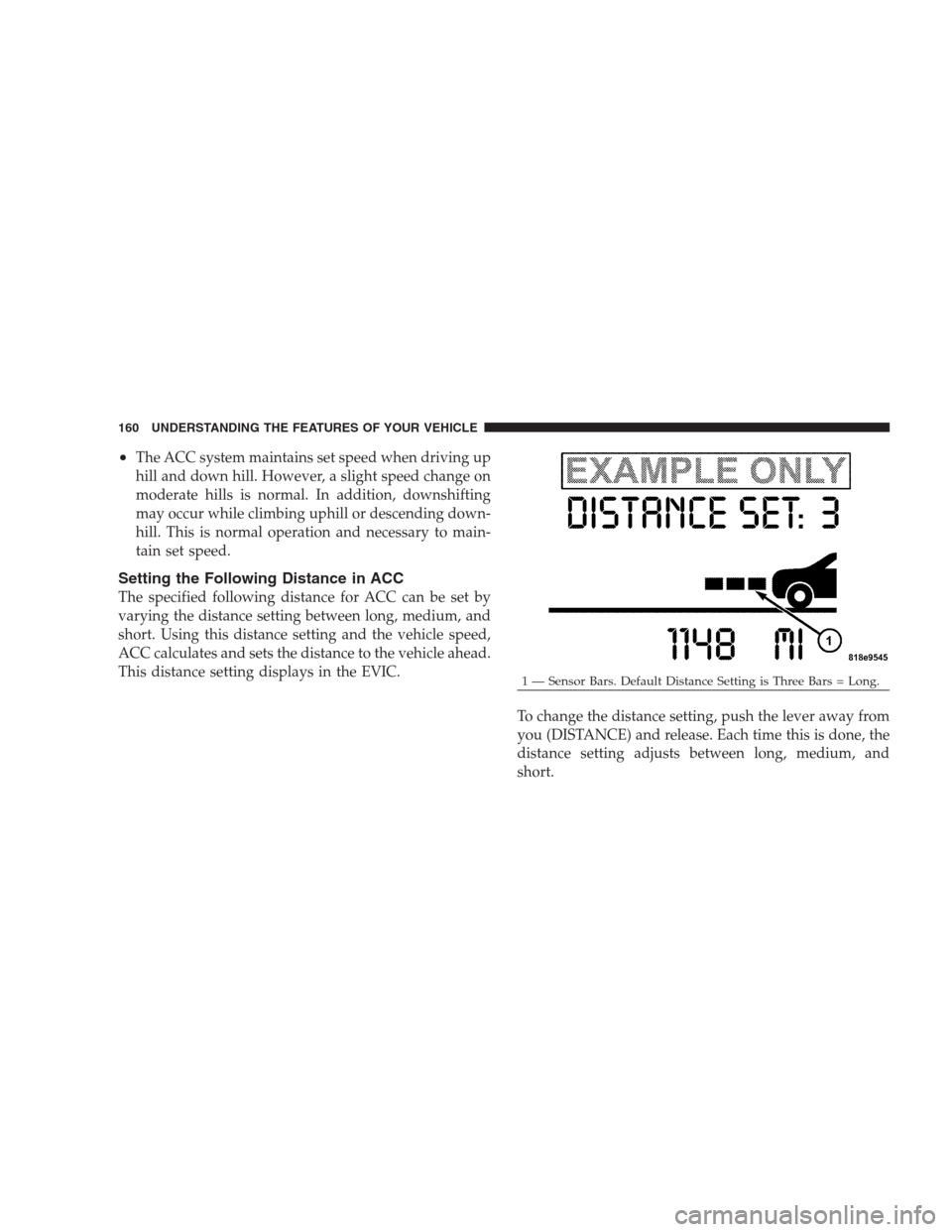
Setting the Following Distance in ACC
The specified following distance for ACC can be set by
varying the distance setting between long, medium, and
short. Using this distance setting and the vehicle speed,
ACC calculates and sets the distance to the vehicle ahead.
This distance setting displays in the EVIC.
To change the distance setting, push the lever away from
you (DISTANCE) and release. Each time this is done, the
distance setting adjusts between long, medium, and
short.
1 — Sensor Bars. Default Distance Setting is Three Bars = Long. 160 UNDERSTANDING THE FEATURES OF YOUR VEHICLE
Page 163 of 493
If there is no vehicle ahead, the vehicle will maintain the
set speed. If a slower moving vehicle is detected in the
same lane, the EVIC displays the “Sensed Vehicle Indi-
cator” icon, and the system adjusts vehicle speed auto-
matically to maintain the distance setting, regardless of
the set speed.
The vehicle will then maintain the set distance until:
•The vehicle ahead accelerates to a speed above the set
speed.
•The vehicle ahead moves out of your lane or view of
the sensor.
•The vehicle ahead slows to a speed below 15 mph
(24 km/h) and the system automatically disengages
itself.
•The distance setting is changed.
•The system disengages. (Refer to the information on
ACC Activation).
The maximum braking applied by ACC is limited; how-
ever, the driver can always apply the brakes manually, if
necessary.
NOTE:The brake lights will illuminate whenever the
ACC system applies the brakes.
UNDERSTANDING THE FEATURES OF YOUR VEHICLE 161
3
Page 165 of 493
Adaptive Cruise Control (ACC) Menu
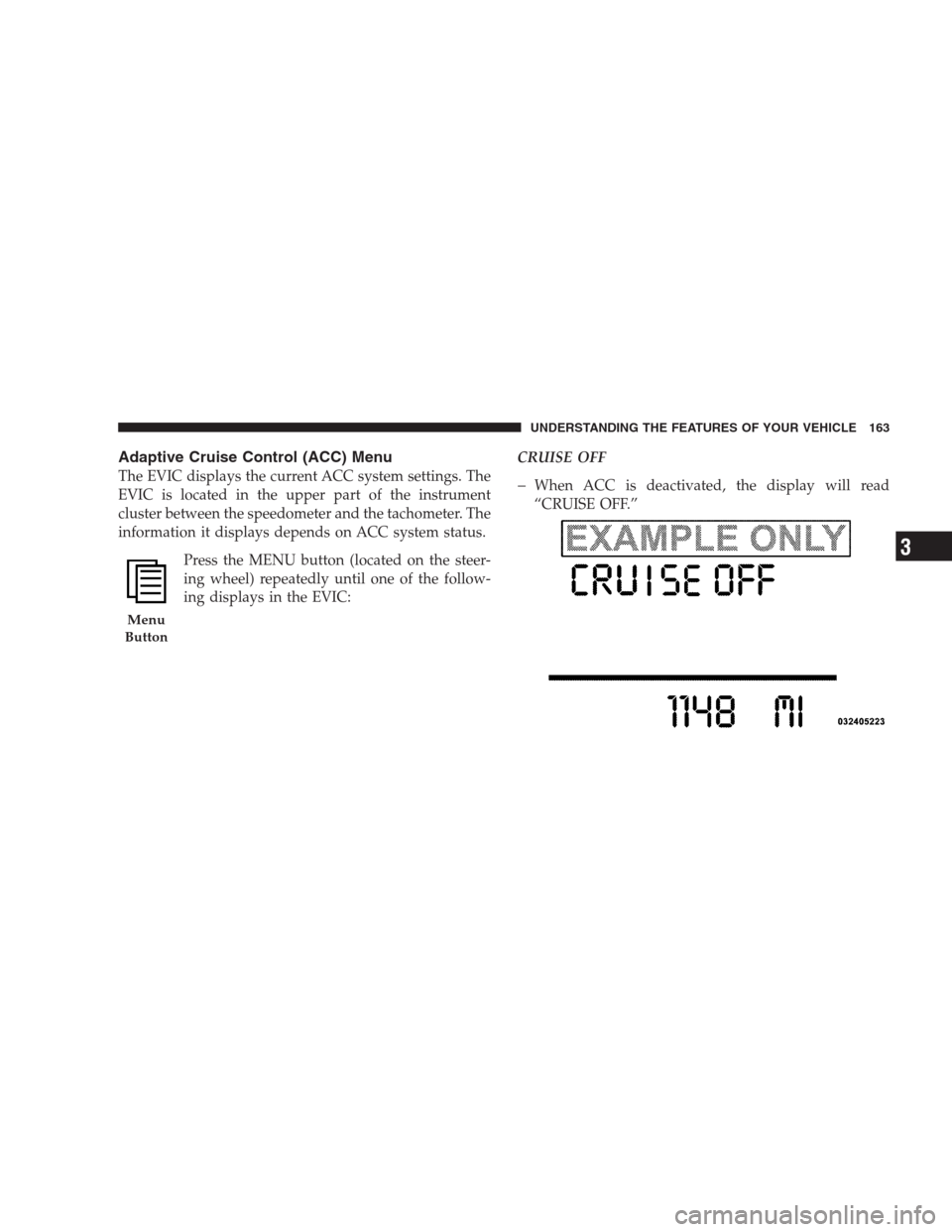
The EVIC displays the current ACC system settings. The
EVIC is located in the upper part of the instrument
cluster between the speedometer and the tachometer. The
information it displays depends on ACC system status.
Press the MENU button (located on the steer-
ing wheel) repeatedly until one of the follow-
ing displays in the EVIC:CRUISE OFFWhen ACC is deactivated, the display will read
“CRUISE OFF.”
Menu
Button
UNDERSTANDING THE FEATURES OF YOUR VEHICLE 163
3
Page 166 of 493
ACC READY
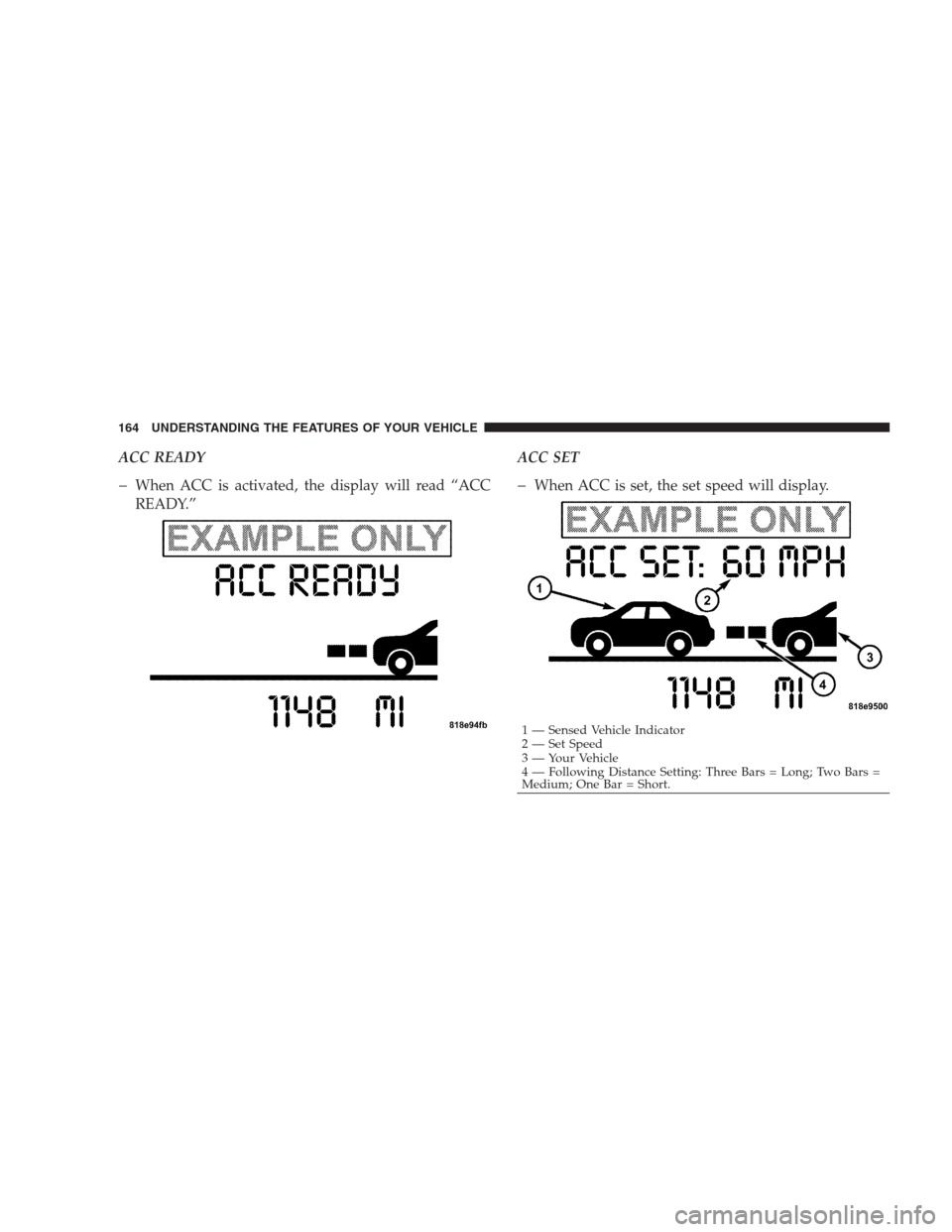
When ACC is activated, the display will read “ACC
READY.”ACC SETWhen ACC is set, the set speed will display.
1 — Sensed Vehicle Indicator
2 — Set Speed
3 — Your Vehicle
4 — Following Distance Setting: Three Bars = Long; Two Bars =
Medium; One Bar = Short. 164 UNDERSTANDING THE FEATURES OF YOUR VEHICLE