ignition CHRYSLER 300 SRT 2014 2.G Owners Manual
[x] Cancel search | Manufacturer: CHRYSLER, Model Year: 2014, Model line: 300 SRT, Model: CHRYSLER 300 SRT 2014 2.GPages: 590, PDF Size: 4.08 MB
Page 481 of 590
CAUTION!
•Do not use sling type equipment when towing.
Damage to the fascia will occur.
• When securing the vehicle to a flatbed truck, do not
attach to the front or rear suspension components.
Damage to your vehicle may result from improper
towing.
• Do not push or tow this vehicle with another
vehicle as damage to the bumper fascia and trans-
mission may result.
• The ignition switch must be in the ON/RUN posi-
tion, not in the OFF or ACC position.
• If the vehicle being towed requires steering, the
ignition switch must be in the ON/RUN position,
not in the OFF or ACC position.
•
The manufacturer does not recommend towing this
vehicle using a tow dolly. Vehicle damage may occur.
The manufacturer recommends towing your vehicle with
all four wheels OFF the ground using a flatbed.
If flatbed equipment is not available, and the transmis-
sion is operable, this vehicle may be towed (with rear
wheels on the ground) under the following conditions:
• The transmission must be in NEUTRAL.
• The towing speed must not exceed 30 mph (48 km/h).
• The towing distance must not exceed 15 miles (24 km).
6
WHAT TO DO IN EMERGENCIES 479
Page 487 of 590
Indicator Light (MIL)” is functioning and is not on when
the engine is running, and that the OBD II system is
ready for testing.
Normally, the OBD II system will be ready. The OBD II
system maynotbe ready if your vehicle was recently
serviced, recently had a dead battery or a battery replace-
ment. If the OBD II system should be determined not
ready for the I/M test, your vehicle may fail the test.
Your vehicle has a simple ignition actuated test, which
you can use prior to going to the test station. To check if
your vehicle’s OBD II system is ready, you must do the
following:
1. Cycle the ignition switch to the ON position, but do not crank or start the engine.
NOTE: If you crank or start the engine, you will have to
start this test over. 2. As soon as you cycle the ignition switch to the ON
position, you will see the MIL symbol come on as part
of a normal bulb check.
3. Approximately 15 seconds later, one of two things will happen:
• The MIL will flash for about 10 seconds and then
return to being fully illuminated until you turn OFF
the ignition or start the engine. This means that your
vehicle’s OBD II system is not readyand you should
not proceed to the I/M station.
• The MIL will not flash at all and will remain fully
illuminated until you turn OFF the ignition or start the
engine. This means that your vehicle’s OBD II system
is ready and you can proceed to the I/M station.
If your OBD II system is not ready,you should see your
authorized dealer or repair facility. If your vehicle was
recently serviced or had a battery failure or replacement,
7
MAINTAINING YOUR VEHICLE 485
Page 501 of 590
To minimize the possibility of catalytic converter dam-
age:
•Do not shut off the engine or interrupt the ignition,
when the transmission is in gear and the vehicle is in
motion.
• Do not try to start the engine by pushing or towing the
vehicle.
• Do not idle the engine with any spark plug wires
disconnected or removed, such as when diagnostic
testing, or for prolonged periods during very rough
idle or malfunctioning operating conditions.Cooling System
WARNING!
• When working near the radiator cooling fan, dis-
connect the fan motor lead or cycle the ignition
switch to the LOCK position. The fan is tempera-
ture controlled and can start at any time the igni-
tion switch is in the ON position.
• You or others can be badly burned by hot engine
coolant (antifreeze) or steam from your radiator. If
you see or hear steam coming from under the hood,
do not open the hood until the radiator has had
time to cool. Never try to open a cooling system
pressure cap when the radiator is hot.
7
MAINTAINING YOUR VEHICLE 499
Page 519 of 590
FUSES
WARNING!
•When replacing a blown fuse, always use an appro-
priate replacement fuse with the same amp rating as
the original fuse. Never replace a fuse with another
fuse of higher amp rating. Never replace a blown
fuse with metal wires or any other material. Failure
to use proper fuses may result in serious personal
injury, fire and/or property damage.
• Before replacing a fuse, make sure that the ignition
is off and that all the other services are switched off
and/or disengaged.
• If the replaced fuse blows again, contact an autho-
rized dealer.
(Continued)
WARNING! (Continued)
•If a general protection fuse for safety systems (air
bag system, braking system), power unit systems
(engine system, gearbox system) or steering system
blows, contact an authorized dealer.
Front Power Distribution Center (Fuses)
The Front Power Distribution Center is located in the
engine compartment. This module contains fuses and
relays.
7
MAINTAINING YOUR VEHICLE 517
Page 527 of 590
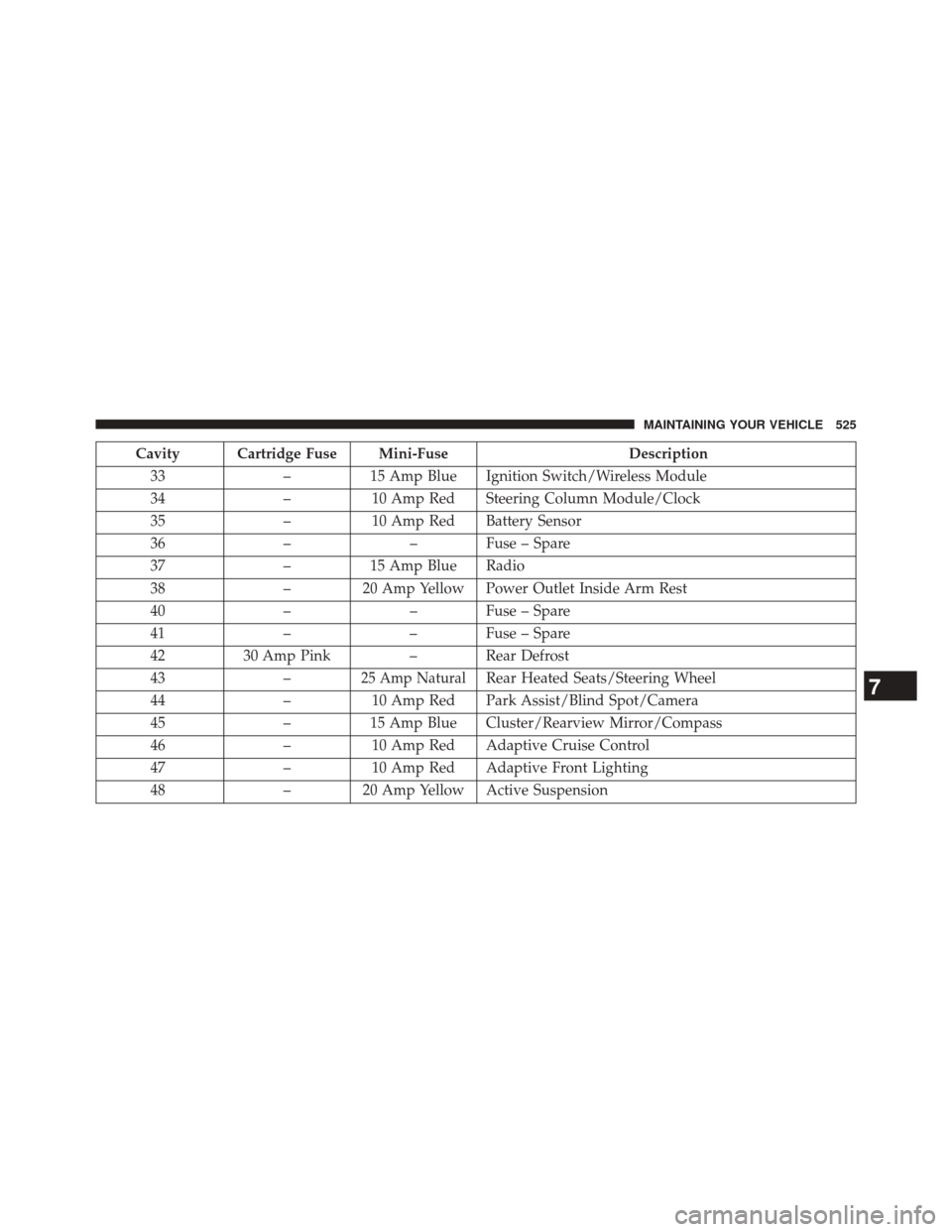
Cavity Cartridge Fuse Mini-FuseDescription
33 –15 Amp Blue Ignition Switch/Wireless Module
34 –10 Amp Red Steering Column Module/Clock
35 –10 Amp Red Battery Sensor
36 –– Fuse – Spare
37 –15 Amp Blue Radio
38 – 20 Amp Yellow Power Outlet Inside Arm Rest
40 –– Fuse – Spare
41 –– Fuse – Spare
42 30 Amp Pink – Rear Defrost
43 –
25 Amp NaturalRear Heated Seats/Steering Wheel
44 –10 Amp Red Park Assist/Blind Spot/Camera
45 –15 Amp Blue Cluster/Rearview Mirror/Compass
46 –10 Amp Red Adaptive Cruise Control
47 –10 Amp Red Adaptive Front Lighting
48 – 20 Amp Yellow Active Suspension7
MAINTAINING YOUR VEHICLE 525
Page 531 of 590
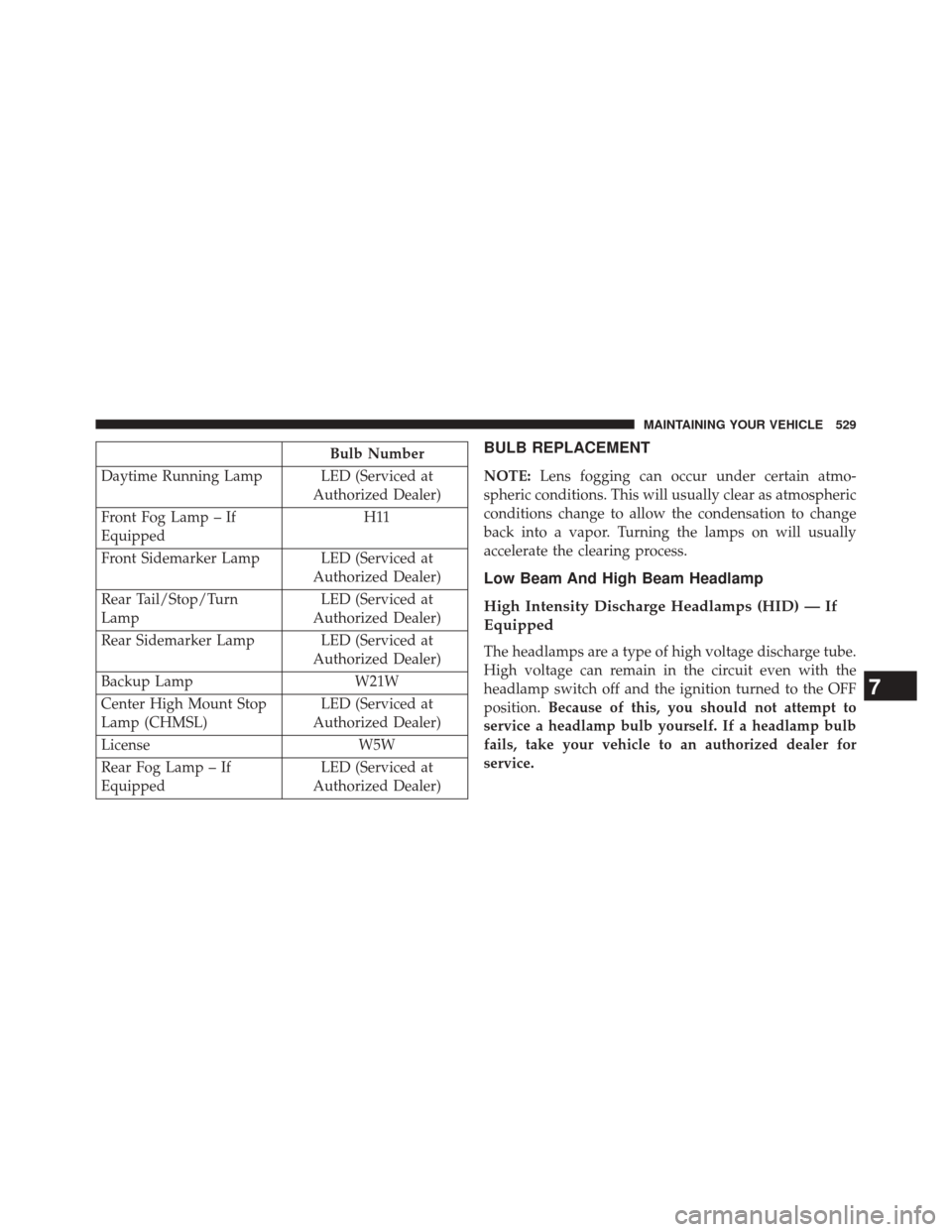
Bulb Number
Daytime Running Lamp LED (Serviced at Authorized Dealer)
Front Fog Lamp – If
Equipped H11
Front Sidemarker Lamp LED (Serviced at Authorized Dealer)
Rear Tail/Stop/Turn
Lamp LED (Serviced at
Authorized Dealer)
Rear Sidemarker Lamp LED (Serviced at Authorized Dealer)
Backup Lamp W21W
Center High Mount Stop
Lamp (CHMSL) LED (Serviced at
Authorized Dealer)
License W5W
Rear Fog Lamp – If
Equipped LED (Serviced at
Authorized Dealer)BULB REPLACEMENT
NOTE: Lens fogging can occur under certain atmo-
spheric conditions. This will usually clear as atmospheric
conditions change to allow the condensation to change
back into a vapor. Turning the lamps on will usually
accelerate the clearing process.
Low Beam And High Beam Headlamp
High Intensity Discharge Headlamps (HID) — If
Equipped
The headlamps are a type of high voltage discharge tube.
High voltage can remain in the circuit even with the
headlamp switch off and the ignition turned to the OFF
position. Because of this, you should not attempt to
service a headlamp bulb yourself. If a headlamp bulb
fails, take your vehicle to an authorized dealer for
service.
7
MAINTAINING YOUR VEHICLE 529
Page 576 of 590
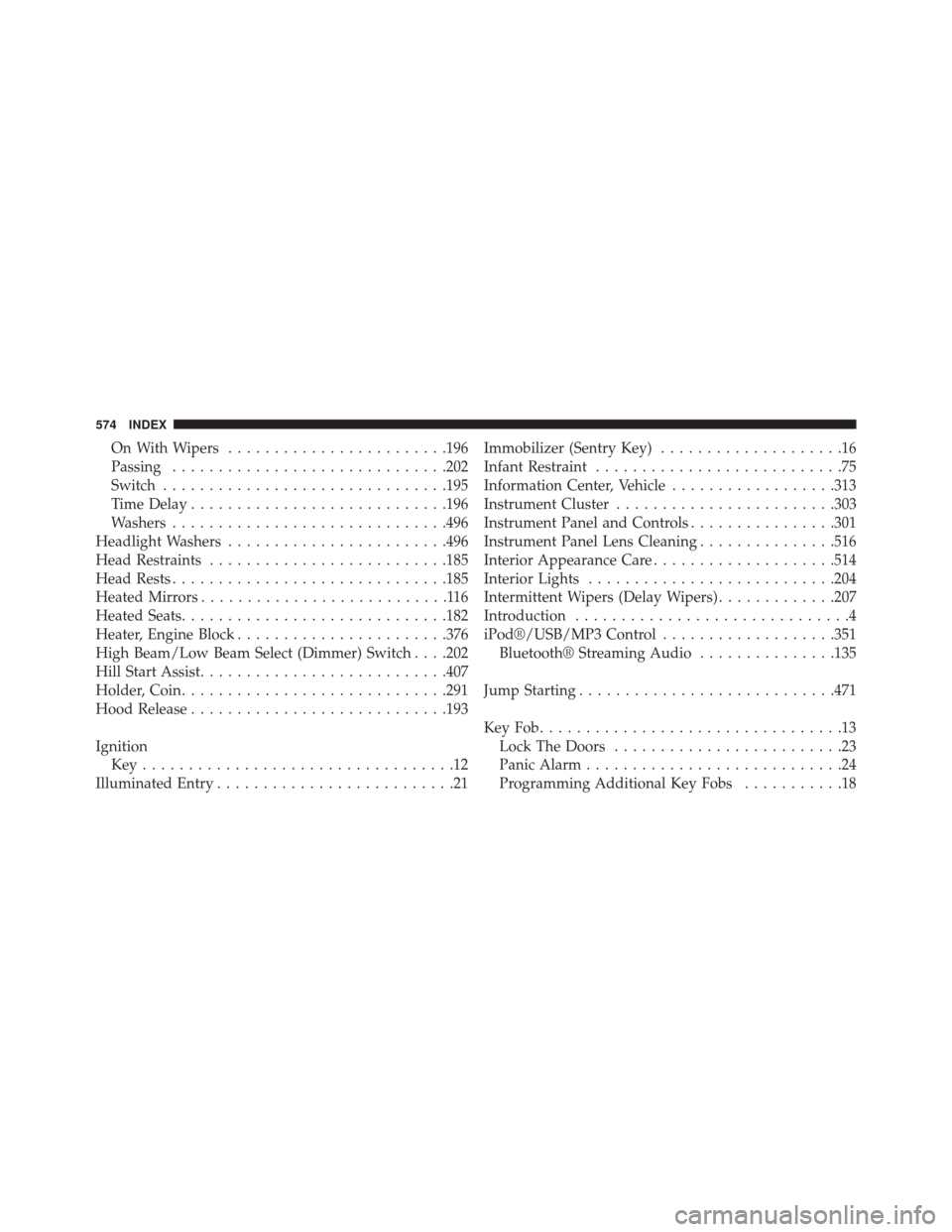
On With Wipers....................... .196
Passing ............................. .202
Switch .............................. .195
Time Delay ........................... .196
Washers ............................. .496
Headlight Washers ....................... .496
Head Restraints ......................... .185
Head Rests ............................. .185
Heated Mirrors ...........................116
Heated Seats ............................ .182
Heater, Engine Block ...................... .376
High Beam/Low Beam Select (Dimmer) Switch . . . .202
Hill Start Assist .......................... .407
Holder, Coin ............................ .291
Hood Release ........................... .193
Ignition Key..................................12
Illuminated Entry ..........................21 Immobilizer (Sentry Key)
....................16
Infant Restraint ...........................75
Information Center, Vehicle ..................313
Instrument Cluster ....................... .303
Instrument Panel and Controls ................301
Instrument Panel Lens Cleaning ...............516
Interior Appearance Care ....................514
Interior Lights .......................... .204
Intermittent Wipers (Delay Wipers) .............207
Introduction ..............................4
iPod®/USB/MP3 Control ...................351
Bluetooth® Streaming Audio ...............135
Jump Starting ........................... .471
KeyFob.................................13 Lock The Doors .........................23
Panic Alarm ............................24
Programming Additional Key Fobs ...........18
574 INDEX