cooling CHRYSLER 300 SRT 2014 2.G User Guide
[x] Cancel search | Manufacturer: CHRYSLER, Model Year: 2014, Model line: 300 SRT, Model: CHRYSLER 300 SRT 2014 2.GPages: 590, PDF Size: 4.08 MB
Page 501 of 590
To minimize the possibility of catalytic converter dam-
age:
•Do not shut off the engine or interrupt the ignition,
when the transmission is in gear and the vehicle is in
motion.
• Do not try to start the engine by pushing or towing the
vehicle.
• Do not idle the engine with any spark plug wires
disconnected or removed, such as when diagnostic
testing, or for prolonged periods during very rough
idle or malfunctioning operating conditions.Cooling System
WARNING!
• When working near the radiator cooling fan, dis-
connect the fan motor lead or cycle the ignition
switch to the LOCK position. The fan is tempera-
ture controlled and can start at any time the igni-
tion switch is in the ON position.
• You or others can be badly burned by hot engine
coolant (antifreeze) or steam from your radiator. If
you see or hear steam coming from under the hood,
do not open the hood until the radiator has had
time to cool. Never try to open a cooling system
pressure cap when the radiator is hot.
7
MAINTAINING YOUR VEHICLE 499
Page 502 of 590
Coolant Checks
Check engine coolant (antifreeze) protection every 12
months (before the onset of freezing weather, where
applicable). If the engine coolant (antifreeze) is dirty, the
system should be drained, flushed, and refilled with
fresh OAT coolant (conforming to MS-12106) only ac-
cording to Chrysler Service Manual procedure or by an
authorized dealer. Check the front of the radiator for any
accumulation of bugs, leaves, etc. If dirty, clean by gently
spraying water from a garden hose vertically down the
face of the condenser.
Check the coolant recovery bottle tubing for brittle rub-
ber, cracking, tears, cuts, and tightness of the connection
at the bottle and radiator. Inspect the entire system for
leaks.With the engine at normal operating temperature (but
not running), check the cooling system pressure cap for
proper vacuum sealing by draining a small amount of
engine coolant (antifreeze) from the radiator drain cock.
If the cap is sealing properly, the engine coolant (anti-
freeze) will begin to drain from the coolant recovery
bottle. DO NOT REMOVE THE COOLANT PRESSURE
CAP WHEN THE COOLING SYSTEM IS HOT.
Cooling System — Drain, Flush And Refill
If the engine coolant (antifreeze) is dirty or contains visible
sediment, have an authorized dealer clean and flush with
OAT coolant (antifreeze) (conforming to MS-12106).
Refer to the “Maintenance Schedule” for the proper
maintenance intervals.
500 MAINTAINING YOUR VEHICLE
Page 503 of 590
NOTE:Some vehicles require special tools to add coolant
properly. Failure to fill these systems properly could lead
to severe internal engine damage. If any coolant is
needed to be added to the system please contact your
local authorized dealer.
Selection Of Coolant
Refer to “Fluids, Lubricants, and Genuine Parts” in
“Maintaining Your Vehicle” for further information.
CAUTION!
• Mixing of engine coolant (antifreeze) other than
specified Organic Additive Technology (OAT) en-
gine coolant (antifreeze), may result in engine
damage and may decrease corrosion protection.
Organic Additive Technology (OAT) engine cool-
ant is different and should not be mixed with
Hybrid Organic Additive Technology (HOAT) en-
gine coolant (antifreeze) or any “globally compat-
ible” coolant (antifreeze). If a non-OAT engine
coolant (antifreeze) is introduced into the cooling
system in an emergency, the cooling system will
need to be drained, flushed, and refilled with fresh
OAT coolant (conforming to MS-12106), by an
authorized dealer as soon as possible.
(Continued)
7
MAINTAINING YOUR VEHICLE 501
Page 505 of 590
•Use only high purity water such as distilled or deion-
ized water when mixing the water/engine coolant
(antifreeze) solution. The use of lower quality water
will reduce the amount of corrosion protection in the
engine cooling system.
Please note that it is the owner’s responsibility to main-
tain the proper level of protection against freezing ac-
cording to the temperatures occurring in the area where
the vehicle is operated.
NOTE:
• Some vehicles require special tools to add coolant
properly. Failure to fill these systems properly could
lead to severe internal engine damage. If any coolant is
needed to be added to the system please contact your
local authorized dealer. •
Mixing engine coolant (antifreeze) types is not recom-
mended and can result in cooling system damage. If
HOAT and OAT coolant are mixed in an emergency,
have a authorized dealer drain, flush, and refill with
OAT coolant (conforming to MS-12106) as soon as
possible.
Cooling System Pressure Cap
The cap must be fully tightened to prevent loss of engine
coolant (antifreeze), and to ensure that engine coolant
(antifreeze) will return to the radiator from the coolant
recovery tank.
The cap should be inspected and cleaned if there is any
accumulation of foreign material on the sealing surfaces.
7
MAINTAINING YOUR VEHICLE 503
Page 506 of 590
WARNING!
•Do not open hot engine cooling system. Never add
engine coolant (antifreeze) when the engine is
overheated. Do not loosen or remove the cap to cool
an overheated engine. Heat causes pressure to
build up in the cooling system. To prevent scalding
or injury, do not remove the pressure cap while the
system is hot or under pressure.
• Do not use a pressure cap other than the one
specified for your vehicle. Personal injury or en-
gine damage may result.
Disposal Of Used Engine Coolant
Used ethylene glycol-based engine coolant (antifreeze) is
a regulated substance requiring proper disposal. Check
with your local authorities to determine the disposal
rules for your community. To prevent ingestion by ani-
mals or children, do not store ethylene glycol-based engine coolant in open containers or allow it to remain in
puddles on the ground. If ingested by a child or pet, seek
emergency assistance immediately. Clean up any ground
spills immediately.
Coolant Level
The coolant bottle provides a quick visual method for
determining that the coolant level is adequate. With the
engine OFF and cold, the level of the engine coolant
(antifreeze) in the bottle should be between the ranges
indicated on the bottle.
The radiator normally remains completely full, so there is
no need to remove the radiator/coolant pressure cap
unless checking for engine coolant (antifreeze) freeze
point or replacing coolant. Advise your service attendant
of this. As long as the engine operating temperature is
satisfactory, the coolant bottle need only be checked once
a month.
504 MAINTAINING YOUR VEHICLE
Page 507 of 590
When additional engine coolant (antifreeze) is needed to
maintain the proper level, only OAT coolant that meets
the requirements of Chrysler Material Standard MS-
12106 should be added to the coolant bottle. Do not
overfill.
Points To Remember
NOTE:When the vehicle is stopped after a few miles/
kilometers of operation, you may observe vapor coming
from the front of the engine compartment. This is nor-
mally a result of moisture from rain, snow, or high
humidity accumulating on the radiator and being vapor-
ized when the thermostat opens, allowing hot engine
coolant (antifreeze) to enter the radiator.
If an examination of your engine compartment shows no
evidence of radiator or hose leaks, the vehicle may be
safely driven. The vapor will soon dissipate.
• Do not overfill the coolant expansion bottle. •
Check the coolant freeze point in the radiator and in
the coolant expansion bottle. If engine coolant (anti-
freeze) needs to be added, the contents of the coolant
expansion bottle must also be protected against freez-
ing.
• If frequent engine coolant (antifreeze) additions are
required, the cooling system should be pressure tested
for leaks.
• Maintain engine coolant (antifreeze) concentration at a
minimum of 50% OAT coolant (conforming to MS-
12106) and distilled water for proper corrosion protec-
tion of your engine which contains aluminum compo-
nents.
• Make sure that the coolant expansion bottle overflow
hoses are not kinked or obstructed.
• Keep the front of the radiator clean. If your vehicle is
equipped with air conditioning, keep the front of the
condenser clean.
7
MAINTAINING YOUR VEHICLE 505
Page 536 of 590
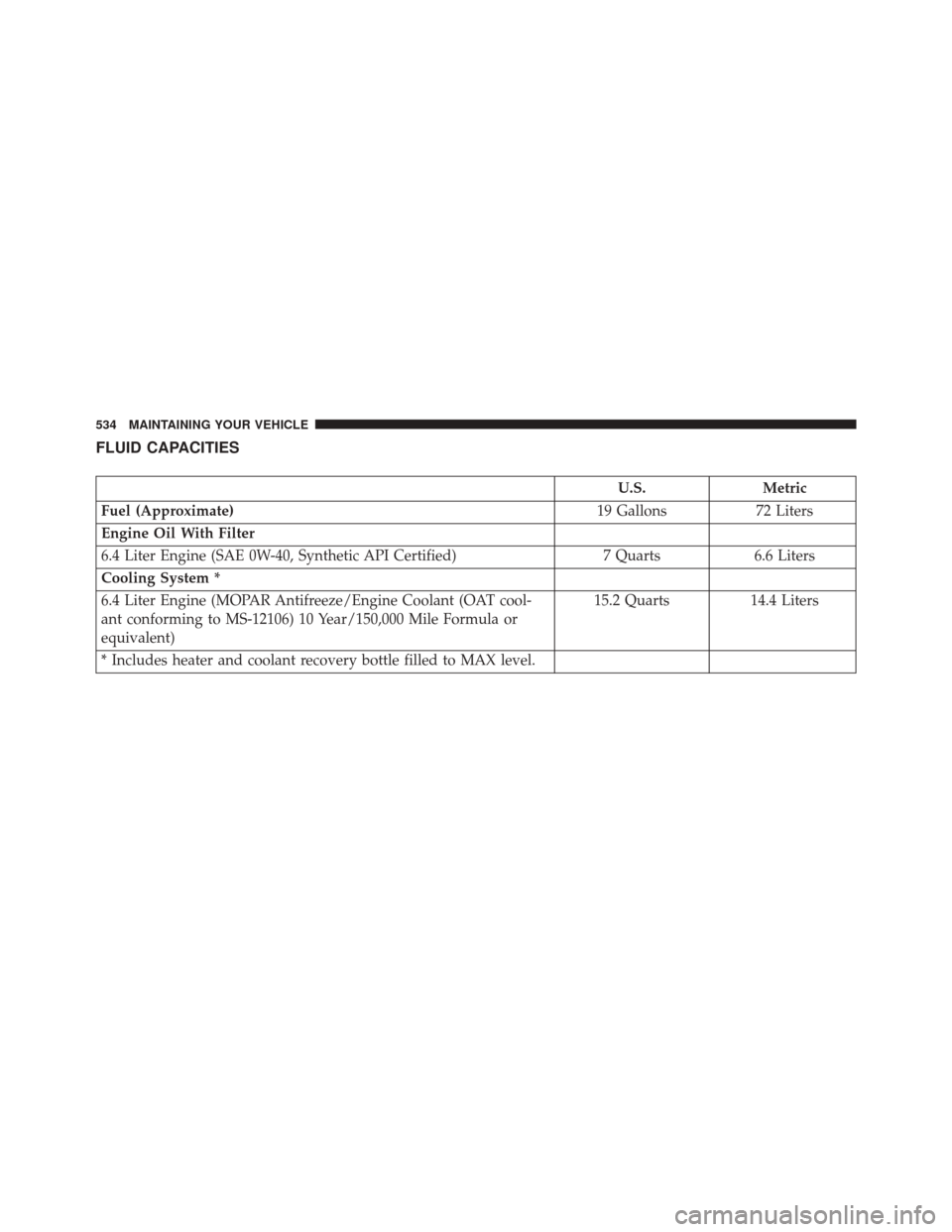
FLUID CAPACITIES
U.S.Metric
Fuel (Approximate) 19 Gallons72 Liters
Engine Oil With Filter
6.4 Liter Engine (SAE 0W-40, Synthetic API Certified) 7 Quarts6.6 Liters
Cooling System *
6.4 Liter Engine (MOPAR Antifreeze/Engine Coolant (OAT cool-
ant conforming to MS-12106) 10 Year/150,000 Mile Formula or
equivalent) 15.2 Quarts
14.4 Liters
* Includes heater and coolant recovery bottle filled to MAX level.
534 MAINTAINING YOUR VEHICLE
Page 571 of 590
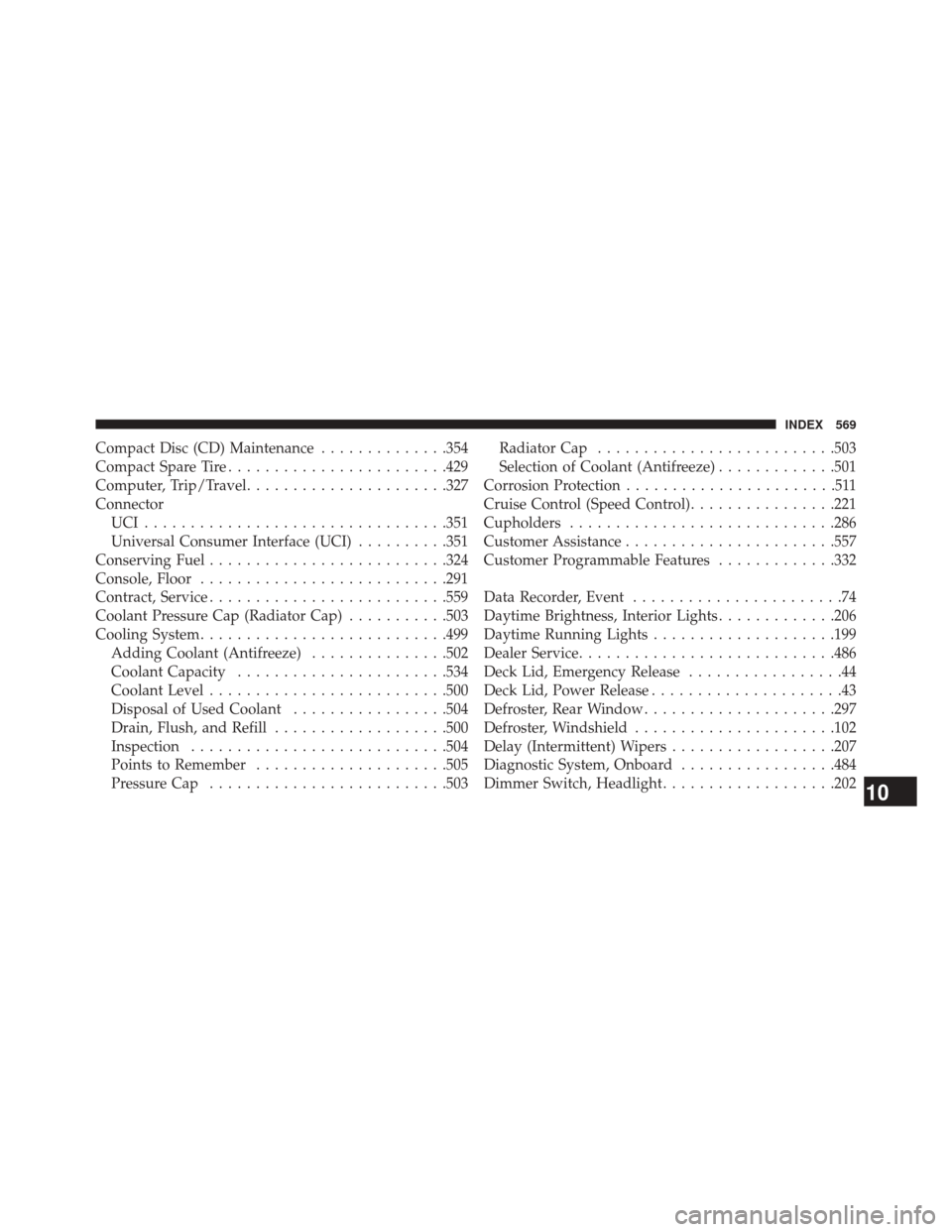
Compact Disc (CD) Maintenance..............354
Compact Spare Tire ....................... .429
Computer, Trip/Travel ..................... .327
Connector UCI................................ .351
Universal Consumer Interface (UCI) ..........351
Conserving Fuel ......................... .324
Console, Floor .......................... .291
Contract, Service ......................... .559
Coolant Pressure Cap (Radiator Cap) ...........503
Cooling System .......................... .499
Adding Coolant (Antifreeze) ...............502
Coolant Capacity ...................... .534
Coolant Level ......................... .500
Disposal of Used Coolant .................504
Drain, Flush, and Refill ...................500
Inspection ........................... .504
Points to Remember .....................505
Pressure Cap ......................... .503Radiator Cap
......................... .503
Selection of Coolant (Antifreeze) .............501
Corrosion Protection .......................511
Cruise Control (Speed Control) ................221
Cupholders ............................ .286
Customer Assistance ...................... .557
Customer Programmable Features .............332
Data Recorder, Event .......................74
Daytime Brightness, Interior Lights .............206
Daytime Running Lights ....................199
Dealer Service ........................... .486
Deck Lid, Emergency Release .................44
Deck Lid, Power Release .....................43
Defroster, Rear Window .....................297
Defroster, Windshield ..................... .102
Delay (Intermittent) Wipers ..................207
Diagnostic System, Onboard .................484
Dimmer Switch, Headlight ...................202
10
INDEX 569
Page 573 of 590
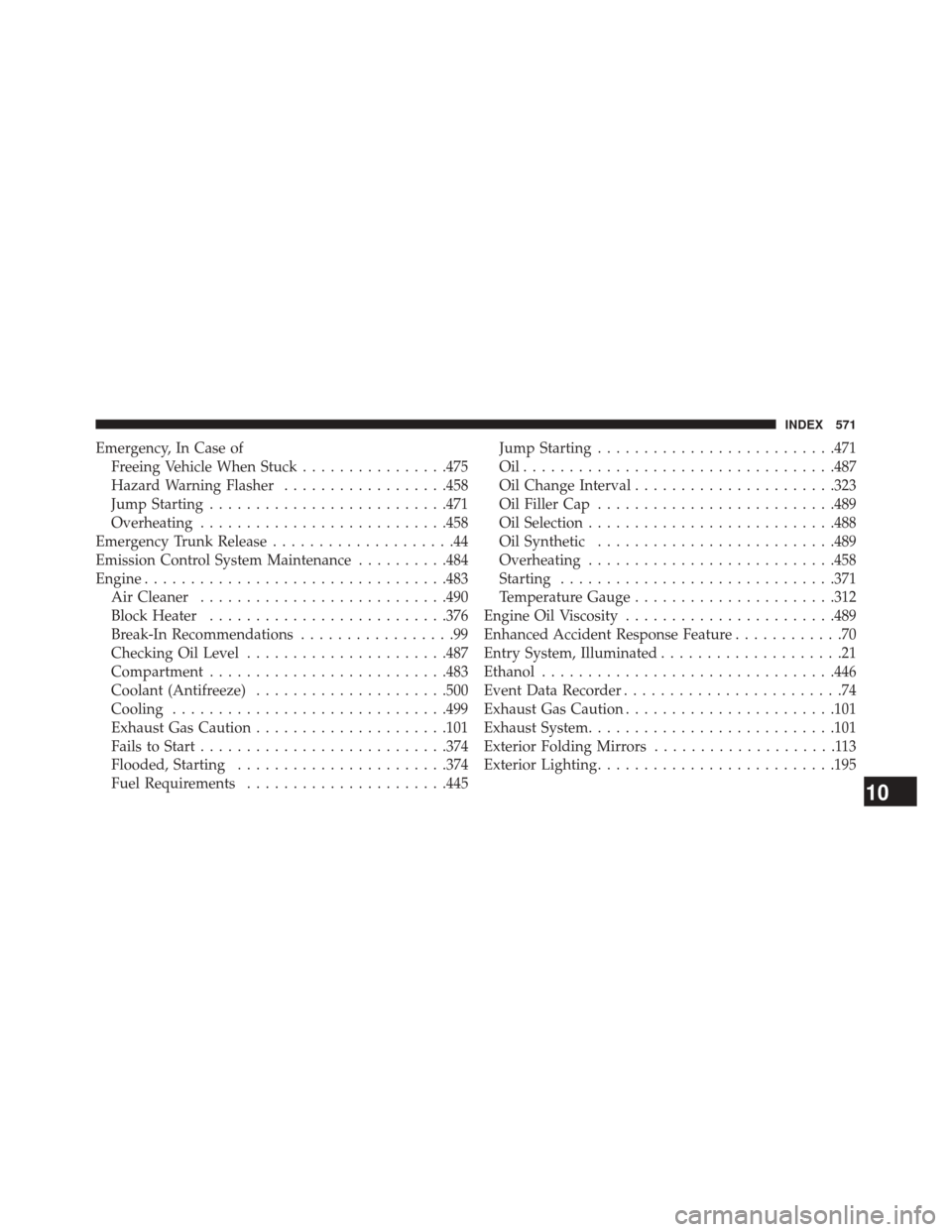
Emergency, In Case ofFreeing Vehicle When Stuck ................475
Hazard Warning Flasher ..................458
Jump Starting ......................... .471
Overheating .......................... .458
Emergency Trunk Release ....................44
Emission Control System Maintenance ..........484
Engine ................................ .483
Air Cleaner .......................... .490
Block Heater ......................... .376
Break-In Recommendations .................99
Checking Oil Level ..................... .487
Compartment ......................... .483
Coolant (Antifreeze) .....................500
Cooling ............................. .499
Exhaust Gas Caution .....................101
Fails to Start .......................... .374
Flooded, Starting ...................... .374
Fuel Requirements ..................... .445Jump Starting
......................... .471
Oil................................. .487
Oil Change Interval ..................... .323
Oil Filler Cap ......................... .489
Oil Selection .......................... .488
Oil Synthetic ......................... .489
Overheating .......................... .458
Starting ............................. .371
Temperature Gauge ..................... .312
Engine Oil Viscosity ...................... .489
Enhanced Accident Response Feature ............70
Entry System, Illuminated ....................21
Ethanol ............................... .446
Event Data Recorder ........................74
Exhaust Gas Caution ...................... .101
Exhaust System .......................... .101
Exterior Folding Mirrors ....................113
Exterior Lighting ......................... .195
10
INDEX 571
Page 574 of 590
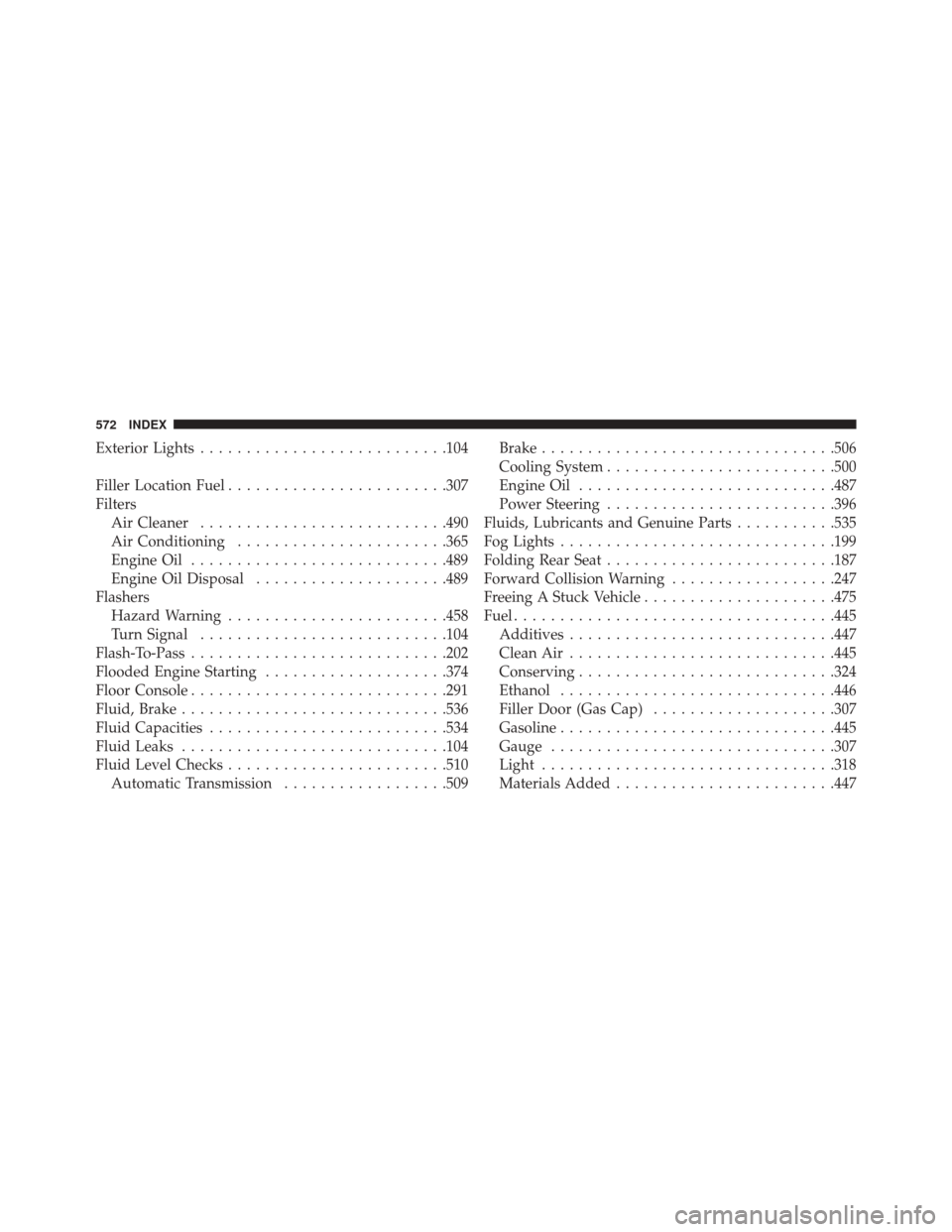
Exterior Lights.......................... .104
Filler Location Fuel ....................... .307
Filters Air Cleaner .......................... .490
Air Conditioning ...................... .365
Engine Oil ........................... .489
Engine Oil Disposal .....................489
Flashers Hazard Warning ....................... .458
Turn Signal .......................... .104
Flash-To-Pass ........................... .202
Flooded Engine Starting ....................374
Floor Console ........................... .291
Fluid, Brake ............................ .536
Fluid Capacities ......................... .534
Fluid Leaks ............................ .104
Fluid Level Checks ....................... .510
Automatic Transmission ..................509 Brake
............................... .506
Cooling System ........................ .500
Engine Oil ........................... .487
Power Steering ........................ .396
Fluids, Lubricants and Genuine Parts ...........535
Fog Lights ............................. .199
Folding Rear Seat ........................ .187
Forward Collision Warning ..................247
Freeing A Stuck Vehicle .....................475
Fuel .................................. .445
Additives ............................ .447
Clean Air ............................ .445
Conserving ........................... .324
Ethanol ............................. .446
Filler Door (Gas Cap) ....................307
Gasoline ............................. .445
Gauge .............................. .307
Light ............................... .318
Materials
Added....................... .447
572 INDEX