trailer CHRYSLER ASPEN 2008 2.G Owner's Manual
[x] Cancel search | Manufacturer: CHRYSLER, Model Year: 2008, Model line: ASPEN, Model: CHRYSLER ASPEN 2008 2.GPages: 479, PDF Size: 4.3 MB
Page 354 of 479
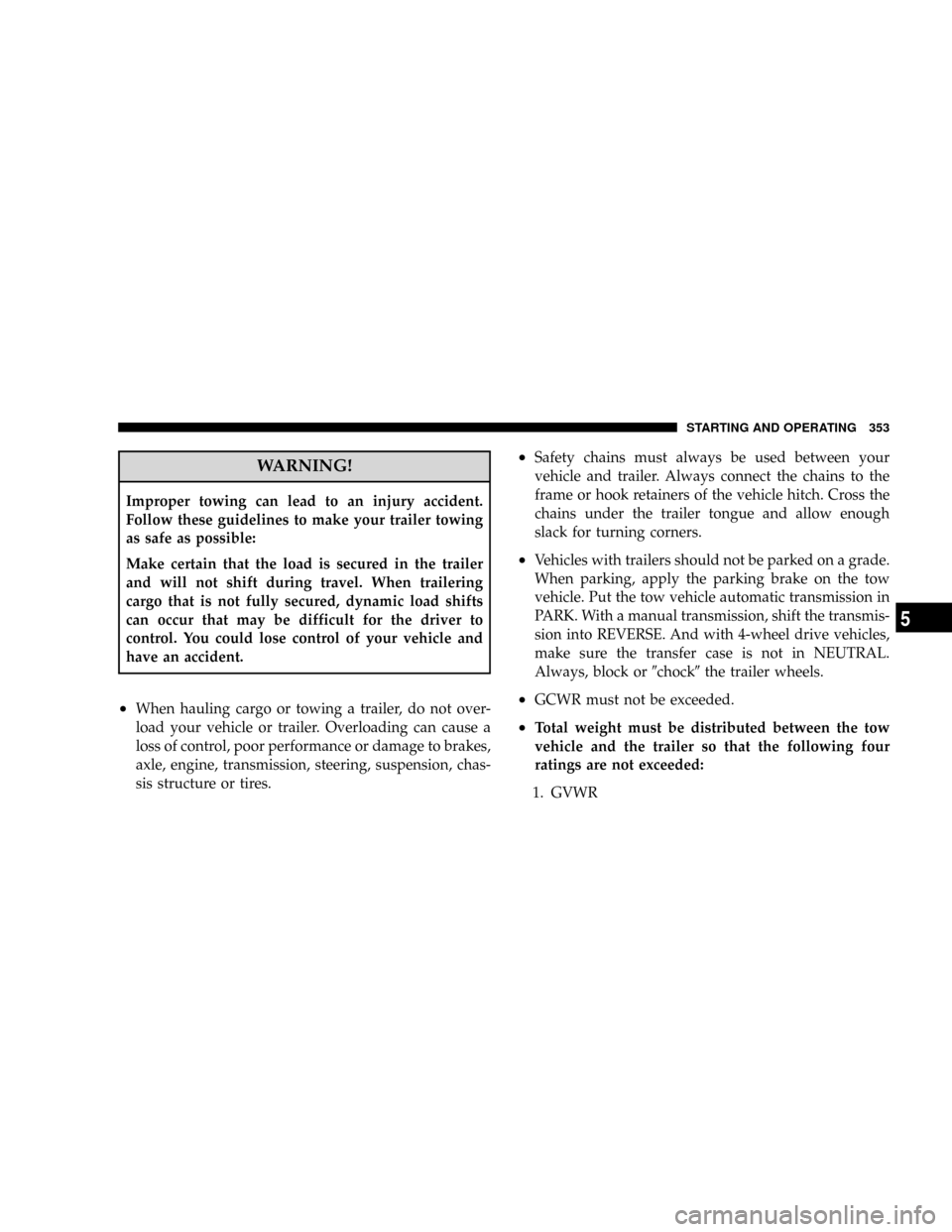
WARNING!
Improper towing can lead to an injury accident.
Follow these guidelines to make your trailer towing
as safe as possible:
Make certain that the load is secured in the trailer
and will not shift during travel. When trailering
cargo that is not fully secured, dynamic load shifts
can occur that may be difficult for the driver to
control. You could lose control of your vehicle and
have an accident.
²When hauling cargo or towing a trailer, do not over-
load your vehicle or trailer. Overloading can cause a
loss of control, poor performance or damage to brakes,
axle, engine, transmission, steering, suspension, chas-
sis structure or tires.
²Safety chains must always be used between your
vehicle and trailer. Always connect the chains to the
frame or hook retainers of the vehicle hitch. Cross the
chains under the trailer tongue and allow enough
slack for turning corners.
²Vehicles with trailers should not be parked on a grade.
When parking, apply the parking brake on the tow
vehicle. Put the tow vehicle automatic transmission in
PARK. With a manual transmission, shift the transmis-
sion into REVERSE. And with 4-wheel drive vehicles,
make sure the transfer case is not in NEUTRAL.
Always, block or9chock9the trailer wheels.
²GCWR must not be exceeded.
²Total weight must be distributed between the tow
vehicle and the trailer so that the following four
ratings are not exceeded:
1. GVWR
STARTING AND OPERATING 353
5
Page 355 of 479
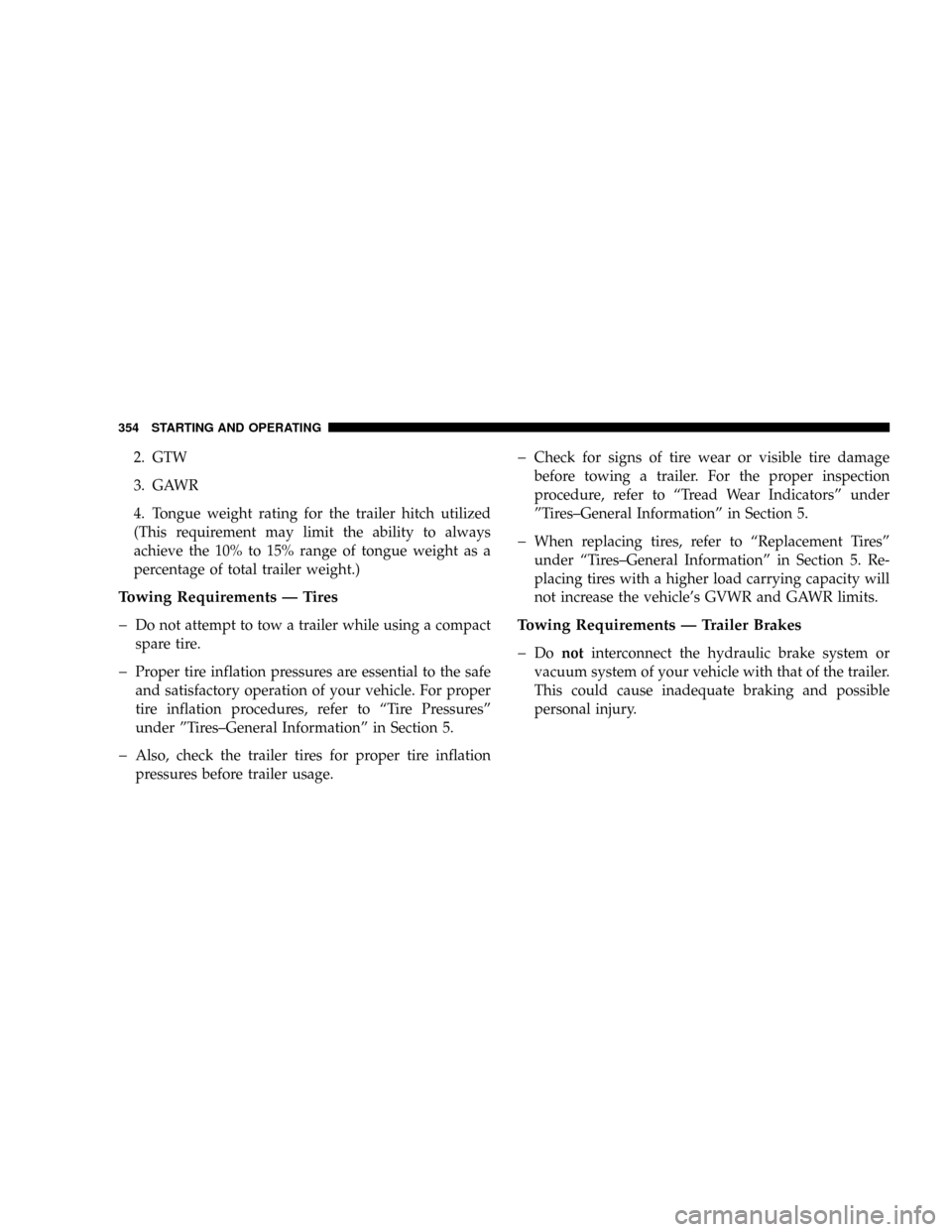
2. GTW
3. GAWR
4. Tongue weight rating for the trailer hitch utilized
(This requirement may limit the ability to always
achieve the 10% to 15% range of tongue weight as a
percentage of total trailer weight.)
Towing Requirements Ð Tires
þ
Do not attempt to tow a trailer while using a compact
spare tire.
þProper tire inflation pressures are essential to the safe
and satisfactory operation of your vehicle. For proper
tire inflation procedures, refer to ªTire Pressuresº
under ºTires±General Informationº in Section 5.
þAlso, check the trailer tires for proper tire inflation
pressures before trailer usage.
þCheck for signs of tire wear or visible tire damage
before towing a trailer. For the proper inspection
procedure, refer to ªTread Wear Indicatorsº under
ºTires±General Informationº in Section 5.
þWhen replacing tires, refer to ªReplacement Tiresº
under ªTires±General Informationº in Section 5. Re-
placing tires with a higher load carrying capacity will
not increase the vehicle's GVWR and GAWR limits.
Towing Requirements Ð Trailer Brakes
þ
Donotinterconnect the hydraulic brake system or
vacuum system of your vehicle with that of the trailer.
This could cause inadequate braking and possible
personal injury.
354 STARTING AND OPERATING
Page 356 of 479

þAn electronically actuated trailer brake controller is
required when towing a trailer with electronically
actuated brakes. When towing a trailer equipped with
a hydraulic surge actuated brake system, an electronic
brake controller is not required.
þTrailer brakes are recommended for trailers over 1,000
lbs (454 kg) and required for trailers in excess of 2,000
lbs (907 kg).
CAUTION!
If the trailer weighs more than 1,000 lbs (454 kg)
loaded, it should have its own brakes and they
should be of adequate capacity. Failure to do this
could lead to accelerated brake lining wear, higher
brake pedal effort, and longer stopping distances.
WARNING!
Do not connect trailer brakes to your vehicle's hy-
draulic brake lines. It can overload your brake sys-
tem and cause it to fail. You might not have brakes
when you need them and could have an accident.
Towing any trailer will increase your stopping dis-
tance. When towing you should allow for additional
space between your vehicle and the vehicle in front
of you. Failure to do so could result in an accident.
STARTING AND OPERATING 355
5
Page 357 of 479

Towing Requirements Ð Trailer Lights and Wiring
Whenever you pull a trailer, regardless of the trailer size,
stop lights and turn signals on the trailer are required for
motoring safety.
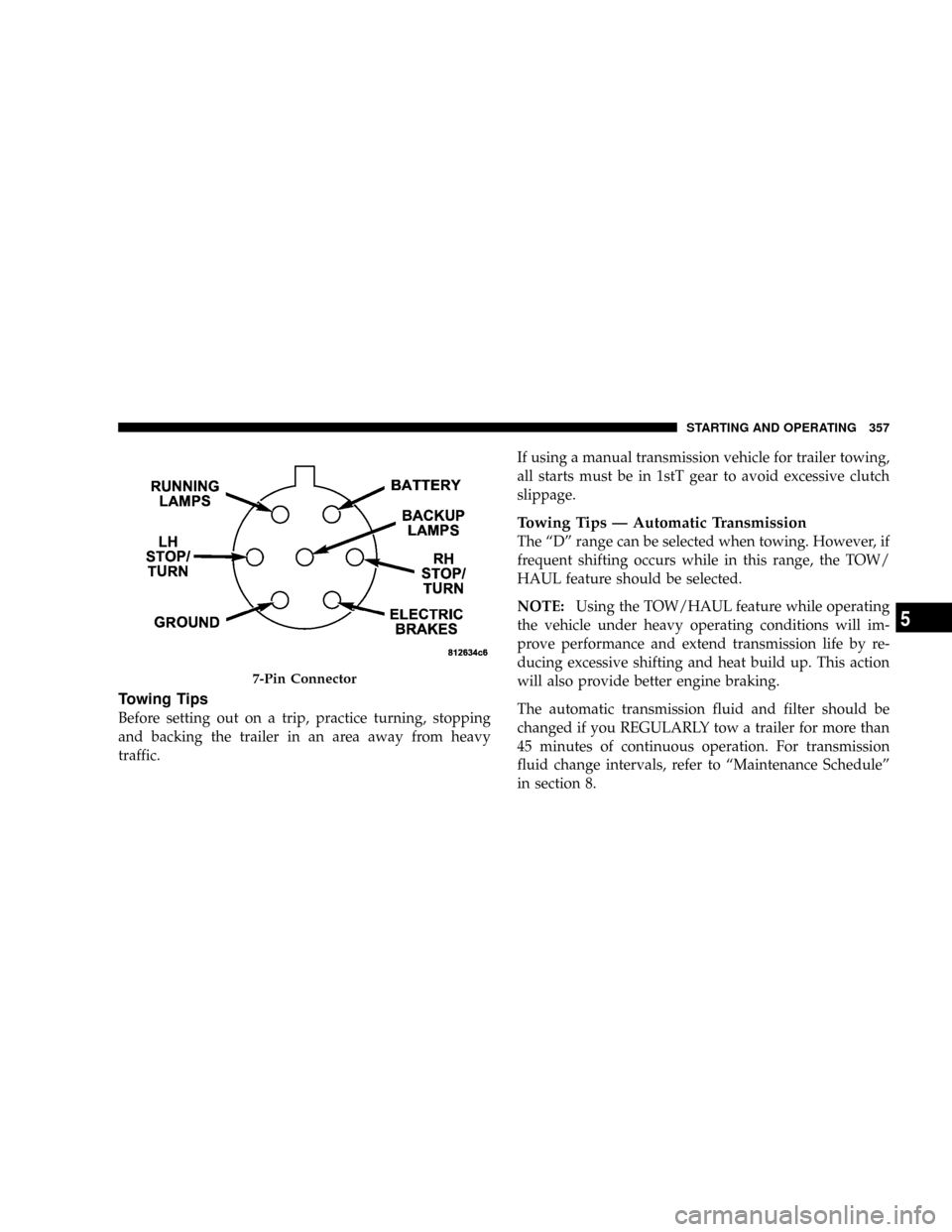
The Trailer Tow Package may include a 4- and 7-pin
wiring harness. Use a factory approved trailer harness
and connector.
NOTE:Do not cut or splice wiring into the vehicle's
wiring harness.
The electrical connections are all complete to the vehicle
but you must mate the harness to a trailer connector.
Refer to the following illustrations:
4-Pin Connector
356 STARTING AND OPERATING
Page 358 of 479
Towing Tips
Before setting out on a trip, practice turning, stopping
and backing the trailer in an area away from heavy
traffic.If using a manual transmission vehicle for trailer towing,
all starts must be in 1stT gear to avoid excessive clutch
slippage.
Towing Tips Ð Automatic Transmission
The ªDº range can be selected when towing. However, if
frequent shifting occurs while in this range, the TOW/
HAUL feature should be selected.
NOTE:Using the TOW/HAUL feature while operating
the vehicle under heavy operating conditions will im-
prove performance and extend transmission life by re-
ducing excessive shifting and heat build up. This action
will also provide better engine braking.
The automatic transmission fluid and filter should be
changed if you REGULARLY tow a trailer for more than
45 minutes of continuous operation. For transmission
fluid change intervals, refer to ªMaintenance Scheduleº
in section 8.
7-Pin Connector
STARTING AND OPERATING 357
5
Page 426 of 479
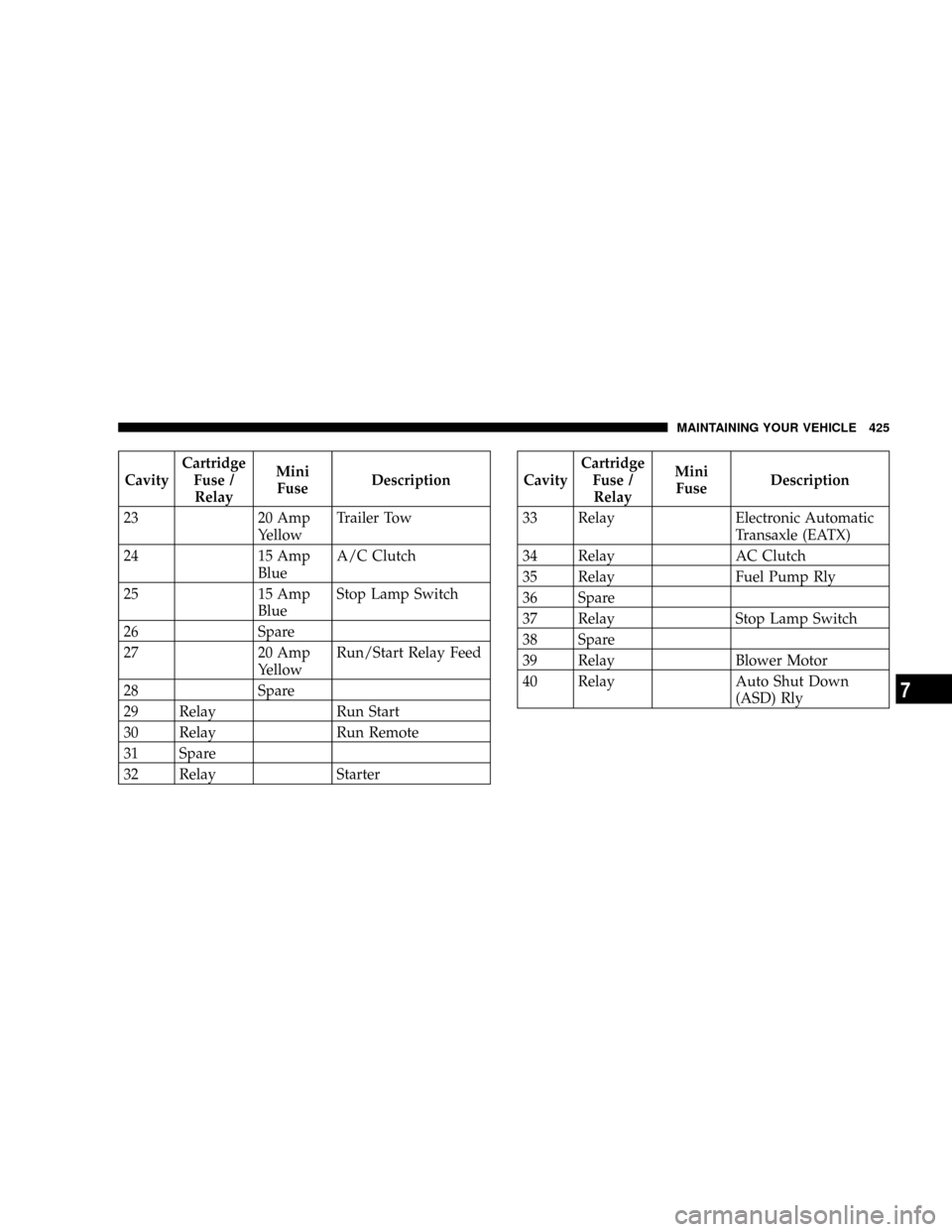
CavityCartridge
Fuse /
RelayMini
FuseDescription
23 20 Amp
YellowTrailer Tow
24 15 Amp
BlueA/C Clutch
25 15 Amp
BlueStop Lamp Switch
26 Spare
27 20 Amp
YellowRun/Start Relay Feed
28 Spare
29 Relay Run Start
30 Relay Run Remote
31 Spare
32 Relay StarterCavityCartridge
Fuse /
RelayMini
FuseDescription
33 Relay Electronic Automatic
Transaxle (EATX)
34 Relay AC Clutch
35 Relay Fuel Pump Rly
36 Spare
37 Relay Stop Lamp Switch
38 Spare
39 Relay Blower Motor
40 Relay Auto Shut Down
(ASD) Rly
MAINTAINING YOUR VEHICLE 425
7
Page 427 of 479
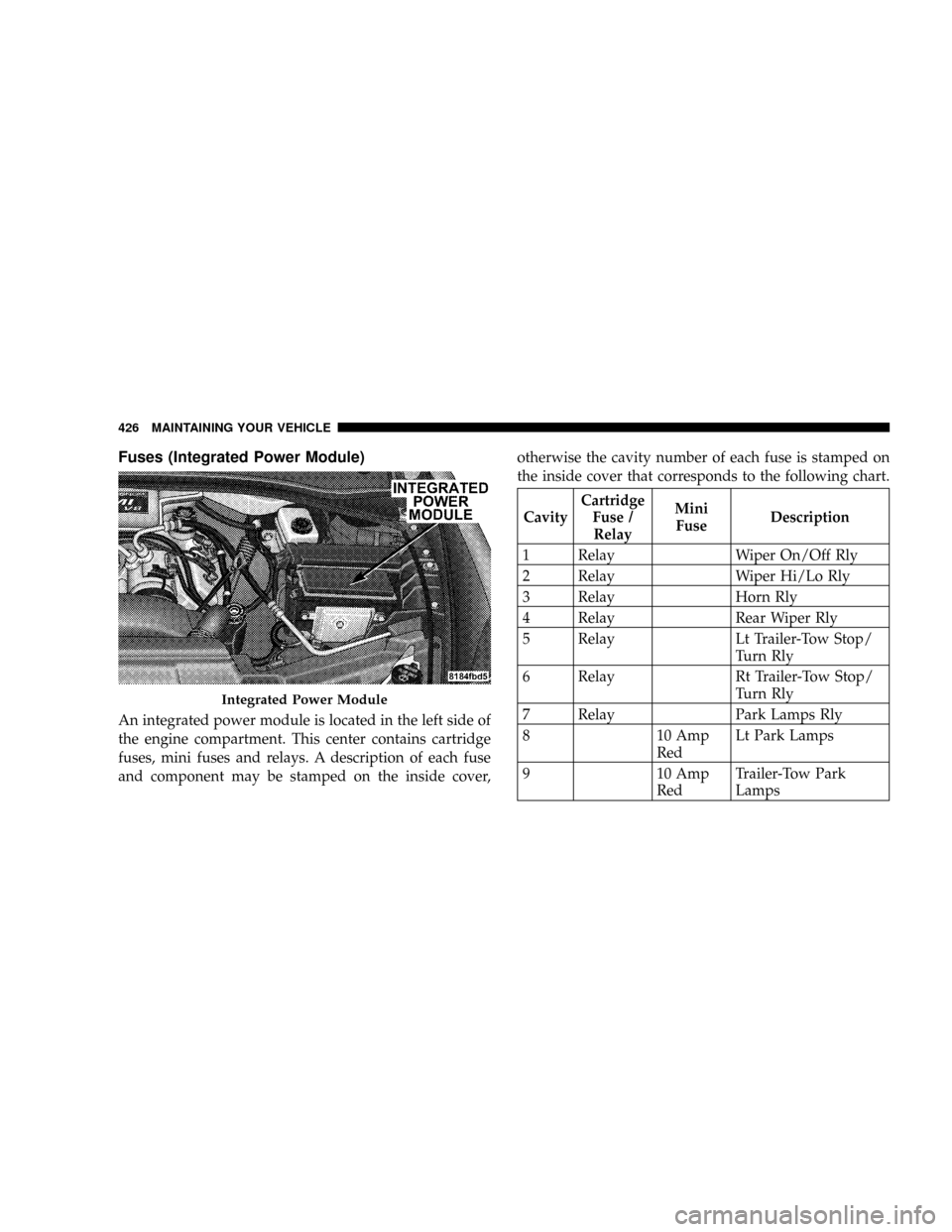
Fuses (Integrated Power Module)
An integrated power module is located in the left side of
the engine compartment. This center contains cartridge
fuses, mini fuses and relays. A description of each fuse
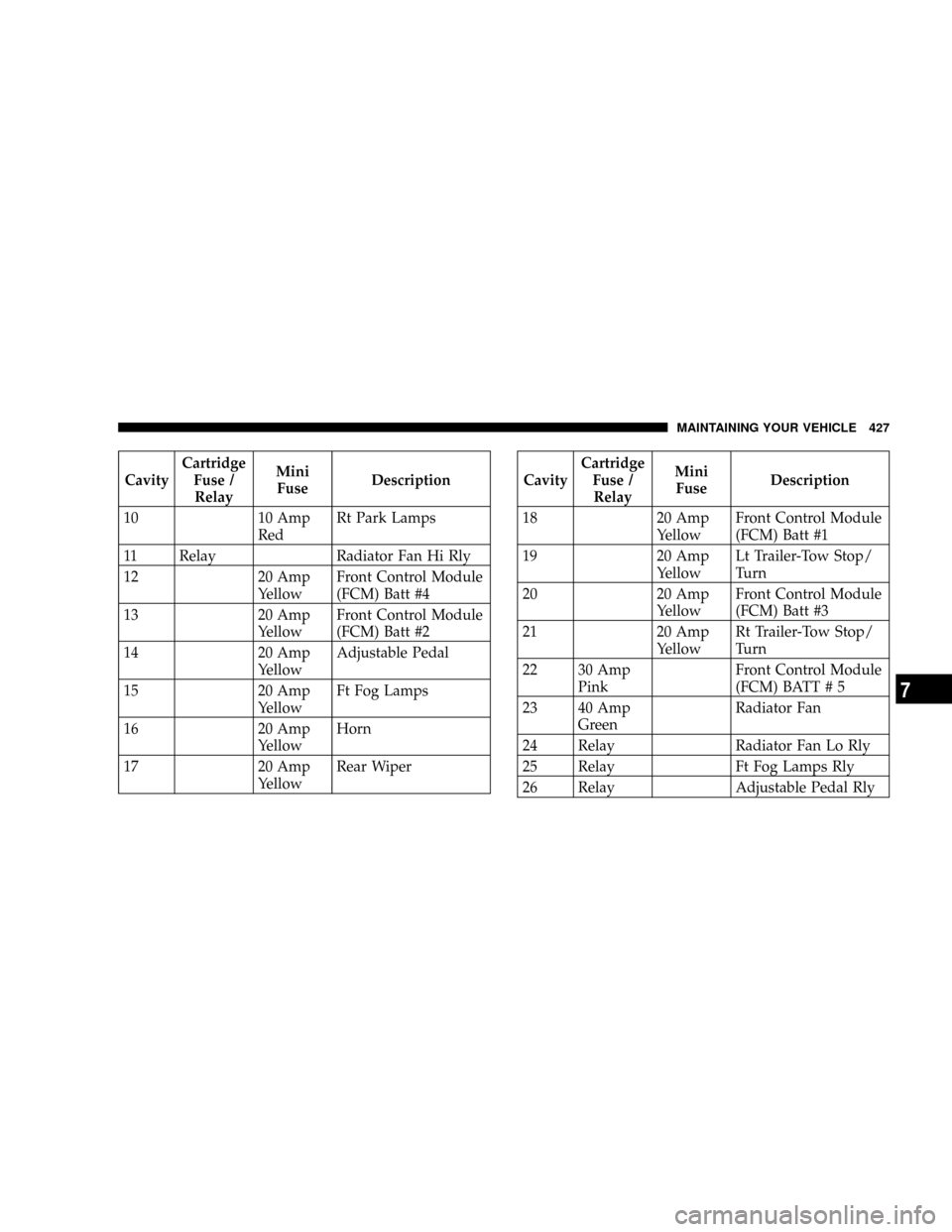
and component may be stamped on the inside cover,otherwise the cavity number of each fuse is stamped on
the inside cover that corresponds to the following chart.
CavityCartridge
Fuse /
RelayMini
FuseDescription
1 Relay Wiper On/Off Rly
2 Relay Wiper Hi/Lo Rly
3 Relay Horn Rly
4 Relay Rear Wiper Rly
5 Relay Lt Trailer-Tow Stop/
Turn Rly
6 Relay Rt Trailer-Tow Stop/
Turn Rly
7 Relay Park Lamps Rly
8 10 Amp
RedLt Park Lamps
9 10 Amp
RedTrailer-Tow Park
Lamps
Integrated Power Module
426 MAINTAINING YOUR VEHICLE
Page 428 of 479
CavityCartridge
Fuse /
RelayMini
FuseDescription
10 10 Amp
RedRt Park Lamps
11 Relay Radiator Fan Hi Rly
12 20 Amp
YellowFront Control Module
(FCM) Batt #4
13 20 Amp
YellowFront Control Module
(FCM) Batt #2
14 20 Amp
YellowAdjustable Pedal
15 20 Amp
YellowFt Fog Lamps
16 20 Amp
YellowHorn
17 20 Amp
YellowRear WiperCavityCartridge
Fuse /
RelayMini
FuseDescription
18 20 Amp
YellowFront Control Module
(FCM) Batt #1
19 20 Amp
YellowLt Trailer-Tow Stop/
Turn
20 20 Amp
YellowFront Control Module
(FCM) Batt #3
21 20 Amp
YellowRt Trailer-Tow Stop/
Turn
22 30 Amp
PinkFront Control Module
(FCM) BATT # 5
23 40 Amp
GreenRadiator Fan
24 Relay Radiator Fan Lo Rly
25 Relay Ft Fog Lamps Rly
26 Relay Adjustable Pedal Rly
MAINTAINING YOUR VEHICLE 427
7
Page 444 of 479

Perform Maintenance Every(Where time and mileage
are listed, follow the interval that occurs first.)
Maintenance Items Miles Kilometers or Months
Change the engine oil and engine oil filter. 6,000 10 000 6
Rotate tires. 6,000 10 000 6
If using your vehicle for any of the following: Dusty or
off-road conditions. Inspect the engine air cleaner filter;
replace if necessary.12,000 20 000 12
Inspect the brake linings; replace if necessary. 12,000 20 000 12
Inspect the front and rear axle fluid; change if using your
vehicle for police, taxi, fleet, off-road or frequent trailer
towing.18,000 30 000 18
Inspect the CV joints. Perform the first inspection at
12,000 mi (20 000 km) or 12 months.24,000 40 000 24
Inspect exhaust system. Perform the first inspection at
12,000 mi (20 000 km) or 12 months.24,000 40 000 24
Inspect the front suspension, tie rod ends and boot seals;
replace if necessary.24,000 40 000 24
MAINTENANCE SCHEDULES 443
8
M
A
I
N
T
E
N
A
N
C
E
S
C
H
E
D
U
L
E
S
Page 445 of 479
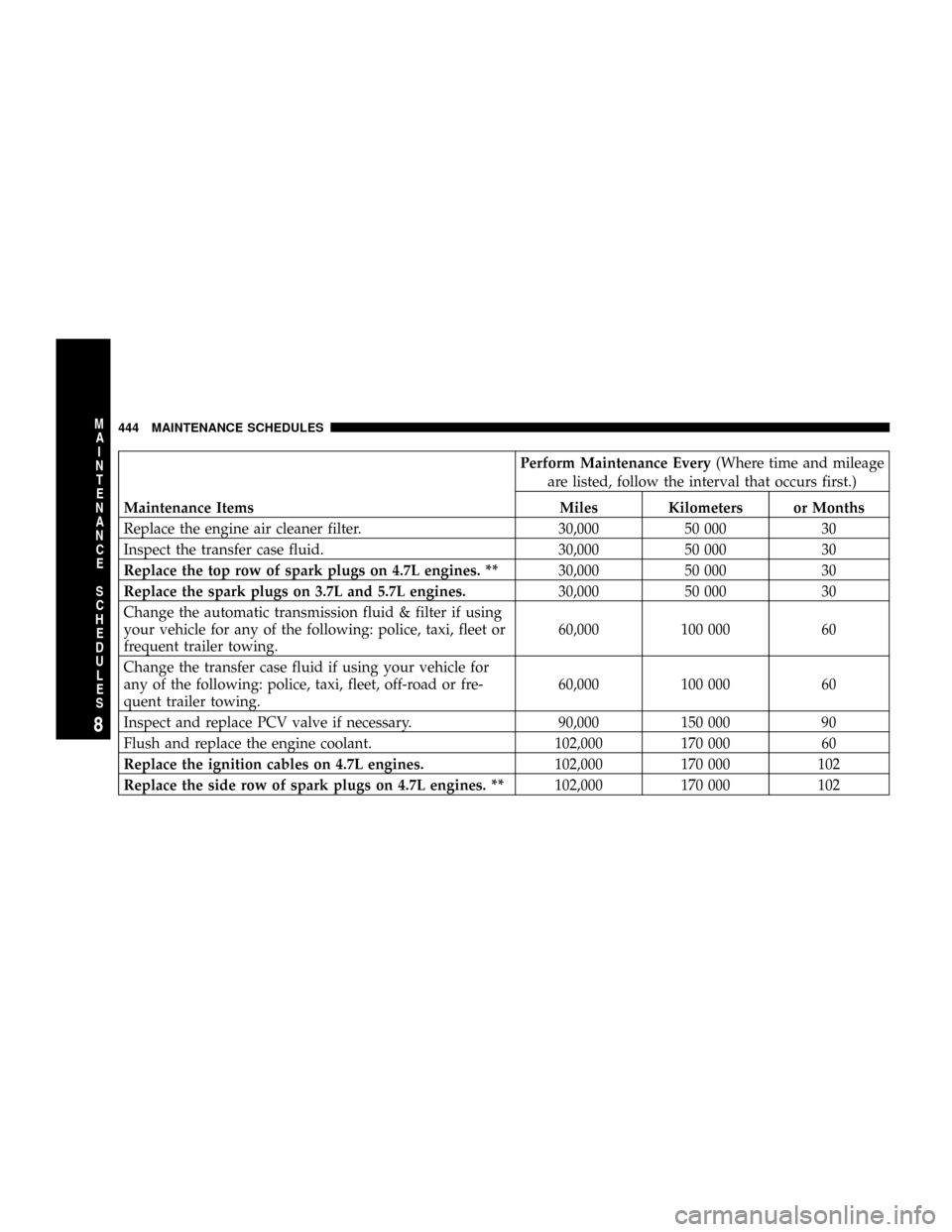
Perform Maintenance Every(Where time and mileage
are listed, follow the interval that occurs first.)
Maintenance Items Miles Kilometers or Months
Replace the engine air cleaner filter. 30,000 50 000 30
Inspect the transfer case fluid. 30,000 50 000 30
Replace the top row of spark plugs on 4.7L engines. **30,000 50 000 30
Replace the spark plugs on 3.7L and 5.7L engines.30,000 50 000 30
Change the automatic transmission fluid & filter if using
your vehicle for any of the following: police, taxi, fleet or
frequent trailer towing.60,000 100 000 60
Change the transfer case fluid if using your vehicle for
any of the following: police, taxi, fleet, off-road or fre-
quent trailer towing.60,000 100 000 60
Inspect and replace PCV valve if necessary. 90,000 150 000 90
Flush and replace the engine coolant. 102,000 170 000 60
Replace the ignition cables on 4.7L engines.102,000 170 000 102
Replace the side row of spark plugs on 4.7L engines. **102,000 170 000 102
444 MAINTENANCE SCHEDULES
8
M
A
I
N
T
E
N
A
N
C
E
S
C
H
E
D
U
L
E
S