instrument panel CHRYSLER ASPEN 2008 2.G Manual Online
[x] Cancel search | Manufacturer: CHRYSLER, Model Year: 2008, Model line: ASPEN, Model: CHRYSLER ASPEN 2008 2.GPages: 479, PDF Size: 4.3 MB
Page 260 of 479

Rear Window Defrosting and Rear Window
Washer/Wiper
Refer to ªRear Window Featuresº in Section 4.
Rear Zone Climate Control Ð If Equipped
Headliner air comes from the outlets in the headliner.
Each of these outlets can be individually adjusted to
direct the flow of air. Moving the air vane knobs on the
outlets to one side will shut off the airflow.
Rear Outlets
INSTRUMENT PANEL AND CONTROLS 259
4
Page 261 of 479
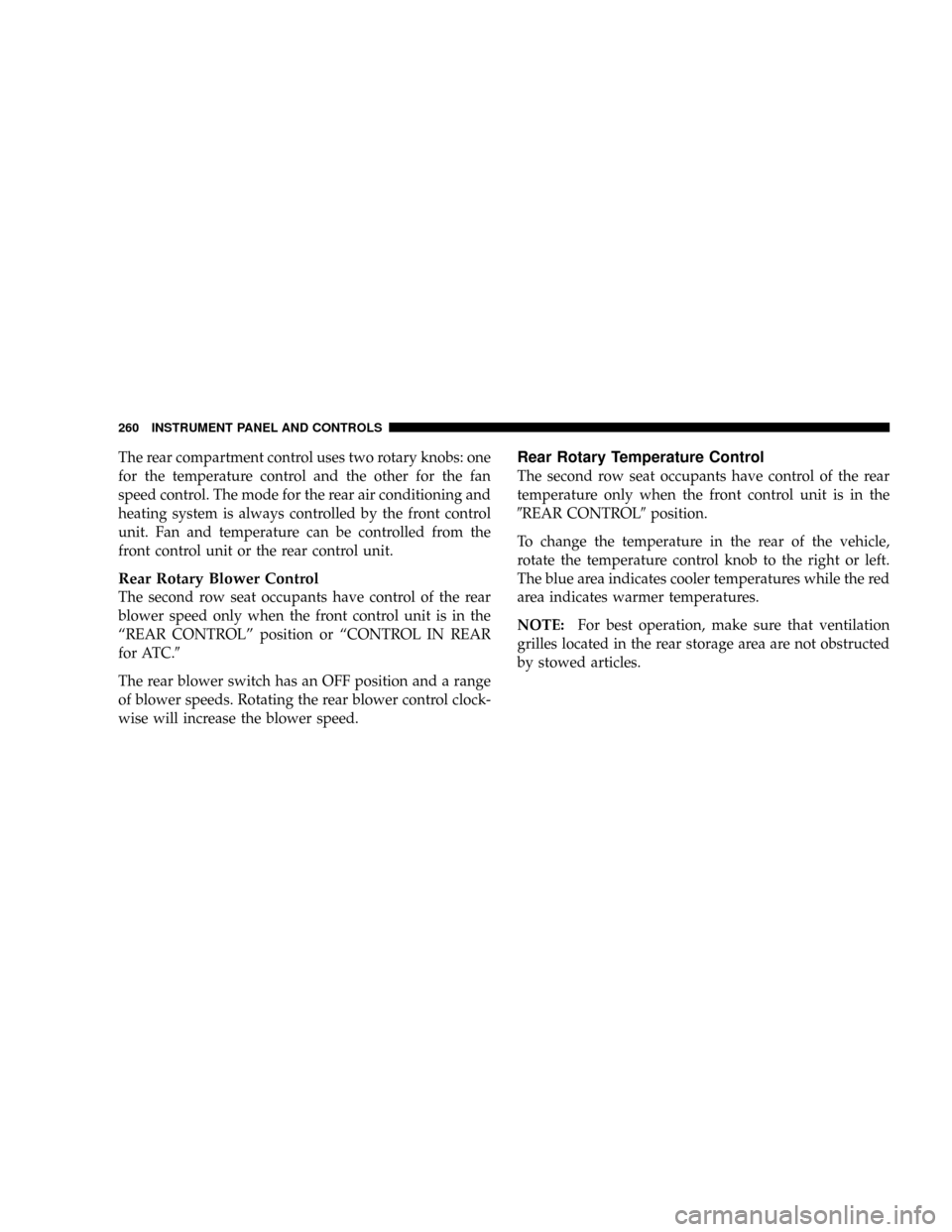
The rear compartment control uses two rotary knobs: one
for the temperature control and the other for the fan
speed control. The mode for the rear air conditioning and
heating system is always controlled by the front control
unit. Fan and temperature can be controlled from the
front control unit or the rear control unit.
Rear Rotary Blower Control
The second row seat occupants have control of the rear
blower speed only when the front control unit is in the
ªREAR CONTROLº position or ªCONTROL IN REAR
for ATC.9
The rear blower switch has an OFF position and a range
of blower speeds. Rotating the rear blower control clock-
wise will increase the blower speed.
Rear Rotary Temperature Control
The second row seat occupants have control of the rear
temperature only when the front control unit is in the
9REAR CONTROL9position.
To change the temperature in the rear of the vehicle,
rotate the temperature control knob to the right or left.
The blue area indicates cooler temperatures while the red
area indicates warmer temperatures.
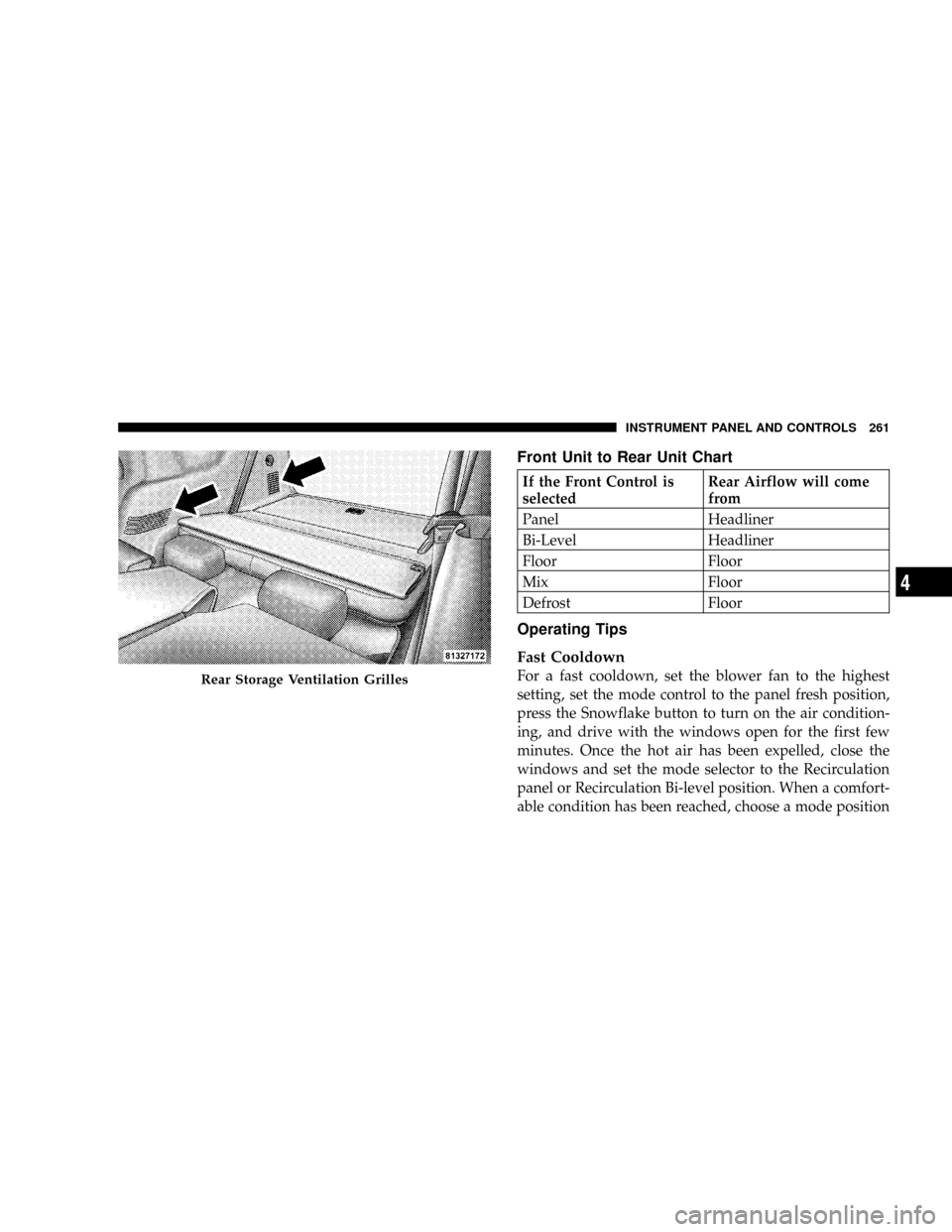
NOTE:For best operation, make sure that ventilation
grilles located in the rear storage area are not obstructed
by stowed articles.
260 INSTRUMENT PANEL AND CONTROLS
Page 262 of 479
Front Unit to Rear Unit Chart
If the Front Control is
selectedRear Airflow will come
from
Panel Headliner
Bi-Level Headliner
Floor Floor
Mix Floor
Defrost Floor
Operating Tips
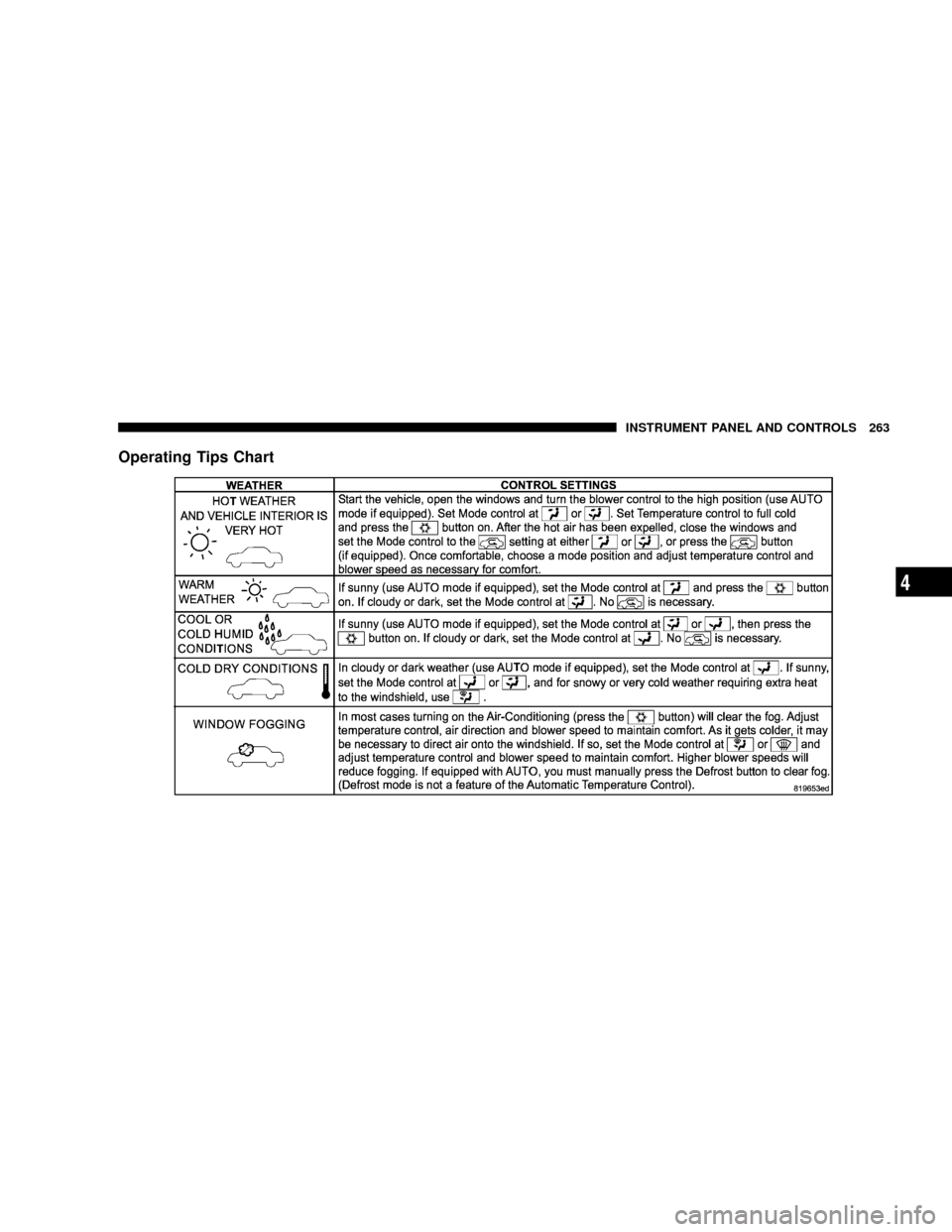
Fast Cooldown
For a fast cooldown, set the blower fan to the highest
setting, set the mode control to the panel fresh position,
press the Snowflake button to turn on the air condition-
ing, and drive with the windows open for the first few
minutes. Once the hot air has been expelled, close the
windows and set the mode selector to the Recirculation
panel or Recirculation Bi-level position. When a comfort-
able condition has been reached, choose a mode positionRear Storage Ventilation Grilles
INSTRUMENT PANEL AND CONTROLS 261
4
Page 263 of 479
and adjust the temperature control and blower speed as
necessary to maintain comfort. For high humidity condi-
tions, it may be necessary to remain in the Recirculation
mode to maintain comfort.
Window Fogging
Windows will fog on the inside when the humidity inside
the vehicle is high. This often occurs in mild or cool
temperatures when it's rainy or humid. In most cases,
turning on the air conditioning (pressing the snowflake
button) will clear the fog. Adjust the temperature control,
air direction and blower speed to maintain comfort.
As the temperature gets colder it may be necessary to
direct air onto the windshield by using Mix Mode
position on the control. Adjust the temperature control
and blower speed to maintain comfort. Interior fogging
on the windshield can be quickly removed by selecting
the defrost mode.Regular cleaning of the inside of the windows with a
non-filming cleaning solution (vinegar and water works
very well) will help prevent contaminants (cigarette
smoke, perfumes, etc.) from sticking to the windows.
Contaminants increase the rate of window fogging.Summer Operation
Air conditioned vehicles must be protected with a high
quality antifreeze coolant during summer to provide
proper corrosion protection and to raise the boiling point
of the coolant for protection against overheating. A 50 %
concentration is recommended.
Winter Operation
When operating the system during the winter months,
make sure the air intake, located directly in front of the
windshield, is free of ice, slush, snow, or other obstruc-
tions. This will also prevent snow ingestion into the
ducts.
262 INSTRUMENT PANEL AND CONTROLS
Page 264 of 479
Operating Tips Chart
INSTRUMENT PANEL AND CONTROLS 263
4
Page 265 of 479
REAR WINDOW FEATURES
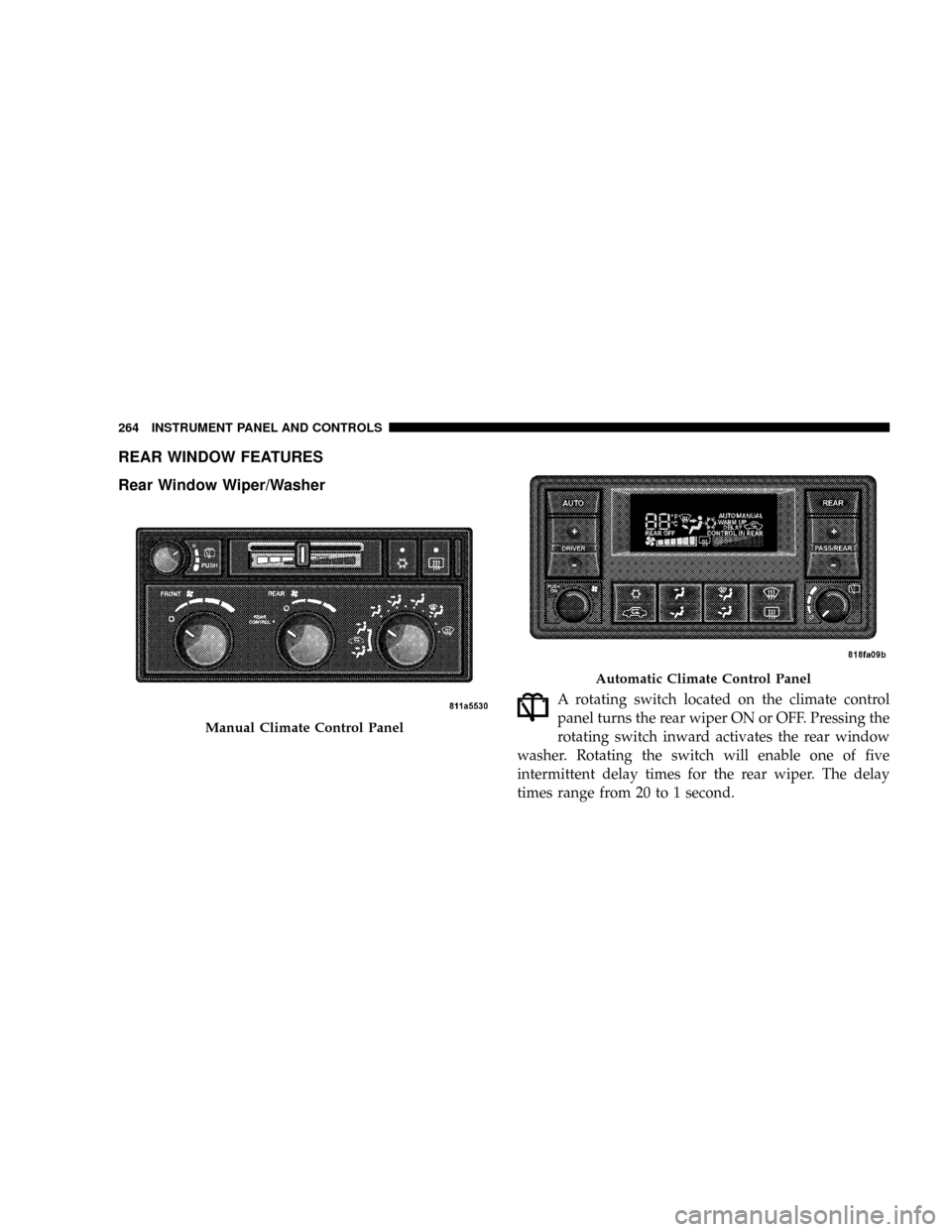
Rear Window Wiper/Washer
A rotating switch located on the climate control
panel turns the rear wiper ON or OFF. Pressing the
rotating switch inward activates the rear window
washer. Rotating the switch will enable one of five
intermittent delay times for the rear wiper. The delay
times range from 20 to 1 second.
Manual Climate Control Panel
Automatic Climate Control Panel
264 INSTRUMENT PANEL AND CONTROLS
Page 266 of 479
If the rear wiper is operating when the ignition is turned
OFF, the wiper will automatically return to the Park
position. When the vehicle is restarted, the wiper will
resume operation.
Rear Window Defrosting
A pushbutton type switch is located in the climate
control panel. Press the switch and the rear win-
dow defroster and electric remote control heated mirrors
(if equipped) will turn on. An amber indicator on the
pushbutton will light when the defroster is turned on. A
symbol will be displayed when the defroster is turned on
with an ATC control. Push again to turn off prior to
time-out. The defroster will automatically turn off after
15 minutes. For 10 more minutes of operation, push the
button again. To prevent excessive battery drain, use the
defroster only when the engine is operating.
CAUTION!
Use care when washing the inside of the rear window
to prevent damage to heating elements. Use a soft
cloth and a mild washing solution, wiping parallel to
the heating elements. Also, keep all objects a safe
distance from the window to prevent damaging the
heating elements.
INSTRUMENT PANEL AND CONTROLS 265
4
Page 281 of 479
FOUR-WHEEL DRIVE OPERATION
NV 140 Transfer Case Operating
Information/Precautions ± If Equipped
The NV 140 is a single speed (4 HI range only) transfer
case which provides convenient full-time 4-wheel drive.
No driver interaction is required. This transfer case
divides engine torque almost evenly with 48 percent of
engine torque to the front axle and 52 percent of engine
torque to the rear axle.
Proper operation of 4-wheel drive vehicles depends on
tires of equal size, type and circumference on each wheel.
Any difference in tire size can cause damage to the
transfer case.
Because 4-wheel drive provides improved traction, there
is a tendency to exceed safe turning and stopping speeds.
Do not go faster than road conditions permit.4WD
Normal 4-Wheel Drive High Range - Employs inter-axle
differential. Allows front and rear wheels to rotate at
different speeds. All road surfaces.
NV 244 Generation II Transfer Case Operating
Information / Precautions
The NV 244 Generation II is an electric-shift transfer case
and is operated by the 4WD Control Switch, which is
located on the instrument panel.
The NV 244 Generation II transfer case provides four
mode positions - Normal 4-wheel drive (4WD) high
range, 4-wheel-drive lock (4WD LOCK), 4-wheel drive
low (4WD LOW) range, and NEUTRAL.
This transfer case is equipped with an inter-axle differ-
ential that allows driving the vehicle in the normal
all-wheel drive position (4WD) at all times on any given
road surface, including dry, hard-surfaced roads. The
4WD mode allows the front and rear wheels to rotate at
280 STARTING AND OPERATING
Page 290 of 479
PARKING BRAKE
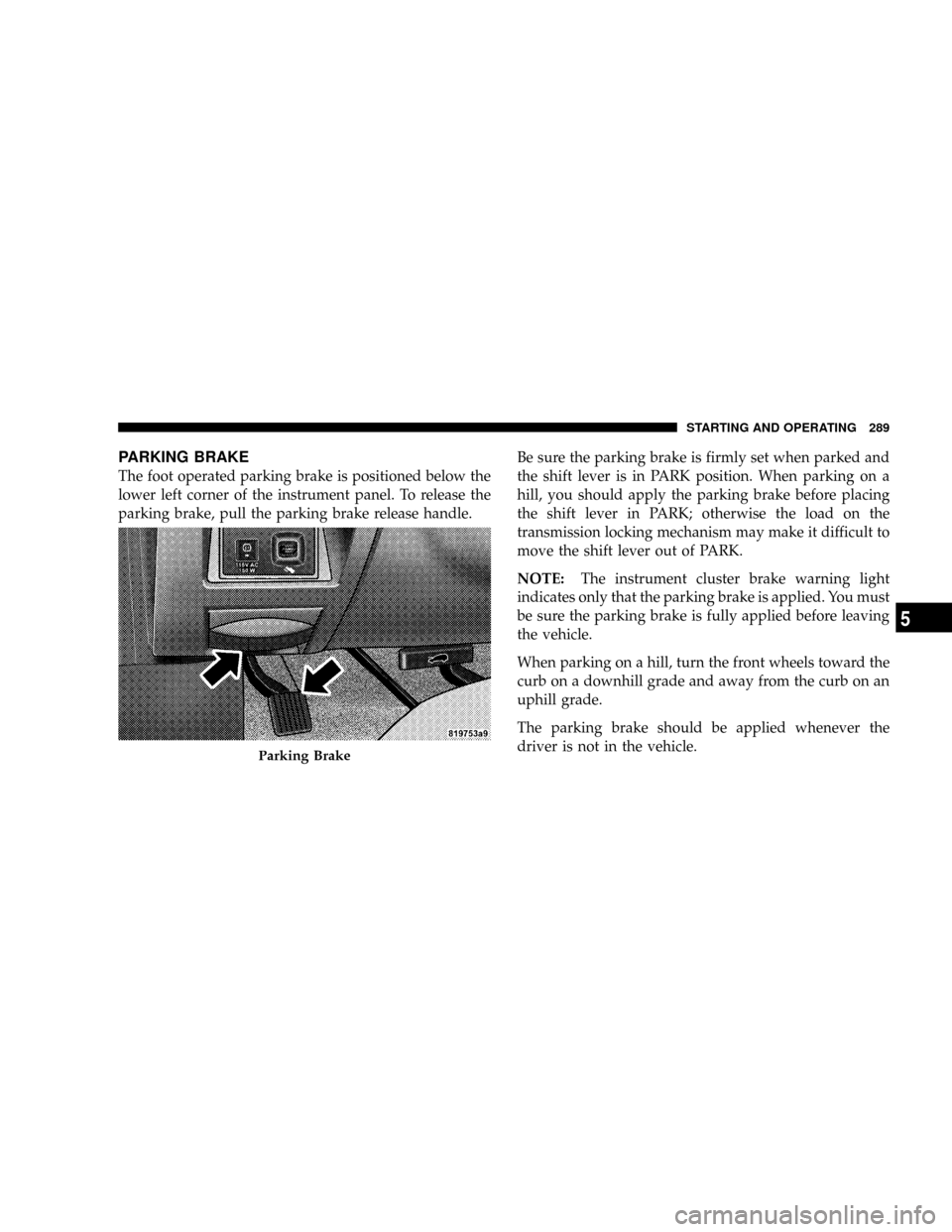
The foot operated parking brake is positioned below the
lower left corner of the instrument panel. To release the
parking brake, pull the parking brake release handle.Be sure the parking brake is firmly set when parked and
the shift lever is in PARK position. When parking on a
hill, you should apply the parking brake before placing
the shift lever in PARK; otherwise the load on the
transmission locking mechanism may make it difficult to
move the shift lever out of PARK.
NOTE:The instrument cluster brake warning light
indicates only that the parking brake is applied. You must
be sure the parking brake is fully applied before leaving
the vehicle.
When parking on a hill, turn the front wheels toward the
curb on a downhill grade and away from the curb on an
uphill grade.
The parking brake should be applied whenever the
driver is not in the vehicle.
Parking Brake
STARTING AND OPERATING 289
5
Page 467 of 479
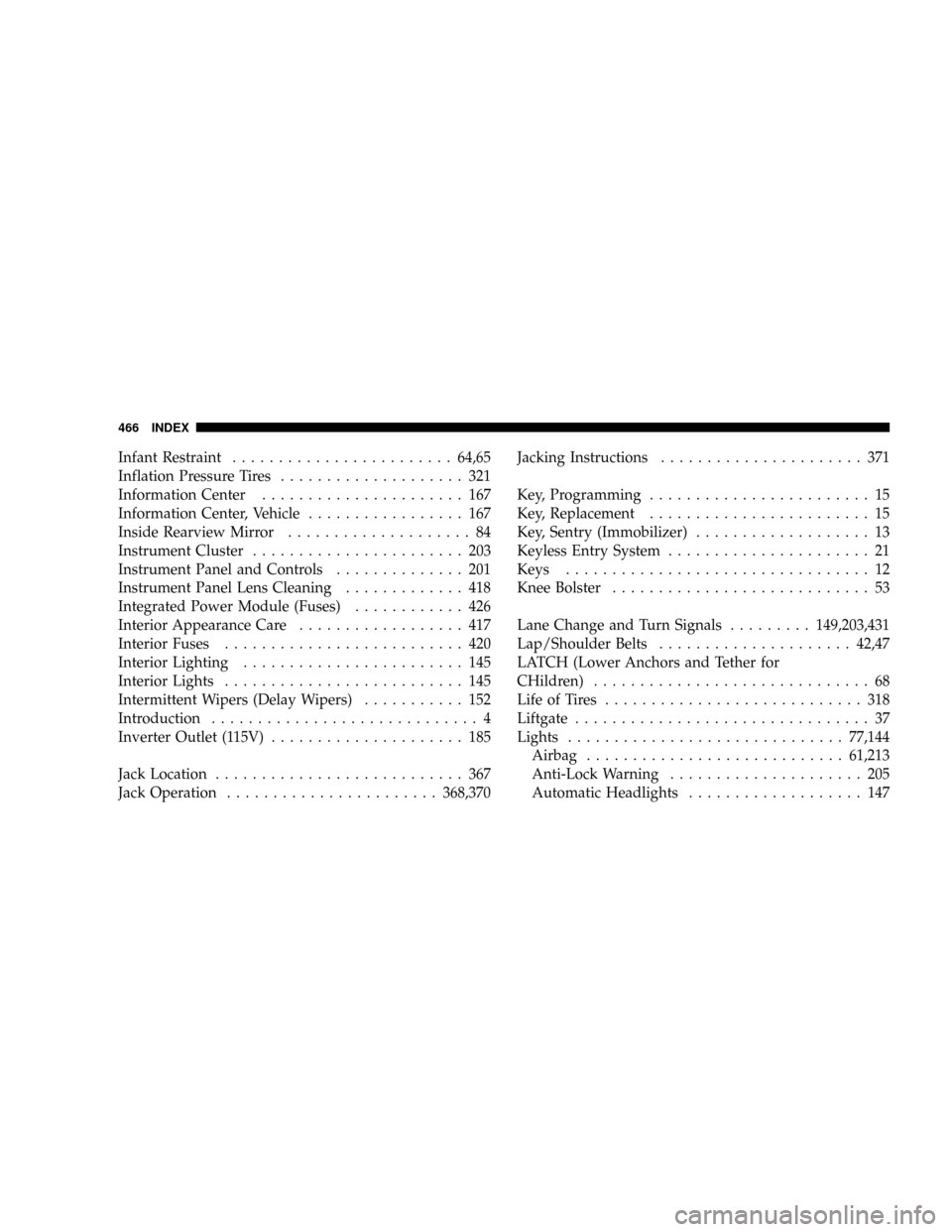
Infant Restraint........................64,65
Inflation Pressure Tires.................... 321
Information Center...................... 167
Information Center, Vehicle................. 167
Inside Rearview Mirror.................... 84
Instrument Cluster....................... 203
Instrument Panel and Controls.............. 201
Instrument Panel Lens Cleaning............. 418
Integrated Power Module (Fuses)............ 426
Interior Appearance Care.................. 417
Interior Fuses.......................... 420
Interior Lighting........................ 145
Interior Lights.......................... 145
Intermittent Wipers (Delay Wipers)........... 152
Introduction............................. 4
Inverter Outlet (115V)..................... 185
Jack Location........................... 367
Jack Operation.......................368,370Jacking Instructions...................... 371
Key, Programming........................ 15
Key, Replacement........................ 15
Key, Sentry (Immobilizer)................... 13
Keyless Entry System...................... 21
Keys................................. 12
Knee Bolster............................ 53
Lane Change and Turn Signals.........149,203,431
Lap/Shoulder Belts.....................42,47
LATCH (Lower Anchors and Tether for
CHildren).............................. 68
Life of Tires............................ 318
Liftgate................................ 37
Lights..............................77,144
Airbag............................61,213
Anti-Lock Warning..................... 205
Automatic Headlights................... 147
466 INDEX