ignition CHRYSLER ASPEN 2009 2.G Owners Manual
[x] Cancel search | Manufacturer: CHRYSLER, Model Year: 2009, Model line: ASPEN, Model: CHRYSLER ASPEN 2009 2.GPages: 481, PDF Size: 9.28 MB
Page 368 of 481
If any of these requirements are not met prior to depress-
ing the NEUTRAL button or are no longer met during the
one second time, then all of the position indicator lights
will flash continuously until all requirements are met or
until the NEUTRAL button is released.
NOTE:The ignition key must be ON for a shift to take
place and for the position indicator lights to be operable.
If the key is not ON, the shift will not take place and no
position indicator lights will be on or flashing.
NOTE:A flashing NEUTRAL position indicator light
indicates that shift requirements have not been met.CAUTION!
²Do not use a bumper-mounted clamp-on tow bar
on your vehicle. The bumper face bar will be
damaged.
²Do not disconnect the rear driveshaft because
fluid will leak from the transfer case and damage
internal parts.
366 STARTING AND OPERATING
Page 370 of 481
HAZARD WARNING FLASHER
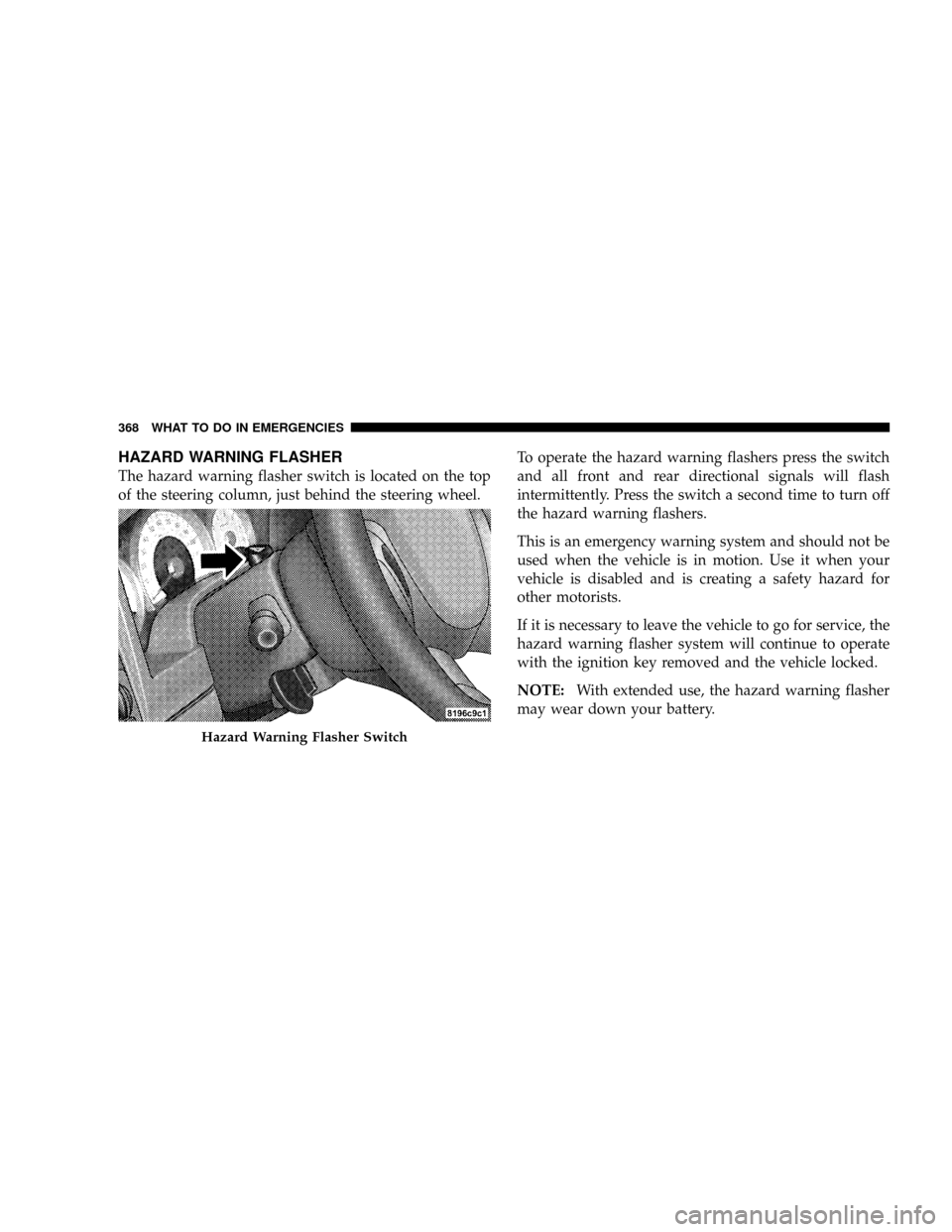
The hazard warning flasher switch is located on the top
of the steering column, just behind the steering wheel.To operate the hazard warning flashers press the switch
and all front and rear directional signals will flash
intermittently. Press the switch a second time to turn off
the hazard warning flashers.
This is an emergency warning system and should not be
used when the vehicle is in motion. Use it when your
vehicle is disabled and is creating a safety hazard for
other motorists.
If it is necessary to leave the vehicle to go for service, the
hazard warning flasher system will continue to operate
with the ignition key removed and the vehicle locked.
NOTE:With extended use, the hazard warning flasher
may wear down your battery.
Hazard Warning Flasher Switch
368 WHAT TO DO IN EMERGENCIES
Page 380 of 481
If the indicator is dark or shows a green dot, proceed as
follows:
1. Wear eye protection and remove all metal jewelry such
as watch bands or bracelets which might make an
unintended electrical contact.
2. Park the booster vehicle within cable reach but with-
out letting the vehicles touch. Set the parking brake, place
the automatic transmission in PARK and turn the ignition
OFF on both vehicles.
3. Turn OFF the heater, radio and all unnecessary elec-
trical loads.
4. Connect one end of a jumper cable to the positive
terminal of the booster battery. Connect the other end of
the same cable to the positive terminal of the discharged
battery.WARNING!
Do not permit vehicles to touch each other as this
could establish a ground connection and personal
injury could result.
5. Connect the other cable, first to the negative terminal
of the booster battery and then to the engine of the
vehicle with the discharged battery. Make sure you have
a good contact on the engine.
WARNING!
Do not connect the cable to the negative post of the
discharge battery. The resulting electrical spark could
cause the battery to explode.
(Continued)
378 WHAT TO DO IN EMERGENCIES
Page 383 of 481
TOWING A DISABLED VEHICLE
Proper towing or lifting equipment is required to prevent
damage to your vehicle. Use of safety chains is recom-
mended.Attach towing device to main structural mem-
bers of the vehicle Ð not to bumpers or associated
brackets. State and local laws, applying to vehicles
under tow, must be observed.
Four-Wheel Drive Vehicles
The manufacturer recommends towing with all wheels
OFFthe ground. Acceptable methods are to tow the
vehicle on a flatbed or with one end of the vehicle raised
and the opposite end on a towing dolly.
Two-Wheel Drive Vehicles
Provided that the transmission is operable, tow with the
transmission in NEUTRAL and the ignition key in the
OFF position, along with the front wheels raised and therear wheels on the ground. The speed must not exceed 30
mph (50 km/h), and the distance must not exceed 15
miles (25 km).
If the vehicle is to be towed more than 15 miles (25 km)
or faster than 30 mph (50 km/h), it must be towed on a
flatbed, or with the rear wheels raised and the front
wheels on the ground, or with the front end raised and
the rear wheels on a towing dolly.
NOTE:Towing the vehicle with the rear wheels on the
ground at more than 30 mph (50 km/h) or for more than
15 miles (25 km), can cause severe transmission damage.
WHAT TO DO IN EMERGENCIES 381
6
Page 390 of 481
problem persists, the message will appear the next time
the vehicle is started. This might indicate a damaged cap.
If the problem is detected twice in a row, the system will
turn on the MIL. Resolving the problem will turn the MIL
off.
EMISSIONS INSPECTION AND MAINTENANCE
PROGRAMS
In some localities, it may be a legal requirement to pass
an inspection of your vehicle's emissions control system.
Failure to pass could prevent vehicle registration.
For states that require an Inspection and Mainte-
nance (I/M), this check verifies the Malfunction
Indicator Light (MIL) is functioning and is not on
when the engine is running, and that the OBD II system
is ready for testing.
Normally, the OBD II system will be ready. The OBD II
system maynotbe ready if your vehicle was recentlyserviced, recently had a dead battery, or a battery replace-
ment. If the OBD II system should be determined not
ready for the I/M test, your vehicle may fail the test.
Your vehicle has a simple ignition key-actuated test,
which you can use prior to going to the test station. To
check if your vehicle's OBD II system is ready, you must
do the following:
1. Insert your ignition key into the ignition switch.
2. Turn the ignition to the ON position, but do not crank
or start the engine.
3. If you crank or start the engine, you will have to start
this test over.
4. As soon as you turn your key to the ON position, you
will see the MIL symbol come on as part of a normal bulb
check.
388 MAINTAINING YOUR VEHICLE
Page 391 of 481
5. Approximately 15 seconds later, one of two things will
happen:
a. The MIL will flash for about 10 seconds and then
return to being fully illuminated until you turn OFF
the ignition key or start the engine. This means that
your vehicle's OBD II system isnot readyand you
shouldnotproceed to the I/M station.
b. The MIL will not flash at all and will remain fully
illuminated until you turn OFF the ignition key or start
the engine. This means that your vehicle's OBD II
system isready, and you can proceed to the I/M
station.
If your OBD II system isnot ready,you should see your
authorized dealer or repair facility. If your vehicle was
recently serviced or had a battery failure or replacement,
you may need to do nothing more than drive your
vehicle as you normally would in order for your OBD IIsystem to update. A recheck with the above test routine
may then indicate that the system is now ready.
Regardless of whether your vehicle's OBD II system is
ready or not ready, if the MIL is illuminated during
normal vehicle operation, you should have your vehicle
serviced before going to the I/M station. The I/M station
can fail your vehicle because the MIL is on with the
engine running.
REPLACEMENT PARTS
Use of genuine MOPARtparts for normal/scheduled
maintenance and repairs is highly recommended to en-
sure the designed performance. Damage or failures
caused by the use of non-MOPARtparts for maintenance
and repairs will not be covered by the manufacturer's
warranty.
MAINTAINING YOUR VEHICLE 389
7
Page 401 of 481
WARNING!
A hot exhaust system can start a fire if you park over
materials that can burn. Such materials might be
grass or leaves coming into contact with your exhaust
system. Do not park or operate your vehicle in areas
where your exhaust system can contact anything that
can burn.
In unusual situations involving grossly malfunctioning
engine operation, a scorching odor may indicate severe
and abnormal catalyst overheating. If this occurs, the
vehicle should be stopped, the engine shut off and the
vehicle allowed to cool. Thereafter, service, including a
tune-up to manufacturer's specifications, should be ob-
tained immediately.To minimize the possibility of catalyst damage:²Do not shut off the engine or interrupt the ignition
when the transmission is in gear and the vehicle is in
motion.
²Do not try to start engine by pushing or towing the
vehicle.
²Do not idle the engine with any spark plug wires
disconnected or removed, such as when diagnostic
testing, or for prolonged periods during very rough
idling or malfunctioning operating conditions.
MAINTAINING YOUR VEHICLE 399
7
Page 418 of 481
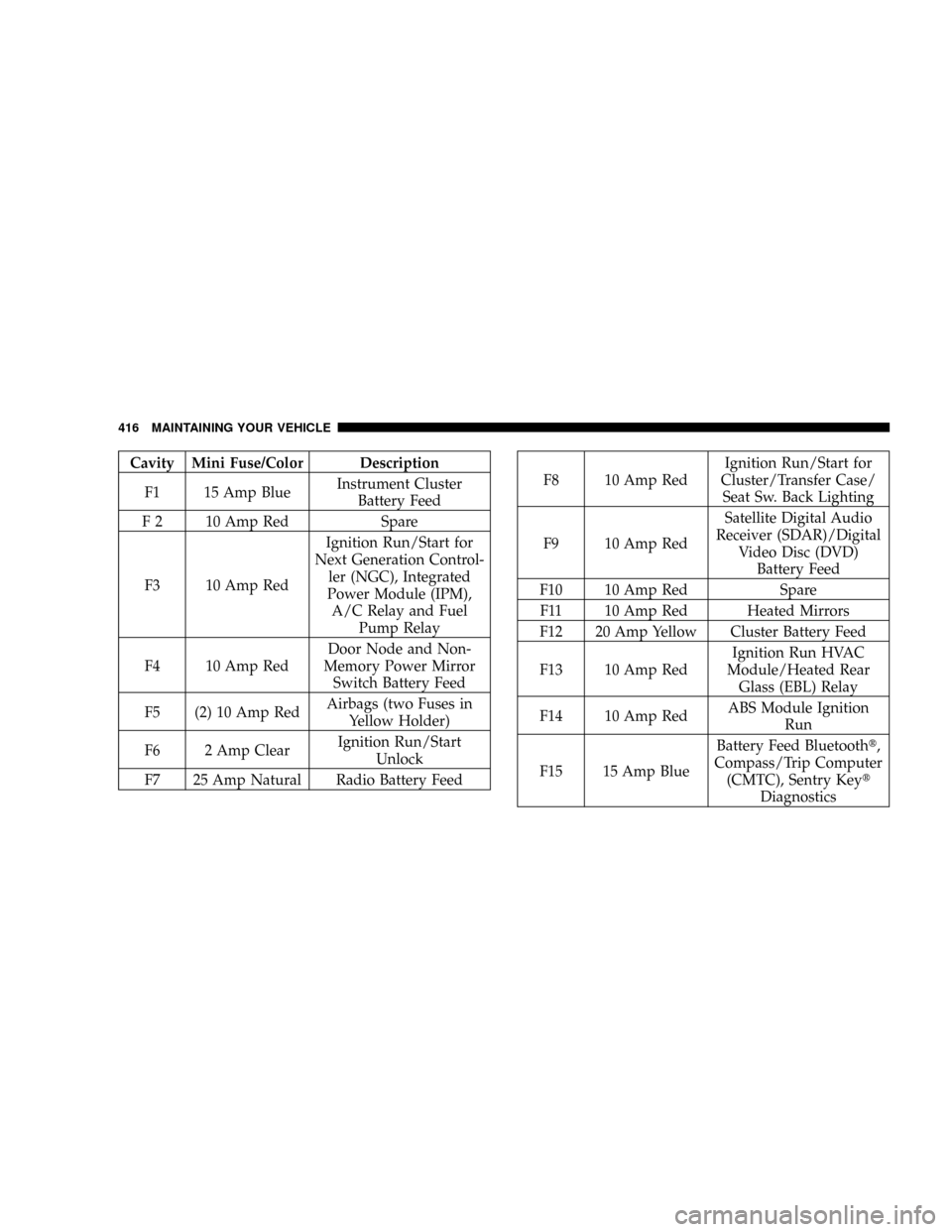
Cavity Mini Fuse/Color Description
F1 15 Amp BlueInstrument Cluster
Battery Feed
F 2 10 Amp Red Spare
F3 10 Amp RedIgnition Run/Start for
Next Generation Control-
ler (NGC), Integrated
Power Module (IPM),
A/C Relay and Fuel
Pump Relay
F4 10 Amp RedDoor Node and Non-
Memory Power Mirror
Switch Battery Feed
F5 (2) 10 Amp RedAirbags (two Fuses in
Yellow Holder)
F6 2 Amp ClearIgnition Run/Start
Unlock
F7 25 Amp Natural Radio Battery Feed
F8 10 Amp RedIgnition Run/Start for
Cluster/Transfer Case/
Seat Sw. Back Lighting
F9 10 Amp RedSatellite Digital Audio
Receiver (SDAR)/Digital
Video Disc (DVD)
Battery Feed
F10 10 Amp Red Spare
F11 10 Amp Red Heated Mirrors
F12 20 Amp Yellow Cluster Battery Feed
F13 10 Amp RedIgnition Run HVAC
Module/Heated Rear
Glass (EBL) Relay
F14 10 Amp RedABS Module Ignition
Run
F15 15 Amp BlueBattery Feed Bluetootht,
Compass/Trip Computer
(CMTC), Sentry Keyt
Diagnostics
416 MAINTAINING YOUR VEHICLE
Page 419 of 481
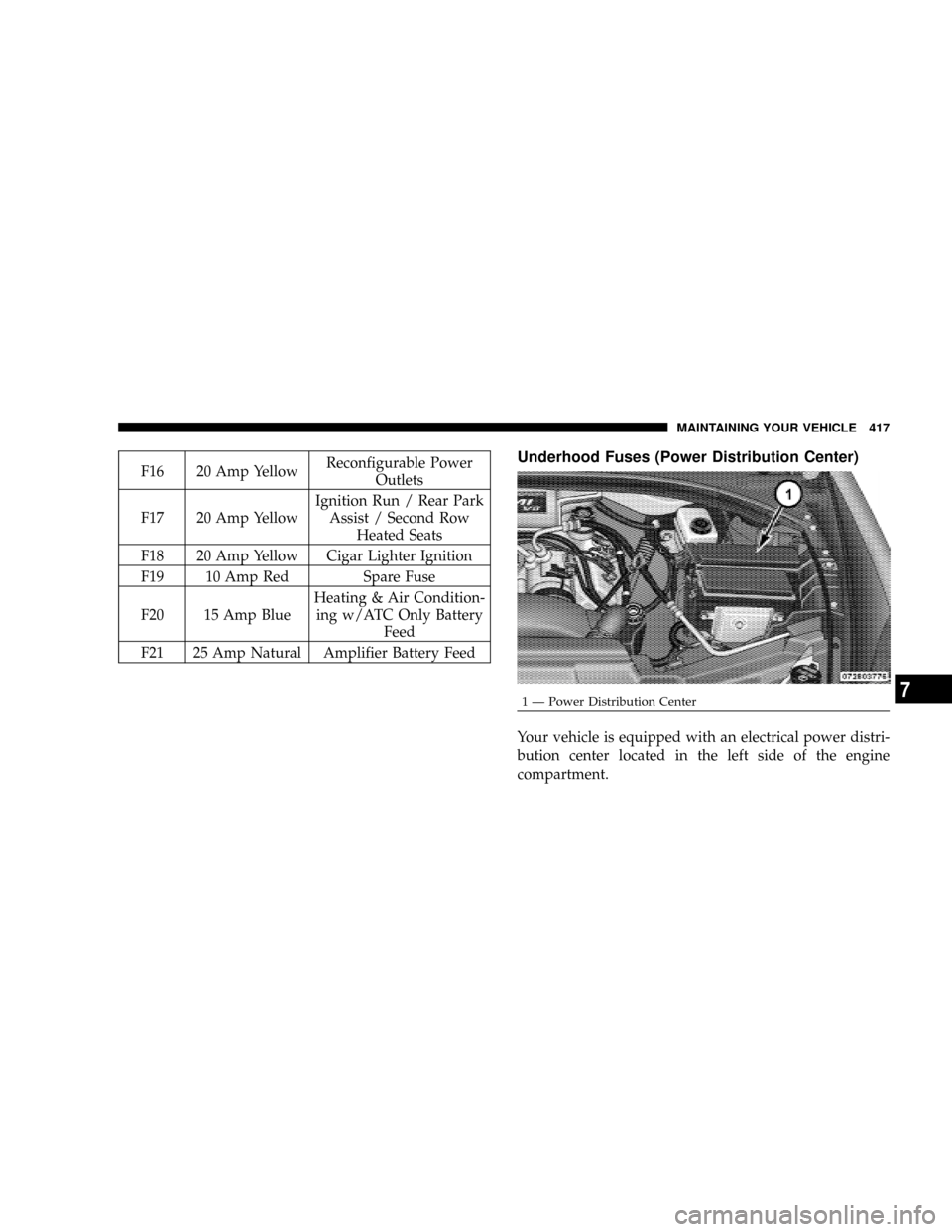
F16 20 Amp YellowReconfigurable Power
Outlets
F17 20 Amp YellowIgnition Run / Rear Park
Assist / Second Row
Heated Seats
F18 20 Amp Yellow Cigar Lighter Ignition
F19 10 Amp Red Spare Fuse
F20 15 Amp BlueHeating & Air Condition-
ing w/ATC Only Battery
Feed
F21 25 Amp Natural Amplifier Battery FeedUnderhood Fuses (Power Distribution Center)
Your vehicle is equipped with an electrical power distri-
bution center located in the left side of the engine
compartment.
1 Ð Power Distribution CenterMAINTAINING YOUR VEHICLE 4177
Page 424 of 481
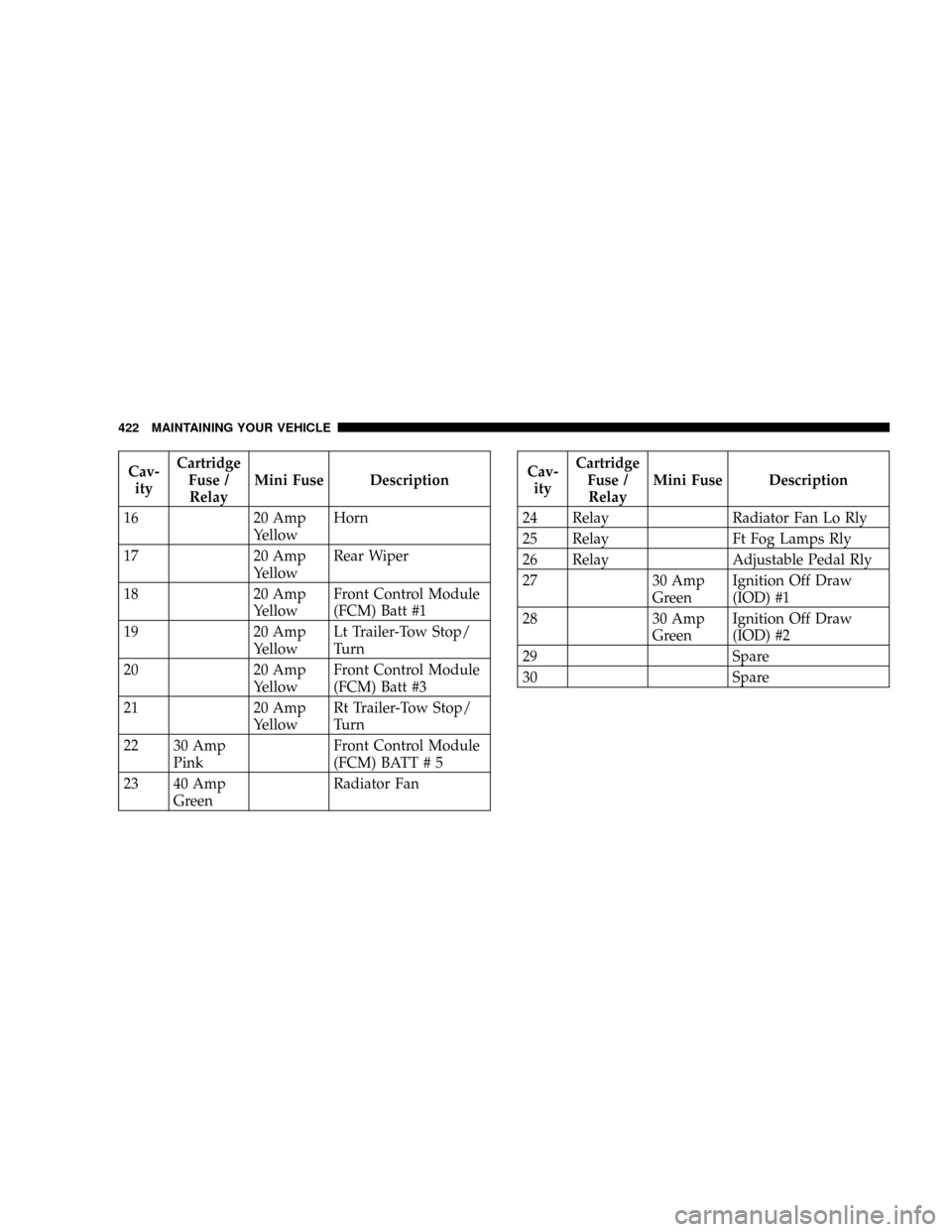
Cav-
ityCartridge
Fuse /
RelayMini Fuse Description
16 20 Amp
YellowHorn
17 20 Amp
YellowRear Wiper
18 20 Amp
YellowFront Control Module
(FCM) Batt #1
19 20 Amp
YellowLt Trailer-Tow Stop/
Turn
20 20 Amp
YellowFront Control Module
(FCM) Batt #3
21 20 Amp
YellowRt Trailer-Tow Stop/
Turn
22 30 Amp
PinkFront Control Module
(FCM) BATT # 5
23 40 Amp
GreenRadiator FanCav-
ityCartridge
Fuse /
RelayMini Fuse Description
24 Relay Radiator Fan Lo Rly
25 Relay Ft Fog Lamps Rly
26 Relay Adjustable Pedal Rly
27 30 Amp
GreenIgnition Off Draw
(IOD) #1
28 30 Amp
GreenIgnition Off Draw
(IOD) #2
29 Spare
30 Spare
422 MAINTAINING YOUR VEHICLE