air suspension CHRYSLER CARAVAN 2003 User Guide
[x] Cancel search | Manufacturer: CHRYSLER, Model Year: 2003, Model line: CARAVAN, Model: CHRYSLER CARAVAN 2003Pages: 2177, PDF Size: 59.81 MB
Page 222 of 2177
BRAKES - ABS
TABLE OF CONTENTS
page page
BRAKES - ABS
DESCRIPTION
DESCRIPTION - ANTILOCK BRAKE
SYSTEM............................75
DESCRIPTION - ANTILOCK BRAKE
SYSTEM (EXPORT)....................75
DESCRIPTION - ELECTRONIC VARIABLE
BRAKE PROPORTIONING...............75
DESCRIPTION - TRACTION CONTROL
SYSTEM............................76
OPERATION
OPERATION - ANTILOCK BRAKE SYSTEM . . 76
OPERATION - ELECTRONIC VARIABLE
BRAKE PROPORTIONING...............77
OPERATION - TRACTION CONTROL
SYSTEM............................77
CAUTION
CAUTIONS..........................78
STANDARD PROCEDURE - ANTILOCK BRAKE
SYSTEM BLEEDING...................78
SPECIFICATIONS
ABS FASTENER TORQUE...............79
TONE WHEEL RUNOUT................79
WHEEL SPEED SENSOR AIR GAP........79
FRONT WHEEL SPEED SENSOR
REMOVAL.............................79
INSTALLATION.........................80
REAR WHEEL SPEED SENSOR - AWD
REMOVAL.............................80INSTALLATION.........................80
REAR WHEEL SPEED SENSOR - FWD
REMOVAL.............................81
INSTALLATION.........................81
TONE WHEEL
INSPECTION - TONE WHEEL..............82
TRACTION CONTROL SWITCH
DIAGNOSIS AND TESTING - TRACTION
CONTROL SWITCH....................82
HYDRAULIC/MECHANICAL
OPERATION - HYDRAULIC CIRCUITS AND
VALVES .............................83
HCU (HYDRAULIC CONTROL UNIT)
DESCRIPTION.........................89
OPERATION...........................89
ICU (INTEGRATED CONTROL UNIT)
DESCRIPTION.........................89
OPERATION...........................90
REMOVAL
REMOVAL - LHD......................90
REMOVAL - RHD......................91
DISASSEMBLY - ICU....................93
ASSEMBLY - ICU.......................94
INSTALLATION
INSTALLATION - LHD..................94
INSTALLATION - RHD..................95
BRAKES - ABS
DESCRIPTION
DESCRIPTION - ANTILOCK BRAKE SYSTEM
This section covers the physical and operational
descriptions and the on-car service procedures for the
Mark 20e Antilock Brake System and the Mark 20e
Antilock Brake System with traction control.
The purpose of the antilock brake system (ABS) is
to prevent wheel lockup under braking conditions on
virtually any type of road surface. Antilock braking is
desirable because a vehicle that is stopped without
locking the wheels retains directional stability and
some steering capability. This allows the driver to
retain greater control of the vehicle during braking.
DESCRIPTION - ANTILOCK BRAKE SYSTEM
(EXPORT)
Four-wheel disc antilock brakes are standard on all
models. The Mark 20e antilock brake system is used
on all models. Depending on whether the vehicle is a
left-hand drive (LHD) or right-hand drive (RHD)
model, the integrated control unit (ICU) is located in
one of two locations. On LHD models, the ICU is
mounted above the front suspension cradle/cross-
member below the master cylinder. On RHD models,
the ICU is located behind the front suspension cra-
dle/crossmember on the left side of the vehicle.
DESCRIPTION - ELECTRONIC VARIABLE
BRAKE PROPORTIONING
Vehicles equipped with ABS use electronic variable
brake proportioning (EVBP) to balance front-to-rear
braking. The EVBP is used in place of a rear propor-
RSBRAKES - ABS5-75
ProCarManuals.com
Page 1356 of 2177
FRONT CRADLE
CROSSMEMBER
DESCRIPTION
DESCRIPTION - FRONT CRADLE
CROSSMEMBER
This vehicle uses a one piece cast aluminum cradle
for the front cradle crossmember. The cradle cross-
member is used as the attaching points for the lower
control arms, stabilizer bar and steering gear. The
cradle also has the power steering hoses and the
chassis brake tubes attached to it.
WARNING: If a threaded hole in the suspension cra-
dle needs to be repaired, only use the type of
thread insert and installation procedure specified
for this application.
The threaded holes in the front cradle crossmem-
ber that are used for attachment of the lower control
arm rear bushing retainer, power steering hose and
chassis brake tubes can be repaired. The repair is
done by the installation of a Heli-Coiltthread insert
which has been specifically developed for this appli-
cation. Refer to the Mopar Parts Catalog for the spec-
ified Heli-Coiltthread insert to be used for this
application. The procedure for installing the Heli-
Coiltthread insert is detailed in the Service Proce-
dures section in this group of the service manual.
DESCRIPTION - FRONT CRADLE
CROSSMEMBER THREAD REPAIR
WARNING: When performing this procedure use
only the thread inserts which are specified in the
Mopar Parts Catalog for this repair procedure.
These thread inserts have been specifically devel-
oped for this application and use of other types of
thread inserts can result in an inferior long term
repair.
The threaded holes in the front cradle crossmem-
ber, if damaged, can repaired by installing a Heli-
Coiltthread insert.
The threaded holes that are repairable using the
thread insert, are the lower control arm rear bushing
retainer mounting bolt holes, routing bracket attach-
ing locations for the power steering hoses, and brake
hose attachment holes.
This repair procedure now allows the threaded
holes in the cradle crossmember to be repaired, elim-
inating the need to replace the cradle crossmember if
damage occurs to one of the threaded holes.The thread inserts for this application are specified
by part number in the Mopar Parts Catalog.Do not
use a substitute thread insert.
The specific tools and equipment required to install
the thread insert are listed below. Refer to the
instructions included with the thread insert for the
detailed procedure used for the installation of the
thread insert.
NOTE: The thread inserts for this application are for
the repair of M8x1.25 and M10x1.5 threads. Be sure
the correct tools are used for the required thread
insert size.
TOOL REQUIREMENT FOR M8x1.25 Thread
²8.3mm (5/16 in.) Drill Bit
²120É Countersink
²Heli-CoiltTap #4863-8
²Heli-CoiltGage #4624-8
²Heli-CoiltHand Inserting Tool 7751-8
²Needle Nose Pliers ± For Removal Of Thread
Insert Driving Tang
TOOL REQUIREMENT FOR M10x1.5 Thread
²10.5mm (25/64 in.) Drill Bit
²120É Countersink
²Heli-CoiltTap #4863-10
²Heli-CoiltGage #4624-10
²Heli-CoiltHand Inserting Tool 7751-10
²Needle Nose Pliers ± For Removal Of Thread
Insert Driving Tang
REMOVAL
The front cradle crossmember must be installed in
the design location to achieve proper front end sus-
pension alignment. If the cradle crossmember is
removed without applying reference marks on the
frame rails, align the cradle crossmember according
to the dimensions provided in this group.
NOTE: If the caged nuts in the frame rails become
damaged and cannot be reused, a replacement nut
can be obtained through MoparT.
REMOVAL
(1) Disconnect battery negative cable.
(2) Remove steering column lower cover from
instrument panel (Refer to 23 - BODY/INSTRU-
MENT PANEL/STEERING COLUMN OPENING
COVER - REMOVAL).
(3) Remove steering column cover backing plate
(Refer to 23 - BODY/INSTRUMENT PANEL/STEER-
ING COLUMN COVER BACKING PLATE - REMOV-
AL).
RSFRAME & BUMPERS13-9
ProCarManuals.com
Page 1357 of 2177
(4) Position steering so front wheels are straight
ahead.
CAUTION: Do not rotate steering wheel after disen-
gaging lower coupling from steering gear, damage
to air bag clock spring can result.
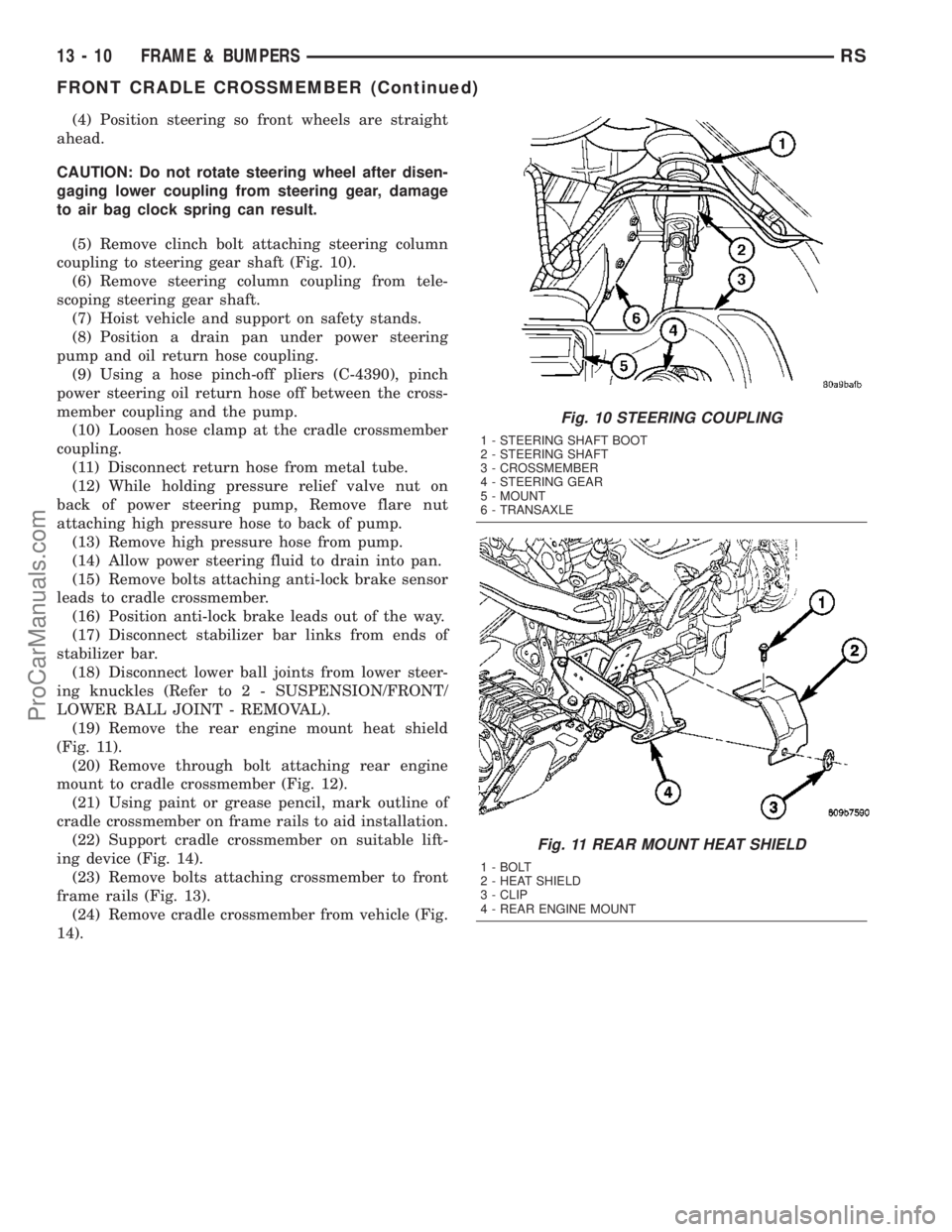
(5) Remove clinch bolt attaching steering column
coupling to steering gear shaft (Fig. 10).
(6) Remove steering column coupling from tele-
scoping steering gear shaft.
(7) Hoist vehicle and support on safety stands.
(8) Position a drain pan under power steering
pump and oil return hose coupling.
(9) Using a hose pinch-off pliers (C-4390), pinch
power steering oil return hose off between the cross-
member coupling and the pump.
(10) Loosen hose clamp at the cradle crossmember
coupling.
(11) Disconnect return hose from metal tube.
(12) While holding pressure relief valve nut on
back of power steering pump, Remove flare nut
attaching high pressure hose to back of pump.
(13) Remove high pressure hose from pump.
(14) Allow power steering fluid to drain into pan.
(15) Remove bolts attaching anti-lock brake sensor
leads to cradle crossmember.
(16) Position anti-lock brake leads out of the way.
(17) Disconnect stabilizer bar links from ends of
stabilizer bar.
(18) Disconnect lower ball joints from lower steer-
ing knuckles (Refer to 2 - SUSPENSION/FRONT/
LOWER BALL JOINT - REMOVAL).
(19) Remove the rear engine mount heat shield
(Fig. 11).
(20) Remove through bolt attaching rear engine
mount to cradle crossmember (Fig. 12).
(21) Using paint or grease pencil, mark outline of
cradle crossmember on frame rails to aid installation.
(22) Support cradle crossmember on suitable lift-
ing device (Fig. 14).
(23) Remove bolts attaching crossmember to front
frame rails (Fig. 13).
(24) Remove cradle crossmember from vehicle (Fig.
14).
Fig. 10 STEERING COUPLING
1 - STEERING SHAFT BOOT
2 - STEERING SHAFT
3 - CROSSMEMBER
4 - STEERING GEAR
5 - MOUNT
6 - TRANSAXLE
Fig. 11 REAR MOUNT HEAT SHIELD
1 - BOLT
2 - HEAT SHIELD
3 - CLIP
4 - REAR ENGINE MOUNT
13 - 10 FRAME & BUMPERSRS
FRONT CRADLE CROSSMEMBER (Continued)
ProCarManuals.com
Page 1398 of 2177

(6) Start engine and let idle just long enough to
circulate power steering fluid through the analyzer
and hoses. Shut off engine.
(7) Check power steering fluid level and add fluid
as necessary. Start engine again and let idle until the
air is out of the fluid.
(8) Gauge should read below 300 psi (2068 kPa). If
above, inspect the hoses for restrictions and repair as
necessary. The initial pressure should be in the range
of 100-275 psi (689-1896 kPa) depending on fluid
temperature. The flow meter should read above 1.5
GPM.
CAUTION: The following test procedure involves
testing maximum pump pressure output and flow
control valve operation. Do not leave valve closed
for more than four seconds as the pump could be
damaged.
NOTE:
Power steering pump maximum pressure for
2.4L engines is 1,200 ± 1,350 psi (8,274 ± 9,308 kPa).
Power steering pump maximum pressure for all other
engines is 1,400 ± 1,500 psi (9,653 ± 10,342 kPa).
(9) Close analyzer valve fully three times and
record highest pressure indicated each time. All three
readings must be within specifications. If any of the
three power steering pump pressures are above orbelow specifications, replace pump. (Refer to 19 -
STEERING/PUMP - REMOVAL)
CAUTION: Do not force the steering to operate
against the stops for more than 4 seconds at a time
because pump damage can result.
(10) Once the pump has been verified as working
correctly, completely open the valve on the Power
Steering Analyzer. Turn the steering wheel to the
extreme left until the stop in the steering gear is
met. Hold it there for 2±4 seconds, then release it.
Now turn the steering wheel to the right until the
right stop is met. Hold it there for 2±4 seconds, then
release it. Record the stabilized pressure at each
position. Compare the recorded readings to the spec-
ifications. If the output pressures are not within 100
psi (689 kPa) of one another against either stop or
are below specifications, the steering gear is leaking
internally and must be replaced. (Refer to 19 -
STEERING/GEAR - REMOVAL)
DIAGNOSIS AND TESTING - STEERING
SYSTEM DIAGNOSIS CHARTS
NOTE: There are three diagnosis charts following
that cover POWER STEERING NOISE, STEERING
WHEEL FEEL, and POWER STEERING FLUID.
POWER STEERING NOISE
CONDITION POSSIBLE CAUSES CORRECTION
OBJECTIONABLE HISS
OR WHISTLE*1. Damaged or mispositioned
steering column shaft/coupling dash
panel seal.1. Reposition or replace steering column
shaft/coupling dash panel seal.
2. Noisy valve in power steering
gear.2. Replace power steering gear.
3. Mis-routed power steering hose. 3. Check routing of power steering
hoses. Ensure hoses do not come in
unwanted contact with other components
and objects.
RATTLE OR EXCESSIVE
CLUNK**1. Power steering gear loose on front
suspension crossmember.1. Inspect power steering gear mounting
bolts. Replace as necessary. Tighten to
the specified torque.
2. Front suspension crossmember
mounting fasteners loose at frame.2. Tighten the front suspension
crossmember mounting fasteners to the
specified torque.
3. Loose tie rod (outer or inner). 3. Check tie rod pivot points for wear.
Replace worn/loose parts as required.
4. Loose lower control arm mounting
bolts at front suspension
crossmember.4. Tighten control arm mounting bolts to
the specified torques.
RSSTEERING19-3
STEERING (Continued)
ProCarManuals.com
Page 1399 of 2177

CONDITION POSSIBLE CAUSES CORRECTION
5. Lower control arm pivot bushing
worn.5. Replace lower control arm pivot
bushing.
6. Loose strut assembly mounting
fasteners at tower or knuckle.6. Tighten strut assembly fasteners to the
specified torque.
7. Power steering fluid hose touching
the body of the vehicle.7. Adjust hose to proper position by
loosening, repositioning, and tightening
attachments to specified torque. Do not
bend tubing.
8. Internal power steering gear
noise.8. Replace power steering gear.
9. Damaged front suspension
crossmember.9. Replace front suspension
crossmember.
10. Stabilizer bar link ball joints
worn.10. Replace stabilizer bar link.
11. Lug nuts loose. 11. Tighten lug nuts to specifications.
12. Excessive Wheel bearing
free-play.12. Verify correct driveshaft hub nut
torque. Replace bearing if torque is okay.
POPPING NOISE 1. Worn outer tie rod. 1. Check ball joint for free-play; Replace
outer tie rod.
2. Loose inner tie rod. 2. Replace power steering gear.
CHIRP OR SQUEAL
(POWER STEERING
PUMP)1. Loose power steering pump drive
belt.1. Check and adjust power steering
pump drive belt to specifications or
replace automatic tensioner where
applicable. Replace belt if worn or
glazed.
2. Malfuctioning belt auto-tensioner 2. Replace belt auto-tensioner.
WHINE, GROWL, MOAN
OR GROAN (POWER
STEERING PUMP)***1. Low fluid level. 1. Fill power steering fluid reservoir to
proper level and check for leaks (make
sure all air is bled from the system fluid).
2. Power steering hose touching
vehicle body or frame.2. Adjust hose to proper position by
loosening, repositioning, and tightening
fitting to specified torque. Do not bend
tubing. Replace hose if damaged.
3. Extreme wear of power steering
pump internal components.3. Replace power steering pump and
flush system as necessary.
4. Extremely low ambient
temperature.4. Some noise can be expected, but will
go away as vehicle warms. Replace
pump if noise is excessive.
SUCKING AIR SOUND 1. Loose clamp on power steering
fluid return hose.1. Tighten or replace hose clamp.
2. Missing O-Ring on power steering
hose connection.2. Inspect connection and replace O-Ring
as required.
3. Low power steering fluid level. 3. Fill power steering fluid reservoir to
proper level and check for leaks.
4. Loose clamp on fluid supply hose. 4. Tighten or replace hose clamp.
19 - 4 STEERINGRS
STEERING (Continued)
ProCarManuals.com
Page 1407 of 2177

WARNING: THE AIR BAG SYSTEM IS A SENSITIVE,
COMPLEX ELECTRO-MECHANICAL UNIT. BEFORE
ATTEMPTING TO DIAGNOSE, REMOVE OR INSTALL
THE AIR BAG SYSTEM COMPONENTS YOU MUST
FIRST DISCONNECT AND ISOLATE THE BATTERY
NEGATIVE (GROUND) CABLE. THEN WAIT TWO
MINUTES FOR THE SYSTEM CAPACITOR TO DIS-
CHARGE. FAILURE TO DO SO COULD RESULT IN
ACCIDENTAL DEPLOYMENT OF THE AIR BAG AND
POSSIBLE PERSONAL INJURY. THE FASTENERS,
SCREWS, AND BOLTS, ORIGINALLY USED FOR
THE AIR BAG COMPONENTS, HAVE SPECIAL
COATINGS AND ARE SPECIFICALLY DESIGNED
FOR THE AIR BAG SYSTEM. THEY MUST NEVER
BE REPLACED WITH ANY SUBSTITUTES. ANYTIME
A NEW FASTENER IS NEEDED, REPLACE WITH
THE CORRECT FASTENERS PROVIDED IN THE
SERVICE PACKAGE OR FASTENERS LISTED IN
THE PARTS BOOKS.
WARNING: SAFETY GOGGLES SHOULD BE WORN
AT ALL TIMES WHEN WORKING ON STEERING
COLUMNS.
CAUTION: Disconnect negative (ground) cable from
the battery before servicing any column compo-
nent.
CAUTION: Do not attempt to remove the pivot pins
to disassemble the tilting mechanism. Damage will
occur.
DIAGNOSIS AND TESTING - STEERING
COLUMN
For diagnosis of conditions relating to the steering
column (Refer to 19 - STEERING - DIAGNOSIS AND
TESTING) and (Refer to 19 - STEERING - DIAGNO-
SIS AND TESTING).
REMOVAL
NOTE: Before proceeding, (Refer to 19 - STEERING/
COLUMN - WARNING).
(1) Make sure the front wheels of the vehicle are
in the STRAIGHT AHEAD position before beginning
the column removal procedure.
(2) Disconnect negative (ground) cable from the
battery and isolate cable from battery terminal.
(3) Remove the lower shroud (Refer to 19 -
STEERING/COLUMN/LOWER SHROUD - REMOV-
AL).
(4) Remove the traction off switch.
(5) Remove the upper shroud.
(6) Remove the cluster trim bezel (Refer to 23 -
BODY/INSTRUMENT PANEL/CLUSTER BEZEL -
REMOVAL).
(7) Remove the knee blocker (Refer to 23 - BODY/
INSTRUMENT PANEL/STEERING COLUMN
OPENING COVER - REMOVAL).
(8) Remove the parking brake handle link.
(9) Remove the knee blocker reinforcement (Refer
to 23 - BODY/INSTRUMENT PANEL/KNEE
BLOCKER - REMOVAL).
(10) Remove the airbag (Refer to 8 - ELECTRI-
CAL/RESTRAINTS/DRIVER AIRBAG - REMOVAL).
(11) Remove the steering wheel retaining nut.
(12) Remove the vibration damper weight.
(13) Remove the steering wheel (Refer to 19 -
STEERING/COLUMN/STEERING WHEEL -
REMOVAL). (Fig. 3)
(14) Disconnect the wiring harness connectors
from the clockspring, multi-function switch, halo
lamp, SKIM module, ignition switch and BTSI sole-
noid.
(15) Disconnect the shift cable at the lever. (Fig. 4)
(16) Remove the pinch side clip, then remove the
cable from the bracket on the column.
(17) Remove the pinch bolt coupling. (Fig. 5)
(18) Loosen the two lower mounting nuts.
(19) Remove the two upper mounting nuts
(20) Remove the steering column.
1 - CLOCKSPRING WIRING
2 - STEERING WHEEL
3 - UPPER SHROUD
4 - FIXED SHROUD
5 - SCREW
6 - STEERING COLUMN MOUNTING PLATE
7 - NUT
8 - DASH PANEL STEERING COLUMN MOUNTING BRACKET
9 - STUDS (4)
10 - STEERING COLUMN LOCKING PIN
11 - NUT/WASHER ASSEMBLY
12 - STEERING COLUMN ASSEMBLY
13 - LOWER SHROUD
14 - SCREWS
15 - STEERING WHEEL RETAINING NUT16 - STEERING WHEEL DAMPER
17 - CLOCKSPRING
18 - SCREW
19 - MULTI-FUNCTION SWITCH
20 - PINCH BOLT
21 - STEERING COLUMN COUPLER
22 - PINCH BOLT RETAINING PIN
23 - DASH PANEL
24 - SILENCER SHELL
25 - INTERMEDIATE SHAFT SHIELD AND SEAL
26 - INTERMEDIATE SHAFT
27 - ROLL PIN
28 - POWER STEERING GEAR
29 - FRONT SUSPENSION CRADLE/CROSSMEMBER
19 - 12 COLUMNRS
COLUMN (Continued)
ProCarManuals.com
Page 1445 of 2177

(6) Attach return hose tubes to suspension cradle
crossmember using routing clamp and bolt (Fig. 20).
Tighten clamp bolt to 23 N´m (200 in. lbs.) torque.
(7) Install the power steering fluid cooler on the
cradle crossmember reinforcement (Fig. 23). Install
the mounting bolts and tighten to 11 N´m (100 in.
lbs.). When installing mounting bolts, include pres-
sure hose routing clamp.
(8) Tighten hose tube nut at power steering gear
port to 31 N´m (275 in. lbs.) torque.
(9) Install front emissions vapor canister. (Refer to
25 - EMISSIONS CONTROL/EVAPORATIVE EMIS-
SIONS/VAPOR CANISTER - INSTALLATION)
(10) Lower vehicle.
(11) Install return hose tube into retainer on ABS
bracket (Fig. 20). Close the bracket.
(12) Install return hose onto reservoir (Fig. 21).
Slide the hose clamp into position on fluid reservoir
and attach it.Be sure hose clamp in installed
past bead on fluid reservoir fitting.
(13) Fill and bleed power steering system using
the Power Steering Pump Initial Operation Proce-
dure. (Refer to 19 - STEERING/PUMP - STANDARD
PROCEDURE)
(14) Inspect system for leaks.
HOSE - POWER STEERING
SUPPLY
REMOVAL
REMOVAL - 2.4L ENGINE
(1) Remove filler cap from power steering fluid res-
ervoir.
(2) Using a siphon pump, remove as much power
steering fluid as possible from the power steering
fluid reservoir.
(3) Raise vehicle. (Refer to LUBRICATION &
MAINTENANCE/HOISTING - STANDARD PROCE-
DURE)
(4) Remove hose clamp securing supply hose to
power steering pump, then remove supply hose from
pump fitting.
(5) Lower vehicle.
(6) Remove hose clamp attaching power steering
fluid supply hose to power steering fluid reservoir,
then remove supply hose.
(7) Remove the power steering fluid supply hose
from the vehicle.
REMOVAL - 3.3L/3.8L ENGINE
NOTE: Before proceeding, review all WARNINGS
and CAUTIONS. (Refer to 19 - STEERING/PUMP -WARNING)(Refer to 19 - STEERING/PUMP - CAU-
TION)
(1) Remove cap from power steering fluid reser-
voir.
(2) Using a siphon pump, remove as much power
steering fluid as possible from power steering fluid
reservoir.
(3) Place an oil drain pan under vehicle to catch
any draining power steering fluid.
(4) Remove clamp attaching supply hose to power
steering fluid reservoir. Disconnect hose from reser-
voir (Fig. 21).
(5) Pull upward on hose routing clip releasing it
from bracket on cylinder head cover (Fig. 21).
NOTE: It may be necessary to remove air cleaner
housing to gain greater access to supply hose at
power steering pump. (Refer to 9 - ENGINE/AIR
INTAKE SYSTEM/AIR CLEANER HOUSING -
REMOVAL)
(6) Remove clamp attaching supply hose to power
steering pump. Disconnect hose from pump and
remove from vehicle (Fig. 21).
INSTALLATION
INSTALLATION - 2.4L ENGINE
(1) Install and correctly route power steering fluid
supply hose from remote fluid reservoir to power
steering pump.
(2) Install fluid supply hose onto power steering
fluid reservoir. Install hose clamp.Be sure hose
clamp is installed past bead on fluid reservoir
fitting.
(3) Raise vehicle. (Refer to LUBRICATION &
MAINTENANCE/HOISTING - STANDARD PROCE-
DURE)
(4) Install power steering fluid supply hose on
power steering pump supply fitting. Install hose
clamp.Be sure hose clamp is installed past bead
on pump fitting.
(5) Lower vehicle.
(6) Fill and bleed power steering system using
Power Steering Pump Initial Operation Procedure.
(Refer to 19 - STEERING/PUMP - STANDARD PRO-
CEDURE)
(7) Inspect system for leaks.
INSTALLATION - 3.3L/3.8L ENGINE
(1) Install supply hose onto supply fitting on power
steering pump (Fig. 21). Slide the hose clamp into
position on fluid reservoir and attach it.Be sure
hose clamp in installed past bead on fluid res-
ervoir fitting.
19 - 50 PUMPRS
HOSE - POWER STEERING RETURN (Continued)
ProCarManuals.com
Page 1787 of 2177

(3) Align with paint breaks around bolt heads.
(4) Install bolts attaching ends of crossmember to
radiator closure panel (Fig. 14). Tighten bolts to 19
N´m (14 ft. lbs.) torque.
(5) Install bolts attaching radiator isolators to
crossmember.
(6) Install screw attaching coolant recovery bottle
to crossmember.
(7) Install bolt attaching air cleaner housing to
crossmember.
(8) Install engine air inlet resonator.
(9) Install radiator sight shield.
(10) Install hood prop rod.
(11) Align hood latch by placing latch over net
pierce tabs. If alignment is required, flatten tabs.
(12) Install bolts attaching hood latch to cross-
member. Tighten bolts to 13.5 N´m (10 ft. lbs.)
torque.
(13) Verify hood latch operation and hood align-
ment.
FRONT WHEELHOUSE
SPLASH SHIELD
REMOVAL
(1) Hoist and support vehicle on safety stands.
(Refer to LUBRICATION & MAINTENANCE/HOIST-
ING - STANDARD PROCEDURE).
(2) Remove front wheel.
(3) Remove push pin fasteners attaching splash
shield to frame rail forward of suspension.
(4) Remove push pin fasteners attaching splash
shield to frame rail rearward of suspension.
(5) Remove screws attaching wheelhouse splash
shield to front fender and front bumper fascia.
(6) Remove splash shield from vehicle (Fig. 15).
INSTALLATION
(1) Place splash shield in position on vehicle (Fig.
15).
(2) Install push pin fasteners attaching splash
shield to frame rail forward of suspension.
(3) Install push pin fasteners attaching splash
shield to frame rail rearward of suspension.
(4) Install screws attaching wheelhouse splash
shield to front fender.
(5) Install front wheel.
(6) Lower vehicle.
LUGGAGE RACK RISER
REMOVAL
(1) Remove two fasteners from the front riser.
Gently pull up on the luggage rack side rail and
detach the riser snap to remove riser from the rail
(Fig. 16).
(2) Repeat for the opposite side, if necessary.
(3) Remove front riser(s) from vehicle (Fig. 17).
Fig. 15 FRONT WHEELHOUSE SPLASH SHIELD
1 - FRONT FENDER WHEELHOUSE SPLASH SHIELD
2 - PUSH PIN FASTENERS
3 - ACCESSORY DRIVE SPLASH SHIELD
4 - SCREWS
Fig. 16 LUGGAGE RACK RISER COVER
1 - FRONT RISER COVER
2 - LOCK TABS
3 - LUGGAGE RACK SIDE RAIL
4 - FRONT RISER
23 - 54 EXTERIORRS
GRILLE OPENING REINFORCEMENT (Continued)
ProCarManuals.com
Page 2115 of 2177
OPERATIONÐThe Oxygen Sensor Heater Moni-
tor begins after the ignition has been turned OFF.
The PCM sends a 5 volt bias to the oxygen sensor
every 1.6 seconds. The PCM keeps it biased for 35
ms each time. As the sensor cools down, the resis-
tance increases and the PCM reads the increase in
voltage. Once voltage has increased to a predeter-
mined amount, higher than when the test started,
the oxygen sensor is cool enough to test heater oper-
ation.
When the oxygen sensor is cool enough, the PCM
energizes the ASD relay. Voltage to the O2 sensor
begins to increase the temperature. As the sensor
temperature increases, the internal resistance
decreases. The PCM continues biasing the 5 volt sig-
nal to the sensor. Each time the signal is biased, the
PCM reads a voltage decrease. When the PCM
detects a voltage decrease of a predetermined value
for several biased pulses, the test passes.
The heater elements are tested each time the
engine is turned OFF if all the enabling conditions
are met. If the monitor fails, the PCM stores a
maturing fault and a Freeze Frame is entered. If two
consecutive tests fail, a DTC is stored. Because the
ignition is OFF, the MIL is illuminated at the begin-
ning of the next key cycle.
Enabling ConditionsÐThe following conditions
must be met for the PCM to run the oxygen sensor
heater test:
²Engine run time of at least 3 minutes
²Engine run time at a predetermined speed
and throttle opening.
²Key OFF power down
²Battery voltage of at least 10 volts
²Sufficient Oxygen Sensor cool down
Pending ConditionsÐThere are not conditions or
situations that prompt conflict or suspension of test-
ing. The oxygen sensor heater test is not run pending
resolution of MIL illumination due to oxygen sensor
failure.
SuspendÐThere are no conditions which exist for
suspending the Heater Monitor.
CATALYST MONITOR
To comply with clean air regulations, vehicles are
equipped with catalytic converters. These converters
reduce the emission of hydrocarbons, oxides of nitro-
gen and carbon monoxide.
Normal vehicle miles or engine misfire can cause a
catalyst to decay. A meltdown of the ceramic core can
cause a reduction of the exhaust passage. This can
increase vehicle emissions and deteriorate engine
performance, driveability and fuel economy.
The catalyst monitor uses dual oxygen sensors
(O2S's) to monitor the efficiency of the converter. The
dual O2S strategy is based on the fact that as a cat-alyst deteriorates, its oxygen storage capacity and its
efficiency are both reduced. By monitoring the oxy-
gen storage capacity of a catalyst, its efficiency can
be indirectly calculated. The upstream O2S is used to
detect the amount of oxygen in the exhaust gas
before the gas enters the catalytic converter. The
PCM calculates the A/F mixture from the output of
the O2S. A low voltage indicates high oxygen content
(lean mixture). A high voltage indicates a low content
of oxygen (rich mixture).
When the upstream O2S detects a lean condition,
there is an abundance of oxygen in the exhaust gas.
A functioning converter would store this oxygen so it
can use it for the oxidation of HC and CO. As the
converter absorbs the oxygen, there will be a lack of
oxygen downstream of the converter. The output of
the downstream O2S will indicate limited activity in
this condition.
As the converter loses the ability to store oxygen,
the condition can be detected from the behavior of
the downstream O2S. When the efficiency drops, no
chemical reaction takes place. This means the con-
centration of oxygen will be the same downstream as
upstream. The output voltage of the downstream
O2S copies the voltage of the upstream sensor. The
only difference is a time lag (seen by the PCM)
between the switching of the O2S's.
To monitor the system, the number of lean-to-rich
switches of upstream and downstream O2S's is
counted. The ratio of downstream switches to
upstream switches is used to determine whether the
catalyst is operating properly. An effective catalyst
will have fewer downstream switches than it has
upstream switches i.e., a ratio closer to zero. For a
totally ineffective catalyst, this ratio will be one-to-
one, indicating that no oxidation occurs in the device.
The system must be monitored so that when cata-
lyst efficiency deteriorates and exhaust emissions
increase to over the legal limit, the MIL (check
engine lamp) will be illuminated.
Monitor OperationÐTo monitor catalyst effi-
ciency, the PCM expands the rich and lean switch
points of the heated oxygen sensor. With extended
switch points, the air/fuel mixture runs richer and
leaner to overburden the catalytic converter. Once
the test is started, the air/fuel mixture runs rich and
lean and the O2 switches are counted. A switch is
counted when an oxygen sensor signal goes from
below the lean threshold to above the rich threshold.
The number of Rear O2 sensor switches is divided by
the number of Front O2 sensor switches to determine
the switching ratio.
The test runs for 20 seconds. As catalyst efficiency
deteriorated over the life of the vehicle, the switch
rate at the downstream sensor approaches that of the
upstream sensor. If at any point during the test
25 - 4 EMISSIONS CONTROLRS
EMISSIONS CONTROL (Continued)
ProCarManuals.com
Page 2151 of 2177

EXHAUSTER - REMOVAL, REAR
QUARTER PANEL/FENDER AIR..........23-56
EXPANSION VALVE - DESCRIPTION . 24-72,24-96
EXPANSION VALVE - DIAGNOSIS AND
TESTING......................24-72,24-97
EXPANSION VALVE - INSTALLATION . 24-74,24-98
EXPANSION VALVE - OPERATION . . . 24-72,24-97
EXPANSION VALVE - REMOVAL....24-73,24-97
EXPORT - BRAKE ROTOR...............5-55
EXPORT - DESCRIPTION................5-58
EXPORT - DESCRIPTION................2-10
EXPORT - DESCRIPTION, ANTENNA
MODULE............................8A-6
EXPORT - DESCRIPTION, DIESEL
SUPPLEMENTAL HEATER - DCHA.......24-106
EXPORT - DESCRIPTION, HEADLAMP
LEVELING SWITCH...................8L-15
EXPORT - DESCRIPTION, HEADLAMP
WASHERS..........................8R-10
EXPORT - DESCRIPTION, POWER
FOLDAWAY MIRROR SWITCH..........8N-48
EXPORT - DESCRIPTION, QUARTER
GLASS INTEGRAL ANTENNA.............8A-9
EXPORT - DESCRIPTION, REAR FOG
LAMP..............................8L-22
EXPORT - DIAGNOSIS AND TESTING,
ANTENNA MODULE....................8A-7
EXPORT - DIAGNOSIS AND TESTING,
HEADLAMP LEVELING MOTOR..........8L-14
EXPORT - DIAGNOSIS AND TESTING,
HEADLAMP LEVELING SWITCH.........8L-15
EXPORT - DIAGNOSIS AND TESTING,
HEADLAMP SWITCH..................8L-16
EXPORT - DIAGNOSIS AND TESTING,
HEADLAMP WASHERS................8R-10
EXPORT - DIAGNOSIS AND TESTING,
QUARTER GLASS INTEGRAL ANTENNA....8A-9
EXPORT - INSTALLATION...............2-12
EXPORT - INSTALLATION, ANTENNA
MODULE............................8A-7
EXPORT - INSTALLATION, FRONT FOG
LAMP...............................8L-9
EXPORT - INSTALLATION, FRONT
POSITION LAMP.....................8L-10
EXPORT - INSTALLATION, HEADLAMP....8L-13
EXPORT - INSTALLATION, HEADLAMP
LEVELING MOTOR....................8L-15
EXPORT - INSTALLATION, HEADLAMP
UNIT..............................8L-20
EXPORT - INSTALLATION, HEADLAMP
WASHER HOSE......................8R-12
EXPORT - INSTALLATION, HEADLAMP
WASHER PUMP MOTOR...............8R-13
EXPORT - INSTALLATION, HEADLAMP
WASHERS..........................8R-12
EXPORT - INSTALLATION, HOOD AJAR
SWITCH............................8Q-3
EXPORT - INSTALLATION, PARK/TURN
SIGNAL LAMP.......................8L-22
EXPORT - INSTALLATION, POWER
FOLDAWAY MIRROR SWITCH..........8N-49
EXPORT - INSTALLATION, REPEATER
LAMP..............................8L-22
EXPORT - INSTALLATION, TAIL LAMP....8L-23
EXPORT - OPERATION, ANTENNA
MODULE............................8A-6
EXPORT - OPERATION, HEADLAMP
WASHERS
..........................8R-10
EXPORT - OPERATION, POWER
FOLDAWAY MIRROR SWITCH
..........8N-48
EXPORT - OPERATION, QUARTER GLASS
INTEGRAL ANTENNA
...................8A-9
EXPORT - REMOVAL
...................2-11
EXPORT - REMOVAL, ANTENNA MODULE
. . 8A-7
EXPORT - REMOVAL, FRONT FOG LAMP
. . . 8L-9
EXPORT - REMOVAL, FRONT POSITION
LAMP
..............................8L-10
EXPORT - REMOVAL, HEADLAMP
........8L-13
EXPORT - REMOVAL, HEADLAMP
LEVELING MOTOR
....................8L-14
EXPORT - REMOVAL, HEADLAMP UNIT
. . . 8L-20
EXPORT - REMOVAL, HEADLAMP
WASHER HOSE
......................8R-12
EXPORT - REMOVAL, HEADLAMP
WASHER PUMP MOTOR
...............8R-12
EXPORT - REMOVAL, HEADLAMP
WASHERS
..........................8R-12EXPORT - REMOVAL, HOOD AJAR
SWITCH............................8Q-3
EXPORT - REMOVAL, PARK/TURN
SIGNAL LAMP.......................8L-22
EXPORT - REMOVAL, POWER
FOLDAWAY MIRROR SWITCH..........8N-48
EXPORT - REMOVAL, REPEATER LAMP . . . 8L-22
EXPORT - REMOVAL, TAIL LAMP........8L-23
EXPORT - STANDARD PROCEDURE,
FRONT FOG LAMP UNIT ALIGNMENT......8L-9
EXPORT - STANDARD PROCEDURE,
HEADLAMP UNIT ALIGNMENT..........8L-17
EXTENSION - INSTALLATION,
EVAPORATOR LINE...................24-96
EXTENSION - REMOVAL, EVAPORATOR
LINE...............................24-95
EXTENSION TRIM - INSTALLATION,
A-PILLAR LOWER....................23-73
EXTENSION TRIM - REMOVAL, A-PILLAR
LOWER............................23-73
EXTENSION TUBES - INSTALLATION,
HEATER CORE.......................24-77
EXTENSION TUBES - REMOVAL, HEATER
CORE..............................24-75
EXTERIOR - DESCRIPTION, LAMPS/
LIGHTING...........................8L-2
EXTERIOR - OPERATION, LAMPS/
LIGHTING...........................8L-3
EXTERIOR - WARNING, LAMPS/
LIGHTING...........................8L-4
EXTERIOR HANDLE - INSTALLATION.....23-22,
23-39
EXTERIOR HANDLE - REMOVAL.....23-22,23-39
EXTERIOR HANDLE SWITCH -
DESCRIPTION.......................8N-11
EXTERIOR HANDLE SWITCH -
INSTALLATION......................8N-12
EXTERIOR HANDLE SWITCH -
OPERATION.........................8N-11
EXTERIOR HANDLE SWITCH - REMOVAL . . 8N-11
EXTERIOR LAMPS, SPECIFICATIONS......8L-4
EXTERIOR NAME PLATES - ADHESIVE
ATTACHED - INSTALLATION............23-50
EXTERIOR NAME PLATES - ADHESIVE
ATTACHED - REMOVAL................23-50
EXTERIOR NAME PLATES - TAPE
ATTACHED - INSTALLATION............23-50
EXTERIOR NAME PLATES - TAPE
ATTACHED - REMOVAL................23-50
FACTOR SETTING - STANDARD
PROCEDURE, PINION............8E-15,8E-23
FAILED PARK SWITCH - DIAGNOSIS AND
TESTING............................8R-2
FAN - DESCRIPTION, RADIATOR..........7-28
FAN - INSTALLATION, RADIATOR.........7-30
FAN - OPERATION, RADIATOR...........7-29
FAN - REMOVAL, RADIATOR.............7-30
FAN MOTOR - DIAGNOSIS AND
TESTING, RADIATOR...................7-29
FAN RELAY - DESCRIPTION, RADIATOR....7-30
FAN RELAY - INSTALLATION, RADIATOR . . . 7-30
FAN RELAY - OPERATION, RADIATOR......7-30
FAN RELAY - REMOVAL, RADIATOR.......7-30
FASCIA - INSTALLATION, FRONT.........13-1
FASCIA - INSTALLATION, REAR..........13-2
FASCIA - REMOVAL, FRONT.............13-1
FASCIA - REMOVAL, REAR..............13-2
FASCIA - SCUFF PAD - INSTALLATION,
REAR...............................13-4
FASCIA - SCUFF PAD - REMOVAL, REAR . . . 13-3
FASTENER IDENTIFICATION -
DESCRIPTION......................Intro.-2
FASTENER TORQUE, SPECIFICATIONS -
ABS ................................5-79
FASTENER TORQUE, SPECIFICATIONS -
BRAKE...............................5-9
FASTENER TORQUE, SPECIFICATIONS -
FRONT SUSPENSION...................2-3
FASTENER TORQUE, SPECIFICATIONS -
POWER STEERING....................19-9
FASTENER TORQUE, SPECIFICATIONS -
REAR SUSPENSION
...................2-27
FASTENER USAGE - DESCRIPTION
......Intro.-5
FEED CIRCUIT RESISTANCE TEST -
DIAGNOSIS AND TESTING
..............8F-32
FEED CIRCUIT TEST - DIAGNOSIS AND
TESTING
...........................8F-33
FENDER - INSTALLATION, FRONT
........23-51FENDER - REMOVAL, FRONT...........23-51
FFV REPLACEMENT PARTS -
DESCRIPTION........................14-2
FILL - DIAGNOSIS AND TESTING,
VEHICLE DOES NOT..................25-16
FILL - STANDARD PROCEDURE, FLUID
DRAIN.............................21-71
FILL DOOR - INSTALLATION, FUEL.......23-51
FILL DOOR - REMOVAL, FUEL..........23-51
FILL DOOR BLOCKER LATCH -
INSTALLATION, FUEL.................23-52
FILL DOOR BLOCKER LATCH -
REMOVAL, FUEL.....................23-52
FILL DOOR BLOCKER LATCH STRIKER -
INSTALLATION, FUEL.................23-52
FILL DOOR BLOCKER LATCH STRIKER -
REMOVAL, FUEL.....................23-52
FILL DOOR BLOCKER LOCKOUT LINK -
INSTALLATION, FUEL.................23-53
FILL DOOR BLOCKER LOCKOUT LINK -
REMOVAL, FUEL.....................23-52
FILL/CHECK LOCATIONS - DESCRIPTION,
FLUID...............................0-7
FILLER CAP - DESCRIPTION, FUEL.......25-12
FILLER CAP - OPERATION, FUEL........25-12
FILLER NECK SEAL - DIAGNOSIS AND
TESTING, RADIATOR CAP TO............7-27
FILLER TUBE - INSTALLATION, FUEL
TANK ..............................14-12
FILLER TUBE - REMOVAL, FUEL TANK....14-12
FILLING - STANDARD PROCEDURE,
COOLING SYSTEM.......................7-5
FILLING - STANDARD PROCEDURE,
HEATER CORE.......................24-98
FILTER - DESCRIPTION, AIR............24-39
FILTER - DESCRIPTION, OIL.............9-53
FILTER - INSTALLATION, AIR...........24-40
FILTER - INSTALLATION, FUEL...........14-4
FILTER - INSTALLATION, INLET..........14-13
FILTER - INSTALLATION, OIL.......9-139,9-53
FILTER - REMOVAL, AIR...............24-39
FILTER - REMOVAL, FUEL...............14-4
FILTER - REMOVAL, INLET.............14-13
FILTER - REMOVAL, OIL...........9-139,9-53
FILTER ADAPTER - INSTALLATION, OIL . . . 9-139
FILTER ADAPTER - REMOVAL, OIL.......9-139
FILTER CHANGE - STANDARD
PROCEDURE, ENGINE OIL..........9-137,9-53
FILTER SERVICE - STANDARD
PROCEDURE, FLUID.................21-203
FINAL DRIVE - ASSEMBLY............21-195
FINAL DRIVE - DISASSEMBLY.........21-190
FINESSE SANDING/BUFFING &
POLISHING - DESCRIPTION............23-84
FINISH - DESCRIPTION, BASE
COAT/CLEARCOAT....................23-84
FIRING ORDER, SPECIFICATIONS.........8I-3
FIRST ROW - BENCH - INSTALLATION,
SEAT BELT BUCKLE..................8O-12
FIRST ROW - BENCH - REMOVAL, SEAT
BELT BUCKLE.......................8O-12
FIRST ROW - OUTBOARD -
INSTALLATION, SEAT BELT &
RETRACTOR........................8O-13
FIRST ROW - OUTBOARD - REMOVAL,
SEAT BELT & RETRACTOR.............8O-13
FIRST ROW INBOARD - QUAD BUCKET -
INSTALLATION, SEAT BELT BUCKLE......8O-11
FIRST ROW INBOARD - QUAD BUCKET -
REMOVAL, SEAT BELT BUCKLE.........8O-11
FITTING - CONNECTING ROD............9-45
FITTING - PISTON RING................9-45
FITTING - STANDARD PROCEDURE,
MAIN BEARING......................9-123
FITTING - STANDARD PROCEDURE,
PISTON RING.......................9-121
FITTING - STANDARD PROCEDURE,
PISTON TO CYLINDER BORE............9-42
FITTING CONNECTING RODS -
STANDARD PROCEDURE...............9-116
FITTING PISTONS - STANDARD
PROCEDURE........................9-117
FITTINGS - STANDARD PROCEDURE,
QUICK-CONNECT
.....................14-13
FLANGE SEAL - INSTALLATION, INPUT
....3-45
FLANGE SEAL - INSTALLATION, OUTPUT
. . . 3-46
FLANGE SEAL - REMOVAL, INPUT
........3-44
FLANGE SEAL - REMOVAL, OUTPUT
.......3-45
12 INDEXRS
Description Group-Page Description Group-Page Description Group-Page
ProCarManuals.com