tires CHRYSLER CONCORDE 2004 2.G User Guide
[x] Cancel search | Manufacturer: CHRYSLER, Model Year: 2004, Model line: CONCORDE, Model: CHRYSLER CONCORDE 2004 2.GPages: 273, PDF Size: 6 MB
Page 166 of 273
CAUTION!
Replacing original tires with tires of a different size
may result in false speedometer and odometer read-
ings. Check with your dealer before replacing tires
with a different size.
Tire Rotation Recommendations
Tires on the front and rear axles of vehicles operate at
different loads and perform different steering, driving
and braking functions. For these reasons, they wear at
unequal rates, and tend to develop irregular wear pat-
terns.
These effects can be reduced by timely rotation of tires.
The benefits of rotation are especially worthwhile with
aggressive tread designs such as those on all season type
tires. Rotation will increase tread life, help to maintain
mud, snow and wet traction levels, and contribute to a
smooth, quiet ride.Rotate your tires at intervals shown on the maintenance
schedules. More frequent rotation is permissible if de-
sired. The reasons for any rapid or unusual wear should
be corrected before rotating.
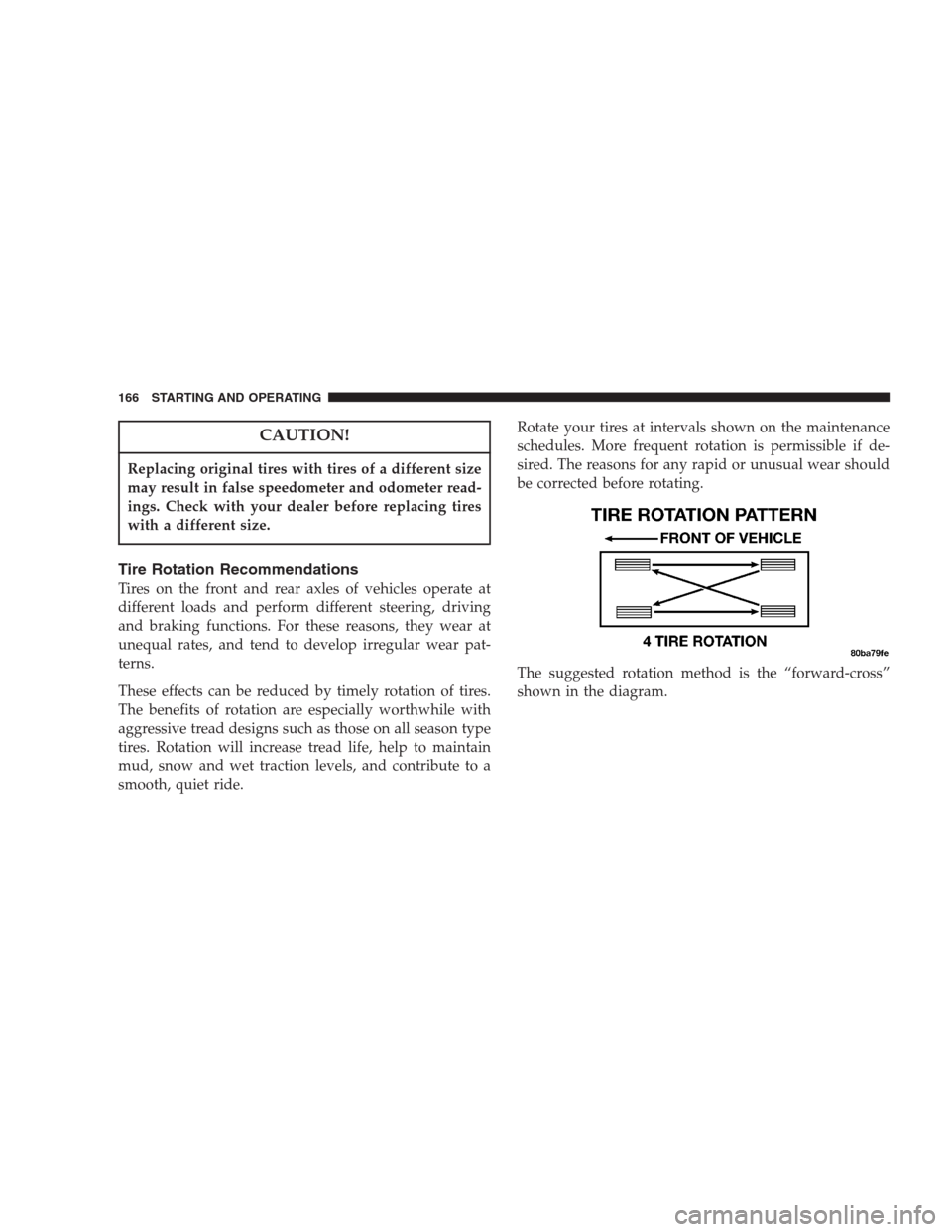
The suggested rotation method is the “forward-cross”
shown in the diagram.
166 STARTING AND OPERATING
Page 167 of 273
Alignment And Balance
The suspension components of your vehicle should be
inspected and aligned when needed to obtain full tire
tread mileage.
Poor suspension alignment may result in:
•fast tire wear;
•uneven tire wear, such as feathering and one-sided
wear;
•vehicle pull to right or left.
Tires may also cause vehicle to pull to the left or right.
Alignment will not correct this condition. See your dealer
for proper diagnosis.
Improper alignment will not cause vehicle vibration.
Vehicle vibration may be a result of tire and wheel
out-of-balance. Proper balancing will reduce vibration
and avoid tire cupping and spotty wear.
FUEL REQUIREMENTS
Your engine is designed to meet all emis-
sions regulations and provide satisfactory
fuel economy and performance when us-
ing high quality unleaded gasoline having
an octane range of 87 to 89 or higher. The
manufacturer recommends the use of 89
octane for optimum performance.
Light spark knock at low engine speeds is not harmful to
your engine. However, continued heavy spark knock at
high speeds can cause damage and should be reported to
your dealer immediately. Engine damage resulting from
operating with a heavy spark knock may not be covered
by the new vehicle warranty.
Poor quality gasoline can cause problems such as hard
starting, stalling and stumble. If you experience these
problems, try another brand of gasoline before consider-
ing service for the vehicle.
STARTING AND OPERATING 167
5
Page 185 of 273
6. Start the engine in the vehicle which has the booster
battery, let the engine idle a few minutes, then start the
engine in the vehicle with the discharged battery.
7. When removing the jumper cables, reverse the above
sequence exactly. Be careful of the moving belts and fan.
DRIVING ON SLIPPERY SURFACES
Acceleration
Rapid acceleration on snow covered, wet, or other slip-
pery surfaces may cause the front wheels to pull errati-
cally to the right or left. This phenomenon occurs when
there is a difference in the surface traction under the front
(driving) wheels.
WARNING!
Rapid acceleration on slippery surfaces is danger-
ous. Unequal traction can cause sudden pulling of
the front wheels. You could lose control of the
vehicle and possibly have an accident. Accelerate
slowly and carefully whenever there is likely to be
poor traction (ice, snow, wet, mud, loose sand, etc.).
Traction
When driving on wet or slushy roads, it is possible for a
wedge of water to build up between the tire and road
surface. This is known as hydroplaning and may cause
partial or complete loss of vehicle control and stopping
ability. To reduce this possibility, the following precau-
tions should be observed:
1. Slow down during rainstorms or when roads are
slushy.
2. Slow down if road has standing water or puddles.
3. Replace tires when tread wear indicators first become
visible.
4. Keep tires properly inflated.
5. Maintain sufficient distance between your vehicle and
the vehicle in front of you to avoid a collision in a sudden
stop.
NOTE:If so equipped, turn on the Traction Control
System to accelerate on slippery surfaces.
WHAT TO DO IN EMERGENCIES 185
6
Page 186 of 273
FREEING A STUCK VEHICLE
If your vehicle is equipped with Traction Control, turn
the system off before attempting to “rock” the vehicle.
If your vehicle becomes stuck in mud, sand or snow, it
can often be moved by a rocking motion. Turn your
steering wheel right and left to clear the area around the
front wheels. Then shift back and forth between Reverse
and Drive. Usually the least accelerator pedal pressure to
maintain the rocking motion without spinning the
wheels is most effective.
CAUTION!
Racing the engine or spinning the wheels too fast
may lead to transmission overheating and failure. It
can also damage the tires. Do not spin the wheels
above 30 mph (48 km/h).
TOWING A DISABLED VEHICLE
Only two ways of towing are approved; front towing and
flat bed towing.
CAUTION!
•Do not attempt to tow this vehicle from the front
with sling type towing equipment. Damage to the
front fascia will result.
•Always use wheel lift equipment when towing
from the front. The only other approved method
of towing is with a flat bed truck.
•Do not tow the vehicle from the rear. Damage to
the rear sheet metal and fascia will occur.
•Do not push or tow this vehicle with another
vehicle as damage to the bumper fascia and trans-
axle may result.
If damage to the vehicle prevents towing from the front,
move the vehicle onto a flat bed tow truck.
186 WHAT TO DO IN EMERGENCIES
Page 238 of 273
Once a Month
•
Check tire pressure and look for unusual wear or
damage.
•Inspect the battery and clean and tighten the terminals
as required.
•Check the fluid levels of coolant reservoir, brake
master cylinder, power steering and transaxle and add
as needed.
•Check all lights and all other electrical items for correct
operation.
•Check rubber seals on each side of the radiator for
proper fit.
At Each Oil Change
•
Change the engine oil filter.
•Inspect the exhaust system.
•Inspect the brake hoses.
•Inspect the CV joints and front and rear suspension
components.
•Check the automatic transmission fluid level.
•Check the coolant level, hoses, and clamps.
•Rotate the tires at each oil change interval shown on
Schedule “A” 6,000 miles (10 000 km) or every other
interval shown on Schedule “B” 6,000 miles (10 000
km).
238 MAINTENANCE SCHEDULES
8
M
A
I
N
T
E
N
A
N
C
E
S
C
H
E
D
U
L
E
S
Page 259 of 273
DEPARTMENT OF TRANSPORTATION UNIFORM
TIRE QUALITY GRADES
The following describes the tire grading categories estab-
lished by the National highway Traffic Safety Adminis-
tration. The specific grade rating assigned by the tire’s
manufacturer in each category is shown on the sidewall
of the tires on your car.
All Passenger Car Tires Must Conform to Federal Safety
Requirements in Addition to These Grades.
Treadwear
The treadwear grade is a comparative rating based on the
wear rate of the tire when tested under controlled con-
ditions on a specified government test course. For ex-
ample, a tire graded 150 would wear one and a half (1
1/2) times as well on the government course as a tire
graded 100. The relative performance of tires depends
upon the actual conditions of their use, however, and
may depart significantly from the norm due to variations
in driving habits, service practices and differences in road
characteristics and climate.
Traction Grades
The traction grades, from highest to lowest, are A, B, and
C, and they represent the tire’s ability to stop on wet
pavement as measured under controlled conditions on
specified government test surfaces of asphalt and con-
crete. A tire marked C may have poor traction perfor-
mance.
WARNING!
The traction grade is based on braking (straight-
ahead) traction tests and does not include cornering
(turning) performance.
Temperature Grades
The temperature grades are A (highest), B, and C, repre-
senting the tire’s resistance to the generation of heat and
its ability to dissipate heat when tested under controlled
conditions on a specified indoor laboratory test wheel.
Sustained high temperature can cause the material of the
tire to degenerate and reduce tire life, and excessive
temperature can lead to sudden tire failure. The grade C
IF YOU NEED CONSUMER ASSISTANCE 259
9
Page 260 of 273
corresponds to a level of performance which all passen-
ger car tires must meet under the Federal Motor Vehicle
Safety Standard No. 109. Grades B and A represent
higher levels of performance on the laboratory test wheel
than the minimum required by law.WARNING!
The temperature grade is established for a tire that is
properly inflated and not overloaded. Excessive
speed, underinflation, or excessive loading, either
separately or in combination, can cause heat buildup
and possible tire failure.
260 IF YOU NEED CONSUMER ASSISTANCE
Page 262 of 273
About Your Brakes...................... 157
ABS (Anti-Lock Brake) System............. 112
Accident Damage....................... 221
Adding Engine Coolant (Antifreeze)......... 211
Adding Fuel.......................... 170
Air Cleaner, Engine..................... 202
Air Conditioning....................137,140
Air Conditioning Controls.............137,140
Air Conditioning, Operating Tips........... 146
Air Conditioning Refrigerant.............. 205
Air Conditioning System................. 204
Air Pressure, Tires...................159,161
Airbag................................ 33
Airbag Deployment....................37,38
Airbag Light....................37,41,49,111
Airbag Maintenance...................... 40
Alarm System.......................... 23
Alignment and Balance.................. 167
Antifreeze Disposal..................... 211
Antifreeze (Engine Coolant)............... 211
Anti-Lock Brake System.................. 157
Anti-Lock Warning Light................. 112
Anti-Theft Security Alarm................. 23Appearance Care....................... 220
Auto Down Power Windows............... 25
Automatic Dimming Mirror................ 56
Automatic Door Locks.................... 16
Automatic Headlights..................67,70
Automatic Off, Interior Lights.............. 65
Automatic Temperature Control............ 140
Automatic Transaxle..................153,217
Fluid and Filter Changes................ 219
Fluid Level Check..................... 218
Reset Mode......................... 154
Selection Of Lubricant................. 217
Shifting............................ 154
Special Additives..................... 219
Backfire, Engine........................ 202
Ball Joints............................ 207
Battery............................182,203
Emergency Starting.................... 182
Gas Caution......................182,203
Jump Starting........................ 182
Keyless Transmitter Replacement.......... 22
Location.........................183,203
262 INDEX
Page 270 of 273
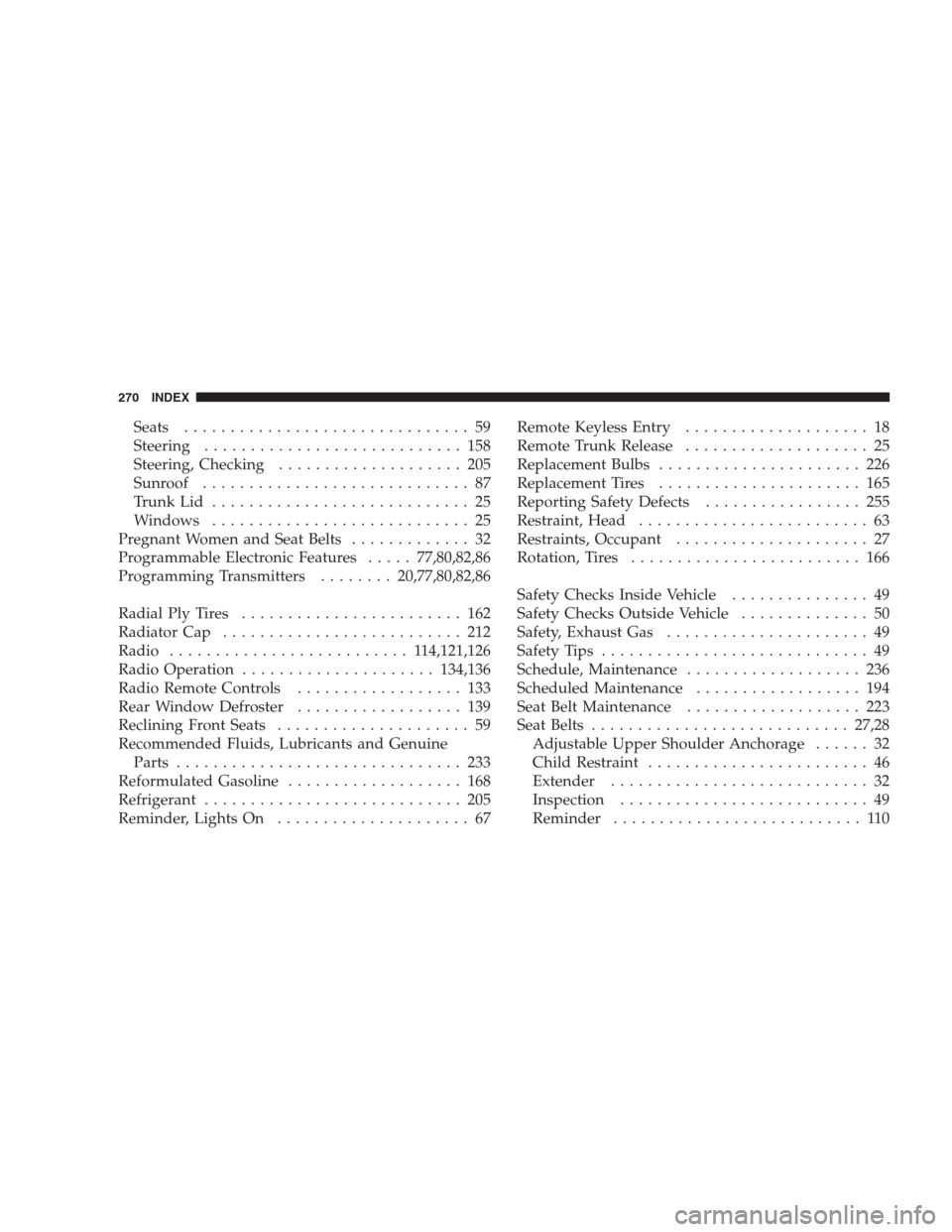
Seats............................... 59
Steering............................ 158
Steering, Checking.................... 205
Sunroof............................. 87
TrunkLid ............................ 25
Windows............................ 25
Pregnant Women and Seat Belts............. 32
Programmable Electronic Features.....77,80,82,86
Programming Transmitters........20,77,80,82,86
Radial Ply Tires........................ 162
Radiator Cap.......................... 212
Radio.......................... 114,121,126
Radio Operation.....................134,136
Radio Remote Controls.................. 133
Rear Window Defroster.................. 139
Reclining Front Seats..................... 59
Recommended Fluids, Lubricants and Genuine
Parts............................... 233
Reformulated Gasoline................... 168
Refrigerant............................ 205
Reminder, Lights On..................... 67Remote Keyless Entry.................... 18
Remote Trunk Release.................... 25
Replacement Bulbs...................... 226
Replacement Tires...................... 165
Reporting Safety Defects................. 255
Restraint, Head......................... 63
Restraints, Occupant..................... 27
Rotation, Tires......................... 166
Safety Checks Inside Vehicle............... 49
Safety Checks Outside Vehicle.............. 50
Safety, Exhaust Gas...................... 49
Safety Tips............................. 49
Schedule, Maintenance................... 236
Scheduled Maintenance.................. 194
Seat Belt Maintenance................... 223
Seat Belts............................27,28
Adjustable Upper Shoulder Anchorage...... 32
Child Restraint........................ 46
Extender............................ 32
Inspection........................... 49
Reminder........................... 110
270 INDEX
Page 271 of 273
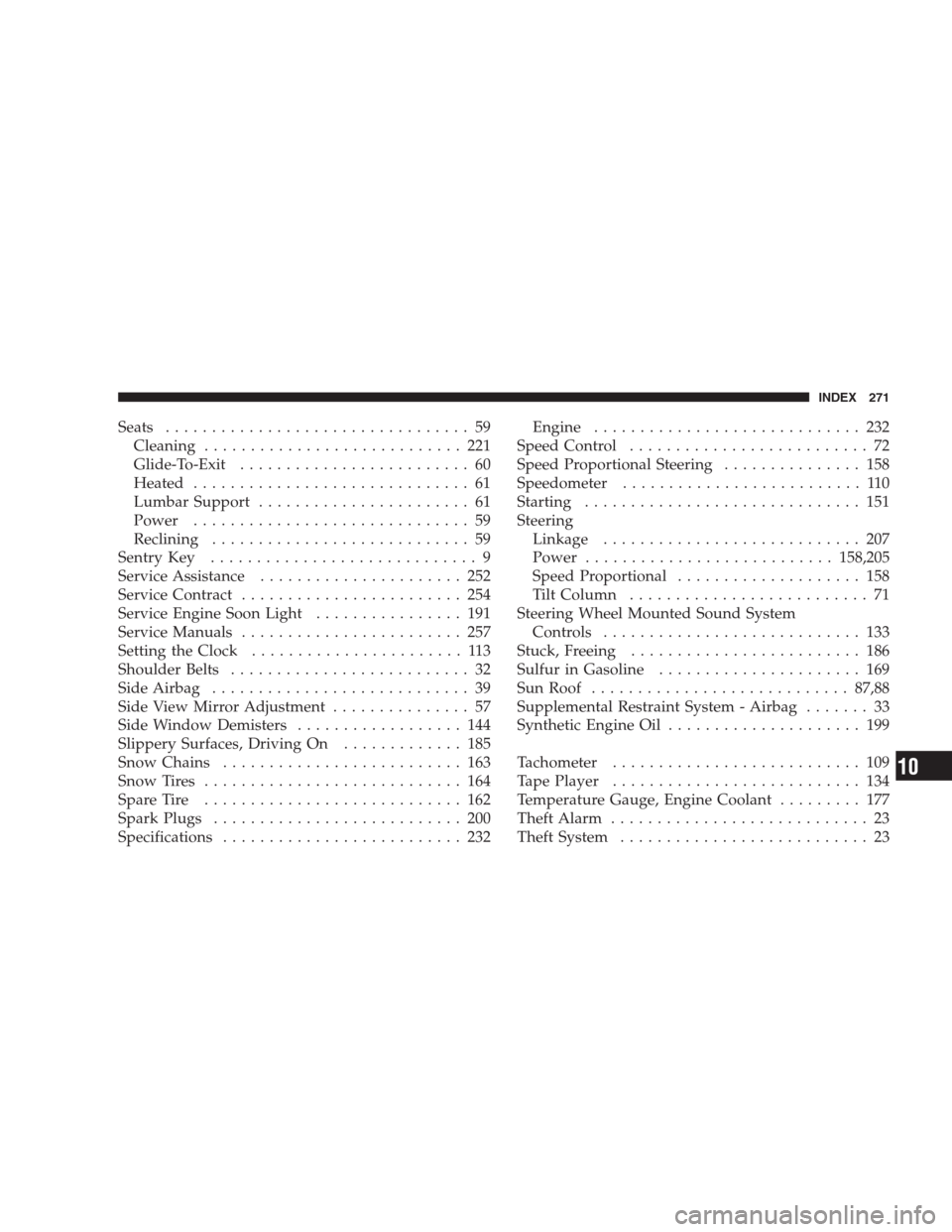
Seats................................. 59
Cleaning............................ 221
Glide-To-Exit......................... 60
Heated.............................. 61
Lumbar Support....................... 61
Power.............................. 59
Reclining............................ 59
Sentry Key............................. 9
Service Assistance...................... 252
Service Contract........................ 254
Service Engine Soon Light................ 191
Service Manuals........................ 257
Setting the Clock....................... 113
Shoulder Belts.......................... 32
Side Airbag............................ 39
Side View Mirror Adjustment............... 57
Side Window Demisters.................. 144
Slippery Surfaces, Driving On............. 185
Snow Chains.......................... 163
Snow Tires............................ 164
Spare Tire............................ 162
Spark Plugs........................... 200
Specifications.......................... 232Engine............................. 232
Speed Control.......................... 72
Speed Proportional Steering............... 158
Speedometer.......................... 110
Starting.............................. 151
Steering
Linkage............................ 207
Power...........................158,205
Speed Proportional.................... 158
Tilt Column.......................... 71
Steering Wheel Mounted Sound System
Controls............................ 133
Stuck, Freeing......................... 186
Sulfur in Gasoline...................... 169
Sun Roof............................87,88
Supplemental Restraint System - Airbag....... 33
Synthetic Engine Oil..................... 199
Tachometer........................... 109
Tape Player........................... 134
Temperature Gauge, Engine Coolant......... 177
Theft Alarm............................ 23
Theft System........................... 23
INDEX 271
10