flat tire CHRYSLER CROSSFIRE 2006 1.G User Guide
[x] Cancel search | Manufacturer: CHRYSLER, Model Year: 2006, Model line: CROSSFIRE, Model: CHRYSLER CROSSFIRE 2006 1.GPages: 296, PDF Size: 1.6 MB
Page 163 of 296

Tread Wear Indicators
Tread wear indicators are in the original equipment tires
to help you in determining when your tires should be
replaced.
These indicators are molded into the bottom of the tread
grooves and will appear as bands when the tread depth
becomes 1/16 inch (2 mm). When the indicators appear
in 2 or more adjacent grooves, the tire should be replaced.
Many states have laws requiring tire replacement at this
point.
Replacement Tires
The tires on your new vehicle provide a balance of many
characteristics. They should be inspected regularly for
wear and correct cold tire inflation pressure. The manu-
facturer strongly recommends that you use tires equiva-
lent to the originals in size, quality and performance
when replacement is needed (see the paragraph on tread
wear indicators). Refer to the Tire and Loading Informa-
tion placard for the size designation of your tire. The
service description and load identification will be found
on the original equipment tire. Failure to use equivalent
replacement tires may adversely affect the safety, han-
dling, and ride of your vehicle. We recommend that you
contact your original equipment or an authorized tire
dealer with any questions you may have on tire specifi-
cations or capability.
STARTING AND OPERATING 163
5
Page 164 of 296
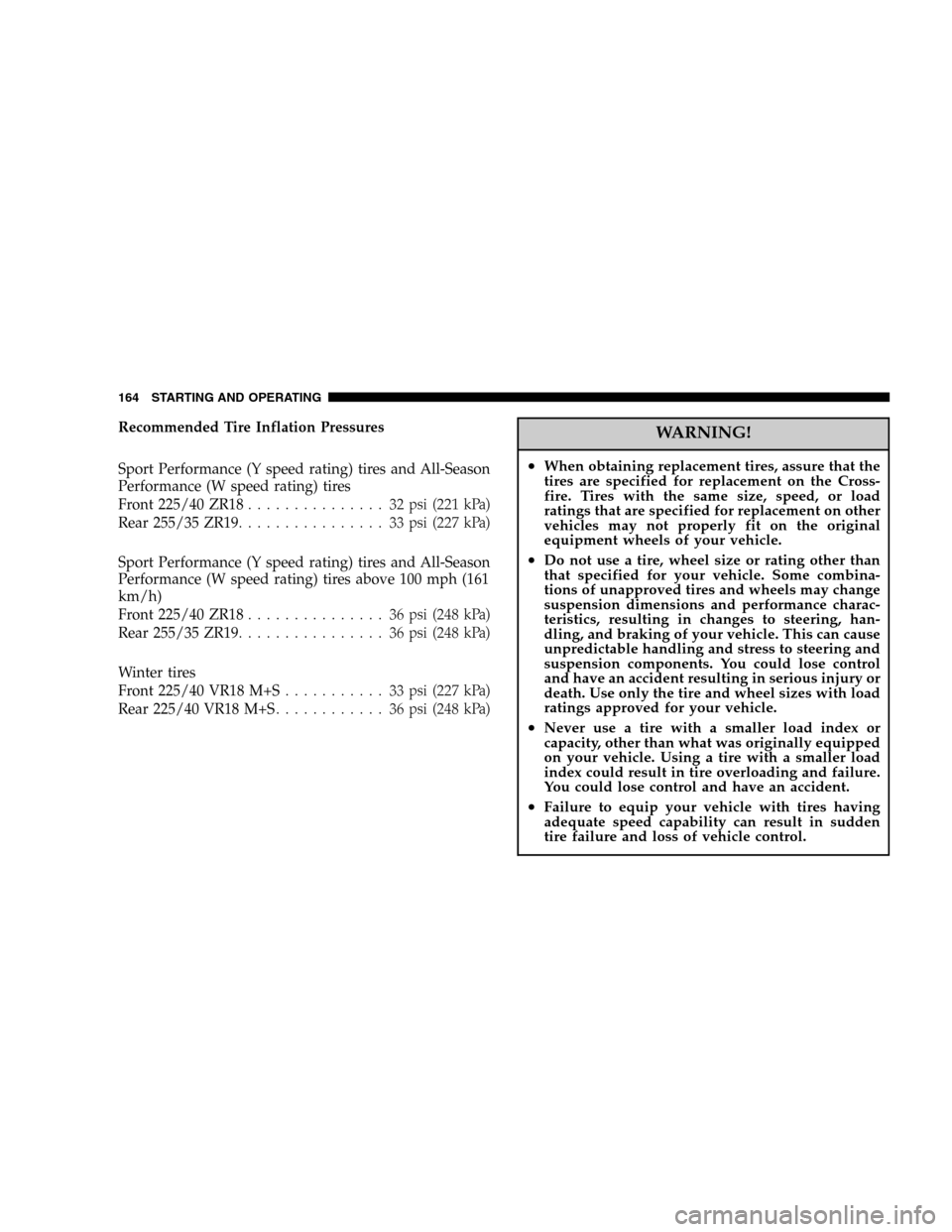
Recommended Tire Inflation Pressures
Sport Performance (Y speed rating) tires and All-Season
Performance (W speed rating) tires
Front 225/40 ZR18............... 32psi(221 kPa)
Rear 255/35 ZR19................ 33psi(227 kPa)
Sport Performance (Y speed rating) tires and All-Season
Performance (W speed rating) tires above 100 mph (161
km/h)
Front 225/40 ZR18............... 36psi(248 kPa)
Rear 255/35 ZR19................ 36psi(248 kPa)
Winter tires
Front 225/40 VR18 M+S........... 33psi(227 kPa)
Rear 225/40 VR18 M+S............ 36psi(248 kPa)WARNING!
•When obtaining replacement tires, assure that the
tires are specified for replacement on the Cross-
fire. Tires with the same size, speed, or load
ratings that are specified for replacement on other
vehicles may not properly fit on the original
equipment wheels of your vehicle.
•Do not use a tire, wheel size or rating other than
that specified for your vehicle. Some combina-
tions of unapproved tires and wheels may change
suspension dimensions and performance charac-
teristics, resulting in changes to steering, han-
dling, and braking of your vehicle. This can cause
unpredictable handling and stress to steering and
suspension components. You could lose control
and have an accident resulting in serious injury or
death. Use only the tire and wheel sizes with load
ratings approved for your vehicle.
•Never use a tire with a smaller load index or
capacity, other than what was originally equipped
on your vehicle. Using a tire with a smaller load
index could result in tire overloading and failure.
You could lose control and have an accident.
•Failure to equip your vehicle with tires having
adequate speed capability can result in sudden
tire failure and loss of vehicle control.
164 STARTING AND OPERATING
Page 165 of 296
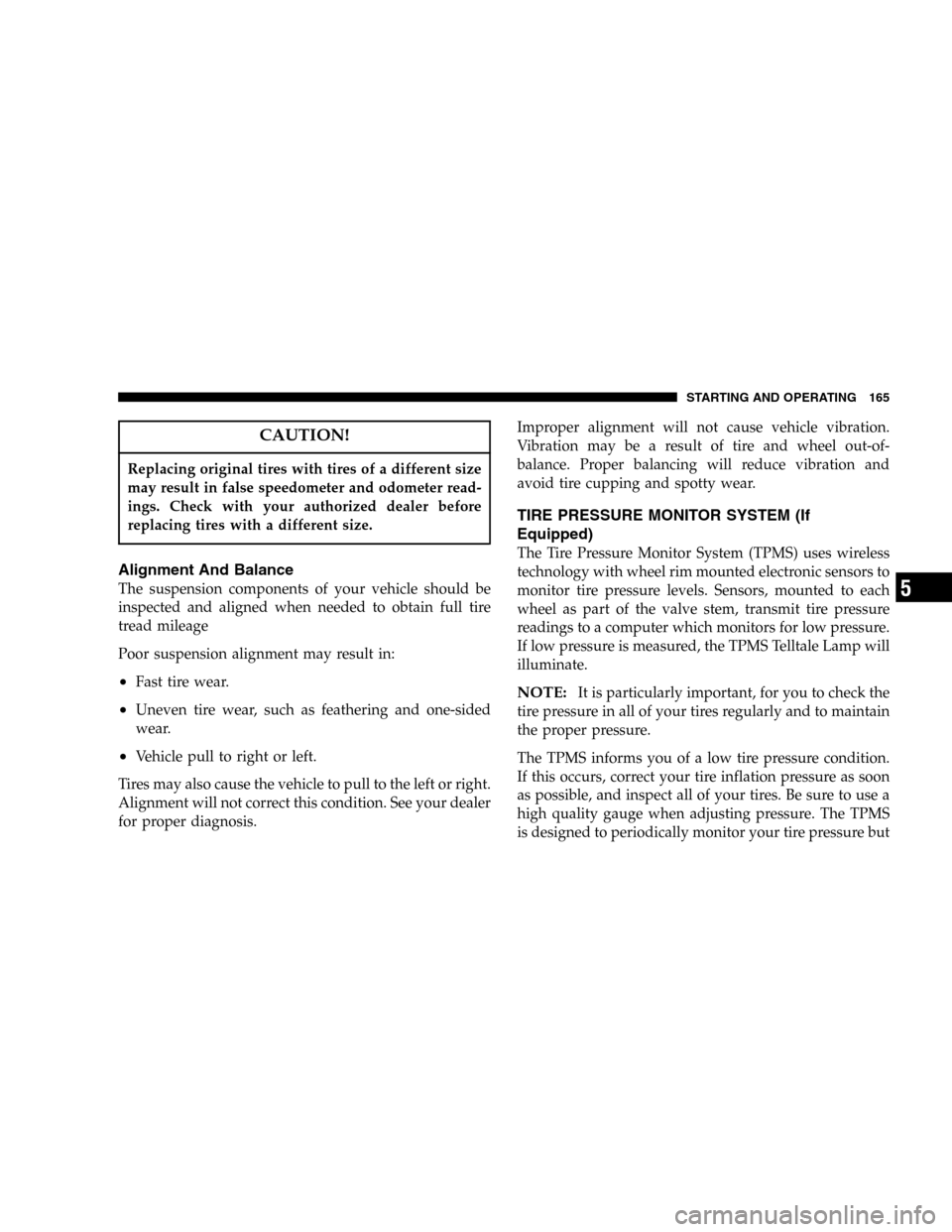
CAUTION!
Replacing original tires with tires of a different size
may result in false speedometer and odometer read-
ings. Check with your authorized dealer before
replacing tires with a different size.
Alignment And Balance
The suspension components of your vehicle should be
inspected and aligned when needed to obtain full tire
tread mileage
Poor suspension alignment may result in:
•Fast tire wear.
•Uneven tire wear, such as feathering and one-sided
wear.
•Vehicle pull to right or left.
Tires may also cause the vehicle to pull to the left or right.
Alignment will not correct this condition. See your dealer
for proper diagnosis.Improper alignment will not cause vehicle vibration.
Vibration may be a result of tire and wheel out-of-
balance. Proper balancing will reduce vibration and
avoid tire cupping and spotty wear.
TIRE PRESSURE MONITOR SYSTEM (If
Equipped)
The Tire Pressure Monitor System (TPMS) uses wireless
technology with wheel rim mounted electronic sensors to
monitor tire pressure levels. Sensors, mounted to each
wheel as part of the valve stem, transmit tire pressure
readings to a computer which monitors for low pressure.
If low pressure is measured, the TPMS Telltale Lamp will
illuminate.
NOTE:It is particularly important, for you to check the
tire pressure in all of your tires regularly and to maintain
the proper pressure.
The TPMS informs you of a low tire pressure condition.
If this occurs, correct your tire inflation pressure as soon
as possible, and inspect all of your tires. Be sure to use a
high quality gauge when adjusting pressure. The TPMS
is designed to periodically monitor your tire pressure but
STARTING AND OPERATING 165
5
Page 166 of 296

cannot be expected to function as a tire pressure gauge.
There can be a delay between the instant you adjust the
air pressure in a tire and when the system updates the
display. The TPMS is not intended to provide you with
notification of rapid air loss.
The TPMS will cause the Telltale lamp in the instrument
cluster to illuminate whenever the pressure in one tire
falls 25% below the recommended pressure shown on the
tire label.
NOTE:A TPMS does not replace normal tire mainte-
nance.
CAUTION!
The TPMS has been optimized for the original
equipment tires and wheels. TPMS pressures have
been established for the tire size equipped on your
vehicle. Undesirable operation or sensor damage
may result when using replacement equipment that
is not of the same size, type, and/or style. Aftermar-
ket wheels can cause sensor damage. Do not use
aftermarket tire sealant or balance beads as damage
to the sensors may result. The standard TIREFIT
system (see Tirefit Tire Repair and Jacking Instruc-
tions in the What To Do In Emergencies section) is
specifically designed to operate in conjunction with
the TPMS, and will not damage the sensors.
NOTE:The pressure in your tires changes with tem-
perature. A significant decrease in temperature could
reduce cold inflation pressure below the TPMS setpoint.
For example, tires inflated to the proper cold inflation
pressure on a warm day or in a warm garage could
illuminate the TPMS Telltale lamp on the following day if
166 STARTING AND OPERATING
Page 181 of 296
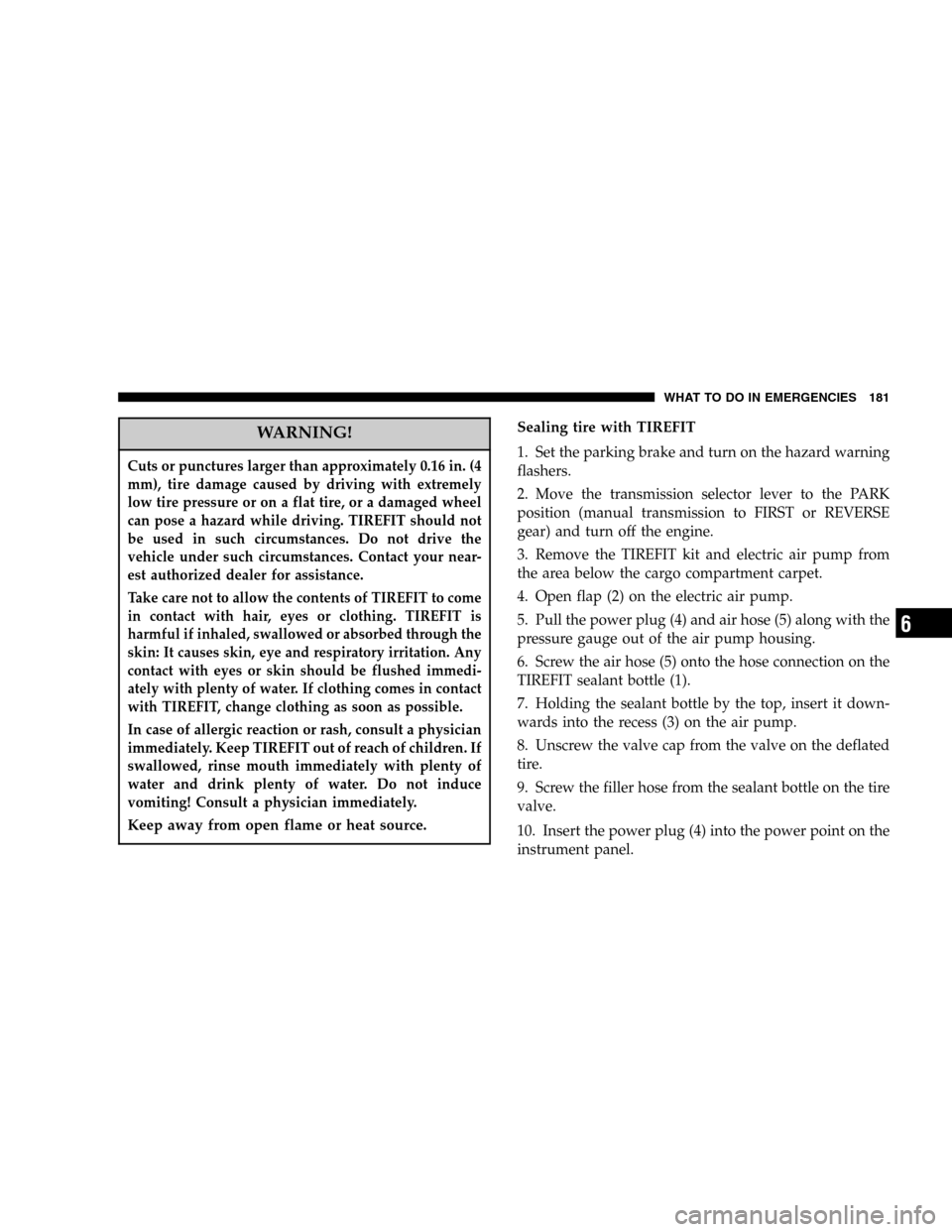
WARNING!
Cuts or punctures larger than approximately 0.16 in. (4
mm), tire damage caused by driving with extremely
low tire pressure or on a flat tire, or a damaged wheel
can pose a hazard while driving. TIREFIT should not
be used in such circumstances. Do not drive the
vehicle under such circumstances. Contact your near-
est authorized dealer for assistance.
Take care not to allow the contents of TIREFIT to come
in contact with hair, eyes or clothing. TIREFIT is
harmful if inhaled, swallowed or absorbed through the
skin: It causes skin, eye and respiratory irritation. Any
contact with eyes or skin should be flushed immedi-
ately with plenty of water. If clothing comes in contact
with TIREFIT, change clothing as soon as possible.
In case of allergic reaction or rash, consult a physician
immediately. Keep TIREFIT out of reach of children. If
swallowed, rinse mouth immediately with plenty of
water and drink plenty of water. Do not induce
vomiting! Consult a physician immediately.
Keep away from open flame or heat source.
Sealing tire with TIREFIT
1. Set the parking brake and turn on the hazard warning
flashers.
2. Move the transmission selector lever to the PARK
position (manual transmission to FIRST or REVERSE
gear) and turn off the engine.
3. Remove the TIREFIT kit and electric air pump from
the area below the cargo compartment carpet.
4. Open flap (2) on the electric air pump.
5. Pull the power plug (4) and air hose (5) along with the
pressure gauge out of the air pump housing.
6. Screw the air hose (5) onto the hose connection on the
TIREFIT sealant bottle (1).
7. Holding the sealant bottle by the top, insert it down-
wards into the recess (3) on the air pump.
8. Unscrew the valve cap from the valve on the deflated
tire.
9. Screw the filler hose from the sealant bottle on the tire
valve.
10. Insert the power plug (4) into the power point on the
instrument panel.
WHAT TO DO IN EMERGENCIES 181
6
Page 182 of 296

11. Turn the ignition key to the ON/RUN position.
12. Press the switch on the air pump to 1. The air pump
should start to inflate the tire.
13. After five minutes, the tire should be inflated to at
least 26 psi (180 kPa) on the pressure gauge.
14. If the tire doesn’t inflate to this level, press the air
pump switch to 0, disconnect the TIREFIT system from
the tire, and drive the vehicle back and forth approxi-
mately 30 feet (9 m) to distribute the sealant more evenly
within the tire.
15. Attach the air pump hose directly to the tire, press the
switch to 1, and inflate the tire again.NOTE:If a tire
pressure of 26 psi (180 kPa) is not reached after five
minutes, the tire is too badly damaged. Do not attempt to
drive the vehicle further, and call for assistance.
16.
If a tire pressure of 26 psi (180 kPa) is obtained, press
the air pump switch to 0, turn the ignition switch to the
OFF/LOCK position, and disconnect the TIREFIT system.
17. Drive the vehicle for about 10 minutes to ensure
optimum distribution of the tire sealant within the tire.18. Check the pressure in the tire. If the pressure is above
19 psi (130 kPa), inflate the tire to the pressure indicated
on the tire pressure label on the driver side latch pillar.
19. Have the tire inspected at the earliest opportunity at
an authorized dealer or tire service center.
NOTE:Do not exceed 50 mph (80 km/h) until the tire
has been inspected.
NOTE:If a pressure of at least 19 psi (130 kPa) cannot
be maintained in the tire, the tire is too badly damaged.
Do not attempt to drive the vehicle further, and call for
assistance.
NOTE:Do not operate the electric air pump for more
than eight minutes to avoid overheating. The air pump
may be used again once it has cooled down.
NOTE:Replace the TIREFIT sealant bottle once every
four years to assure optimum operation of the system.
NOTE:If TIREFIT is liquid, clean water and a damp
cloth will remove the material from the vehicle or tire and
wheel components. Once TIREFIT sealing material has
dried, it can easily be peeled off and properly discarded.
182 WHAT TO DO IN EMERGENCIES
Page 184 of 296

•Block the wheel diagonally opposite the flat tire.
•Passengers must not remain in the vehicle when the
vehicle is jacked.
NOTE:The jack is designed exclusively for jacking up
the vehicle at the specified jack location points built
beneath either side of the vehicle.
Jack Location and Instructions
1. Remove the jack and jack handle from stowage be-
neath the cargo compartment carpet.
184 WHAT TO DO IN EMERGENCIES
Page 190 of 296

Traction
When driving on wet or slushy roads, it is possible for a
wedge of water to build up between the tire and road
surface. This is hydroplaning and may cause partial or
complete loss of vehicle control and stopping ability. To
reduce this possibility, the following precautions should
be observed:
1. Slow down during rainstorms or when roads are
slushy.
2. Slow down if the road has standing water or puddles.
3. Replace tires when tread wear indicators first become
visible.
4. Keep tires properly inflated.
5. Maintain enough distance between your vehicle and
the vehicle in front to avoid a collision in a sudden stop.
FREEING A STUCK VEHICLE
In order to free a stuck vehicle you must turn off the
Electronic Stability Program (ESP) before attempting to
“rock” the vehicle.
If your vehicle becomes stuck in mud, sand or snow, it
can often be moved by a rocking motion. Turn your
steering wheel right and left to clear the area around the
front wheels. Then shift back and forth between Reverse
and Drive. Usually the least accelerator pedal pressure to
maintain the rocking motion without spinning the
wheels is most effective.
NOTE:ESP should be turned on again after freeing the
vehicle from a stuck condition.
CAUTION!
Racing the engine or spinning the wheels too fast
may lead to transmission/axle overheating and fail-
ure. It can also damage the tires. Do not spin the
wheels above 35 mph (55 km/h).
190 WHAT TO DO IN EMERGENCIES
Page 248 of 296

Check the battery every four to six weeks to ensure that
the voltage is above 12.40. Voltage will drop more rapidly
in hot temperatures. If battery voltage drops below 12.40,
follow the battery recharge procedure in the Service
Manual.
•Check that the radiator coolant level of protection is to
at least -20°F (-29°C).
•Block the wheels. Do not apply the parking brake.
•Make sure that all tires are inflated to the optimum
pressure.
•Cut blocks of plywood about the same size of the tires.
Cover each block with indoor/outdoor carpeting and
place them between the tires and concrete. This will
prevent tire flat spotting.
•For long term storage, remove the tires and put the
vehicle up on blocks. Stack the tires on plywood and
cover with a tarp to prevent flat spotting.
•Move the wiper blades away from the windshield.
NOTE:To help prevent the battery from discharging
during shorter periods of inactivity, perform the follow-
ing:
1. Make sure that the rear liftgate/decklid, hood, and
doors are completely closed.
2. Make sure that the remote transmitter is operating and
that the battery is good.
3. Make sure that the hood, rear liftgate and door
switches are in adjustment.
4. Use the remote transmitter to set the alarm.
248 MAINTAINING YOUR VEHICLE
Page 258 of 296

Your Flexible Service System (FSS) — see Understanding
Your Instrument Panel section — should give you an
exact indication of when your vehicle should be sched-
uled for service and which schedule to follow.
Additional Periodic Maintenanceitems should also be
performed beyond the items listed in the following charts
to assure the optimum performance of your Crossfire.
SCOPE OF WORK FOR “A” SCHEDULE
MAINTENANCE SERVICE
Oil Change
•Change oil and replace filter
Maintenance
•Lubricate hood hinges, latch, and secondary latch
•Reset FSS Display
Function Check
•Horn, hazard warning flashers, turn signals, and indi-
cator lamps
•Headlamps and exterior lighting
•Windshield wipers and washer system
Inspection
•Check front and rear brake pads for lining thickness
•Check tires for damage and general condition
•Check tire inflation pressures and correct if necessary
Fluid Levels
Check fluid levels for the following systems and correct if
necessary. Should there be a loss of fluid that cannot be
explained by regular use, trace and eliminate the cause.
•Engine cooling system (check corrosion inhibitor/
antifreeze)
•Hydraulic brake system
•Power steering system
•Windshield washer system
258 MAINTENANCE SCHEDULES
8
M
A
I
N
T
E
N
A
N
C
E
S
C
H
E
D
U
L
E
S