light CHRYSLER CROSSFIRE 2006 1.G Workshop Manual
[x] Cancel search | Manufacturer: CHRYSLER, Model Year: 2006, Model line: CROSSFIRE, Model: CHRYSLER CROSSFIRE 2006 1.GPages: 296, PDF Size: 1.6 MB
Page 130 of 296

Basic Setting - Air Conditioner
Press the air conditioning ON/OFF switch. The
light in the switch will illuminate. Select a
temperature for each side of the passenger
compartment. Select the air volume with the
fan control switch, at least to position 1. Set the air
distribution control switch to one of the positions shown
above. Open center air outlets. Open left and right side
air outlets.
NOTE:The air conditioning compressor will not run if
the fan control switch is not set to position 1 or higher.
NOTE:The dot between the air distribution control
icons is a mix position between the two modes.
Slight changes in engine speed or power may be noticed
when the compressor is on. This is a normal occurrence,
since the compressor will cycle on and off to maintain
comfort and increase fuel economy.
NOTE:If your air conditioning performance seems
lower than expected, check the front of the A/C con-
denser for an accumulation of dirt or insects.
Defrosting
Set the temperature selectors to the maximum
heating position, set the fan control to position 5,
and the air distribution to the defrost position. Close the
center air outlets. Close the left and right side air outlets.
Turn the defroster outlets for the side windows to the
detent position.
Defogging Windows Fogged Up On Inside
Press the A/C button; the indicator light should illumi-
nate. Switch off the air recirculation; the indicator light
should go out. Set the air distribution control switch to
the defrost position. Increase air volume with the fan
130 UNDERSTANDING YOUR INSTRUMENT PANEL
Page 131 of 296

control switch to position 1 or higher. Close the center,
left, and right side air outlets. Turn the defroster outlets
for the side windows to the detent position.
NOTE:The air conditioner removes moisture from the
air inside your vehicle. The quickest and most efficient
method for defogging your windows, even if the air
temperature in your vehicle is cool, is to use the air
conditioner. Make sure that you press the A/C button to
defog your windows.
Windshield Fogged Up On Outside
Switch on the windshield wipers. Set the air distribution
control switch to the defrost position. Increase air volume
with the fan control switch. Close the center and right
side air outlets. Turn the defroster outlets for the side
windows to the detent position.
Ventilation
To receive outside air through the panel outlets, turn off
the Air Conditioning ON/OFF switch. The light in the
switch should be off. Set the controls as above for basic
air conditioning.
UNDERSTANDING YOUR INSTRUMENT PANEL 131
4
Page 132 of 296

Climate Control - OFF
To switch the climate control off, set the air volume
control switch to position 0. The fresh air supply to the
vehicle interior is shut off. While driving, use this setting
only temporarily, otherwise the windshield could fog up.
Rear Window Defroster
Turn the key in the ignition switch to the
ON/RUN position. To select, press the rear
window defroster button once and release. The
indicator light in the switch should illuminate.
To cancel, press the rear window defroster button again
and release.
NOTE:Heavy accumulation of snow and ice should be
removed before activating the defroster. The rear win-
dow defroster uses a large amount of power. To keep the
battery drain to a minimum, turn off the defroster as soon
as the window is clear. The defroster is automatically
turned off after a maximum of 12 minutes of operation.
If several components in the vehicle are consuming
power simultaneously, or the battery is only partially
charged, it is possible that the defroster will automati-
cally turn itself off. When this happens, the indicator lightinside the switch starts blinking. As soon as the battery
has sufficient voltage, the defroster automatically turns
itself back on.
CAUTION!
To avoid damaging the electrical conductors, do not
use scrapers, sharp instruments, or abrasive window
cleaners on the interior surface of the rear window.
Labels can be peeled off by soaking with warm
water.
Air Recirculation/REST
This mode can be selected to temporarily re-
duce the entry of annoying odors or dust into
the vehicle’s interior. Outside air does not flow
into the vehicle’s interior. To select, press the
recirculation button. To cancel, press the recirculation
button again.
The system will automatically switch from recirculated
air to fresh air after approximately five minutes at
outside temperatures below approximately 40°F (5°C);
132 UNDERSTANDING YOUR INSTRUMENT PANEL
Page 133 of 296

after approximately 30 minutes, at outside temperatures
above approximately 40°F (5°C); after approximately five
minutes, if the A/C button is pressed.
At high outside temperatures, the system automatically
engages the recirculated air mode for approximately 30
minutes, thereby increasing the cooling capacity perfor-
mance. Press the recirculation button again to extend the
recirculated air mode.
Residual Engine Heat Utilization (REST)
With the engine switched off, it is possible to
continue heating the interior for a short while.
Air volume is controlled automatically. Select a
temperature for each side of the passenger
compartment. Set the air distribution control switch to
the desired position.
To select, turn the key in the ignition switch to the ACC
or the OFF/LOCK position or remove. Press the recircu-
lation button. The indicator light in the button illumi-
nates. This function selection will not activate if the
battery charge level is insufficient.To cancel, press the recirculation button. The indicator
light in the button goes out. The system will automati-
cally shut off if you turn the key in the ignition switch to
the ON/RUN position, after approximately 30 minutes,
or if the battery voltage drops.
NOTE:This vehicle is equipped with an air conditioner
system that uses R-134a (HFC: hydrofluorocarbon) as a
refrigerant. Repairs should always be performed by a
qualified technician, and refrigerant should be collected
in a recovery system for recycling.
Dust Filter (If Equipped)
Nearly all dust particles and pollen are filtered out before
outside air enters the passenger compartment through
the air distribution system.
NOTE:Keep the air intake grille in front of windshield
free of snow and debris.
UNDERSTANDING YOUR INSTRUMENT PANEL 133
4
Page 140 of 296

Fully depress the clutch pedal before you shift gears. As
you release the clutch pedal, lightly depress the accelera-
tor pedal.
Be sure the transmission is in FIRST gear, (not THIRD),
when starting from a stopped position. Damage to the
clutch can result from starting in THIRD.
NOTE:If there is a need to restart your engine, you
must recycle your ignition switch to the OFF position
before restarting the engine.
For most city driving, you will find it easier to use only
the lower gears. For steady highway driving with light
accelerations, sixth gear is recommended.
Never drive with your foot resting on the clutch pedal, or
try to hold the vehicle on a hill with the clutch pedal
partially engaged. This will cause abnormal wear on the
clutch.
Never shift into REVERSE until the vehicle has come to a
complete stop.
NOTE:During cold weather, until the transmission
lubricant has warmed, you may have difficulty shifting.
This is normal and not harmful to the transmission.
Recommended Shift Speeds
To use your manual transmission for both fuel economy
and performance, it should be upshifted as shown in the
chart. Shift at the vehicle speeds listed for acceleration.
Earlier upshifts during cruise conditions (relatively
steady speeds) will result in increased fuel economy, and
may be used as indicated.
Higher upshift speeds may be used to obtain a desired
acceleration rate.
MANUAL TRANSMISSION
RECOMMENDED SHIFT SPEEDS
1-2 2-3 3-4 4-5 5-6
MPH 15 25 40 45 50
(km/h) (24) (40) (64) (72) (80)
140 STARTING AND OPERATING
Page 143 of 296

Maneuvering
To maneuver in tight areas, control the vehicle speed by
gradually releasing the brakes. Accelerate gently and
never abruptly step on the accelerator.
To rock a vehicle out of soft ground (mud or snow),
alternately shift from forward to reverse, while applying
only slight acceleration. Rocking a vehicle free in this
manner may cause the ABS or traction system malfunc-
tion indicator light to come on. Turn off the engine and
restart the engine to clear the malfunction indication.
Park Position
The PARK position is to be used when parking the
vehicle. Engage only with the vehicle stopped. The PARK
position is not intended to serve as a brake when the
vehicle is parked. Rather, the driver should always use
the parking brake in addition to placing the selector lever
in PARK to secure the vehicle.
NOTE:The key can be removed from the ignition
switch only with the selector lever in the PARK position.
With the key removed, the selector lever is locked in the
PARK position.
STARTING AND OPERATING 143
5
Page 148 of 296

Emergency Operation (Limp Home Mode)
If vehicle acceleration worsens, or the transmission no
longer shifts, the transmission is most likely operating in
Limp Home Mode which engages when there is a
malfunction of the transmission.
This condition may be accompanied by the CHECK
ENGINE light in the instrument cluster coming on.
In this mode only the SECOND gear or REVERSE gear
can be activated.
To engage SECOND gear or REVERSE:
1. Stop the vehicle.
2. Move the selector lever to the PARK position.
3. Turn off the engine.
4. Wait approximately 10 seconds.
5. Restart the engine.
6. Move the selector lever to the DRIVE position (for
SECOND gear), or move the selector lever to the RE-
VERSE position (for REVERSE gear).Have the transmission checked at your authorized dealer
as soon as possible.
PARKING BRAKE
When you apply the parking brake with engine
running, the brake system warning light in the
instrument cluster will come on.
NOTE:This light, when illuminated with parking brake
application, shows only that the parking brake is on. It
does not show the degree of brake application.
NOTE:If the light remains on with the parking brake
released, a brake system malfunction is indicated. Have
the brake system serviced by an authorized dealer im-
mediately.
Before leaving the vehicle, make sure that the parking
brake is fully applied. For manual transmission vehicles,
place the gear selector in REVERSE. For vehicles
equipped with automatic transmissions, place the gear
selector in the PARK position.
148 STARTING AND OPERATING
Page 149 of 296
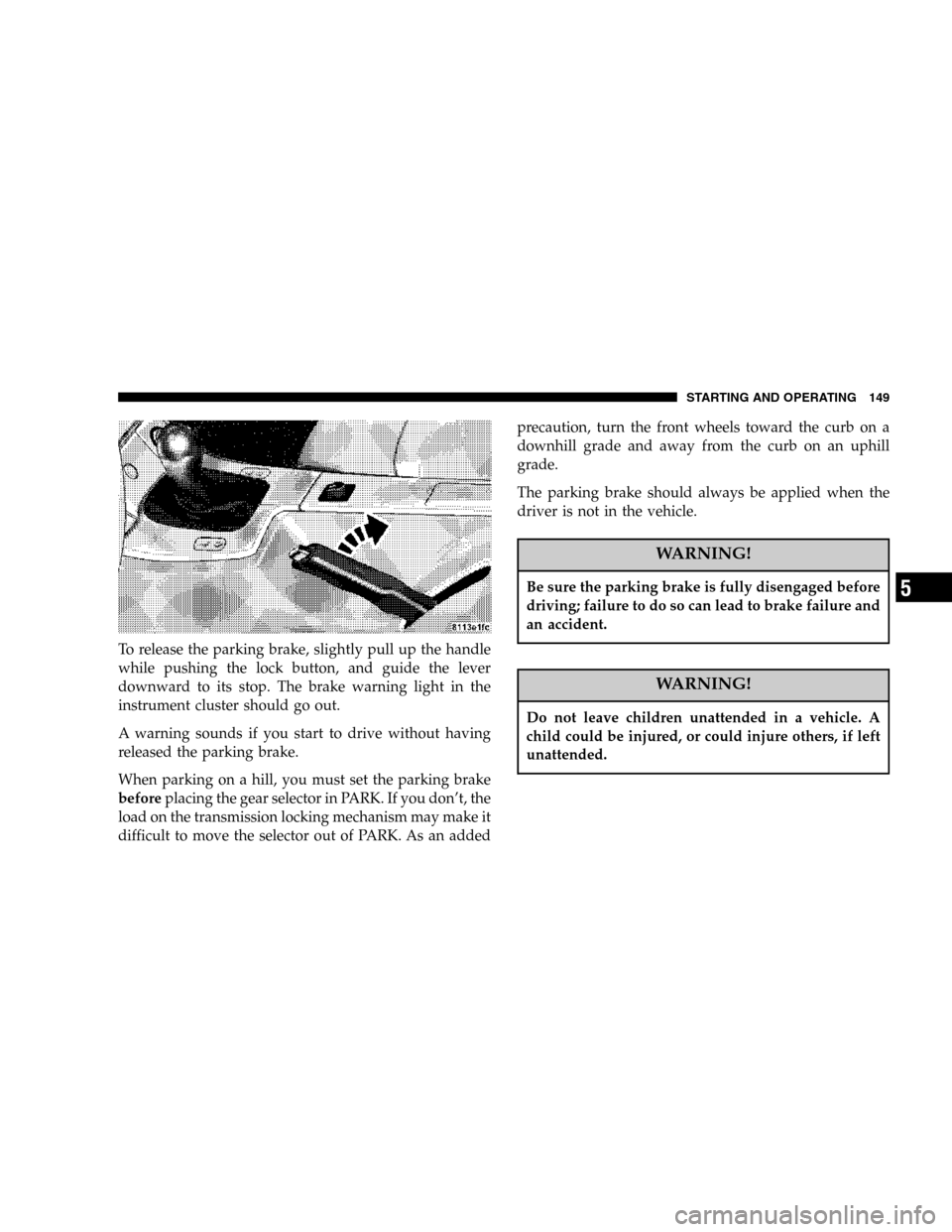
To release the parking brake, slightly pull up the handle
while pushing the lock button, and guide the lever
downward to its stop. The brake warning light in the
instrument cluster should go out.
A warning sounds if you start to drive without having
released the parking brake.
When parking on a hill, you must set the parking brake
beforeplacing the gear selector in PARK. If you don’t, the
load on the transmission locking mechanism may make it
difficult to move the selector out of PARK. As an addedprecaution, turn the front wheels toward the curb on a
downhill grade and away from the curb on an uphill
grade.
The parking brake should always be applied when the
driver is not in the vehicle.
WARNING!
Be sure the parking brake is fully disengaged before
driving; failure to do so can lead to brake failure and
an accident.
WARNING!
Do not leave children unattended in a vehicle. A
child could be injured, or could injure others, if left
unattended.
STARTING AND OPERATING 149
5
Page 150 of 296

BRAKE SYSTEM
Your vehicle is equipped with power brakes as standard
equipment. In the event power assist is lost for any
reason (for example, repeated brake applications with the
engine off), the brakes will still function. The effort
required to brake the vehicle will be much greater than
that required with the power system operating.
If either the front or rear hydraulic system loses normal
capability, the remaining system will still function with
some loss of overall braking effectiveness. This will be
evident by increased pedal travel during application,
greater pedal force required to slow or stop, and activa-
tion of the brake warning light during brake use.
Brake Assist System (BAS)
The BAS is designed to maximize the vehicle’s braking
capability during emergency braking maneuvers. Maxi-
mum power boost is applied to the brakes more quickly
in emergency braking conditions. This can help reduce
braking distances relative to what ordinary driving and
braking style might do.The BAS complements the antilock brake system (ABS).
Applying the brakes very quickly results in maximum
BAS assistance. To receive the benefit of the system you
must apply continuous, full braking power during the
stopping sequence. Do not reduce brake pedal pressure.
WARNING!
BAS cannot prevent the natural laws of physics from
acting on the vehicle, nor can it increase braking
efficiency beyond that afforded by the condition of
the vehicle brakes and tires or the traction afforded.
The BAS cannot prevent accidents, including those
resulting from excessive speed in turns, following
another vehicle too closely, or hydroplaning. Only a
safe, attentive, and skillful driver can prevent acci-
dents. The capabilities of a BAS-equipped vehicle
must never be exploited in a reckless or dangerous
manner which could jeopardize the user’s safety or
the safety of others.
150 STARTING AND OPERATING
Page 151 of 296

Once the brake pedal is released, the BAS is deactivated.
The malfunction indicator light for the BAS is combined
with the Electronic Stability Program (ESP) malfunction
indicator light.The BAS/ESP malfunction indicator light in the instru-
ment cluster comes on with the key in the ignition switch
turned to the ON/RUN position and should go out with
the engine running. If the BAS/ESP malfunction indica-
tor light comes on steadily while the engine is running, a
malfunction has been detected in either the BAS or ESP
system. As a result, it is possible that only partial engine
output will be available, and pressing the accelerator
pedal will require more effort.
If the BAS malfunctions, the brake system functions in
the usual manner, but without BAS.
With the ABS malfunctioning, the BAS and ESP will be
disabled. In this condition, both malfunction indicator
lights come on while the engine is running. If the
malfunction indicator light stays illuminated, have the
BAS and ESP checked at your authorized dealer as soon
as possible.
STARTING AND OPERATING 151
5