transmission CHRYSLER CROSSFIRE 2007 1.G User Guide
[x] Cancel search | Manufacturer: CHRYSLER, Model Year: 2007, Model line: CROSSFIRE, Model: CHRYSLER CROSSFIRE 2007 1.GPages: 299, PDF Size: 8.26 MB
Page 147 of 299

accelerator pedal all the way to the floor and hold it there
while cranking the engine. This should clear any excess
fuel in case the engine is flooded.
CAUTION!
To prevent damage to the starter, do not crank the
engine for more than 15 seconds at a time. Wait 10 to
15 seconds before trying again.
If the engine has been flooded, it may start to run, but not
have enough power to continue running when the key is
released. If this occurs, continue cranking with the accel-
erator pedal pushed all the way to the floor. Release the
accelerator pedal and the key once the engine is running
smoothly.
If the engine shows no sign of starting after two 15-
second periods of cranking with the accelerator pedal
held to the floor, the Normal Starting procedure should
be repeated.
After Starting
The idle speed will automatically decrease as the engine
warms up.
TRANSMISSION SHIFTING
Manual Transmission
NOTE:
The parking brake should be engaged and the
gear selector placed in REVERSE before leaving the
vehicle, especially on an incline. To place the transmis-
sion in REVERSE, lift up on the shifter knob, push it to
the left and pull it back.
STARTING AND OPERATING 147
5
Page 148 of 299

Fully depress the clutch pedal before you shift gears. As
you release the clutch pedal, lightly depress the accelera-
tor pedal.
Be sure the transmission is in FIRST gear, (not THIRD),
when starting from a stopped position. Damage to the
clutch can result from starting in THIRD.
NOTE:If there is a need to restart your engine, you
must recycle your ignition switch to the OFF position
before restarting the engine.
For most city driving, you will find it easier to use only
the lower gears. For steady highway driving with light
accelerations, sixth gear is recommended.
Never drive with your foot resting on the clutch pedal, or
try to hold the vehicle on a hill with the clutch pedal
partially engaged. This will cause abnormal wear on the
clutch.
Never shift into REVERSE until the vehicle has come to a
complete stop.
NOTE:During cold weather, until the transmission
lubricant has warmed, you may have difficulty shifting.
This is normal and not harmful to the transmission.
Recommended Shift Speeds
To use your manual transmission for both fuel economy
and performance, it should be upshifted as shown in the
chart. Shift at the vehicle speeds listed for acceleration.
Earlier upshifts during cruise conditions (relatively
steady speeds) will result in increased fuel economy, and
may be used as indicated.
Higher upshift speeds may be used to obtain a desired
acceleration rate.
MANUAL TRANSMISSION
RECOMMENDED SHIFT SPEEDS
1-2 2-3 3-4 4-5 5-6
MPH 15 25 40 45 50
(km/h) (24) (40) (64) (72) (80)
148 STARTING AND OPERATING
Page 149 of 299
WARNING!
When leaving the vehicle, always remove the key
from the ignition switch, and lock the vehicle. Do not
leave children unattended in the vehicle, or with
access to an unlocked vehicle. Children could move
the gearshift lever, which could result in an accident
or serious injury.
WARNING!
Skipping more than one gear while downshifting
could cause you to lose control of your vehicle. You
could have an accident.
CAUTION!
If you skip more than one gear while downshifting
or downshift at too high an engine speed, you could
damage the engine, transmission, or clutch.
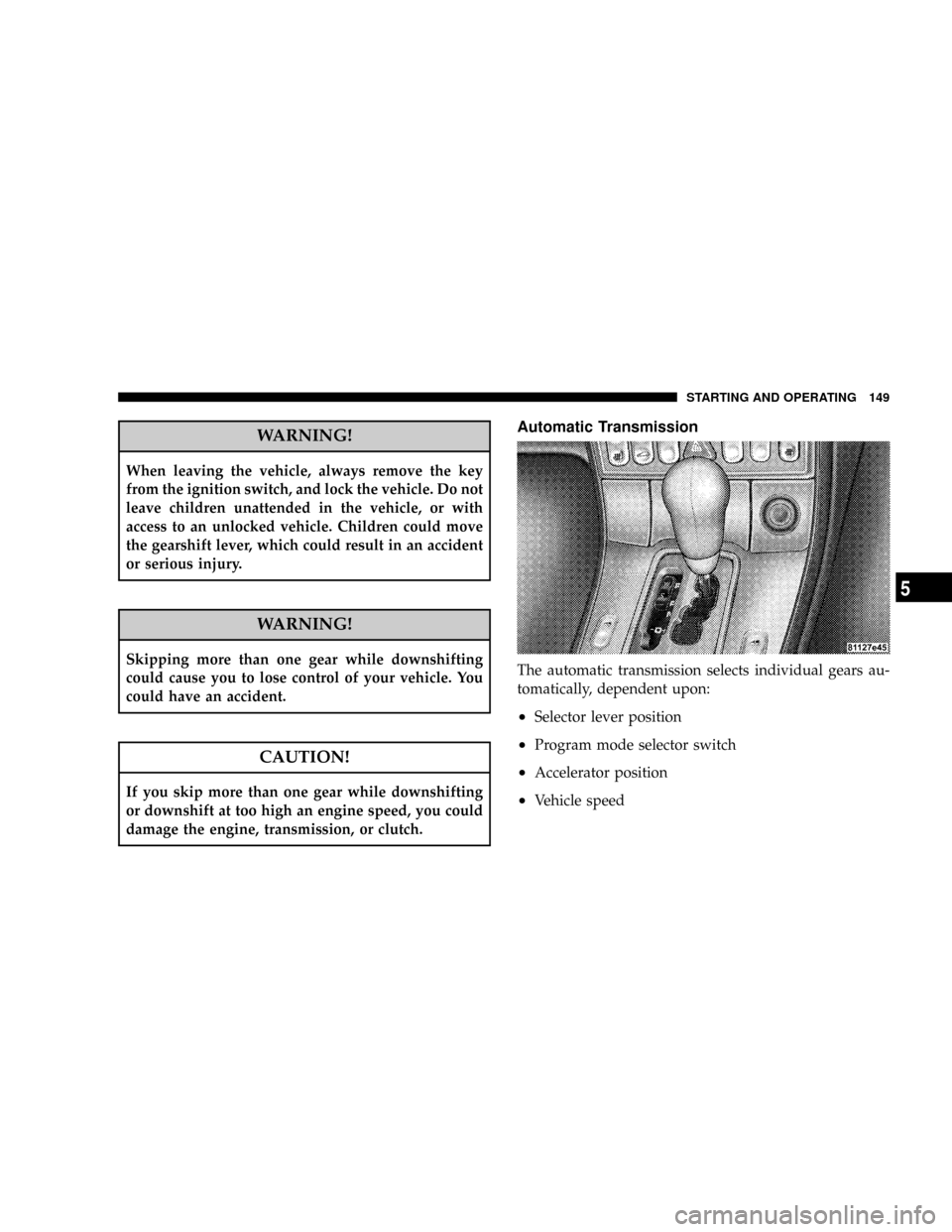
Automatic Transmission
The automatic transmission selects individual gears au-
tomatically, dependent upon:
²Selector lever position
²Program mode selector switch
²Accelerator position
²Vehicle speed
STARTING AND OPERATING 149
5
Page 150 of 299

The gear shifting process is continuously adapted, de-
pendent on the driving style, the driving situation and
the road characteristics.
The selector lever is automatically locked while in the
PARK position. To move the selector lever out of the
PARK position, the brake pedal must be firmly depressed
before the shift lock will release.
Shift the selector lever to the desired position only when
the engine is idling normally and the brake pedal is
applied. Do not release the brake until ready to drive. The
vehicle may otherwise accelerate quickly when the selec-
tor lever is in DRIVE or REVERSE position.
NOTE:After selecting any driving position, wait a
moment to allow the gear to fully engage before acceler-
ating, especially when the engine is cold.
WARNING!
It is dangerous to shift the selector lever out of PARK
or NEUTRAL if the engine speed is higher than idle
speed. If your foot is not firmly on the brake pedal,
the vehicle could accelerate quickly forward or in
reverse. You could lose control of the vehicle and hit
someone or something. Only shift into gear when the
engine is idling normally and when your foot is
firmly on the brake pedal.
Stopping
For brief stops, leave the transmission in gear and hold
the vehicle with the brake pedal. For longer stops with
the engine idling, shift into the NEUTRAL or PARK
position and hold the vehicle with the parking brake.
When stopping the vehicle uphill, do not hold it with the
accelerator; use the brake. This avoids unnecessary trans-
mission heat build-up.
150 STARTING AND OPERATING
Page 152 of 299

the tool from the opening, the cover will not close fully.
Only after moving the selector lever to the ªD+º and
ªD-º positions does the cover return to its closed posi-
tion.
Reverse
Shift into REVERSE gear only when the vehicle is com-
pletely stopped.
Dependent on the program mode selector switch position
ªSº or ªW,º the maximum speed in the REVERSE gear is
different. However, it is not possible to change the
program mode while in REVERSE.
Neutral
No power is transmitted from the engine to the drive
axle. When the brakes are released, the vehicle can be
moved freely (pushed or towed). Do not engage in
NEUTRAL position while driving except to coast when
the vehicle is in danger of skidding (e.g., on icy roads).
NOTE:Coasting the vehicle, or driving for any other
reason with selector lever in NEUTRAL can result in
transmission damage that is not covered by the Limited
Warranty.
Drive
The transmission automatically upshifts through fifth
gear. The DRIVE position provides optimum driving
characteristics under all normal operating conditions.
AutoStickTGear selection
The transmission gear can be selected by pressing the
selector lever to the right or the left with the selector lever
in the DRIVE position. The gear currently selected is
indicated in the instrument cluster display. Briefly press
selector lever in the ªD-º direction. The transmission will
shift from the current gear to the next lower gear. Shifting
152 STARTING AND OPERATING
Page 153 of 299

into another gear that allows for quicker acceleration or
to slow the vehicle down is possible. Downshifts can also
be performed.
Press and hold the selector lever in the ªD-º direction.
The transmission will shift from the current gear directly
to the best gear for acceleration.
NOTE:To avoid overrevving the engine when the
selector lever is moved in ªD-º direction, the transmis-
sion will not shift to a lower gear if the engine's revolu-
tions per minute limit would be exceeded.
Briefly press the selector lever in the ªD+º direction. The
transmission will shift from the current gear to the next
higher gear.
Press and hold the selector lever in the ªD+º direction.
The transmission will shift from the current gear directly
to gear ªD.º
WARNING!
On slippery road surfaces, never downshift in order
to obtain braking action. This could result in drive
wheel slip and reduced vehicle control. Your vehi-
cle's ABS will not prevent this type of loss of control.
You could lose control of your vehicle and have an
accident.
NOTE:With transmission in gear ªD,º ª4,º or ª3,º
upshifting from FIRST to SECOND to THIRD gear may
be delayed, depending on vehicle speed and engine
temperature. This allows the catalytic converter to heat
up more quickly to operating temperatures.
The delayed upshift is effective with vehicle speeds
below 31 mph (50 km/h) at partial throttle and engine
temperatures below 95ÉF (35ÉC). To prevent the engine
from laboring at low RPM when driving uphill or with
your vehicle heavily loaded, the automatic transmis-
sion will downshift when necessary to maintain en-
gine RPM within the best torque range.
STARTING AND OPERATING 153
5
Page 154 of 299

Gear Ranges
ªPº PARK
NOTE:If the key is in the ON/RUN position, you must
press the brake pedal to shift out of the PARK position.
PARK supplements the parking brake by locking the
transmission. The engine can be started in this range.
Never attempt to use PARK while the vehicle is in motion.
Apply the parking brake when leaving the vehicle in this
range.
ªRº REVERSE
Shift into this range only after the vehicle has come to a
complete stop.
ªNº NEUTRAL
The engine may be started in this range. Use this range
for starting your vehicle if it is moving or being towed.
ªDº OVERDRIVE
This range should be used for most city and highway
driving. It provides the smoothest upshifts and down-
shifts and best fuel economy.
Program mode selector switch
The transmission is provided with a selector switch for
Standard ªSº and Winter/Wet ªWº (snow and ice) pro-
gram modes.
For standard mode, press the ªSº symbol on the switch.
Use this mode for all regular driving. The vehicle starts
out in FIRST gear.
Depressing the accelerator pedal rapidly or nearly to the
floor while driving (kickdown position), rather than
depressing the accelerator pedal in slow, small move-
ments, will cause the automatic transmission to shift
154 STARTING AND OPERATING
Page 155 of 299

down into a lower gear. Rapid release of the accelerator
pedal will normally result in an upshift. This gear shift-
ing process is dependent on the current vehicle speed.
For Winter/Wet (snow and ice) mode, press the ªWº
symbol on the switch. The vehicle starts out in SECOND
gear, unless FIRST gear has been selected, or the accel-
erator pedal is in the kickdown position. The ªWº mode
helps to improve traction and driving stability of the
vehicle. The gear shifting process occurs at lower vehicle
and engine speeds than in the ªSº program mode.
CAUTION!
Never change the program mode when the selector
lever is out of the PARK position. It could result in a
change of driving characteristics for which you may
not be prepared.
Emergency Operation (Limp Home Mode)
If vehicle acceleration worsens, or the transmission no
longer shifts, the transmission is most likely operating in
Limp Home Mode which engages when there is a
malfunction of the transmission.
This condition may be accompanied by the CHECK
ENGINE light in the instrument cluster coming on.
In this mode only the SECOND gear or REVERSE gear
can be activated.
To engage SECOND gear or REVERSE:
1. Stop the vehicle.
2. Move the selector lever to the PARK position.
3. Turn off the engine.
4. Wait approximately 10 seconds.
5. Restart the engine.
6. Move the selector lever to the DRIVE position (for
SECOND gear), or move the selector lever to the RE-
VERSE position (for REVERSE gear).
STARTING AND OPERATING 155
5
Page 156 of 299

Have the transmission checked at your authorized dealer
as soon as possible.
PARKING BRAKE
When you apply the parking brake with engine
running, the brake system warning light in the
instrument cluster will come on.
NOTE:This light, when illuminated with parking brake
application, shows only that the parking brake is on. It
does not show the degree of brake application.
NOTE:If the light remains on with the parking brake
released, a brake system malfunction is indicated. Have
the brake system serviced by an authorized dealer im-
mediately.
Before leaving the vehicle, make sure that the parking
brake is fully applied. For manual transmission vehicles,
place the gear selector in REVERSE. For vehicles
equipped with automatic transmissions, place the gear
selector in the PARK position.To release the parking brake, slightly pull up the handle
while pushing the lock button, and guide the lever
downward to its stop. The brake warning light in the
instrument cluster should go out.
A warning sounds if you start to drive without having
released the parking brake.
When parking on a hill, you must set the parking brake
beforeplacing the gear selector in PARK. If you don't, the
load on the transmission locking mechanism may make it
difficult to move the selector out of PARK. As an added
156 STARTING AND OPERATING
Page 165 of 299
WARNING!
ABS cannot prevent the natural laws of physics from
acting on the vehicle, nor can it increase braking or
steering efficiency beyond that afforded by the con-
dition of the vehicle brakes and tires or the traction
afforded. The ABS cannot prevent accidents, includ-
ing those resulting from excessive speed in turns,
following another vehicle too closely, or hydroplan-
ing. Only a safe, attentive, and skillful driver can
prevent accidents. The capabilities of an ABS-
equipped vehicle must never be exploited in a reck-
less or dangerous manner which could jeopardize the
user's safety or the safety of others.
WARNING!
To use your brakes and accelerator more safely,
follow these tips:
²Do not ªrideº the brakes by resting your foot on
the pedal. This could overheat the brakes and
result in unpredictable braking action, longer
stopping distances, or brake damage.
²When descending mountains or hills, repeated
braking can cause brake fade with loss of braking
control. Avoid repeated heavy braking by down-
shifting the transmission whenever possible.
²Do not drive too fast for road conditions, espe-
cially when roads are wet or slushy. A wedge of
water can build up between the tire tread and the
road. This hydroplaning action can cause loss of
traction, braking ability, and control.
²After going through deep water or a car wash,
brakes may become wet, resulting in decreased
performance and unpredictable braking action.
Dry the brakes by gentle, intermittent pedal action
while driving at very slow speeds.
STARTING AND OPERATING 165
5