light CHRYSLER CROSSFIRE 2007 1.G Owner's Guide
[x] Cancel search | Manufacturer: CHRYSLER, Model Year: 2007, Model line: CROSSFIRE, Model: CHRYSLER CROSSFIRE 2007 1.GPages: 299, PDF Size: 8.26 MB
Page 95 of 299

CAUTION!
The TPM system has been optimized for the original
equipment tires and wheels. TPM system pressures
have been established for the tire size equipped on
your vehicle. Undesirable operation or sensor dam-
age may result when using replacement equipment
that is not of the same size, type, and/or style.
Aftermarket wheels can cause sensor damage. Do not
use aftermarket tire sealant or balance beads, as
damage to the sensors may result.
NOTE:The standard TIREFIT system (refer to What To
Do In Emergencies for more information) is specifically
designed to operate in conjunction with the TPM system,
and will not damage the sensors.
If your tire pressure is low, you should correct your tire
inflation pressure as soon as possible and inspect all of
your tires. Low tire pressure will cause the tire pressure
light to illuminate. They will remain on for the rest of the
driving cycle, or until the tire pressure is corrected.
In addition to monitoring tire pressures, the TPM system
also monitors faults within the system. If the TPM light
and alarm continue after the tire pressure has been
corrected, see your authorized dealer.
This device complies with part 15 of FCC rules and with
RSS-210 of Industry Canada. Operation is subject to the
following conditions:
1. This device may not cause harmful interference.
UNDERSTANDING THE FEATURES OF YOUR VEHICLE 95
3
Page 97 of 299

The spoiler control also incorporates an emergency stop
feature. If, for any reason, spoiler motion needs to be
stopped, pressing either the top or bottom of the switch
will stop the spoiler motion. Once the deployment speed
is reached, however, the spoiler deploys to its full up
position.
The spoiler will deploy as a safety precaution if the ESP
system detects a large difference in wheel speed between
the front and rear wheels. This could occur as a result of
a speed signal malfunction, or could occur if the vehicle
is attempting to accelerate on a low friction surface
causing the rear wheels to spin. The spoiler will remain
deployed and the warning light in the spoiler switch will
blink until the vehicle is restarted. If the spoiler continues
to deploy in this fashion below the normal deployment
speed, see your authorized dealer.Should a malfunction occur that prevents the spoiler
from deploying automatically, a red warning light will
illuminate in the override switch and an audible warning
will sound.
UNDERSTANDING THE FEATURES OF YOUR VEHICLE 97
3
Page 99 of 299
BAS complements the antilock brake system (ABS). Ap-
plying the brakes very quickly results in maximum BAS
assistance. To receive the benefit of the system, you must
apply continuous full braking power during the stopping
sequence. Do not reduce brake pedal pressure.
Once the brake pedal is released, the BAS is deactivated.
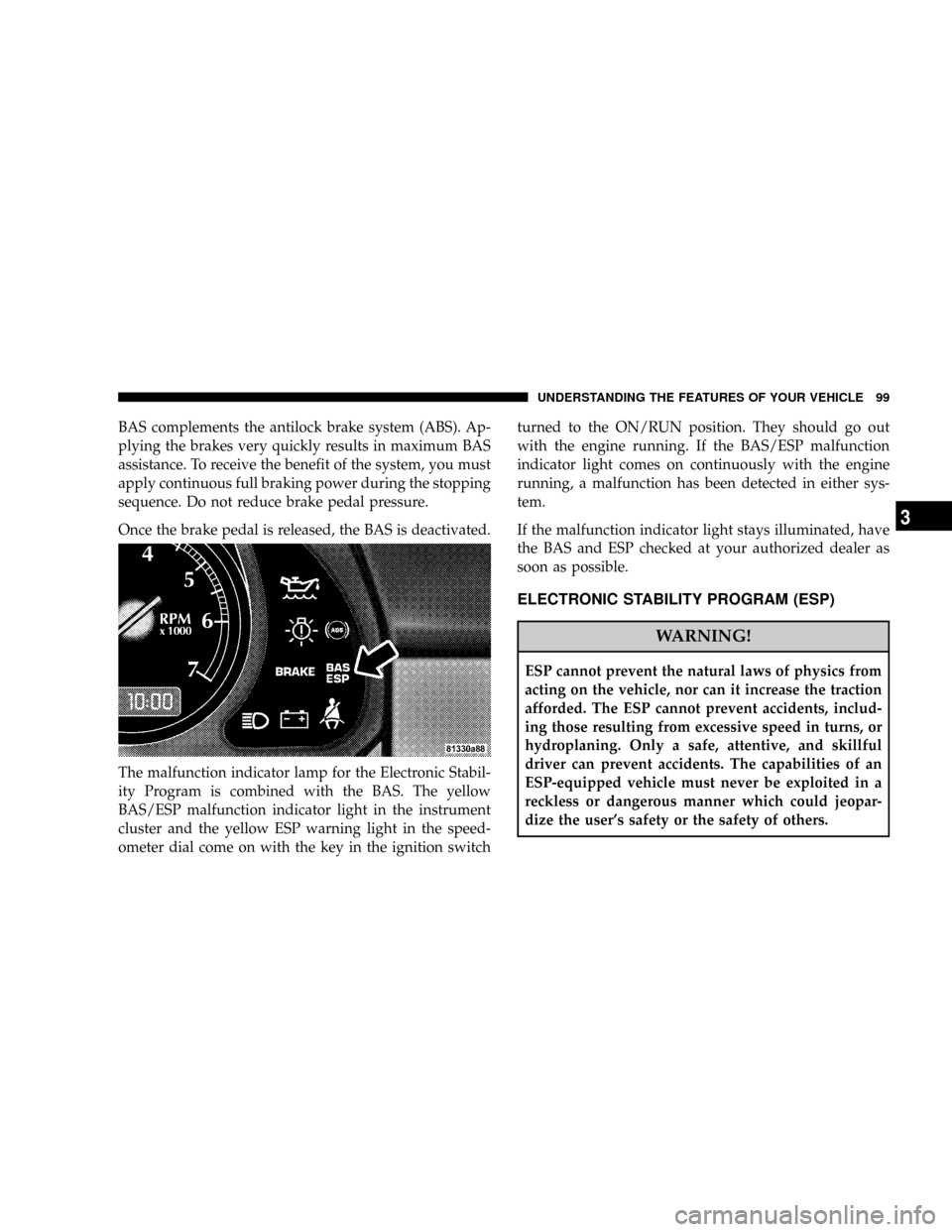
The malfunction indicator lamp for the Electronic Stabil-
ity Program is combined with the BAS. The yellow
BAS/ESP malfunction indicator light in the instrument
cluster and the yellow ESP warning light in the speed-
ometer dial come on with the key in the ignition switchturned to the ON/RUN position. They should go out
with the engine running. If the BAS/ESP malfunction
indicator light comes on continuously with the engine
running, a malfunction has been detected in either sys-
tem.
If the malfunction indicator light stays illuminated, have
the BAS and ESP checked at your authorized dealer as
soon as possible.
ELECTRONIC STABILITY PROGRAM (ESP)
WARNING!
ESP cannot prevent the natural laws of physics from
acting on the vehicle, nor can it increase the traction
afforded. The ESP cannot prevent accidents, includ-
ing those resulting from excessive speed in turns, or
hydroplaning. Only a safe, attentive, and skillful
driver can prevent accidents. The capabilities of an
ESP-equipped vehicle must never be exploited in a
reckless or dangerous manner which could jeopar-
dize the user's safety or the safety of others.
UNDERSTANDING THE FEATURES OF YOUR VEHICLE 99
3
Page 100 of 299

The ESP enhances directional control and reduces driving
wheel spin of the vehicle under various driving condi-
tions.
The ESP system corrects for over/understeering of the
vehicle by applying brakes to the appropriate wheel.
Engine torque is also limited. The ESP warning light,
located in the instrument cluster, starts to flash as soon as
the tires lose traction and the wheels begin to spin.To improve the vehicle's traction when driving with
snow chains, or starting off in deep snow, sand or gravel,
switch off the ESP system by pressing the upper half of
the ESP switch.
With the ESP system switched off, the engine torque
reduction feature is cancelled. Therefore, the enhanced
vehicle stability offered by ESP is unavailable. ESP al-
ways operates under braking, even with the switch in the
OFF position. If one drive wheel loses traction and begins
to spin, the brake is applied by the ESP system until the
100 UNDERSTANDING THE FEATURES OF YOUR VEHICLE
Page 101 of 299
wheel regains sufficient traction. The traction control
engages at approximately 24 mph (40 km/h), and
switches off at 50 mph (80 km/h).
If the ESP warning light begins to flash during accelera-
tion, ease up on the accelerator and apply as little throttle
as possible. Be sure to adapt your speed and driving to
the prevailing road conditions. When the ESP warning
light is illuminated continuously, the ESP is switched off.
To return to the enhanced vehicle stability offered by ESP,
press the lower half of the switch (the ESP warning light
in the speedometer dial goes out). Avoid spinning one
drive wheel. This may cause serious damage to the drive
train and is not covered by the DaimlerChrysler war-
ranty.
CAUTION!
If the vehicle is towed with the front axle raised, the
engine must be shut off (key in the ignition switch to
the OFF/LOCK or ACC position). Otherwise the ESP
will immediately be engaged and will apply the rear
wheel brakes.
Synchronizing ESP
If the power supply was interrupted (battery discon-
nected or discharged), the BAS/ESP malfunction indica-
tor light may be illuminated with the engine running. To
re-synchronize the ESP, and cancel the malfunction indi-
cator light, the steering angle sensor will need to be
recalibrated.
1. Turn the ignition switch to the ON/RUN position.
2. Rotate the steering wheel to the center position.
3. Rotate the steering wheel completely to the left, and
then rotate the steering wheel completely to the right.
4. Bring the steering wheel back to the center position.
5. The BAS/ESP malfunction indicator light will go out.
If the BAS/ESP malfunction indicator light is still illumi-
nated, the vehicle should be serviced at an authorized
dealer.
UNDERSTANDING THE FEATURES OF YOUR VEHICLE 101
3
Page 103 of 299
WARNING!
Leaving the electronic speed control system on when
not in use is dangerous. You could accidentally set
the system or cause it to go faster than you want. You
could lose control and have an accident. Always
leave the system OFF when you are not using it.
To Vary The Speed Setting
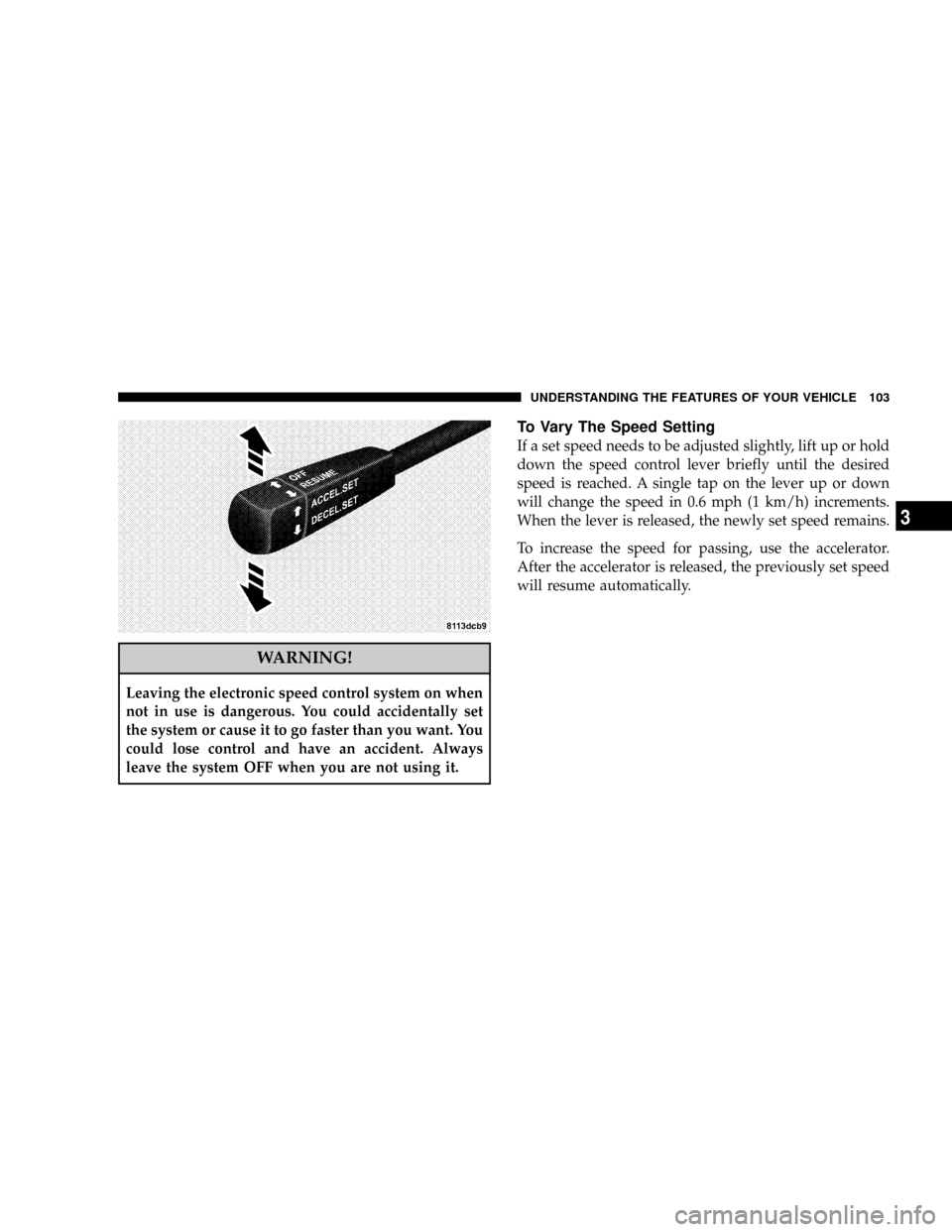
If a set speed needs to be adjusted slightly, lift up or hold
down the speed control lever briefly until the desired
speed is reached. A single tap on the lever up or down
will change the speed in 0.6 mph (1 km/h) increments.
When the lever is released, the newly set speed remains.
To increase the speed for passing, use the accelerator.
After the accelerator is released, the previously set speed
will resume automatically.
UNDERSTANDING THE FEATURES OF YOUR VEHICLE 103
3
Page 105 of 299
Using Speed Control On Hills
Your vehicle is equipped with interactive speed control.
This feature activates when driving up or down hills with
the speed control engaged and the driver's foot off the
accelerator.
WARNING!
Speed control can be dangerous where the system
can't maintain a constant speed. Your vehicle could
go too fast for the conditions, and you could lose
control. An accident could be the result. Don't use
speed control in heavy traffic or on roads that are
winding, icy, snow-covered, or slippery.
For vehicles with automatic transmission:
On a downgrade or an upgrade, downshifting will occur
automatically to allow the engine's braking power to
maintain the set speed. When more level roadway is
reached, the transmission will automatically upshift to
fifth gear.For vehicles with manual transmission:
The set speed control is switched off when declutching
exceeds four seconds during downshifting. In some
cases, you may have to step on the brake pedal to slow
down sufficiently to achieve the desired speed.
NOTE:On very steep hills, a greater speed loss or gain
may occur. It may be preferable to drive without speed
control.
GARAGE DOOR OPENER (If Equipped)
The HomeLinktUniversal Transceiver replaces up to
three remote controls (hand-held transmitters) that oper-
ate devices such as garage door openers, motorized
gates, or home lighting. The transceiver triggers these
devices at the push of a button. The transceiver operates
off your vehicle's battery and charging system: no bat-
teries are needed.
For additional information on HomeLinkt, call 1±800±
355±3515, or on the internet at www.homelink.com.
UNDERSTANDING THE FEATURES OF YOUR VEHICLE 105
3
Page 107 of 299

3. Erase the factory test codes by pressing the two
outside buttons. Release the buttons when the light in the
overhead console display begins to flash (about 20 sec-
onds).
NOTE:Step 3 does not have to be followed to program
additional hand-held transmitters.
4. Choose one of the three buttons to program. Place the
hand-held controller 1±3 inches (25±76 mm) from the
universal transceiver while keeping its indicator light in
view.5. Using both hands, press the hand-held transmitter
button and the desired universal transceiver button. Do
not release the buttons until Step 6 has been completed.
NOTE:Some gate operators and garage door openers
may require you to replace this Programming Step 5 with
procedures noted in the ªGate Operator/Canadian Pro-
grammingº section.
6. The indicator light in the universal transceiver will
begin to flash, first slowly and then rapidly. Release both
buttons after the indicator light changes from slow to
rapid flash. If, after 90 seconds, the indicator does not
flash rapidly or goes out, return to Step 1 and repeat the
procedure.
7. Press and hold the just programmed universal trans-
ceiver button and observe the indicator light. If the
indicator stays on constantly, programming is complete
and your device should activate when the universal
transceiver button is pressed and released.
NOTE:To program the remaining two universal trans-
ceiver buttons, begin with Programming Step 4. Do not
repeat Steps 1, 2, and 3.
UNDERSTANDING THE FEATURES OF YOUR VEHICLE 107
3
Page 108 of 299

If the indicator light blinks rapidly for two seconds
and then turns to a constant light, continue with
Programming Steps 8-10 to complete programming of
a rolling code equipped device (most commonly a
garage door opener).
8. At the garage door opener receiver (motor-head unit)
in the garage, locate the ªlearnº or ªsmartº button. This
can usually be found where the hanging antenna wire is
attached to the motor-head unit.
9. Firmly press and release the ªlearnº or ªsmartº but-
ton. (The name and color of the button may vary by
manufacturer.)
NOTE:There are 30 seconds in which to initiate Step 10.
10. Return to the vehicle and firmly press, hold for two
seconds and release the programmed universal trans-
ceiver button. Repeat the ªpress/hold/releaseº sequence
a second time, and, depending on the brand of the garage
door opener (or other rolling code equipped device),
repeat this sequence a third time to complete the pro-
gramming.The universal transceiver should now activate your roll-
ing code equipped device.
If you do not successfully program the universal trans-
ceiver to learn the signal of your hand-held transmitter,
call toll free for customer assistance at 1-800-355-3515, or
on the internet at www.homelink.com.
Gate Operator/Canadian Programming
Canadian radio-frequency laws require transmitter sig-
nals to ªtime-outº (or quit) after several seconds of
transmission. This may not be long enough for the
universal transceiver to pick up the signal during pro-
gramming. Similar to this Canadian law, some U.S. gate
operators are designed to ªtime-outº in the same manner.
If you live in Canada or you are having difficulties
programming a gate operator by using the programming
procedures (regardless of where you live), replace Pro-
gramming Step 5 with the following:
NOTE:If programming a garage door opener or gate
operator, it is advised to unplug the device during the
ªcyclingº process to prevent possible overheating.
108 UNDERSTANDING THE FEATURES OF YOUR VEHICLE
Page 109 of 299

5. Continue to press and hold the universal transceiver
button while you press and release every two seconds
(ªcycleº) your hand-held transmitter until the frequency
signal has successfully been accepted by the universal
transmitter. (The indicator light will flash slowly and
then rapidly.) Proceed with Programming Step 6 to
complete.
Using the Universal Transceiver
To operate the universal transceiver, simply press and
release the programmed button. Activation will now
occur for the programmed device (i.e. garage door
opener, gate operator, security system, entry door lock,
home/office lighting, etc.) For convenience, the hand-
held transmitter of the device may also be used at any
time.
Erasing Universal Transceiver Buttons
To erase programming from the three buttons (individual
buttons cannot be erased but can be reprogrammed ± see
below), follow this procedure:
²Press and hold the two outer universal transceiver
buttons until the indicator light begins to flash after 20
seconds. Release both buttons. Do not hold for longerthan 30 seconds. The universal transceiver is now in
the program (or learning) mode and can be pro-
grammed at any time beginning with Programming
Step 4.
Reprogramming a Single Button
To program a device using a universal transceiver button
previously programmed, follow these steps:
1. Press and hold the desired universal transceiver but-
ton. DO NOT release the button.
2. The indicator light will begin to flash after 20 seconds.
Without releasing the universal transceiver button, pro-
ceed with Programming Step 4.
Security
If you sell your vehicle, be sure to erase the frequencies.
To erase all of the previously programmed frequencies,
hold down both outside buttons until the light begins to
flash.
UNDERSTANDING THE FEATURES OF YOUR VEHICLE 109
3