light CHRYSLER CROSSFIRE 2008 1.G Owners Manual
[x] Cancel search | Manufacturer: CHRYSLER, Model Year: 2008, Model line: CROSSFIRE, Model: CHRYSLER CROSSFIRE 2008 1.GPages: 358, PDF Size: 4.7 MB
Page 264 of 358
EMISSIONS INSPECTION AND MAINTENANCE
PROGRAMS
In some localities, it may be a legal requirement to pass
an inspection of your vehicle's emissions control system.
Failure to pass could prevent vehicle registration.
For states which have an I/M (Inspection and
Maintenance) requirement, this check verifies
the following: the CHECK ENGINE Light is functioning
and is not on when the engine is running, and that the
Onboard Diagnostic system (OBD II) is ready for testing.
Normally, the OBD II system will be ready. The OBD II
system maynotbe ready if your vehicle was recently
serviced, if you recently had a dead battery, or a battery
replacement. If the OBD II system should be determined
not ready for the I/M test, your vehicle may fail the test.Your vehicle has a simple ignition key actuated test
which you can use prior to going to the test station. To
check if your vehicle's OBD II system is ready, you must
do the following:
1. Insert your ignition key into the ignition switch.
2. Turn the ignition to the ON/RUN position, but do not
crank or start the engine.
3. If you crank or start the engine, you will have to start
this test over.
4. As soon as you turn your key to the ON/RUN
position, you will see your CHECK ENGINE light come
on as part of a normal bulb check.
5. Approximately 15 seconds later, one of two things will
happen:
a. The CHECK ENGINE light will flash for about 10
seconds and then return to being fully illuminated
262 MAINTAINING YOUR VEHICLE
Page 265 of 358
until you turn OFF the ignition key or start the engine.
This means that your vehicle's OBD II system isnot
readyand you shouldnotproceed to the I/M station.
b. The CHECK ENGINE light will not flash at all and
will remain fully illuminated until you turn off the
ignition key or start the engine. This means that your
vehicle's OBD II system isreadyand you can proceed
to the I/M station.
If your OBD II system isnot ready,you should see your
authorized dealer or repair facility. If your vehicle was
recently serviced or had a battery failure or replacement,
you may need to do nothing more than drive your
vehicle as you normally would in order for your OBD II
system to update. A recheck with the above test routine
may then indicate that the system is now ready.
Regardless of whether your vehicle's OBD II system is
ready or not ready, if the CHECK ENGINE light is
illuminated during normal vehicle operation, you shouldhave your vehicle serviced before going to the I/M
station. The I/M station can fail your vehicle because the
CHECK ENGINE light is on with the engine running.
REPLACEMENT PARTS
Use of genuine Mopartparts for normal/scheduled
maintenance and repairs is highly recommended to en-
sure the designed performance. Damage or failures
caused by the use of non-Mopartparts for maintenance
and repairs will not be covered by the warranty offered
by DaimlerChrysler Corporation.
AUTHORIZED DEALER SERVICE
Your authorized dealer has the qualified service person-
nel, special tools and equipment to perform all service
operations in an expert manner. Service Manuals are
available which include detailed service information for
your vehicle. Refer to these manuals before attempting
any procedure yourself.
MAINTAINING YOUR VEHICLE 263
7
Page 268 of 358
Change Engine Oil
The oil change interval for yourvehicle is initially set at
7,000 mi (Canada: 11 000 km).
The Flexible Service System (FSS) in your vehicle evalu-
ates engine temperature, oil level, vehicle speed, engine
speed, distance driven, and the time elapsed since your
last service. It determines when your vehicle needs
maintenance service and alerts you in advance. The next
necessary service is indicated by the FSS in your instru-
ment cluster.
NOTE:Also see the FSS system details in the Under-
standing Your Instrument Panel section of this manual.
Very light duty driving cycles (most trips more than 10
mi [16 km]) at moderate speeds in moderate temperature
conditions) can extend the service interval beyond 7,000
mi (Canada: 11 000 km).IfANYof the following apply to your driving, the oil
change interval can be reduced significantly:
²Day and night temperatures are below 32ÉF (0ÉC)
²Stop-and-go driving
²Extensive engine idling
²Driving in dusty conditions
²Short trips of less than 10 mi (16 km)
²More than 50% of your driving is at sustained high
speeds during hot weather, above 90ÉF (32ÉC)
²Taxi, Police, or delivery service (commercial service)
Observe the oil change interval indicated by your FSS
system. This system will monitor the driving conditions
seen by your vehicle, and will recommend the best
interval for servicing your vehicle to maintain it in top
condition.
266 MAINTAINING YOUR VEHICLE
Page 271 of 358
there is any malfunction due to a faulty spark plug.
Check the specifications section for the proper type of
spark plug for use in your vehicle.
Engine Air Cleaner Filter
Under normal driving conditions, replace the air filter at
each interval called out by FSS.
WARNING!
The air cleaner can provide a measure of protection
in the case of engine backfire. Do not remove the air
cleaner unless such removal is necessary for repair or
maintenance. Make sure that no one is near the
engine compartment before starting the vehicle with
the air cleaner removed. Failure to do so can result in
serious personal injury.
Engine Fuel Filter
A plugged fuel filter can cause hard starting or limit the
speed at which a vehicle can be driven. Should an
excessive amount of dirt accumulate in the fuel tank,
frequent fuel filter replacement may be necessary. See
your authorized dealer for service.
Catalytic Converter
The catalytic converter requires the use of unleaded fuel
only. Leaded gasoline will destroy the effectiveness of the
catalyst as an emission control device.
Under normal operating conditions, the catalytic con-
verter will not require maintenance. However, it is im-
portant to keep the engine properly serviced to assure
proper catalyst operation and prevent possible catalyst
damage.
If the CHECK ENGINE light is flashing, immediate
service is required.
MAINTAINING YOUR VEHICLE 269
7
Page 280 of 358
Windshield Washer Reservoir
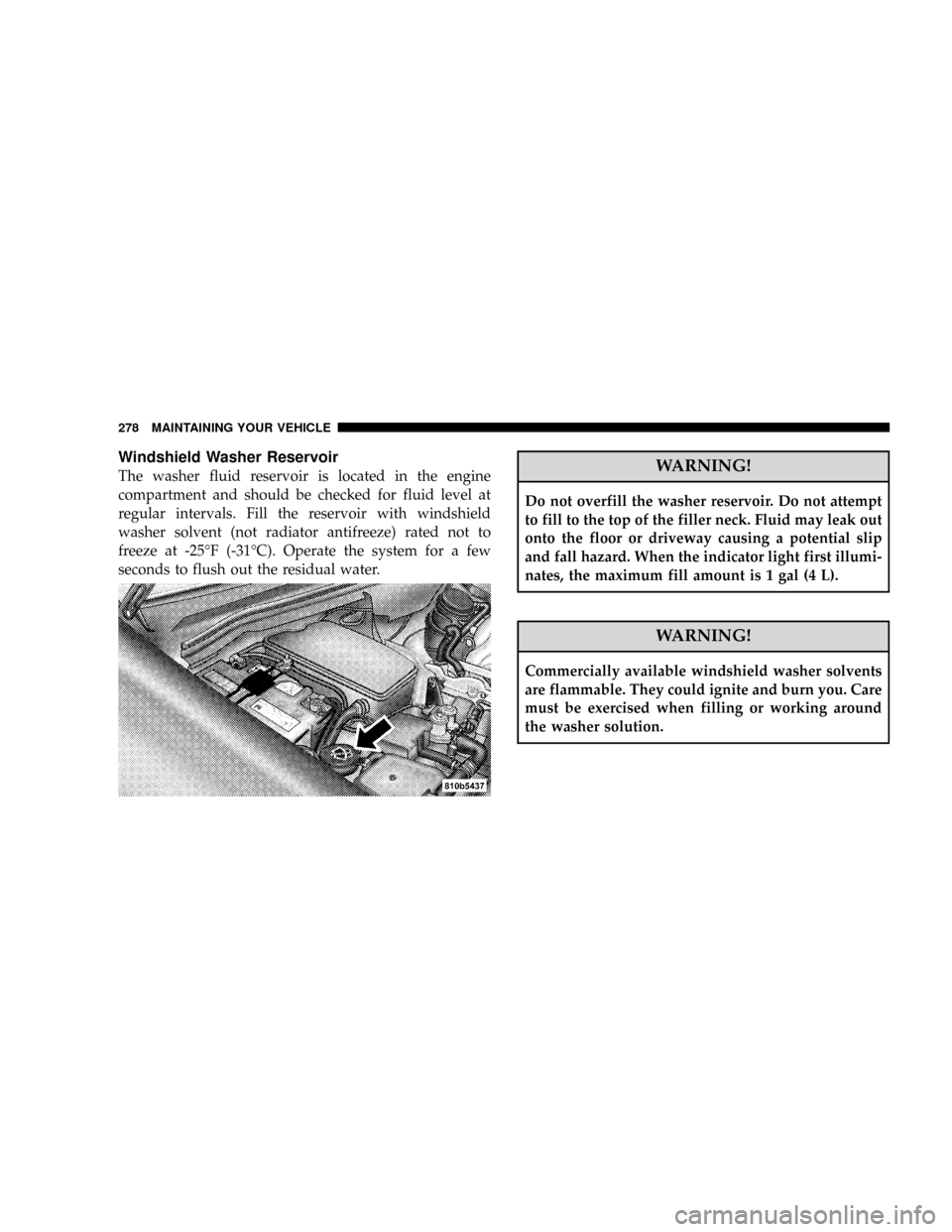
The washer fluid reservoir is located in the engine
compartment and should be checked for fluid level at
regular intervals. Fill the reservoir with windshield
washer solvent (not radiator antifreeze) rated not to
freeze at -25ÉF (-31ÉC). Operate the system for a few
seconds to flush out the residual water.WARNING!
Do not overfill the washer reservoir. Do not attempt
to fill to the top of the filler neck. Fluid may leak out
onto the floor or driveway causing a potential slip
and fall hazard. When the indicator light first illumi-
nates, the maximum fill amount is 1 gal (4 L).
WARNING!
Commercially available windshield washer solvents
are flammable. They could ignite and burn you. Care
must be exercised when filling or working around
the washer solution.
278 MAINTAINING YOUR VEHICLE
Page 288 of 358
NOTE:Inspection of brake hoses should be done when-
ever the brake system is serviced and at every engine oil
change.
WARNING!
Worn brake hoses can burst and cause brake failure.
You could have an accident. If you see any signs of
cracking, scuffing, or worn spots, have the brake
hoses replaced immediately.
Brake Master Cylinder
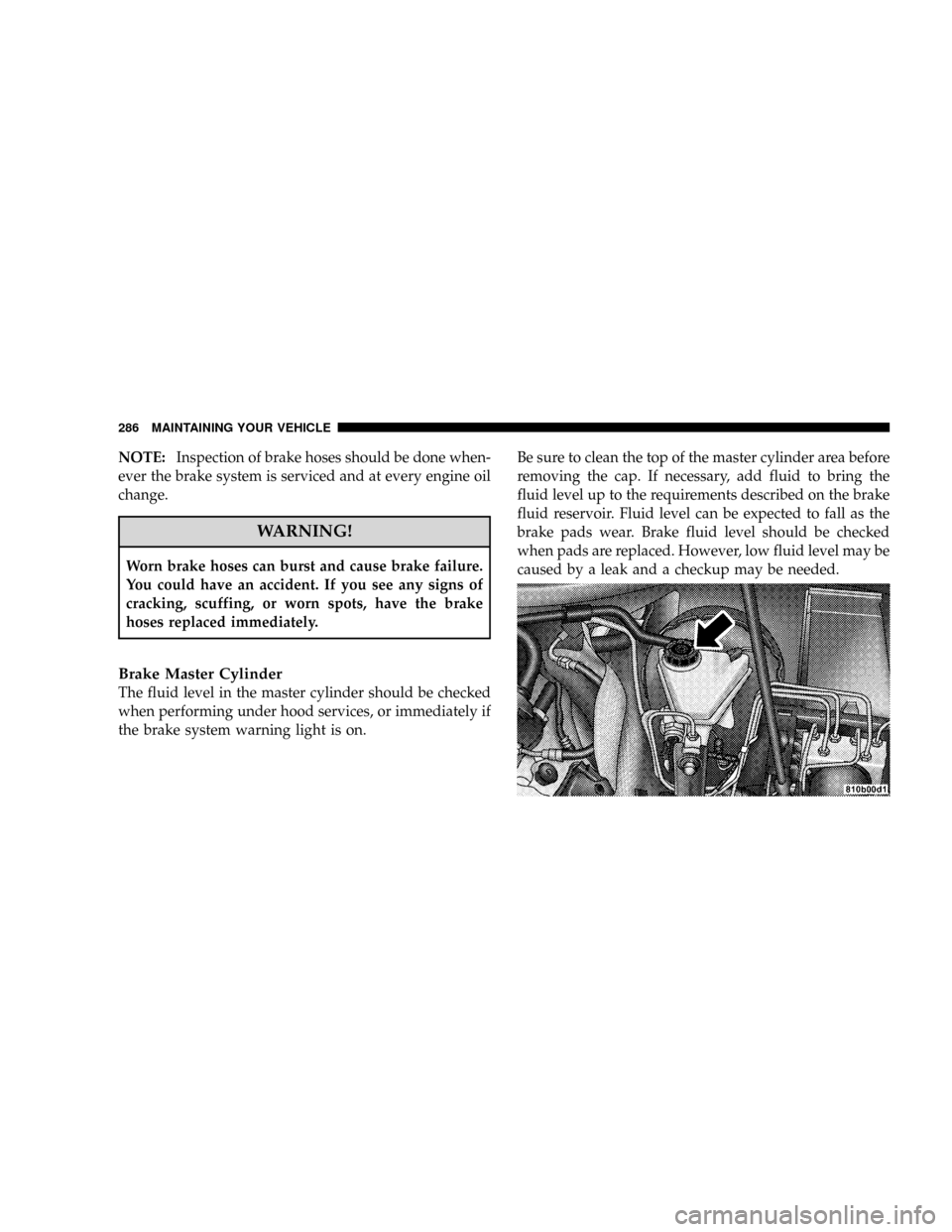
The fluid level in the master cylinder should be checked
when performing under hood services, or immediately if
the brake system warning light is on.Be sure to clean the top of the master cylinder area before
removing the cap. If necessary, add fluid to bring the
fluid level up to the requirements described on the brake
fluid reservoir. Fluid level can be expected to fall as the
brake pads wear. Brake fluid level should be checked
when pads are replaced. However, low fluid level may be
caused by a leak and a checkup may be needed.
286 MAINTAINING YOUR VEHICLE
Page 296 of 358
CAUTION!
The use of vinyl, leather or plastic protectants may
cause excessive gloss and/or discoloration of interior
trim parts.
WARNING!
Do not use volatile solvents for cleaning purposes.
Many are potentially flammable, and if used in
closed areas they may cause respiratory harm.
Cleaning Headlights
Your vehicle has plastic headlights that are lighter and
less susceptible to stone breakage than glass headlights.
Plastic is not as scratch resistant as glass and therefore
different lens cleaning procedures must be followed.To minimize the possibility of scratching the lenses and
reducing light output, avoid wiping with a dry cloth. To
remove road dirt, wash with a mild soap solution fol-
lowed by rinsing.
Do not use abrasive cleaning components, solvents, steel
wool or other aggressive material to clean the lenses.
Glass Surfaces
All glass surfaces should be cleaned on a regular basis
with any commercial household-type glass cleaner.
Never use an abrasive-type cleaner. Use caution when
cleaning inside rear windows equipped with electric
defrosters. Do not use scrapers or other sharp instru-
ments which may scratch the elements.
Instrument Panel Cover
The instrument panel cover has a low glare surface which
minimizes reflections in the windshield. Do not use
294 MAINTAINING YOUR VEHICLE
Page 299 of 358
The following methods are sufficient if the top is only
lightly soiled:
Dry Cleaning
Brush the dry top with a soft-bristled brush from front to
rear of the vehicle.
Wet Cleaning
Wash with clear water or with a mild detergent and an
ample supply of luke warm water by wiping with a
soft-bristled brush or sponge from front to rear. Then
rinse thoroughly with clear water.
Allow the top to dry before lowering. Vacuuming the top
with a wet/dry shop vacuum will decrease the top's
drying time, ensure removal of all dirt, and delete streaks
in the material. Multiple cleanings may be necessary to
remove stubborn stains. If stains persist, contact your
local dealership for further suggestions.
Weather Strip Care
Lubricate all top and door glass weather strips periodi-
cally with Mopar Weather Strip Lubricant (part number
4773427), to keep them soft and pliable.
FUSES
Underhood Accessory Fuse Block Fuses
The underhood accessory fuse block fuses are located
under the hood on the driver's side, between the brake
master cylinder and the left front fender.
To remove the lid, squeeze the tabs together located at the
front of the fusebox. Then lift the lid up by the tabs. The
lid will then slide off the top of the fuse box. To replace
the lid, place the two hinge-like tabs at the rear of the lid
under the tabs on the fusebox. Push down on the front of
the lid until the tabs at the front click.
MAINTAINING YOUR VEHICLE 297
7
Page 302 of 358
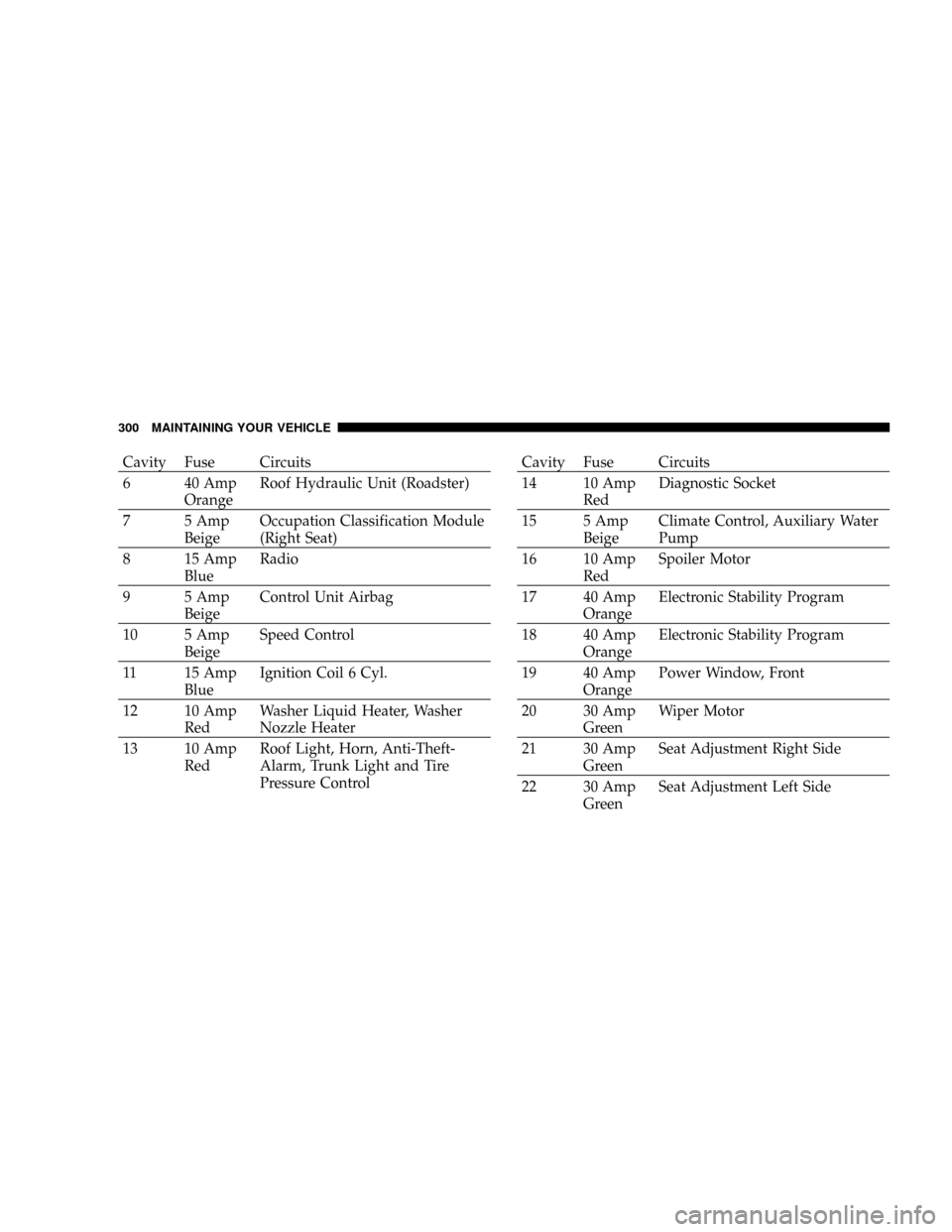
Cavity Fuse Circuits
6 40 Amp
OrangeRoof Hydraulic Unit (Roadster)
7 5 Amp
BeigeOccupation Classification Module
(Right Seat)
8 15 Amp
BlueRadio
9 5 Amp
BeigeControl Unit Airbag
10 5 Amp
BeigeSpeed Control
11 15 Amp
BlueIgnition Coil 6 Cyl.
12 10 Amp
RedWasher Liquid Heater, Washer
Nozzle Heater
13 10 Amp
RedRoof Light, Horn, Anti-Theft-
Alarm, Trunk Light and Tire
Pressure ControlCavity Fuse Circuits
14 10 Amp
RedDiagnostic Socket
15 5 Amp
BeigeClimate Control, Auxiliary Water
Pump
16 10 Amp
RedSpoiler Motor
17 40 Amp
OrangeElectronic Stability Program
18 40 Amp
OrangeElectronic Stability Program
19 40 Amp
OrangePower Window, Front
20 30 Amp
GreenWiper Motor
21 30 Amp
GreenSeat Adjustment Right Side
22 30 Amp
GreenSeat Adjustment Left Side
300 MAINTAINING YOUR VEHICLE
Page 303 of 358
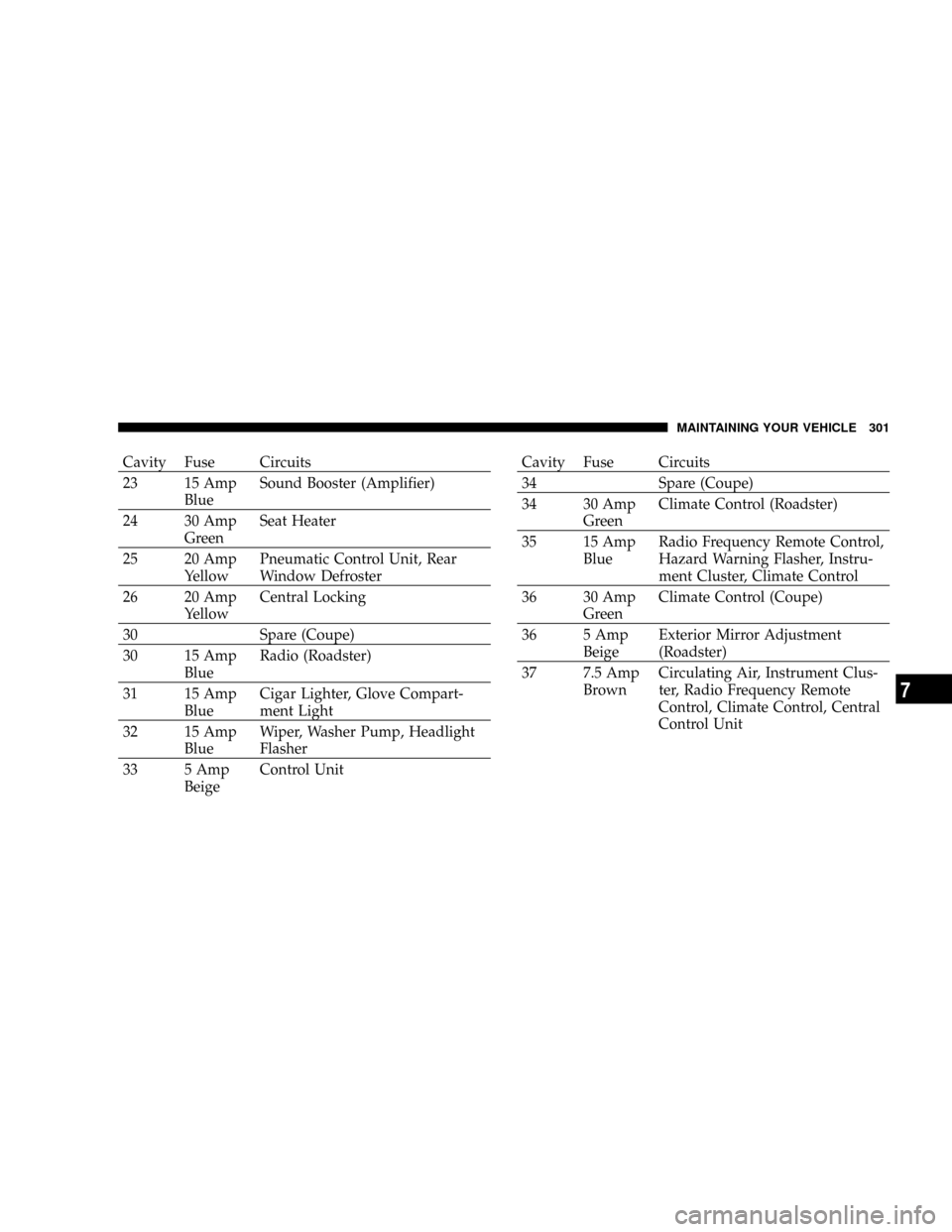
Cavity Fuse Circuits
23 15 Amp
BlueSound Booster (Amplifier)
24 30 Amp
GreenSeat Heater
25 20 Amp
YellowPneumatic Control Unit, Rear
Window Defroster
26 20 Amp
YellowCentral Locking
30 Spare (Coupe)
30 15 Amp
BlueRadio (Roadster)
31 15 Amp
BlueCigar Lighter, Glove Compart-
ment Light
32 15 Amp
BlueWiper, Washer Pump, Headlight
Flasher
33 5 Amp
BeigeControl UnitCavity Fuse Circuits
34 Spare (Coupe)
34 30 Amp
GreenClimate Control (Roadster)
35 15 Amp
BlueRadio Frequency Remote Control,
Hazard Warning Flasher, Instru-
ment Cluster, Climate Control
36 30 Amp
GreenClimate Control (Coupe)
36 5 Amp
BeigeExterior Mirror Adjustment
(Roadster)
37 7.5 Amp
BrownCirculating Air, Instrument Clus-
ter, Radio Frequency Remote
Control, Climate Control, Central
Control Unit
MAINTAINING YOUR VEHICLE 301
7