brake CHRYSLER CROSSFIRE 2008 1.G User Guide
[x] Cancel search | Manufacturer: CHRYSLER, Model Year: 2008, Model line: CROSSFIRE, Model: CHRYSLER CROSSFIRE 2008 1.GPages: 358, PDF Size: 4.7 MB
Page 136 of 358
11. Light Outage Indicator
With the key in the ignition switch turned to
the ON/RUN position, an indicator light
comes on. It should go out when the engine is
running. If the indicator light does not go out
after starting the engine, or if it comes on while driving,
it indicates a failure in the parking light, taillight, stop-
light, low beam headlight, or other exterior lamps.
The indicator light will come on when the exterior light
fails. If a brake light fails, the light outage indicator will
come on when applying the brake and stays on until the
engine is turned off.
NOTE:If additional lighting equipment is installed
(e.g., auxiliary headlights, etc.) be certain to connect into
the fuse before the failure indicator monitoring unit in
order to avoid damaging the system.12. Antilock Warning Indicator Light
The ABS warning indicator light comes on with
the key in the ignition switch turned to the
ON/RUN position, and should go out with the
engine running.
If the ABS warning indicator light comes on while the
engine is running, it indicates that the ABS has detected
a malfunction and has switched off. In this case, the brake
system functions in the usual manner, but without an-
tilock assistance.
If the ABS light is on, have the system checked at your
authorized dealer as soon as possible.
13. Brake Assist Indicator Light
The indicator light for the Brake Assist System
(BAS) is combined with the Electronic Stability
Program (ESP). This yellow indicator light in
the instrument cluster comes on with the key in the
ignition switch turned to the ON/RUN position. The
134 UNDERSTANDING YOUR INSTRUMENT PANEL
Page 137 of 358
BAS/ESP warning indicator light also comes on when a
malfunction is detected in either the Brake Assist System
or the Electronic Stability Program. It should go out with
the engine running. If the BAS/ESP indicator light comes
on continuously, see an authorized dealer as soon as
possible.
14. Seat Belt Indicator Light
With the key in the ignition, the light comes on,
and a warning sounds for a short time if the
driver's seat belt is not fastened.
After starting the engine, the seat belt indicator light
blinks and a chime sounds periodically for up to 90
seconds to remind the driver and passenger to fasten the
seat belts. Fastening the seat belts will extinguish the
light and silence the chime.The seat belt indicator light will remain lit until the seat
belts are fastened.
15. Charging System Indicator Light
Should the charging system indicator light fail
to come on prior to starting when the key is in
the ignition switch in the ON/RUN position,
or should it fail to go out after starting or
during operation, it indicates a malfunction that must be
repaired immediately at an authorized dealer.
If the charging system indicator light comes on, or a loss
of power steering assistance is noticeable while the
engine is running, this may indicate that the accessory
drive belt has broken. Should this condition occur, the
belt must be replaced before continuing to operate the
vehicle.
UNDERSTANDING YOUR INSTRUMENT PANEL 135
4
Page 144 of 358
If the Check Engine light remains on continuously and
the vehicle is driving normally, you may still drive the
vehicle. In most situations, the vehicle will not require
towing. However, we recommend that you have the
system checked at an authorized dealer as soon as
possible.
If the vehicle is not driving normally, and the Check
Engine light flashes or remains on continuously, it is an
alert to serious conditions that could lead to loss of power
or severe catalytic converter damage. The vehicle should
be serviced at an authorized dealer as soon as possible.
27. Brake Wear Indicator Light
With the key in the ignition and turned to the
ON/RUN position, the brake wear indicator
light comes on. The light goes out when the
engine is running.
If the indicator light comes on during braking, this
indicates the brake pads are worn down.Have the brake system checked at your authorized dealer
as soon as possible.
28. Oil Level Indicator Light
With the key in the ignition switch turned to
the ON/RUN position, the oil level indicator
light comes on. It should go out immediately
when the engine is running. If the light does
not go out, or comes on while driving, the engine oil level
has dropped to approximately the minimum mark on the
dipstick.
CHECKING ENGINE OIL LEVEL
A sensor in the oil pan allows oil level to be checked
without opening the hood. It provides an accurate mea-
surement of oil level, whereas the low engine oil level
indicator warns that oil level is definitely too low. With
the vehicle parked on a level surface, the engine is
warmed up and shut off for approximately five minutes.
When the ignition switch is turned to the ON/RUN
142 UNDERSTANDING YOUR INSTRUMENT PANEL
Page 168 of 358
NProgram Mode Selector Switch............180
NEmergency Operation (Limp Home Mode) . . . 181
mDriving On Slippery Surfaces..............182
NTraction............................182
mDriving Through Water..................183
NFlowing/Rising Water..................183
mParking Brake.........................185
mBrake System..........................186
NBrake Assist System (BAS)...............187
NElectronic Stability Program (ESP).........189
NSynchronizing ESP....................191
NESP Control Switch....................191
NAnti-Lock Brake System (ABS)............192NBrake Pad Break-In....................196
mPower Steering........................196
mTire Safety Information...................198
NTire Markings........................198
NTire Loading And Tire Pressure...........203
mTires Ð General Information...............207
NTire Pressure.........................207
NTire Inflation Pressures.................208
NTire Pressures For High Speed Operation....210
NRadial-Ply Tires......................210
NTire Spinning........................211
NTread Wear Indicators..................211
NLife Of Tire.........................212
166 STARTING AND OPERATING
Page 170 of 358
STARTING PROCEDURES
WARNING!
Do not leave animals or children inside parked
vehicles in hot weather; interior heat build up may
cause serious injury or death.
Be sure that the parking brake is engaged and that the
shift lever is in the NEUTRAL or PARK position. Turn the
key in the ignition switch to the ON/RUN position.
Apply the brakes before shifting into any driving gear.
Normal Starting
Vehicles with automatic transmissions:
Do not depress the accelerator. Simply turn the key in the
ignition switch clockwise to the START position and
release when the engine starts. If the engine will not run,turn the key counterclockwise to the OFF/LOCK posi-
tion and repeat the starting procedure. If there are several
unsuccessful attempts, have the system checked at the
nearest authorized dealer.
Vehicles with manual transmissions:
Do not depress the accelerator. Fully depress the clutch
pedal, otherwise the engine cannot be started due to the
integrated safety interlock. Simply turn the key in the
ignition switch clockwise to the START position and
release when the engine starts. The starter will engage
until the engine is running. If the engine will not run,
turn the key counterclockwise to the OFF/LOCK posi-
tion and repeat the starting procedure. If there are several
unsuccessful attempts, have the system checked at the
nearest authorized dealer.
168 STARTING AND OPERATING
Page 173 of 358
TRANSMISSION SHIFTING
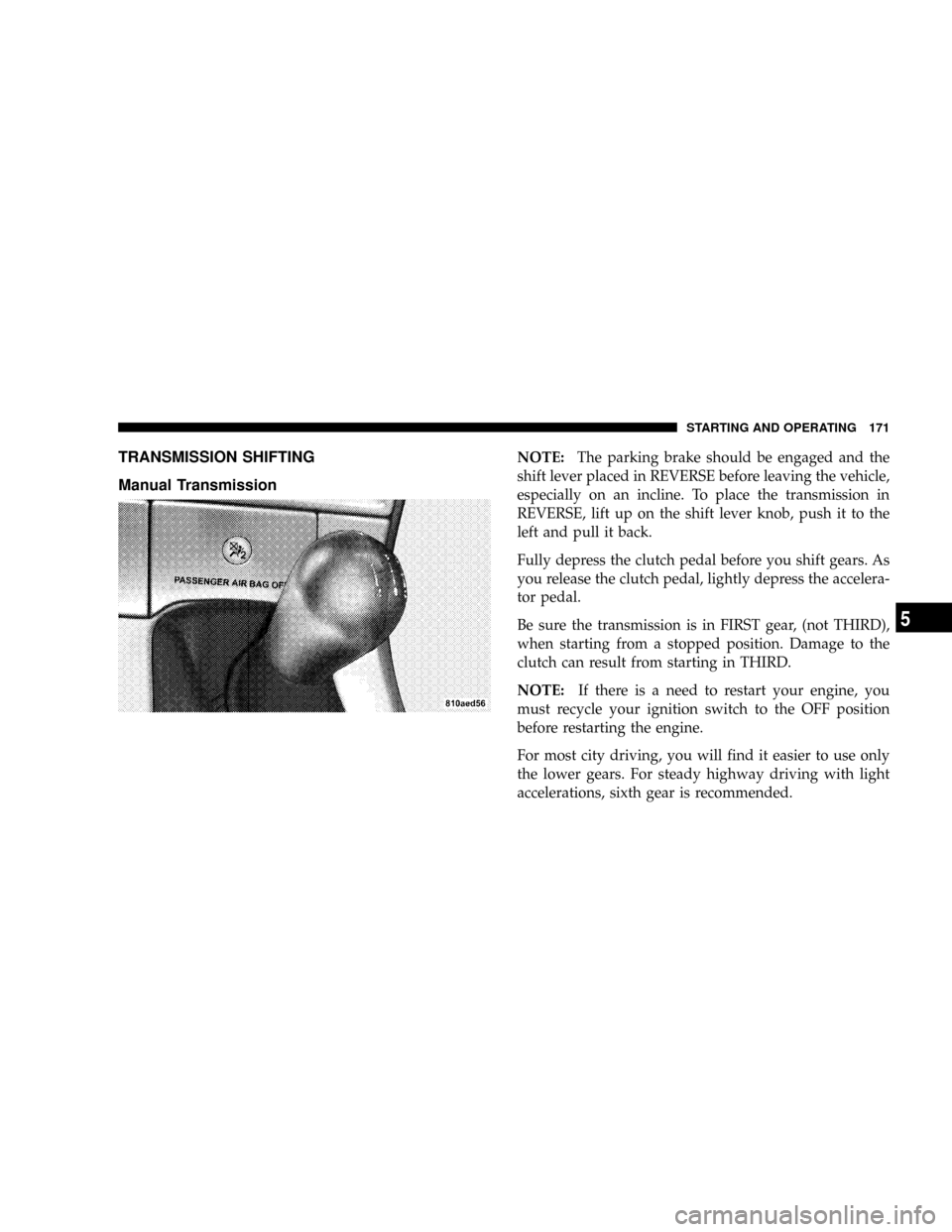
Manual TransmissionNOTE:The parking brake should be engaged and the
shift lever placed in REVERSE before leaving the vehicle,
especially on an incline. To place the transmission in
REVERSE, lift up on the shift lever knob, push it to the
left and pull it back.
Fully depress the clutch pedal before you shift gears. As
you release the clutch pedal, lightly depress the accelera-
tor pedal.
Be sure the transmission is in FIRST gear, (not THIRD),
when starting from a stopped position. Damage to the
clutch can result from starting in THIRD.
NOTE:If there is a need to restart your engine, you
must recycle your ignition switch to the OFF position
before restarting the engine.
For most city driving, you will find it easier to use only
the lower gears. For steady highway driving with light
accelerations, sixth gear is recommended.
STARTING AND OPERATING 171
5
Page 176 of 358
Automatic Transmission
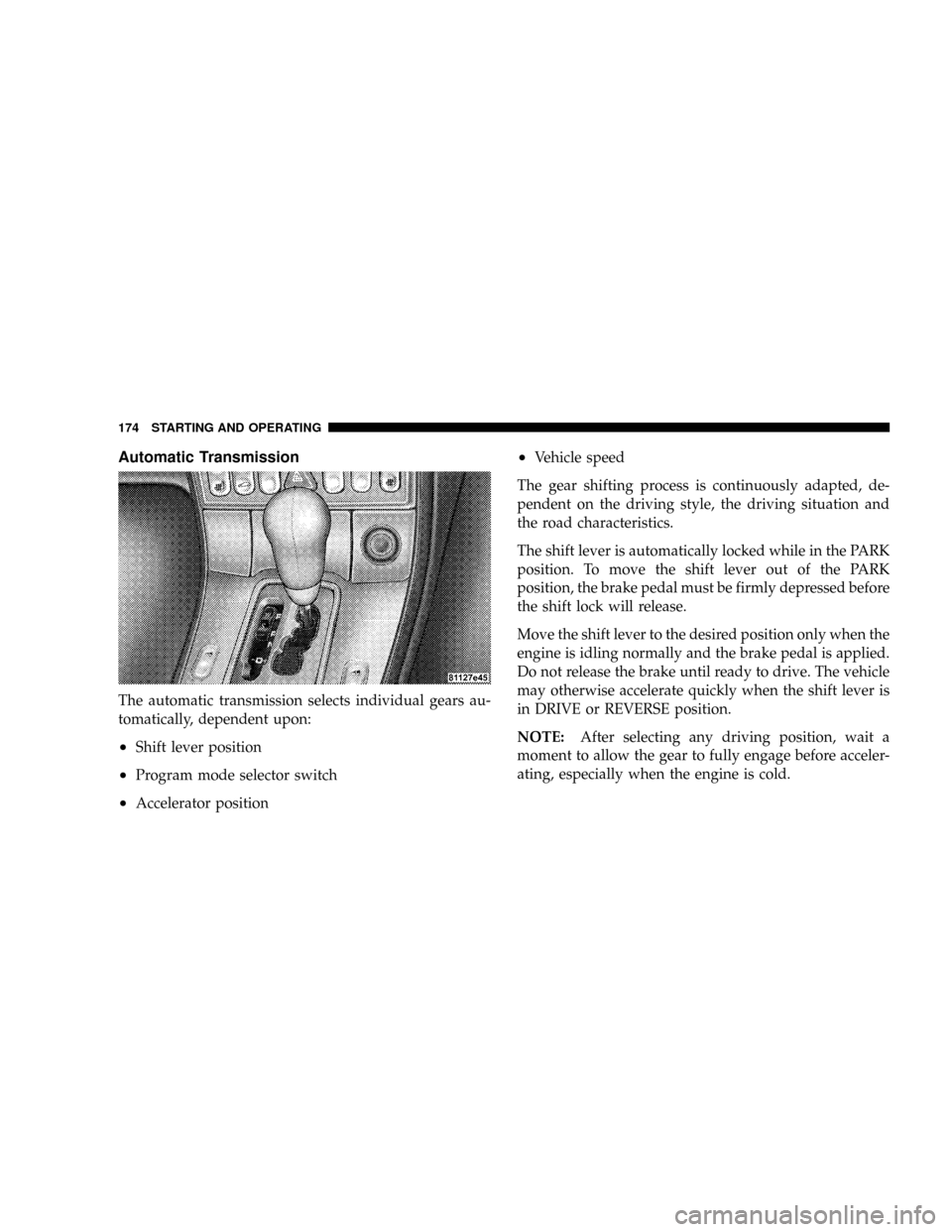
The automatic transmission selects individual gears au-
tomatically, dependent upon:
²Shift lever position
²Program mode selector switch
²Accelerator position
²Vehicle speed
The gear shifting process is continuously adapted, de-
pendent on the driving style, the driving situation and
the road characteristics.
The shift lever is automatically locked while in the PARK
position. To move the shift lever out of the PARK
position, the brake pedal must be firmly depressed before
the shift lock will release.
Move the shift lever to the desired position only when the
engine is idling normally and the brake pedal is applied.
Do not release the brake until ready to drive. The vehicle
may otherwise accelerate quickly when the shift lever is
in DRIVE or REVERSE position.
NOTE:After selecting any driving position, wait a
moment to allow the gear to fully engage before acceler-
ating, especially when the engine is cold.
174 STARTING AND OPERATING
Page 177 of 358
WARNING!
It is dangerous to shift the shift lever out of PARK or
NEUTRAL if the engine speed is higher than idle
speed. If your foot is not firmly on the brake pedal,
the vehicle could accelerate quickly forward or in
reverse. You could lose control of the vehicle and hit
someone or something. Only shift into gear when the
engine is idling normally and when your foot is
firmly on the brake pedal.
Stopping
For brief stops, leave the transmission in gear and hold
the vehicle with the brake pedal. For longer stops with
the engine idling, shift into the NEUTRAL or PARK
position and hold the vehicle with the parking brake.When stopping the vehicle uphill, do not hold it with the
accelerator; use the brake. This avoids unnecessary trans-
mission heat build-up.
Maneuvering
To maneuver in tight areas, control the vehicle speed by
gradually releasing the brakes. Accelerate gently and
never abruptly step on the accelerator.
To rock a vehicle out of soft ground (mud or snow),
alternately shift from FORWARD to REVERSE, while
applying only slight acceleration. Rocking a vehicle free
in this manner may cause the ABS or traction system
malfunction indicator light to come on. Turn off the
engine and restart the engine to clear the malfunction
indication.
STARTING AND OPERATING 175
5
Page 178 of 358
Park Position
The PARK position is to be used when parking the
vehicle. Engage only with the vehicle stopped. The PARK
position is not intended to serve as a brake when the
vehicle is parked. Rather, the driver should always use
the parking brake in addition to placing the shift lever in
PARK to secure the vehicle.
NOTE:The key can be removed from the ignition
switch only with the shift lever in the PARK position.
With the key removed, the shift lever is locked in the
PARK position.
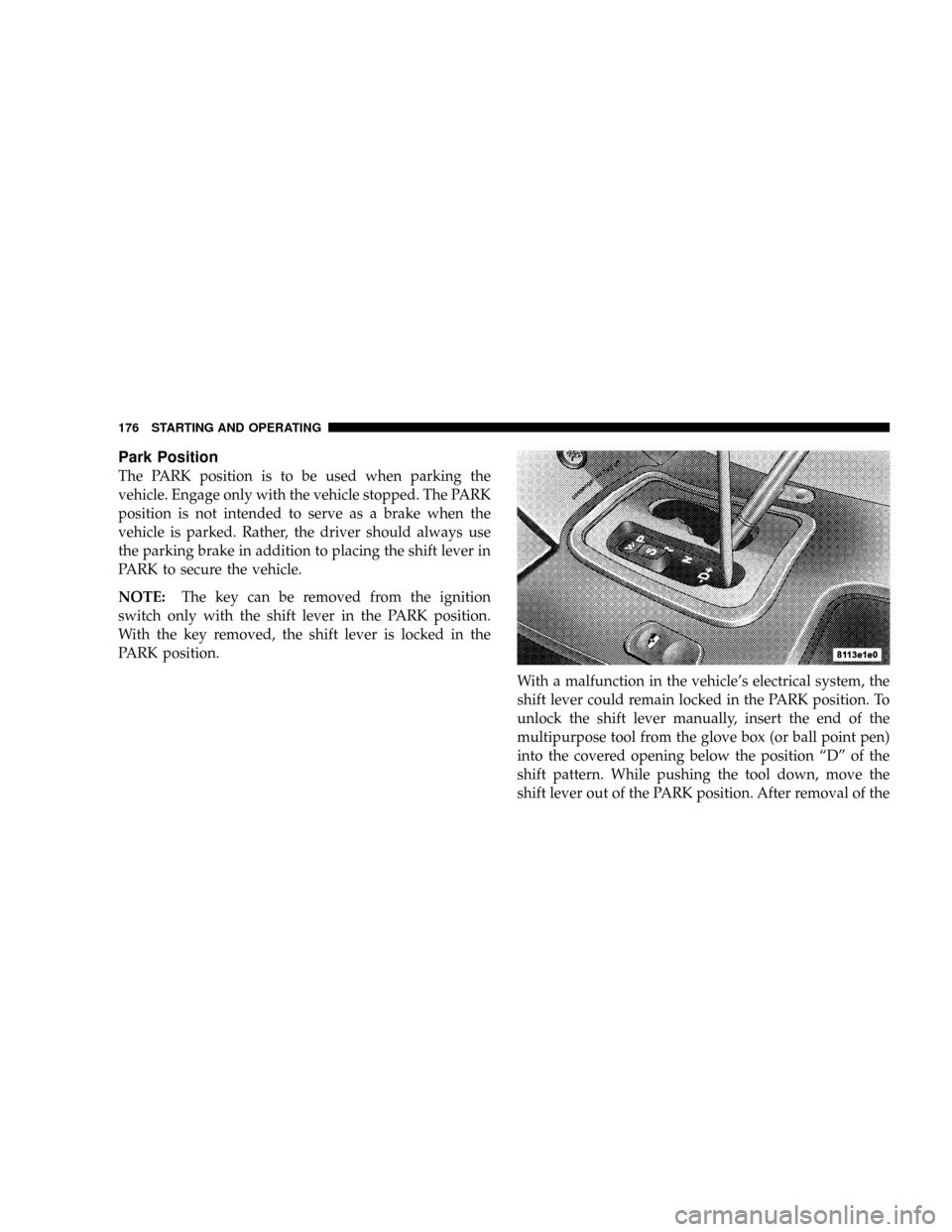
With a malfunction in the vehicle's electrical system, the
shift lever could remain locked in the PARK position. To
unlock the shift lever manually, insert the end of the
multipurpose tool from the glove box (or ball point pen)
into the covered opening below the position ªDº of the
shift pattern. While pushing the tool down, move the
shift lever out of the PARK position. After removal of the
176 STARTING AND OPERATING
Page 179 of 358
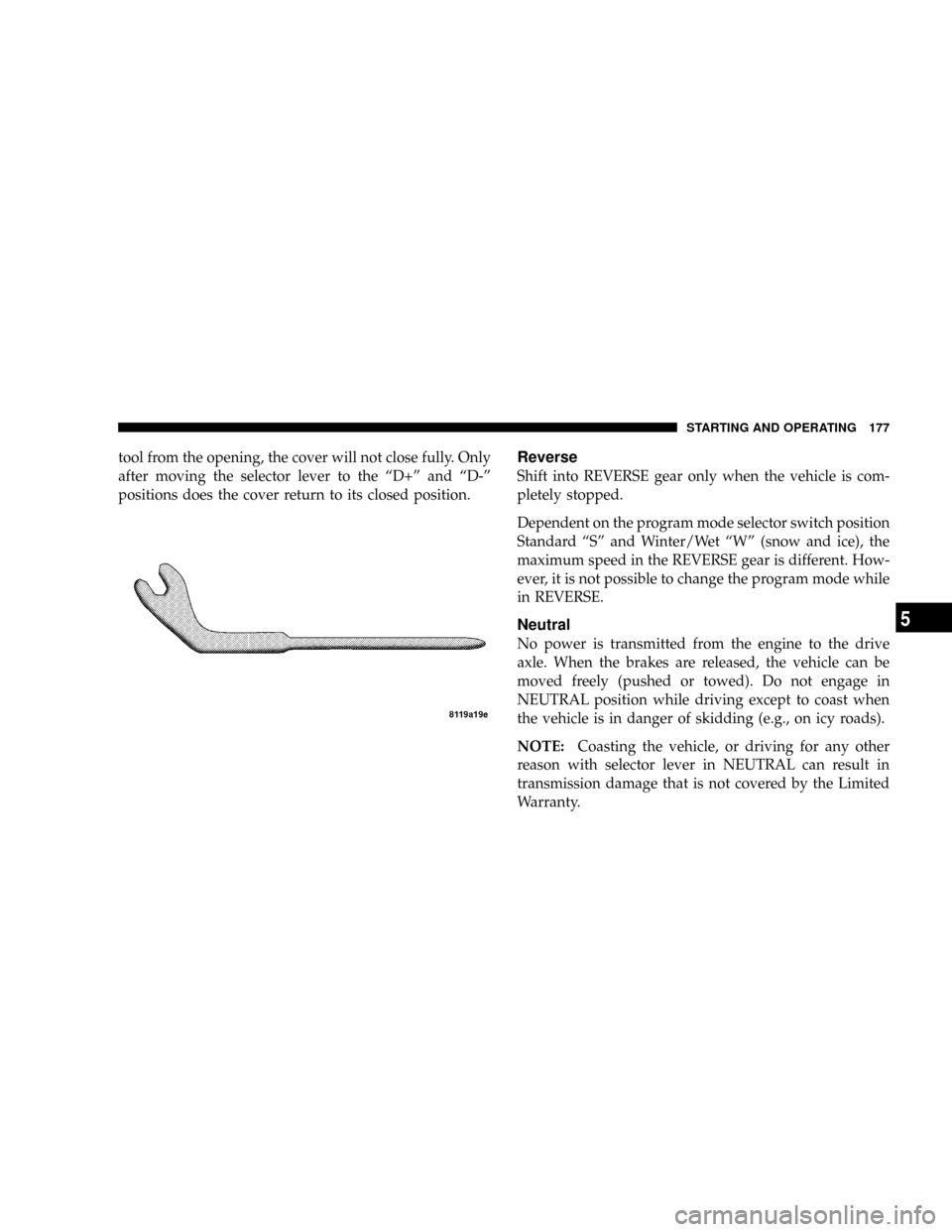
tool from the opening, the cover will not close fully. Only
after moving the selector lever to the ªD+º and ªD-º
positions does the cover return to its closed position.Reverse
Shift into REVERSE gear only when the vehicle is com-
pletely stopped.
Dependent on the program mode selector switch position
Standard ªSº and Winter/Wet ªWº (snow and ice), the
maximum speed in the REVERSE gear is different. How-
ever, it is not possible to change the program mode while
in REVERSE.
Neutral
No power is transmitted from the engine to the drive
axle. When the brakes are released, the vehicle can be
moved freely (pushed or towed). Do not engage in
NEUTRAL position while driving except to coast when
the vehicle is in danger of skidding (e.g., on icy roads).
NOTE:Coasting the vehicle, or driving for any other
reason with selector lever in NEUTRAL can result in
transmission damage that is not covered by the Limited
Warranty.
STARTING AND OPERATING 177
5