cooling CHRYSLER CROSSFIRE 2008 1.G User Guide
[x] Cancel search | Manufacturer: CHRYSLER, Model Year: 2008, Model line: CROSSFIRE, Model: CHRYSLER CROSSFIRE 2008 1.GPages: 358, PDF Size: 4.7 MB
Page 284 of 358
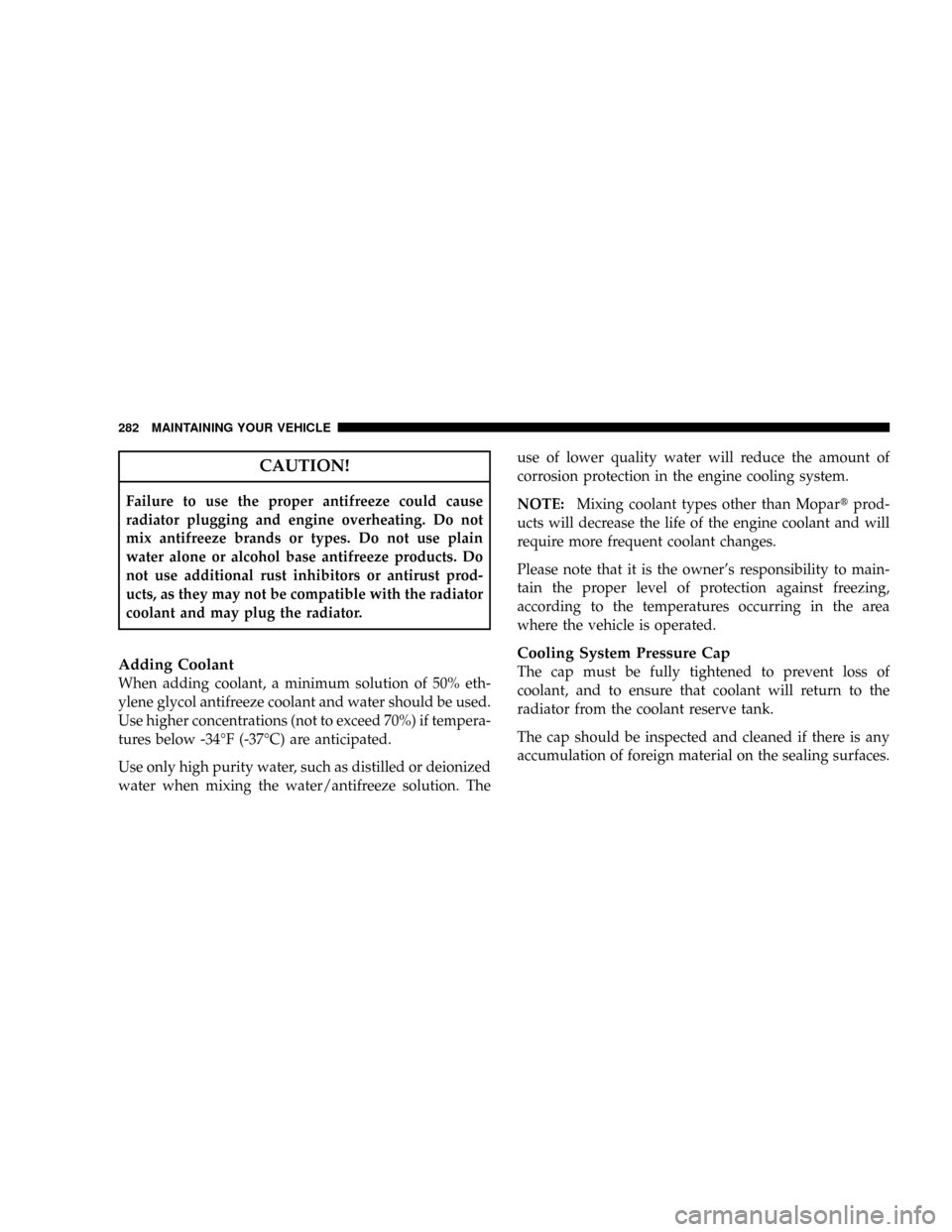
CAUTION!
Failure to use the proper antifreeze could cause
radiator plugging and engine overheating. Do not
mix antifreeze brands or types. Do not use plain
water alone or alcohol base antifreeze products. Do
not use additional rust inhibitors or antirust prod-
ucts, as they may not be compatible with the radiator
coolant and may plug the radiator.
Adding Coolant
When adding coolant, a minimum solution of 50% eth-
ylene glycol antifreeze coolant and water should be used.
Use higher concentrations (not to exceed 70%) if tempera-
tures below -34ÉF (-37ÉC) are anticipated.
Use only high purity water, such as distilled or deionized
water when mixing the water/antifreeze solution. Theuse of lower quality water will reduce the amount of
corrosion protection in the engine cooling system.
NOTE:Mixing coolant types other than Mopartprod-
ucts will decrease the life of the engine coolant and will
require more frequent coolant changes.
Please note that it is the owner's responsibility to main-
tain the proper level of protection against freezing,
according to the temperatures occurring in the area
where the vehicle is operated.
Cooling System Pressure Cap
The cap must be fully tightened to prevent loss of
coolant, and to ensure that coolant will return to the
radiator from the coolant reserve tank.
The cap should be inspected and cleaned if there is any
accumulation of foreign material on the sealing surfaces.
282 MAINTAINING YOUR VEHICLE
Page 285 of 358
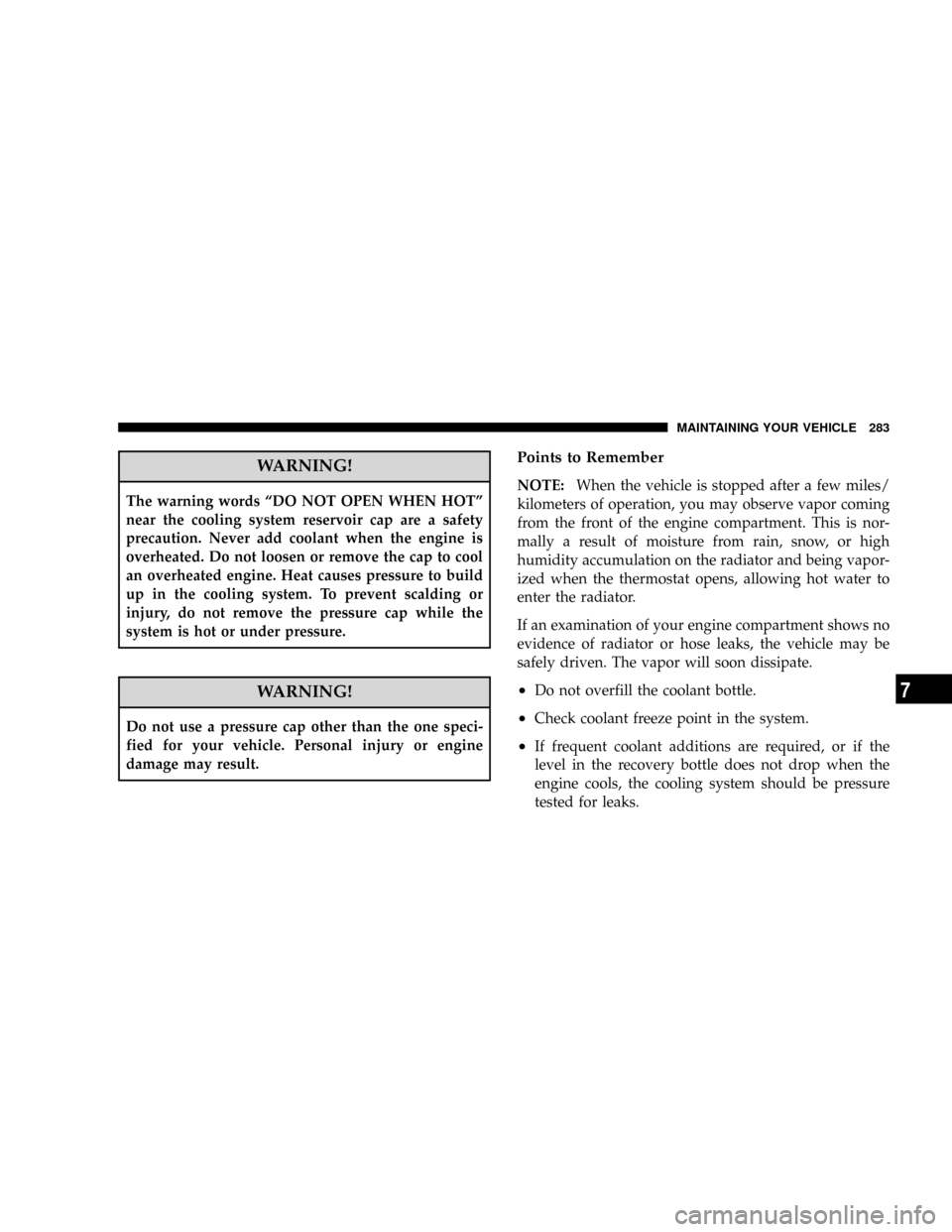
WARNING!
The warning words ªDO NOT OPEN WHEN HOTº
near the cooling system reservoir cap are a safety
precaution. Never add coolant when the engine is
overheated. Do not loosen or remove the cap to cool
an overheated engine. Heat causes pressure to build
up in the cooling system. To prevent scalding or
injury, do not remove the pressure cap while the
system is hot or under pressure.
WARNING!
Do not use a pressure cap other than the one speci-
fied for your vehicle. Personal injury or engine
damage may result.
Points to Remember
NOTE:When the vehicle is stopped after a few miles/
kilometers of operation, you may observe vapor coming
from the front of the engine compartment. This is nor-
mally a result of moisture from rain, snow, or high
humidity accumulation on the radiator and being vapor-
ized when the thermostat opens, allowing hot water to
enter the radiator.
If an examination of your engine compartment shows no
evidence of radiator or hose leaks, the vehicle may be
safely driven. The vapor will soon dissipate.
²Do not overfill the coolant bottle.
²Check coolant freeze point in the system.
²If frequent coolant additions are required, or if the
level in the recovery bottle does not drop when the
engine cools, the cooling system should be pressure
tested for leaks.
MAINTAINING YOUR VEHICLE 283
7
Page 286 of 358
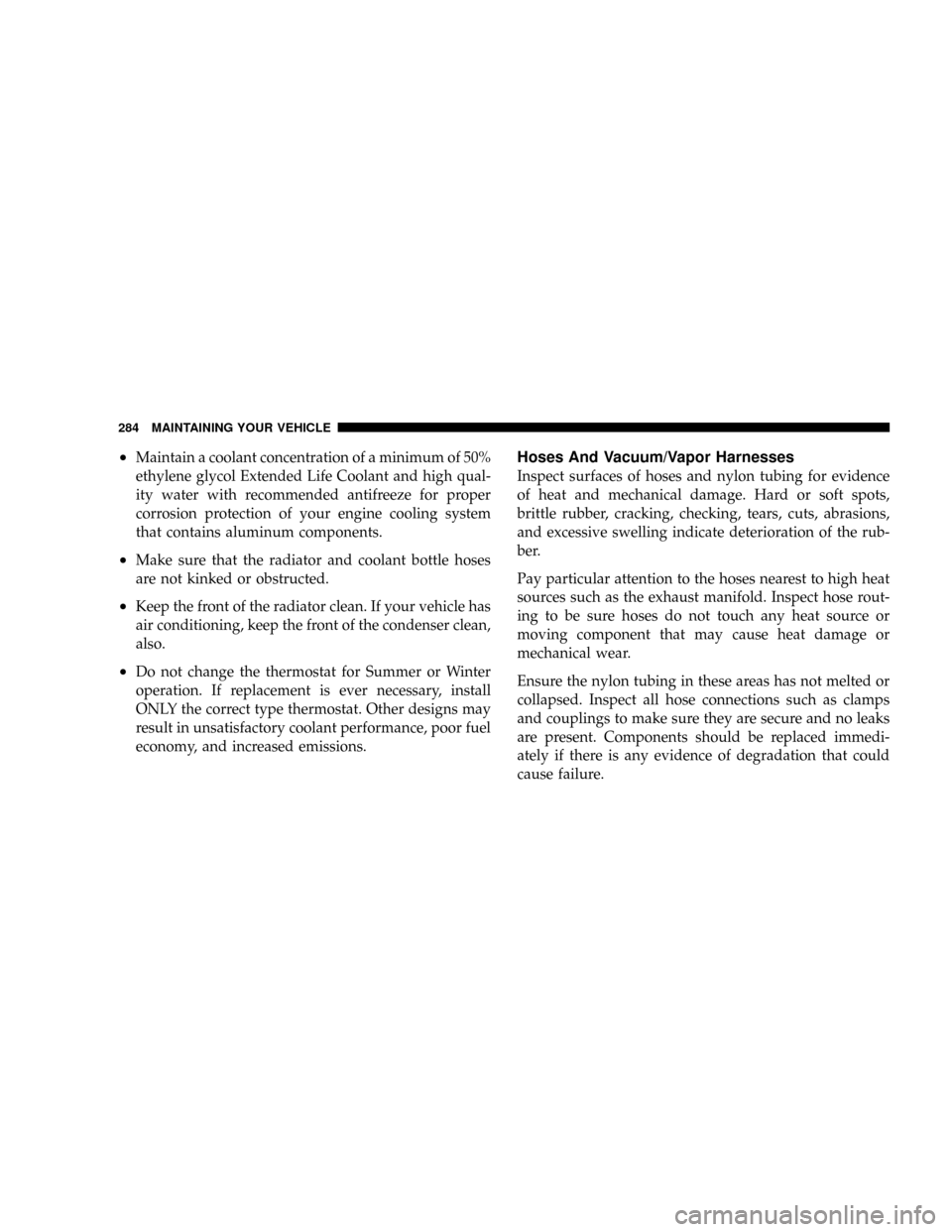
²Maintain a coolant concentration of a minimum of 50%
ethylene glycol Extended Life Coolant and high qual-
ity water with recommended antifreeze for proper
corrosion protection of your engine cooling system
that contains aluminum components.
²Make sure that the radiator and coolant bottle hoses
are not kinked or obstructed.
²Keep the front of the radiator clean. If your vehicle has
air conditioning, keep the front of the condenser clean,
also.
²Do not change the thermostat for Summer or Winter
operation. If replacement is ever necessary, install
ONLY the correct type thermostat. Other designs may
result in unsatisfactory coolant performance, poor fuel
economy, and increased emissions.
Hoses And Vacuum/Vapor Harnesses
Inspect surfaces of hoses and nylon tubing for evidence
of heat and mechanical damage. Hard or soft spots,
brittle rubber, cracking, checking, tears, cuts, abrasions,
and excessive swelling indicate deterioration of the rub-
ber.
Pay particular attention to the hoses nearest to high heat
sources such as the exhaust manifold. Inspect hose rout-
ing to be sure hoses do not touch any heat source or
moving component that may cause heat damage or
mechanical wear.
Ensure the nylon tubing in these areas has not melted or
collapsed. Inspect all hose connections such as clamps
and couplings to make sure they are secure and no leaks
are present. Components should be replaced immedi-
ately if there is any evidence of degradation that could
cause failure.
284 MAINTAINING YOUR VEHICLE
Page 317 of 358
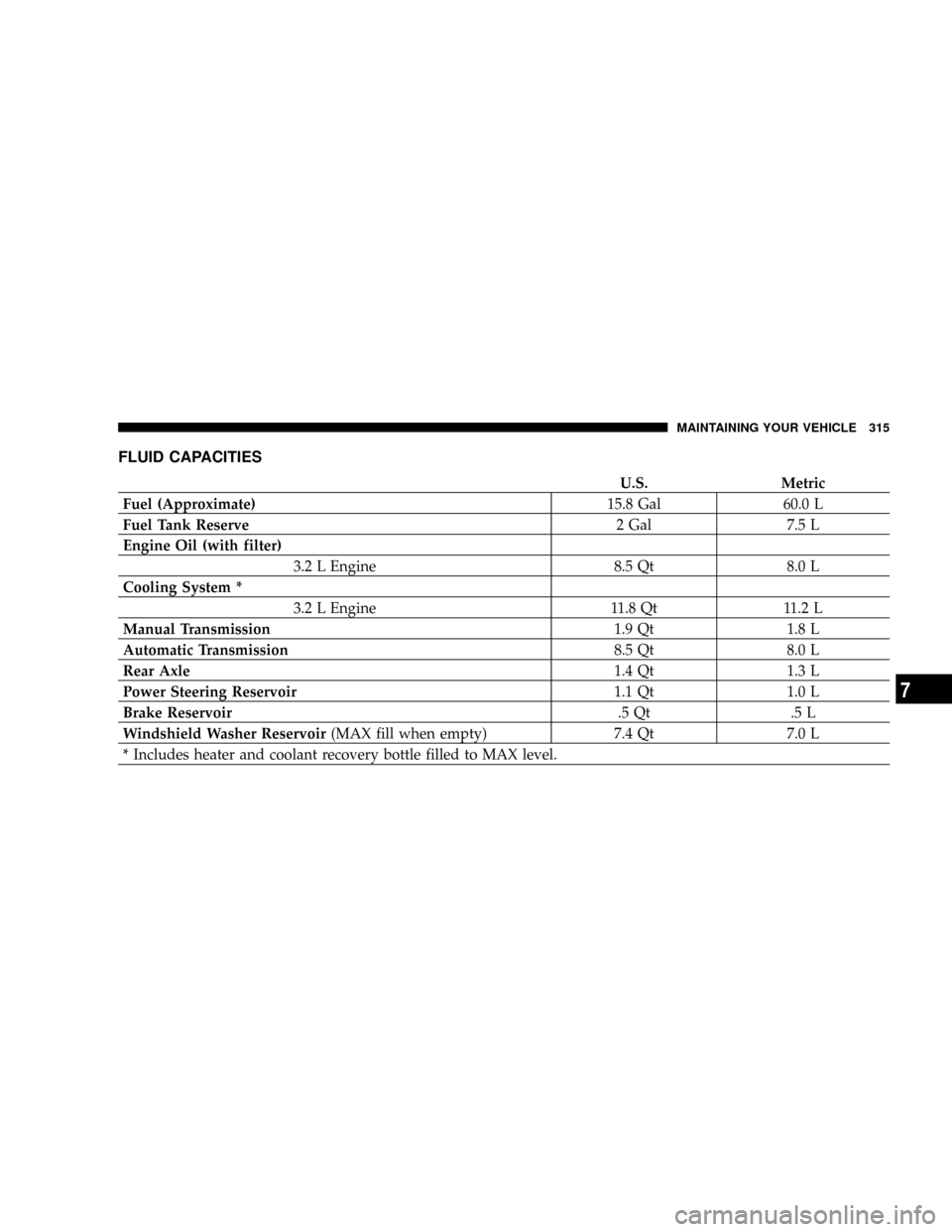
FLUID CAPACITIES
U.S. Metric
Fuel (Approximate)15.8 Gal 60.0 L
Fuel Tank Reserve2 Gal 7.5 L
Engine Oil (with filter)
3.2 L Engine 8.5 Qt 8.0 L
Cooling System *
3.2 L Engine 11.8 Qt 11.2 L
Manual Transmission1.9 Qt 1.8 L
Automatic Transmission8.5 Qt 8.0 L
Rear Axle1.4 Qt 1.3 L
Power Steering Reservoir1.1 Qt 1.0 L
Brake Reservoir.5 Qt .5 L
Windshield Washer Reservoir(MAX fill when empty) 7.4 Qt 7.0 L
* Includes heater and coolant recovery bottle filled to MAX level.
MAINTAINING YOUR VEHICLE 315
7
Page 325 of 358
²Check tires for damage and general condition
²Check tire inflation pressures and correct if necessary
Fluid Levels
Check fluid levels for the following systems and correct if
necessary. Should there be a loss of fluid that cannot be
explained by regular use, trace and eliminate the cause.
²Engine cooling system (check corrosion inhibitor/
antifreeze)
²Hydraulic brake system
²Power steering system
²Windshield washer system
SCOPE OF WORK FOR ªBº SCHEDULE
MAINTENANCE SERVICE
Oil Change
²Change oil and replace filter
Maintenance
²Rotate tires
²Replace dust filter (if equipped)
²Lubricate hood hinges, latch, and secondary latch
²Reset FSS Display
Function Check
²Horn, hazard warning flashers, turn signals, and indi-
cator lamps
²Headlamps and exterior lighting
²Windshield wipers and washer system
MAINTENANCE SCHEDULES 323
8
M
A
I
N
T
E
N
A
N
C
E
S
C
H
E
D
U
L
E
S
Page 326 of 358
²Check seat belts for damage and proper function
²Test hydraulic brakes and check parking brake func-
tion
Inspection
²Check front and rear brake pads for lining thickness
²Check condition of front and rear brake discs
²Check tires for damage and general condition
²Check tire inflation pressures and correct if necessary
²Check major underbody components for leakage or
damage (if there are signs of leakage, determine cause
and repair)
²Check condition of front axle ball joints and rubber
boots
²Check condition of steering components and rubber
boots
²Check underhood components for leakage or damage
(if there are signs of leakage determine cause and
repair)
²Check condition of accessory drive belt
²Check headlamp aiming, adjust if necessary
²Check windshield wiper blades, replace if necessary
Fluid Levels
Check fluid levels for the following systems and correct if
necessary. Should there be a loss of fluid that cannot be
explained by regular use, trace and eliminate the cause.
²Engine cooling system (check corrosion inhibitor/
antifreeze)
²Hydraulic brake system
²Power steering system
²Windshield washer system
324 MAINTENANCE SCHEDULES
8
M
A
I
N
T
E
N
A
N
C
E
S
C
H
E
D
U
L
E
S
Page 346 of 358
Cooling System......................... 280
Adding Coolant (Antifreeze).............. 282
Coolant Level......................... 280
Disposal of Used Coolant................ 281
Drain, Flush, and Refill.................. 281
Points to Remember.................282,283
Pressure Cap......................... 282
Rubber and Plastic Components............ 284
Selection of Coolant (Antifreeze)........... 281
Corrosion Protection..................... 290
Crankcase Emission Control System.......... 271
Cup Holder............................ 84
Customer Assistance..................... 333
Cylinders, Lock......................... 276
Dealer Service.......................... 263
Deck Lid.............................. 22
Defroster, Windshield...................... 62Disposal
Engine Oil........................... 268
Door Locks, Automatic.................... 15
Drive Belts............................ 268
Drive Shaft Universal Joints................ 275
Driving
On Slippery Surfaces.................... 182
Through Flowing, Rising, or Shallow Standing
Water.............................. 183
Electronic Speed Control (Cruise Control)....... 113
Electronic Stability Program (ESP)............ 110
Emergency, In Case of
Hazard Warning Flasher................. 232
Jump Starting......................... 241
Overheating.......................... 232
Towing............................. 245
Emergency Trunk Release................... 22
Emission Control System Maintenance......262,321
344 INDEX
Page 355 of 358

INTRODUCTION INTRODUCTION HOW TO USE THIS MANUAL WARNINGS AND CAUTIONS VEHICLE IDENTIFICATION NUMBER THINGS TO KNOW BEFORE STARTING YOUR VEHICLE A WORD ABOUT YOUR KEYS KeysObtaining Replacement KeysIgnition
Key RemovalKey-In-Ignition ReminderGLOVE COMPARTMENT LOCK DOOR LOCKS Central Locking SwitchAutomatic Central LockingGeneral Notes On the Central Locking SystemEmergency Unlocking FeatureStart LockoutREMOTE KEYLESS ENTRY To Unlock the
DoorsTo Lock The DoorsPanic AlarmTo Use the Panic AlarmGeneral InformationTransmitter Battery ServiceSECURITY ALARM SYSTEM Tow-Away AlarmDECKLID INTERNAL EMERGENCY RELEASE - ROADSTER POWER WINDOWS Power Window Operation With
The Convertible Top Switch (Roadster Only)REAR LIFTGATE/DECKLID RELEASE OCCUPANT RESTRAINTS Lap/Shoulder BeltsSeat Belts and Pregnant WomenSeat Belt ExtenderSupplemental Restraint System (SRS) - AirbagChild RestraintENGINE BREAK-IN
RECOMMENDATIONS SAFETY TIPS Exhaust GasSafety Checks You Should Make Inside the VehiclePeriodic Safety Checks You Should Make Outside the VehicleUNDERSTANDING THE FEATURES OF YOUR VEHICLE CONVERTIBLE TOP OPERATION To Lower
The TopTo Raise The TopConvertible Top Lamp and Audible Signal ChartCONSOLE FEATURES Storage Compartments (If Equipped)AshtrayCoin HolderPower Outlet/Cigar LighterGlove CompartmentCUPHOLDER (If Equipped) MIRRORS Inside Day/Night MirrorExterior
Mirrors Folding FeatureHeated Remote Control Mirrors (If Equipped)Outside MirrorsPower Remote Control Outside MirrorsVanity Mirrors SEATS Manual Seat Adjustments (If Equipped)Driver Eight-Way Power Seat (If Equipped)Passenger Four-Way Power Seat (If Equipped)
Heated Seats (If Equipped)TO OPEN AND CLOSE THE HOOD INTERIOR LIGHTS Front Map/Reading LightsBattery Saver FeatureInstrument Panel LightingNightSecurity IlluminationEXTERIOR LIGHTS Headlights and Parking LightsDaytime Running Lights (Where
Applicable)Fog Lights (If Equipped)Standing LightsMULTIFUNCTION CONTROL LEVER Turn SignalsHeadlight Dimmer SwitchPassing LightWindshield Wipers And WasherMist FunctionTELESCOPING STEERING COLUMN REAR SPOILER BRAKE ASSIST SYSTEM
(BAS) ELECTRONIC STABILITY PROGRAM (ESP) Synchronizing ESPELECTRONIC SPEED CONTROL To Vary The Speed SettingTo DeactivateTo Resume SpeedUsing Speed Control On HillsGARAGE DOOR OPENER (If Equipped) Programming The Universal
TransceiverGate Operator/Canadian ProgrammingUsing the Universal TransceiverErasing Universal Transceiver ButtonsReprogramming a Single ButtonSecurityUMBRELLA HOOK UNDERSTANDING YOUR INSTRUMENT PANEL INSTRUMENTS AND CONTROLS
NSTRUMENT CLUSTER INSTRUMENT CLUSTER DESCRIPTION INFINITY MODULUS AM/FM STEREO RADIO WITH SINGLE-DISC CD PLAYER AND GPS NAVIGATION AM/FM STEREO RADIO WITH SINGLE-DISC CD PLAYER INFINITY MODULUS Entertainment
SystemsCD Player OperationUser MenuUser Memory (USER - 1, 2, 3)Mono/StereoDriver - L/RTelephone mute characteristicsCOMPACT DISC MAINTENANCE RADIO ANTENNA RADIO OPERATION AND CELLULAR PHONES CLIMATE CONTROLS Temperature Control
Fan ControlBasic Setting - HeaterBasic Setting - Air ConditionerDust Filter (If Equipped)Operating Tips STARTING AND OPERATING STARTING PROCEDURES Normal StartingExtremely Cold Weather (below -20 degrees F or -29 degrees C)If Engine Fails to StartAfter
StartingTRANSMISSION SHIFTING Manual Transmission Recommended Shift SpeedsAutomatic Transmission StoppingManeuveringPark PositionReverseNeutralDriveAutoStick Gear selectionGear RangesProgram mode selector switchEmergency Operation (Limp Home
Mode)DRIVING ON SLIPPERY SURFACES Traction DRIVING THROUGH WATER Flowing/Rising WaterPARKING BRAKE BRAKE SYSTEM Brake Assist System (BAS)Electronic Stability Program (ESP)Synchronizing ESPESP Control switchAnti-Lock Brake System (ABS)
Brake Pad Break-InPOWER STEERING TIRE SAFETY INFORMATION TIRE MARKINGS TIRE LOADING AND TIRE PRESSURETIRES - GENERAL INFORMATION Tire PressureTire Inflation PressuresTire Pressures For High Speed OperationRadial-Ply TiresTire Spinning
Tread Wear IndicatorsLife Of TireReplacement TiresAlignment And BalanceTIRE PRESSURE MONITOR SYSTEM General InformationTIRE CHAINS ORIGINAL EQUIPMENT TIRES SNOW TIRES TIRE ROTATION RECOMMENDATIONS FUEL REQUIREMENTS
Reformulated GasolineGasoline/Oxygenate BlendsMMT in GasolineMaterials Added to FuelSulfur in GasolineADDING FUEL Fuel Filler Cap (Gas Cap)VEHICLE LOADING Roof Luggage RackTRAILER TOWING WHAT TO DO IN EMERGENCIES HAZARD WARNING
FLASHER IF YOUR ENGINE OVERHEATS TIREFIT TIRE REPAIR AND JACKING TIREFITPreparations for JackingJack Location and Instructions JUMP-STARTING THEBATTERY FREEING A STUCK VEHICLE TOWING A DISABLED VEHICLE Towing EyesTow-Away
AlarmCONVERTIBLE TOP EMERGENCY OPERATION Relieving Hydraulic PressureOpening a Locked DecklidMAINTAINING YOUR VEHICLE 3.2L ENGINE ONBOARD DIAGNOSTIC SYSTEM (OBD II) EMISSIONS INSPECTION AND MAINTENANCE PROGRAMS
REPLACEMENT PARTS AUTHORIZED DEALER SERVICE MAINTENANCE PROCEDURES Engine OilIgnition Wiring SystemCrankcase Emission Control SystemMaintenance-Free BatteryAir ConditionerPower Steering FluidChassis LubricationBody LubricationWindshield
Wiper BladesWindshield Wiper Blade ReplacementWindshield Washer ReservoirExhaust SystemCooling SystemHoses And Vacuum/Vapor HarnessesBrakesAutomatic TransmissionManual TransmissionAppearance Care and Protection from CorrosionCONVERTIBLE TOP
CARE WashingGeneral CleaningWeather Strip CareFUSES Underhood Accessory Fuse Block FusesRelay Control Module Fuses Interior Fuses REPLACEMENT BULBS Interior Light BulbsExterior Light BulbsEXTERIOR LIGHT BULB SERVICE HeadlightsFront Turn Signal
and Parking/Standing LightsFront and Rear Sidemarker LightsTail, Stop, Back Up and Turn Signal LightsLicense Plate LightHeadlight AimingVEHICLESTORAGE SPECIFICATIONS FLUID CAPACITIES RECOMMENDED FLUIDS, LUBRICANTS AND GENUINE PARTS
EngineChassisBodyMAINTENANCE SCHEDULES INTRODUCTION WARRANTY EMISSION CONTROL SYSTEM MAINTENANCE MAINTENANCE SCHEDULES SCOPE OF WORK FOR A SCHEDULE MAINTENANCE SERVICESCOPE OF WORK FOR B SCHEDULE
MAINTENANCE SERVICEFSS SYSTEM REGULAR CHECK-UPS Additional Periodic MaintenanceSPECIAL MAINTENANCE REQUIREMENTS CoolantDust Filter for Heating/Ventilation Replacement (If Equipped)ENGINE OIL CHANGE AND FILTER REPLACEMENT IF
YOU NEED CONSUMER ASSISTANCE SUGGESTIONS FOR OBTAINING SERVICE FOR YOUR VEHICLE Prepare For The AppointmentPrepare A ListBe Reasonable With RequestsIF YOU NEED ASSISTANCE Chrysler Motors LLC Customer CenterChrysler Canada
Inc. Customer CenterIn Mexico contactCustomer Assistance For The Hearing Or Speech Impaired (TDD/TTY)Service ContractWARRANTY INFORMATION (U.S. Vehicles Only) MOPAR PARTS REPORTING SAFETY DEFECTS In The 50 United States And Washington,
D.CIn CanadaPUBLICATION ORDER FORMS DEPARTMENT OF TRANSPORTATION UNIFORM TIRE QUALITY GRADES TreadwearTraction GradesTemperature GradesINDEX