flat tire CHRYSLER CROSSFIRE 2008 1.G User Guide
[x] Cancel search | Manufacturer: CHRYSLER, Model Year: 2008, Model line: CROSSFIRE, Model: CHRYSLER CROSSFIRE 2008 1.GPages: 358, PDF Size: 4.7 MB
Page 211 of 358
check tire pressure. Do not make a visual judgement
when determining proper inflation. Radial tires may look
properly inflated even when they are underinflated.
CAUTION!
After inspecting or adjusting the tire pressure, al-
ways reinstall the valve stem cap (if equipped). This
will prevent moisture and dirt from entering the
valve stem, which could damage it.
Inflation pressures specified on the placard are always
cold tire inflation pressure. Cold tire inflation pressure is
defined as the tire pressure after the vehicle has not been
driven for at least three hours, or driven less than 1 mi
(1.6 km) after a three-hour period. The cold tire inflation
pressure must not exceed the maximum inflation pres-
sure molded into the tire sidewall.Check tire pressures more often if subject to a wide range
of outdoor temperatures, as tire pressures vary with
temperature changes.
Tire pressures change by approximately 1 psi (7 kPa) per
12ÉF (7ÉC) of air temperature change. Keep this in mind
when checking tire pressure inside a garage, especially in
the winter.
Example: If garage temperature = 68ÉF (20ÉC) and the
outside temperature = 32ÉF (0ÉC) then the cold tire
inflation pressure should be increased by 3 psi (21 kPa),
which equals 1 psi (7 kPa) for every 12ÉF (7ÉC) for this
outside temperature condition.
Tire pressure may increase from 2 to 6 psi (13 to 40 kPa)
during operation. DO NOT reduce this normal pressure
build-up, or your tire pressure will be too low.
STARTING AND OPERATING 209
5
Page 212 of 358
Tire Pressures For High Speed Operation
The manufacturer advocates driving at safe speeds
within posted speed limits. Where speed limits or condi-
tions are such that the vehicle can be driven at high
speeds, maintaining correct tire inflation pressure is very
important. Increased tire pressure and reduced vehicle
loading may be required for high-speed vehicle opera-
tion. Refer to original equipment or an authorized tire
dealer for recommended safe operating speeds, loading
and cold tire inflation pressures.
WARNING!
High speed driving with your vehicle at or above
maximum load is dangerous. The added strain on
your tires could cause them to fail. You could have a
serious accident. Don't drive a vehicle loaded to the
maximum capacity at continuous speeds above 75
mph (120 km/h).
Radial-Ply Tires
WARNING!
Combining radial ply tires with other types of tires
on your vehicle will cause your vehicle to handle
poorly. The instability could cause an accident. Al-
ways use radial tires in sets of four. Never combine
them with other types of tires.
Cuts and punctures in radial tires are repairable only in
the tread area because of sidewall flexing. Consult your
authorized dealer for radial tire repairs.
210 STARTING AND OPERATING
Page 215 of 358
Replacement Tires
The tires on your new vehicle provide a balance of many
characteristics. They should be inspected regularly for
wear and correct cold tire inflation pressure. The manu-
facturer strongly recommends that you use tires equiva-
lent to the originals in size, quality and performance
when replacement is needed. (Refer to the paragraph on
ªTread Wear Indicatorsº). Refer to the ªTire and Loading
Informationº placard for the size designation of your
tires. The service description and load identification will
be found on the original equipment tire. Failure to use
equivalent replacement tires may adversely affect the
safety, handling, and ride of your vehicle. We recommend
that you contact your original equipment or an autho-
rized tire dealer with any questions you may have on tire
specifications or capability.WARNING!
²Do not use a tire, wheel size or rating other than that
specified for your vehicle. Some combinations of
unapproved tires and wheels may change suspension
dimensions and performance characteristics, result-
ing in changes to steering, handling, and braking of
your vehicle. This can cause unpredictable handling
and stress to steering and suspension components.
You could lose control and have an accident resulting
in serious injury or death. Use only the tire and wheel
sizes with load ratings approved for your vehicle.
²Never use a tire with a smaller load index or capacity
than what was originally equipped on your vehicle.
Using a tire with a smaller load index could result in
tire overloading and failure. You could lose control
and have an accident.
²Failure to equip your vehicle with tires having ad-
equate speed capability can result in sudden tire
failure and loss of vehicle control.
STARTING AND OPERATING 213
5
Page 216 of 358
CAUTION!
Replacing original tires with tires of a different size
may result in false speedometer and odometer
readings.
Alignment And Balance
Poor suspension alignment may result in:
²Fast tire wear
²Uneven tire wear, such as feathering and one-sided
wear
²Vehicle pull to the left or right
Tires may also cause the vehicle to pull left or right.
Alignment will not correct this problem. See your autho-
rized dealer for proper diagnosis.Improper alignment will not cause vehicle vibration.
Vibration may be a result of tire and wheel out-of-
balance. Proper balancing will reduce vibration and
avoid tire cupping and spotty wear.
TIRE PRESSURE MONITOR SYSTEM
Each tire should be checked monthly when cold and
inflated to the inflation pressure recommended by the
vehicle manufacturer on the vehicle placard or tire infla-
tion pressure label. (If your vehicle has tires of a different
size than the size indicated on the vehicle placard or tire
inflation pressure label, you should determine the proper
tire inflation pressure for those tires.)
As an added safety feature, your vehicle has been
equipped with a Tire Pressure Monitoring System
(TPMS) that illuminates a low tire pressure indicator light
when one or more of your tires is significantly under-
inflated. When the low tire pressure indicator light
illuminates, you should stop and check your tires as soon
214 STARTING AND OPERATING
Page 217 of 358
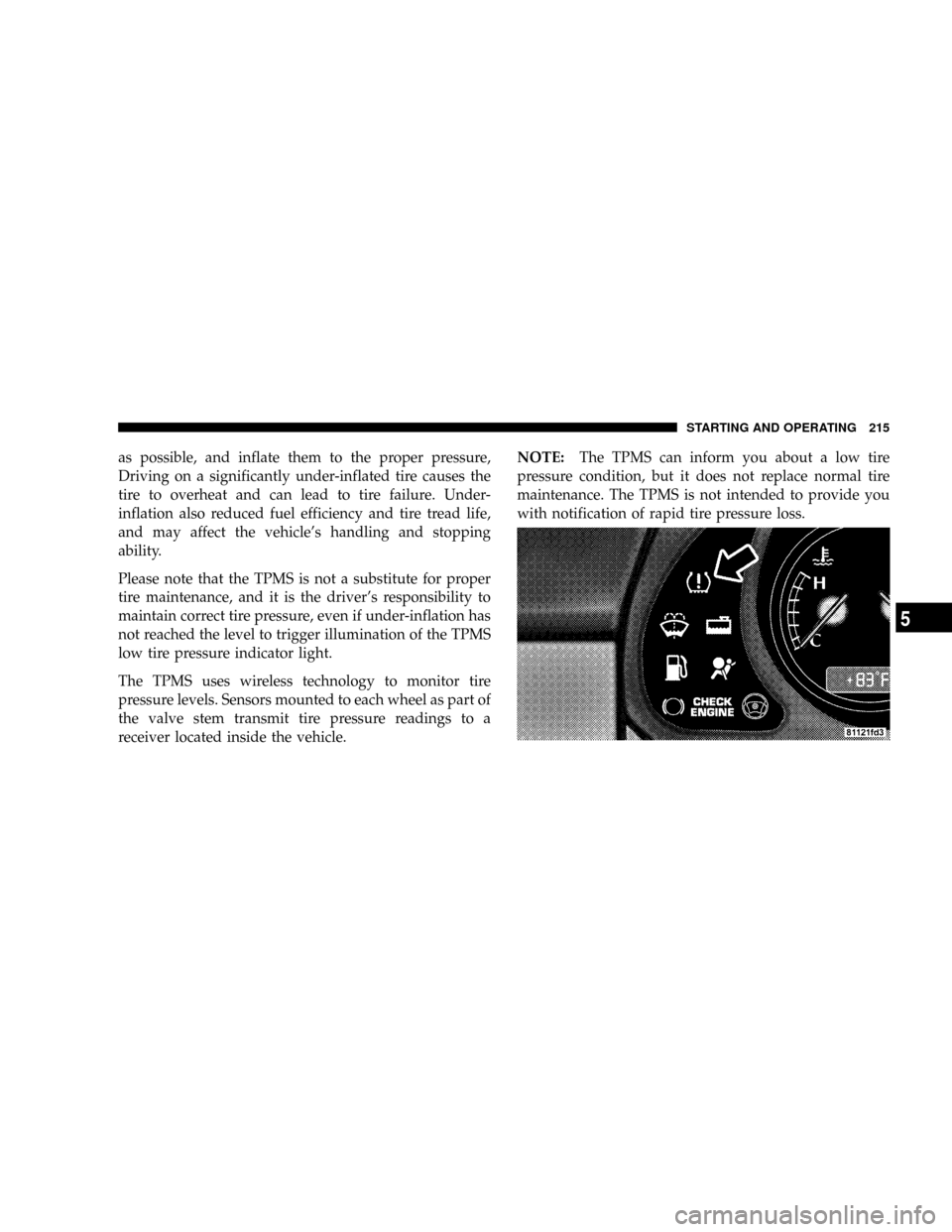
as possible, and inflate them to the proper pressure,
Driving on a significantly under-inflated tire causes the
tire to overheat and can lead to tire failure. Under-
inflation also reduced fuel efficiency and tire tread life,
and may affect the vehicle's handling and stopping
ability.
Please note that the TPMS is not a substitute for proper
tire maintenance, and it is the driver's responsibility to
maintain correct tire pressure, even if under-inflation has
not reached the level to trigger illumination of the TPMS
low tire pressure indicator light.
The TPMS uses wireless technology to monitor tire
pressure levels. Sensors mounted to each wheel as part of
the valve stem transmit tire pressure readings to a
receiver located inside the vehicle.NOTE:The TPMS can inform you about a low tire
pressure condition, but it does not replace normal tire
maintenance. The TPMS is not intended to provide you
with notification of rapid tire pressure loss.
STARTING AND OPERATING 215
5
Page 218 of 358
CAUTION!
The TPM system is designed to monitor your tire
pressure and will not function as a tire pressure
gauge. After adjusting the air pressure in a tire, there
will be a delay before the system updates the display.
The system will automatically update and the Tire
Pressure Monitoring Indicator Light will turn off,
once the system receives the updated tire pressures.
The vehicle needs to be driven above 20 mph in order
for the TPMS to receive this information.The TPMS will cause the indicator light in the instrument
cluster to illuminate whenever the pressure in one tire
falls 25% below the recommended pressure shown on the
vehicle's tire label.
The TPMS will cause the indicator light to flash for
approximately one minute and then remain continuously
illuminated whenever the system detects a TPMS mal-
function.
NOTE:The pressure in your tires changes with tem-
perature. A significant decrease in temperature could
reduce cold inflation pressure below the TPMS set-point.
For example, tires inflated to the proper cold inflation
pressure on a warm day or in a warm garage could
illuminate the TPMS indicator light on the following day
216 STARTING AND OPERATING
Page 220 of 358
If your tire pressure is low, you should correct your tire
inflation pressure as soon as possible and inspect all of
your tires. Low tire pressure will cause the tire pressure
light to illuminate. They will remain on for the rest of the
driving cycle, or until the tire pressure is corrected. If the
TPMS indicator light remains illuminated after the tire
pressure has been corrected, see your authorized dealer.
Your vehicle has also been equipped with a TPMS
malfunction indicator to indicate when the system is not
operating properly. The TPMS malfunction indicator is
combined with the low tire pressure indicator light.
When the system detects a malfunction, the indicator
light will flash for approximately one minute and then
remain continuously illuminated. This sequence will
continue upon subsequent vehicle start-ups as long as the
malfunction exists. When the malfunction indicator is
illuminated, the system may not be able to detect or
signal low tire pressure as intended. TPMS malfunctionsmay occur for a variety of reasons, including the instal-
lation of replacement or alternate tires or wheels on the
vehicle that prevent the TPMS from functioning properly.
Always check the TPMS malfunction indicator light after
replacing one or more tires or wheels on your vehicle to
ensure that the replacement or alternate tires and wheels
allow the TPMS to continue to function properly.
NOTE:Changes and modifications not expressly ap-
proved by the party responsible for compliance could
void the user's authority to operate the equipment.
General Information
This device complies with Part 15 of the FCC rules and
RSS 210 of Industry Canada. Operation is subject to the
following conditions:
²This device may not cause harmful interference.
218 STARTING AND OPERATING
Page 237 of 358
WARNING!
Cuts or punctures larger than approximately 0.16 in. (4 mm),
tire damage caused by driving with extremely low tire
pressure or on a flat tire, or a damaged wheel can pose a
hazard while driving. TIREFIT should not be used in such
circumstances. Do not drive the vehicle under such circum-
stances. Contact your nearest authorized dealer for assis-
tance.
Take care not to allow the contents of TIREFIT to come in
contact with hair, eyes or clothing. TIREFIT is harmful if
inhaled, swallowed or absorbed through the skin: It causes
skin, eye and respiratory irritation. Any contact with eyes
or skin should be flushed immediately with plenty of
water. If clothing comes in contact with TIREFIT, change
clothing as soon as possible.
In case of allergic reaction or rash, consult a physician
immediately. Keep TIREFIT out of reach of children. If
swallowed, rinse mouth immediately with plenty of water
and drink plenty of water. Do not induce vomiting! Consult
a physician immediately.
Keep away from open flame or heat source.
Sealing tire with TIREFIT
1. Set the parking brake and turn on the hazard warning
flashers.
2. Move the transmission selector lever to the PARK
position (manual transmission to FIRST or REVERSE
gear) and turn off the engine.
3. Remove the TIREFIT kit and electric air pump from
the area below the cargo compartment carpet.
4. Open flap (2) on the electric air pump.
5. Pull the power plug (4) and air hose (5) along with the
pressure gauge out of the air pump housing.
6. Screw the air hose (5) onto the hose connection on the
TIREFIT sealant bottle (1).
7. Holding the sealant bottle by the top, insert it down-
wards into the recess (3) on the air pump.
WHAT TO DO IN EMERGENCIES 235
6
Page 238 of 358
8. Unscrew the valve cap from the valve on the deflated
tire.
9. Screw the filler hose from the sealant bottle on the tire
valve.
10. Insert the power plug (4) into the power point on the
instrument panel.
11. Turn the ignition key to the ON/RUN position.
12. Press the switch on the air pump to 1. The air pump
should start to inflate the tire.
13. After five minutes, the tire should be inflated to at
least 26 psi (180 kPa) on the pressure gauge.
14. If the tire doesn't inflate to this level, press the air
pump switch to 0, disconnect the TIREFIT system from
the tire, and drive the vehicle back and forth approxi-
mately 30 feet (9 m) to distribute the sealant more evenly
within the tire.15. Attach the air pump hose directly to the tire, press the
switch to 1, and inflate the tire again.NOTE:If a tire
pressure of 26 psi (180 kPa) is not reached after five
minutes, the tire is too badly damaged. Do not attempt to
drive the vehicle further, and call for assistance.
16. If a tire pressure of 26 psi (180 kPa) is obtained, press
the air pump switch to 0, turn the ignition switch to the
OFF/LOCK position, and disconnect the TIREFIT sys-
tem.
17. Drive the vehicle for about 10 minutes to ensure
optimum distribution of the tire sealant within the tire.
18. Check the pressure in the tire. If the pressure is above
19 psi (130 kPa), inflate the tire to the pressure indicated
on the tire pressure label on the driver side latch pillar.
19. Have the tire inspected at the earliest opportunity at
an authorized dealer or tire service center.
236 WHAT TO DO IN EMERGENCIES
Page 240 of 358
Jacking the vehicle should only be necessary in the event
that a tire has been severely damaged, and must be
replaced. (See TIREFIT Tire Repair section for a descrip-
tion of cuts and punctures that may be repairable with
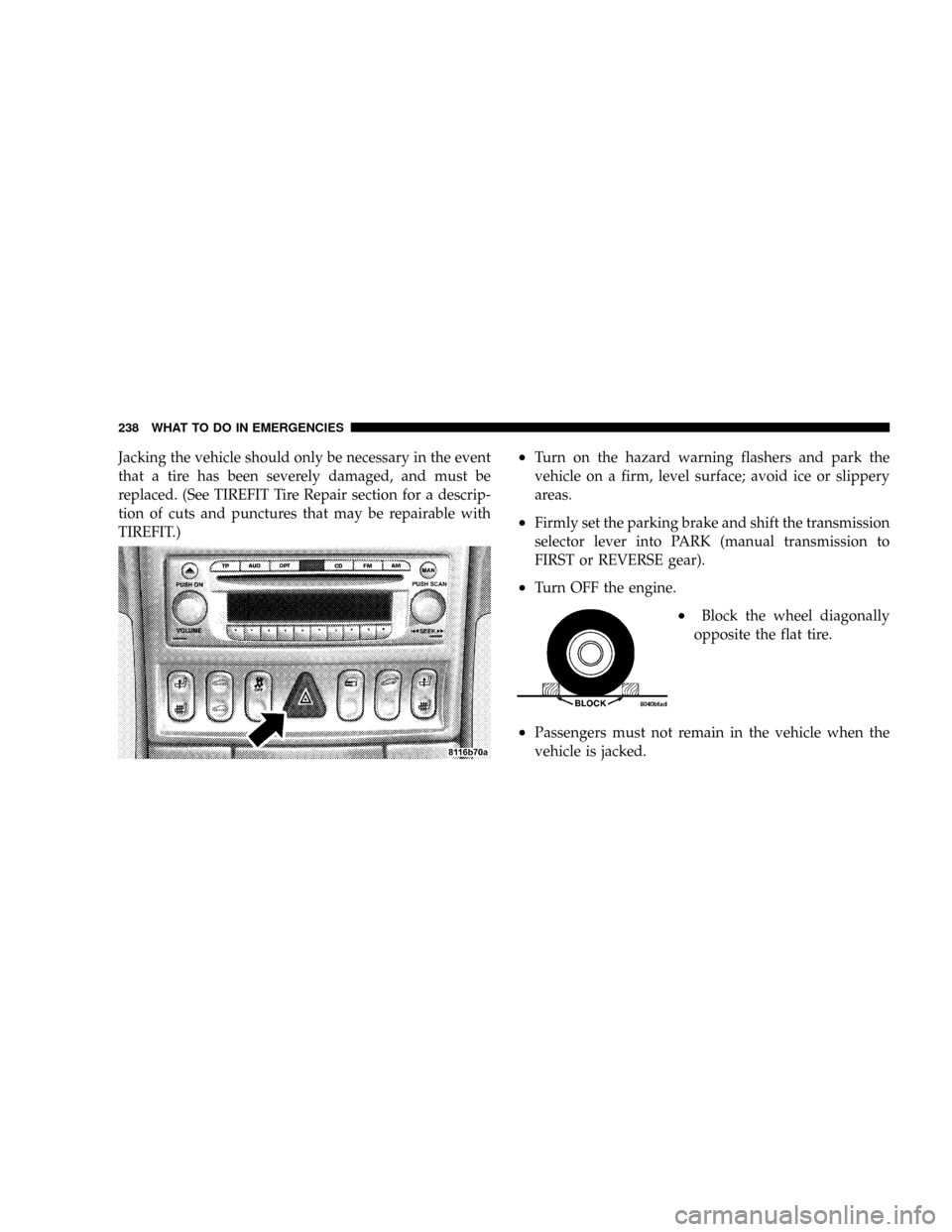
TIREFIT.)²Turn on the hazard warning flashers and park the
vehicle on a firm, level surface; avoid ice or slippery
areas.
²Firmly set the parking brake and shift the transmission
selector lever into PARK (manual transmission to
FIRST or REVERSE gear).
²Turn OFF the engine.
²Block the wheel diagonally
opposite the flat tire.
²Passengers must not remain in the vehicle when the
vehicle is jacked.
238 WHAT TO DO IN EMERGENCIES