maintenance CHRYSLER CROSSFIRE 2008 1.G User Guide
[x] Cancel search | Manufacturer: CHRYSLER, Model Year: 2008, Model line: CROSSFIRE, Model: CHRYSLER CROSSFIRE 2008 1.GPages: 358, PDF Size: 4.7 MB
Page 265 of 358
until you turn OFF the ignition key or start the engine.
This means that your vehicle's OBD II system isnot
readyand you shouldnotproceed to the I/M station.
b. The CHECK ENGINE light will not flash at all and
will remain fully illuminated until you turn off the
ignition key or start the engine. This means that your
vehicle's OBD II system isreadyand you can proceed
to the I/M station.
If your OBD II system isnot ready,you should see your
authorized dealer or repair facility. If your vehicle was
recently serviced or had a battery failure or replacement,
you may need to do nothing more than drive your
vehicle as you normally would in order for your OBD II
system to update. A recheck with the above test routine
may then indicate that the system is now ready.
Regardless of whether your vehicle's OBD II system is
ready or not ready, if the CHECK ENGINE light is
illuminated during normal vehicle operation, you shouldhave your vehicle serviced before going to the I/M
station. The I/M station can fail your vehicle because the
CHECK ENGINE light is on with the engine running.
REPLACEMENT PARTS
Use of genuine Mopartparts for normal/scheduled
maintenance and repairs is highly recommended to en-
sure the designed performance. Damage or failures
caused by the use of non-Mopartparts for maintenance
and repairs will not be covered by the warranty offered
by DaimlerChrysler Corporation.
AUTHORIZED DEALER SERVICE
Your authorized dealer has the qualified service person-
nel, special tools and equipment to perform all service
operations in an expert manner. Service Manuals are
available which include detailed service information for
your vehicle. Refer to these manuals before attempting
any procedure yourself.
MAINTAINING YOUR VEHICLE 263
7
Page 266 of 358
NOTE:Intentional tampering with emissions control
systems can result in civil penalties being assessed
against you.
WARNING!
You can be badly injured working on or around a
motor vehicle. Do only that service work for which
you have the knowledge and the proper equipment.
If you have any doubt about your ability to perform
a service job, take your vehicle to a competent
technician.
MAINTENANCE PROCEDURES
The pages that follow contain the maintenance service
recommended by the engineers who designed your ve-
hicle.
Besides the maintenance items for which there are fixed
maintenance intervals, there are other items that should
operate satisfactorily without periodic maintenance.
However, if a malfunction of these items does occur, it
could adversely affect the engine or vehicle performance.
These items should be inspected if a malfunction is
observed or suspected.
Engine Oil
Checking Oil Level
To assure proper engine lubrication, the engine oil must
be maintained at the correct level. Check the oil level at
regular intervals, such as every fuel stop.
264 MAINTAINING YOUR VEHICLE
Page 268 of 358
Change Engine Oil
The oil change interval for yourvehicle is initially set at
7,000 mi (Canada: 11 000 km).
The Flexible Service System (FSS) in your vehicle evalu-
ates engine temperature, oil level, vehicle speed, engine
speed, distance driven, and the time elapsed since your
last service. It determines when your vehicle needs
maintenance service and alerts you in advance. The next
necessary service is indicated by the FSS in your instru-
ment cluster.
NOTE:Also see the FSS system details in the Under-
standing Your Instrument Panel section of this manual.
Very light duty driving cycles (most trips more than 10
mi [16 km]) at moderate speeds in moderate temperature
conditions) can extend the service interval beyond 7,000
mi (Canada: 11 000 km).IfANYof the following apply to your driving, the oil
change interval can be reduced significantly:
²Day and night temperatures are below 32ÉF (0ÉC)
²Stop-and-go driving
²Extensive engine idling
²Driving in dusty conditions
²Short trips of less than 10 mi (16 km)
²More than 50% of your driving is at sustained high
speeds during hot weather, above 90ÉF (32ÉC)
²Taxi, Police, or delivery service (commercial service)
Observe the oil change interval indicated by your FSS
system. This system will monitor the driving conditions
seen by your vehicle, and will recommend the best
interval for servicing your vehicle to maintain it in top
condition.
266 MAINTAINING YOUR VEHICLE
Page 270 of 358
Disposing of Used Engine Oil
Care should be taken in disposing of used engine oil from
your vehicle. Used oil, indiscriminately discarded, can
present a problem to the environment. Contact your
dealer, service station, or governmental agency for advice
on how and where used oil can be safely discarded in
your area.
Engine Oil Filter
The engine oil filter should be replaced at every engine
oil change.
Engine Oil Filter Selection
All DaimlerChrysler Corporation engines have a full-
flow type disposable oil filter. Use a filter of this type for
replacement. The quality of replacement filters varies
considerably. Only high quality filters should be used to
assure most efficient service. MopartEngine Oil Filters
are high quality oil filters and are recommended.
Drive Belts - Check Condition and Tension
At the distance shown in the maintenance schedules,
check all drive belts for condition and proper tension.
Improper belt tension can cause belt slippage and failure.
Inspect the drive belts for evidence of cuts, cracks, or
glazing and replace them if there is any sign of damage
which could result in belt failure. If adjustment is re-
quired, adjust the belts according to the specifications
and procedures shown in the Service Manual.
Special tools are required to properly measure tension
and to restore belt tension to factory specifications. Also,
check belt routing to make sure there is no interference
between the belts and other engine components.
Spark Plugs
Spark plugs must fire properly to assure engine perfor-
mance and emission control. New spark plugs should be
installed at the distance specified in the appropriate
maintenance chart. The entire set should be replaced if
268 MAINTAINING YOUR VEHICLE
Page 271 of 358
there is any malfunction due to a faulty spark plug.
Check the specifications section for the proper type of
spark plug for use in your vehicle.
Engine Air Cleaner Filter
Under normal driving conditions, replace the air filter at
each interval called out by FSS.
WARNING!
The air cleaner can provide a measure of protection
in the case of engine backfire. Do not remove the air
cleaner unless such removal is necessary for repair or
maintenance. Make sure that no one is near the
engine compartment before starting the vehicle with
the air cleaner removed. Failure to do so can result in
serious personal injury.
Engine Fuel Filter
A plugged fuel filter can cause hard starting or limit the
speed at which a vehicle can be driven. Should an
excessive amount of dirt accumulate in the fuel tank,
frequent fuel filter replacement may be necessary. See
your authorized dealer for service.
Catalytic Converter
The catalytic converter requires the use of unleaded fuel
only. Leaded gasoline will destroy the effectiveness of the
catalyst as an emission control device.
Under normal operating conditions, the catalytic con-
verter will not require maintenance. However, it is im-
portant to keep the engine properly serviced to assure
proper catalyst operation and prevent possible catalyst
damage.
If the CHECK ENGINE light is flashing, immediate
service is required.
MAINTAINING YOUR VEHICLE 269
7
Page 273 of 358
To minimize the possibility of catalyst damage:
²Do not shut off the engine or interrupt the ignition
when the transmission is in gear and the vehicle is in
motion.
²Do not try to start the engine by pushing or towing the
vehicle.
²Do not idle the engine with any spark plug wires
disconnected for a prolonged period.
Ignition Wiring System
The ignition cables should be kept clean and properly
connected. Terminals should be fully seated. Cracked,
damaged, or faulty cables should be replaced.
Crankcase Emission Control System
Proper operation of this system depends on freedom
from sticking or plugging due to deposits.
Check the ventilation hose for indication of damage or
plugging deposits. Replace if necessary.
Maintenance-Free Battery
The top of the maintenance-free battery is permanently
sealed. You will never have to add water, nor is periodic
maintenance required.
MAINTAINING YOUR VEHICLE 271
7
Page 276 of 358
Power Steering Fluid
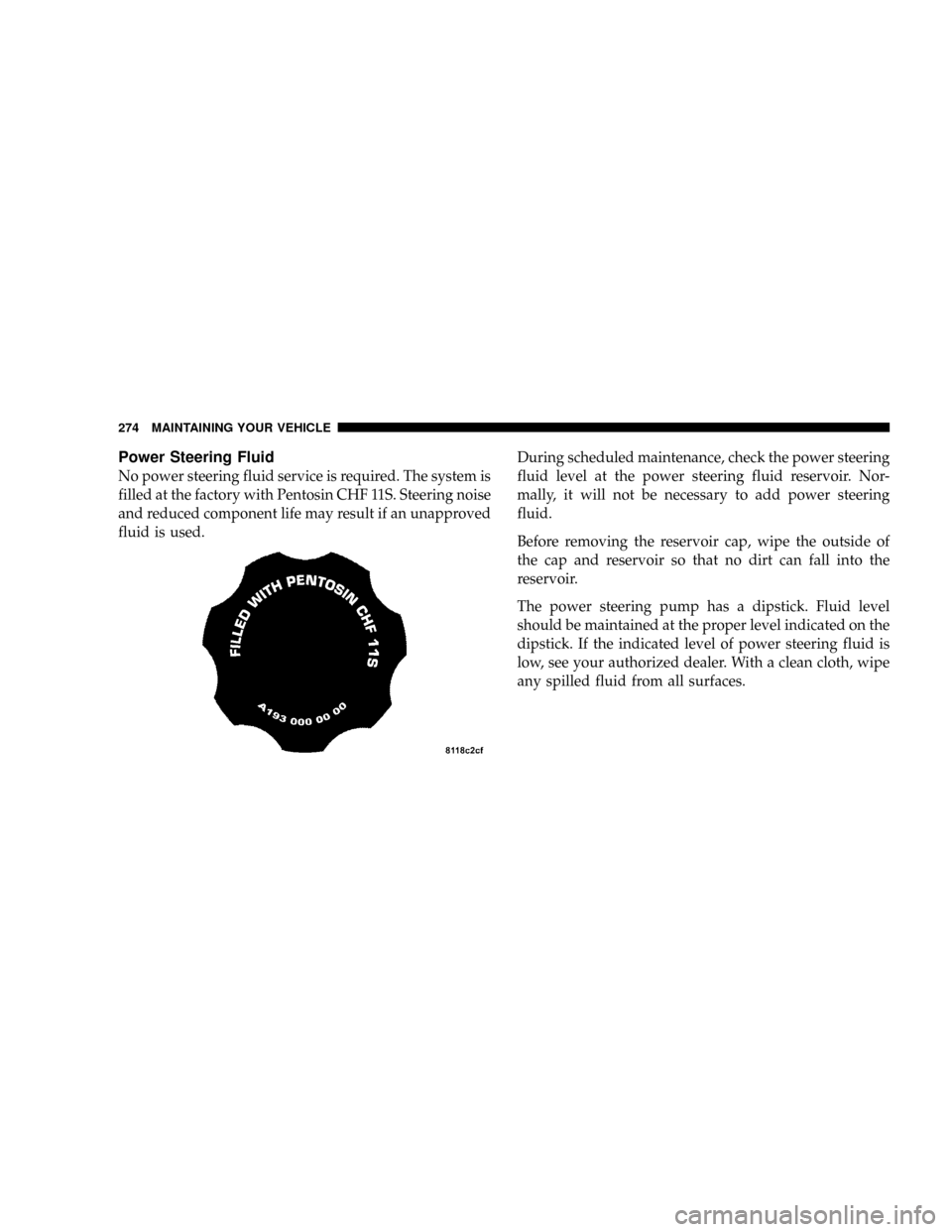
No power steering fluid service is required. The system is
filled at the factory with Pentosin CHF 11S. Steering noise
and reduced component life may result if an unapproved
fluid is used.During scheduled maintenance, check the power steering
fluid level at the power steering fluid reservoir. Nor-
mally, it will not be necessary to add power steering
fluid.
Before removing the reservoir cap, wipe the outside of
the cap and reservoir so that no dirt can fall into the
reservoir.
The power steering pump has a dipstick. Fluid level
should be maintained at the proper level indicated on the
dipstick. If the indicated level of power steering fluid is
low, see your authorized dealer. With a clean cloth, wipe
any spilled fluid from all surfaces.
274 MAINTAINING YOUR VEHICLE
Page 277 of 358
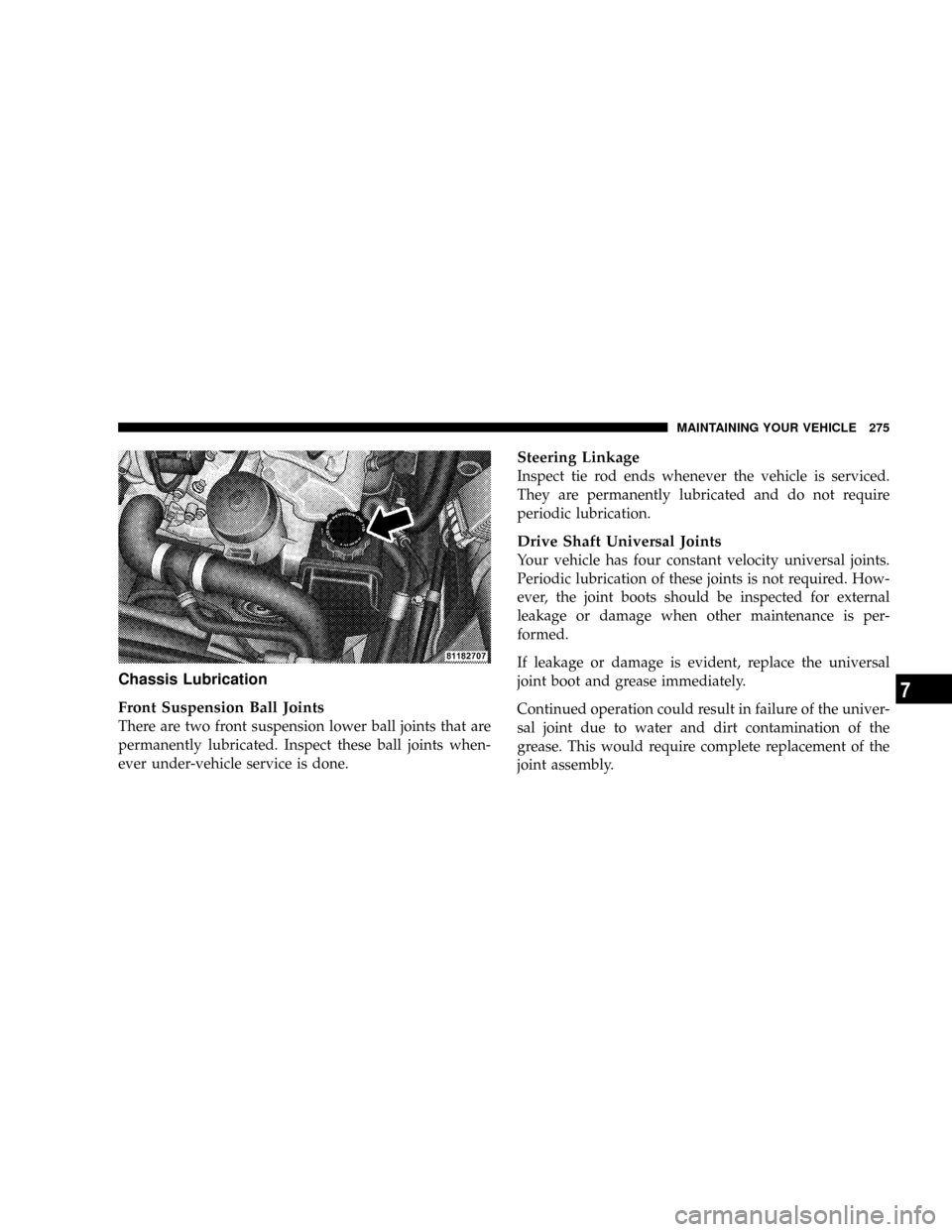
Chassis Lubrication
Front Suspension Ball Joints
There are two front suspension lower ball joints that are
permanently lubricated. Inspect these ball joints when-
ever under-vehicle service is done.
Steering Linkage
Inspect tie rod ends whenever the vehicle is serviced.
They are permanently lubricated and do not require
periodic lubrication.
Drive Shaft Universal Joints
Your vehicle has four constant velocity universal joints.
Periodic lubrication of these joints is not required. How-
ever, the joint boots should be inspected for external
leakage or damage when other maintenance is per-
formed.
If leakage or damage is evident, replace the universal
joint boot and grease immediately.
Continued operation could result in failure of the univer-
sal joint due to water and dirt contamination of the
grease. This would require complete replacement of the
joint assembly.
MAINTAINING YOUR VEHICLE 275
7
Page 283 of 358
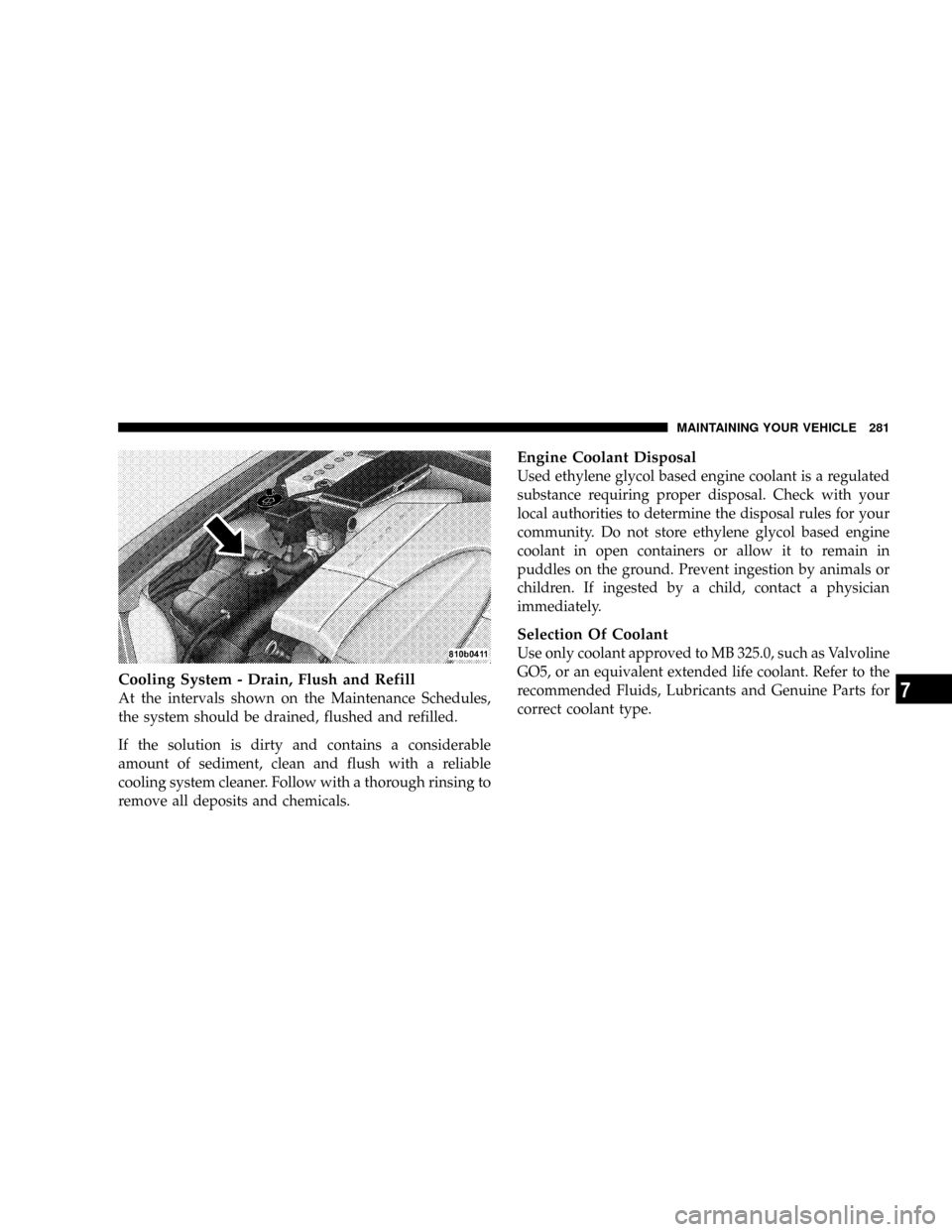
Cooling System - Drain, Flush and Refill
At the intervals shown on the Maintenance Schedules,
the system should be drained, flushed and refilled.
If the solution is dirty and contains a considerable
amount of sediment, clean and flush with a reliable
cooling system cleaner. Follow with a thorough rinsing to
remove all deposits and chemicals.
Engine Coolant Disposal
Used ethylene glycol based engine coolant is a regulated
substance requiring proper disposal. Check with your
local authorities to determine the disposal rules for your
community. Do not store ethylene glycol based engine
coolant in open containers or allow it to remain in
puddles on the ground. Prevent ingestion by animals or
children. If ingested by a child, contact a physician
immediately.
Selection Of Coolant
Use only coolant approved to MB 325.0, such as Valvoline
GO5, or an equivalent extended life coolant. Refer to the
recommended Fluids, Lubricants and Genuine Parts for
correct coolant type.
MAINTAINING YOUR VEHICLE 281
7
Page 287 of 358
Brakes
In order to assure brake system performance, all brake
system components should be inspected periodically.
Suggested service intervals can be found in the Mainte-
nance section.
WARNING!
Riding the brakes can lead to brake failure and
possibly an accident. Driving with your foot resting
or riding on the brake pedal can result in abnormally
high brake temperatures, excessive lining wear, and
possible brake damage. You wouldn't have your full
braking capacity in an emergency.
Brake and Power Steering System Hoses
When servicing the vehicle for scheduled maintenance,
inspect surface of hoses and nylon tubing for evidence of
heat and mechanical damage. Hard and brittle rubber,cracking, checking, tears, cuts, abrasions, and excessive
swelling suggest deterioration of the rubber. Particular
attention should be made to examining those hose sur-
faces nearest to high heat sources, such as the exhaust
manifold.
Inspect all hose clamps and couplings to make sure they
are secure and no leaks are present.
Ensure the nylon tubing in these areas has not melted or
collapsed.
NOTE:Often, fluids such as oil, power steering fluid,
and brake fluid are used during assembly plant opera-
tions to ease the assembly of hoses to couplings. There-
fore, oil wetness at the hose-coupling area is not neces-
sarily an indication of leakage. Actual dripping of hot
fluid when systems are under pressure (during vehicle
operation) should be noted before a hose is replaced
based on leakage.
MAINTAINING YOUR VEHICLE 285
7