steering CHRYSLER CROSSFIRE 2008 1.G User Guide
[x] Cancel search | Manufacturer: CHRYSLER, Model Year: 2008, Model line: CROSSFIRE, Model: CHRYSLER CROSSFIRE 2008 1.GPages: 358, PDF Size: 4.7 MB
Page 113 of 358
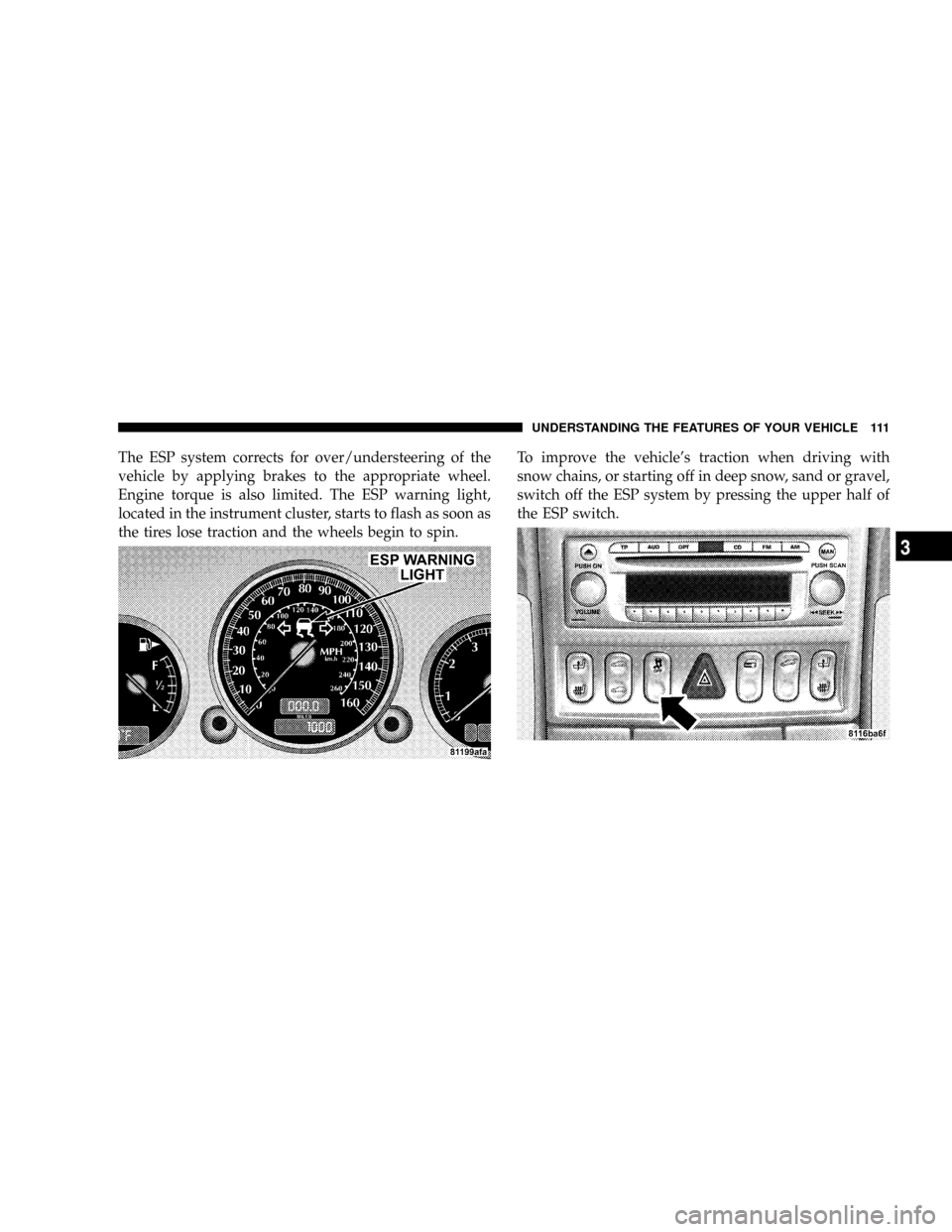
The ESP system corrects for over/understeering of the
vehicle by applying brakes to the appropriate wheel.
Engine torque is also limited. The ESP warning light,
located in the instrument cluster, starts to flash as soon as
the tires lose traction and the wheels begin to spin.To improve the vehicle's traction when driving with
snow chains, or starting off in deep snow, sand or gravel,
switch off the ESP system by pressing the upper half of
the ESP switch.
UNDERSTANDING THE FEATURES OF YOUR VEHICLE 111
3
Page 115 of 358
Synchronizing ESP
If the power supply was interrupted (battery discon-
nected or discharged), the BAS/ESP malfunction indica-
tor light may be illuminated with the engine running. To
re-synchronize the ESP, and cancel the malfunction indi-
cator light, the steering angle sensor will need to be
recalibrated.
1. Turn the ignition switch to the ON/RUN position.
2. Rotate the steering wheel to the center position.
3. Rotate the steering wheel completely to the left, and
then rotate the steering wheel completely to the right.
4. Bring the steering wheel back to the center position.
5. The BAS/ESP malfunction indicator light will go out.
If the BAS/ESP malfunction indicator light is still illumi-
nated, the vehicle should be serviced at an authorized
dealer.
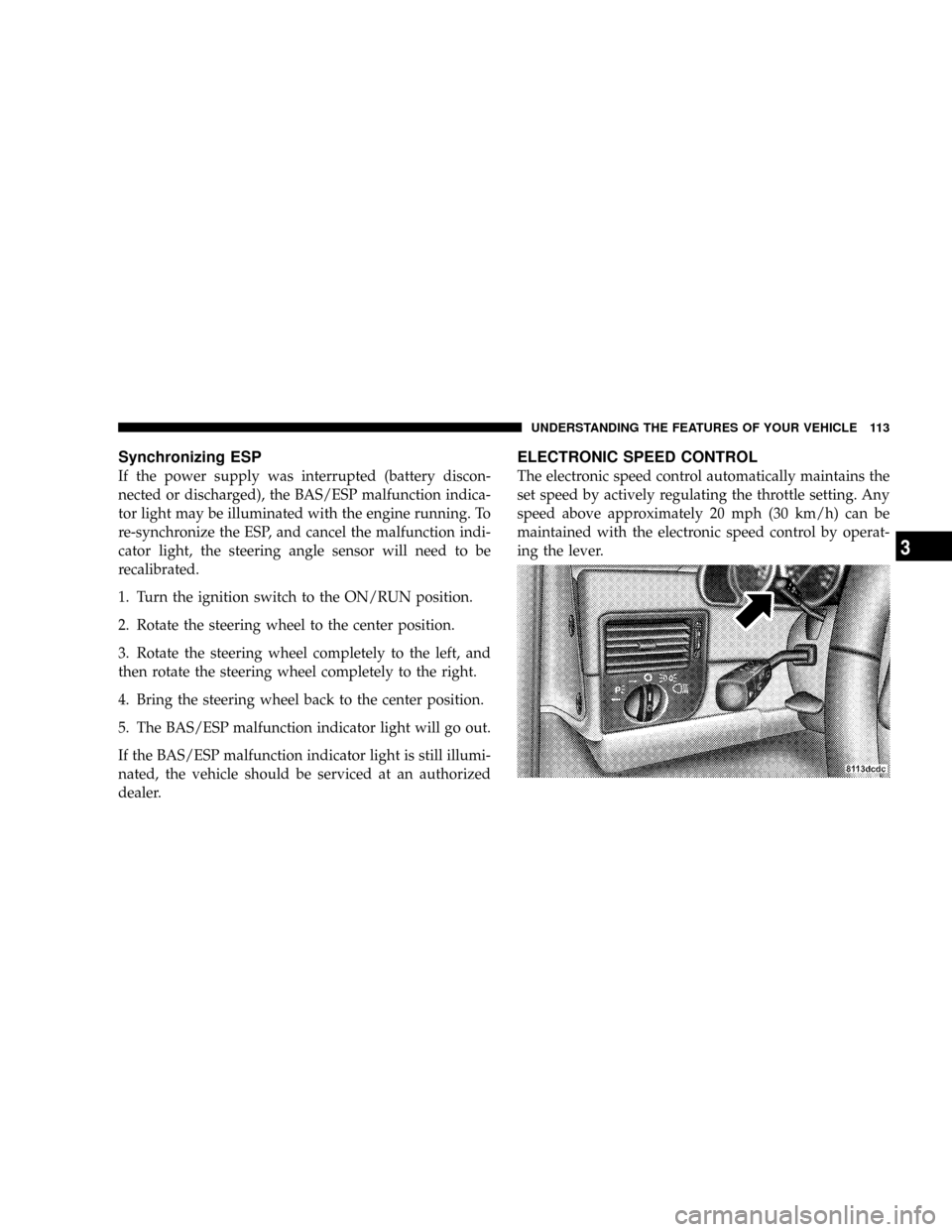
ELECTRONIC SPEED CONTROL
The electronic speed control automatically maintains the
set speed by actively regulating the throttle setting. Any
speed above approximately 20 mph (30 km/h) can be
maintained with the electronic speed control by operat-
ing the lever.
UNDERSTANDING THE FEATURES OF YOUR VEHICLE 113
3
Page 134 of 358
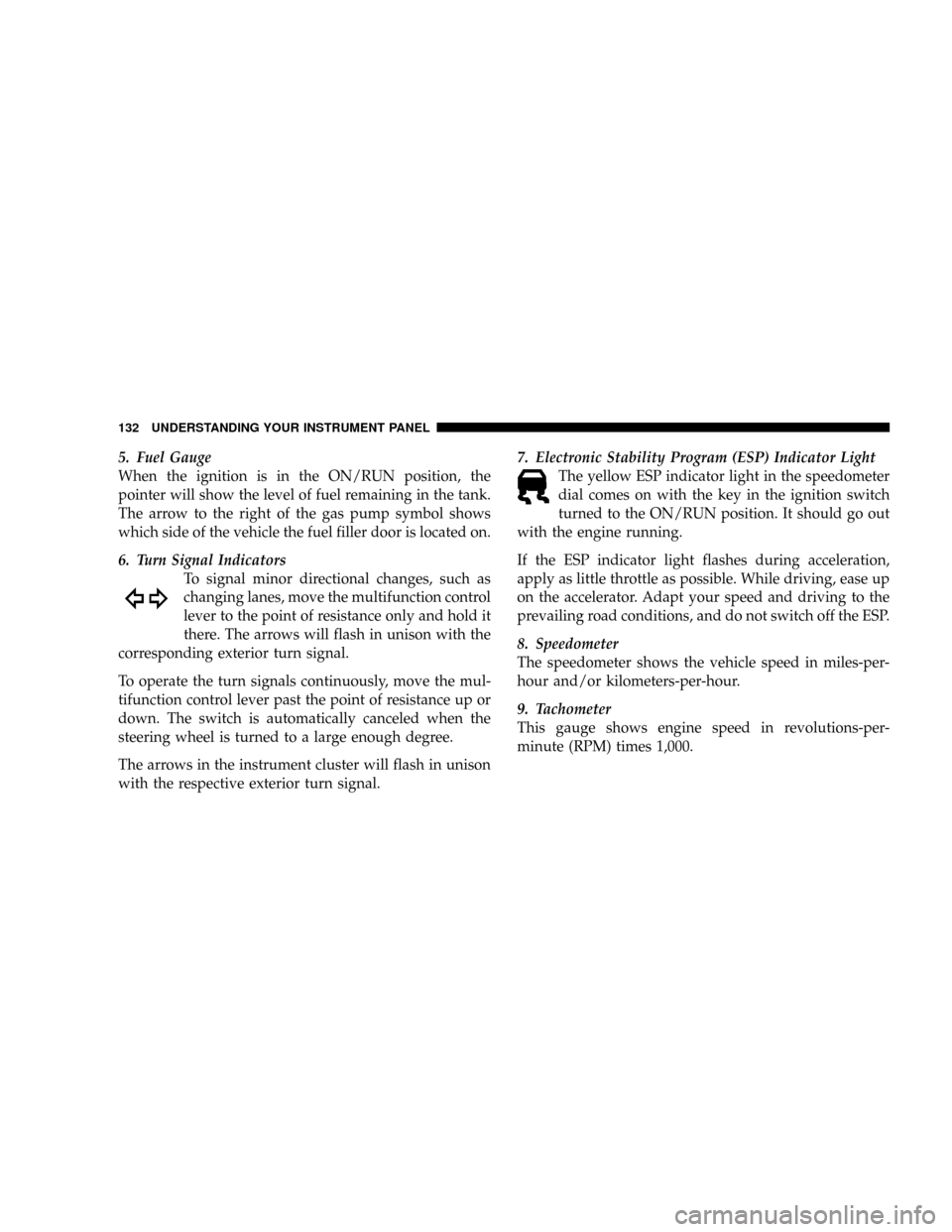
5. Fuel Gauge
When the ignition is in the ON/RUN position, the
pointer will show the level of fuel remaining in the tank.
The arrow to the right of the gas pump symbol shows
which side of the vehicle the fuel filler door is located on.
6. Turn Signal Indicators
To signal minor directional changes, such as
changing lanes, move the multifunction control
lever to the point of resistance only and hold it
there. The arrows will flash in unison with the
corresponding exterior turn signal.
To operate the turn signals continuously, move the mul-
tifunction control lever past the point of resistance up or
down. The switch is automatically canceled when the
steering wheel is turned to a large enough degree.
The arrows in the instrument cluster will flash in unison
with the respective exterior turn signal.7. Electronic Stability Program (ESP) Indicator Light
The yellow ESP indicator light in the speedometer
dial comes on with the key in the ignition switch
turned to the ON/RUN position. It should go out
with the engine running.
If the ESP indicator light flashes during acceleration,
apply as little throttle as possible. While driving, ease up
on the accelerator. Adapt your speed and driving to the
prevailing road conditions, and do not switch off the ESP.
8. Speedometer
The speedometer shows the vehicle speed in miles-per-
hour and/or kilometers-per-hour.
9. Tachometer
This gauge shows engine speed in revolutions-per-
minute (RPM) times 1,000.
132 UNDERSTANDING YOUR INSTRUMENT PANEL
Page 137 of 358
BAS/ESP warning indicator light also comes on when a
malfunction is detected in either the Brake Assist System
or the Electronic Stability Program. It should go out with
the engine running. If the BAS/ESP indicator light comes
on continuously, see an authorized dealer as soon as
possible.
14. Seat Belt Indicator Light
With the key in the ignition, the light comes on,
and a warning sounds for a short time if the
driver's seat belt is not fastened.
After starting the engine, the seat belt indicator light
blinks and a chime sounds periodically for up to 90
seconds to remind the driver and passenger to fasten the
seat belts. Fastening the seat belts will extinguish the
light and silence the chime.The seat belt indicator light will remain lit until the seat
belts are fastened.
15. Charging System Indicator Light
Should the charging system indicator light fail
to come on prior to starting when the key is in
the ignition switch in the ON/RUN position,
or should it fail to go out after starting or
during operation, it indicates a malfunction that must be
repaired immediately at an authorized dealer.
If the charging system indicator light comes on, or a loss
of power steering assistance is noticeable while the
engine is running, this may indicate that the accessory
drive belt has broken. Should this condition occur, the
belt must be replaced before continuing to operate the
vehicle.
UNDERSTANDING YOUR INSTRUMENT PANEL 135
4
Page 143 of 358
WARNING!
In the event a malfunction of the airbag is indicated,
the airbag may not be operational. For your safety, we
strongly recommend that you visit an authorized
dealer immediately to have the system checked;
otherwise the airbag may not be activated when
needed in an accident, which could result in serious
or fatal injury, or it might deploy unexpectedly and
unnecessarily which could also result in injury.
25. Telescoping Wheel Indicator Light
With the key in the ignition and turned to the
ON/RUN position, the indicator light in the
instrument cluster comes on. It should go out
when the engine is running. If the indicator
light does not go out after starting the engine, the
telescoping steering column is not locked properly.
WARNING!
Do not drive the vehicle until you have properly
locked the steering column.
26. Check Engine Light
This light is part of an Onboard Diagnostic
system that monitors the emissions and engine
control systems. If a problem is detected in one of these
systems, the Check Engine light will come on. The light
comes on and stays on briefly as a bulb check when the
ignition is first turned ON.
Certain conditions, such as a loose or missing gas cap, or
poor fuel quality may illuminate the light after the engine
is started. Be sure the gas cap is tightened every time you
refuel.
UNDERSTANDING YOUR INSTRUMENT PANEL 141
4
Page 168 of 358
NProgram Mode Selector Switch............180
NEmergency Operation (Limp Home Mode) . . . 181
mDriving On Slippery Surfaces..............182
NTraction............................182
mDriving Through Water..................183
NFlowing/Rising Water..................183
mParking Brake.........................185
mBrake System..........................186
NBrake Assist System (BAS)...............187
NElectronic Stability Program (ESP).........189
NSynchronizing ESP....................191
NESP Control Switch....................191
NAnti-Lock Brake System (ABS)............192NBrake Pad Break-In....................196
mPower Steering........................196
mTire Safety Information...................198
NTire Markings........................198
NTire Loading And Tire Pressure...........203
mTires Ð General Information...............207
NTire Pressure.........................207
NTire Inflation Pressures.................208
NTire Pressures For High Speed Operation....210
NRadial-Ply Tires......................210
NTire Spinning........................211
NTread Wear Indicators..................211
NLife Of Tire.........................212
166 STARTING AND OPERATING
Page 193 of 358
Synchronizing ESP
If the power supply was interrupted (battery discon-
nected or discharged), the BAS/ESP malfunction indica-
tor light may be illuminated with the engine running. To
re-synchronize the ESP, and cancel the malfunction indi-
cator light, the steering angle sensor will need to be
recalibrated.
1. Turn the ignition switch to the ON/RUN position.
2. Rotate the steering wheel to the center position.
3. Rotate the steering wheel completely to the left, and
then rotate the steering wheel completely to the right.
4. Bring the steering wheel back to the center position.
5. The BAS/ESP malfunction indicator light will go out.
If the BAS/ESP malfunction indicator light is still illumi-
nated, the vehicle should be serviced at an authorized
dealer.
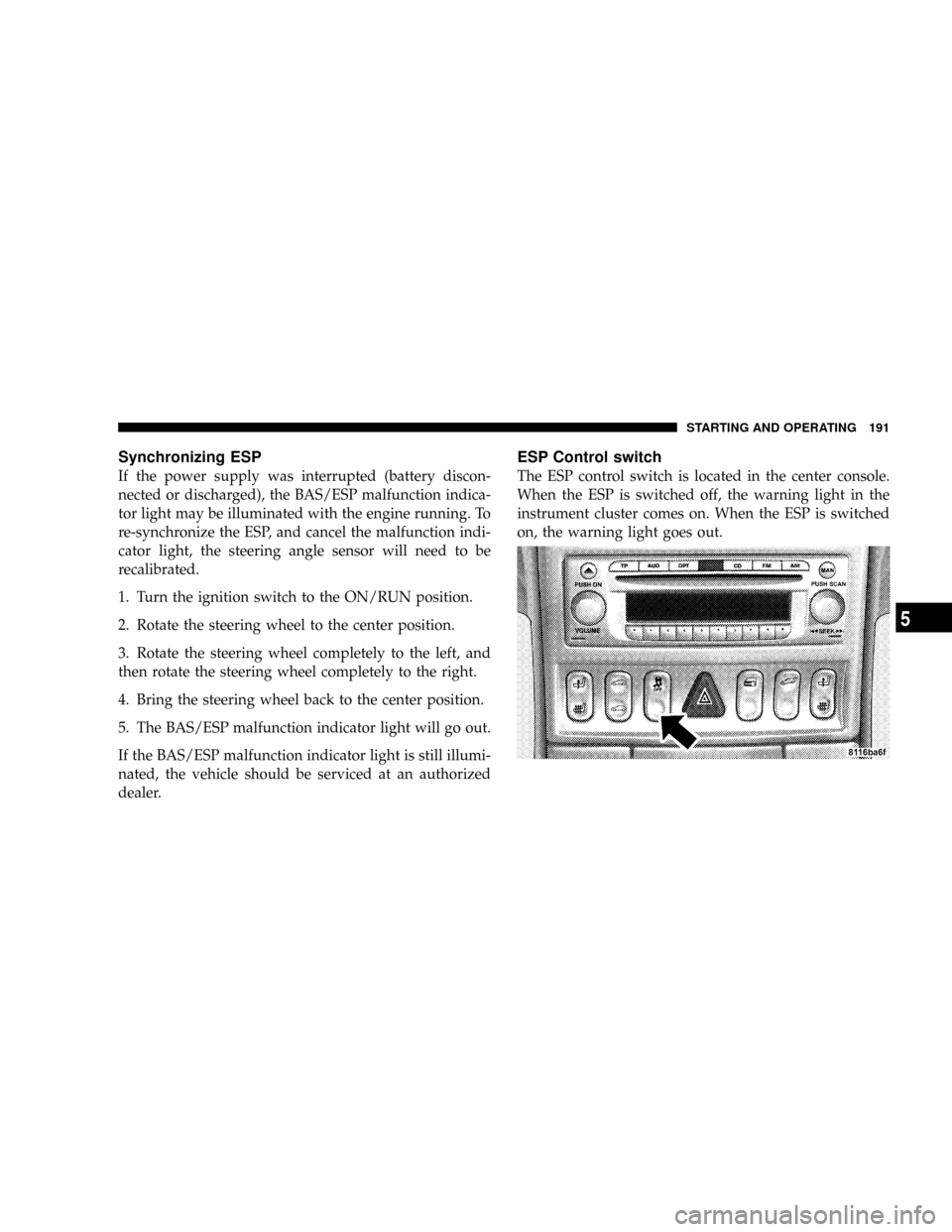
ESP Control switch
The ESP control switch is located in the center console.
When the ESP is switched off, the warning light in the
instrument cluster comes on. When the ESP is switched
on, the warning light goes out.
STARTING AND OPERATING 191
5
Page 194 of 358
To improve the vehicle's traction when driving with
snow chains, or starting off in deep snow, sand, or gravel,
switch off the ESP by pressing the upper half of the ESP
switch. The ESP warning light will then be continuously
illuminated. With the ESP system switched off, the en-
gine torque reduction feature is cancelled. Therefore, the
enhanced vehicle stability offered by ESP is unavailable.
CAUTION!
Snow chains should never be used without the
recommended mud and snow (M+S) rated radial-ply
tires. Damage to your vehicle may result from such
usage.
ESP always operates under braking, even with the switch
in the OFF position.If one drive wheel loses traction and begins to spin, the
ESP system will apply the brake at the affected wheel
until the wheel regains sufficient traction. The traction
control engages at approximately 24 mph (40 km/h), and
switches off at 50 mph (80 km/h).
To return to the enhanced vehicle stability offered by ESP,
press the lower half of the switch (the ESP warning light
goes out).Anti-Lock Brake System (ABS)
The ABS gives increased vehicle stability and brake
performance under most braking conditions. The system
automatically ªpumpsº the brakes during severe braking
conditions to prevent wheel lock-up. The system operates
to prevent wheel lock-up and help avoid skidding on
slippery surfaces.
NOTE:The ABS improves steering control of the vehicle
during hard braking maneuvers.
192 STARTING AND OPERATING
Page 197 of 358
When the ABS malfunction indicator light in the instru-
ment cluster comes on while the engine is running, it
indicates that the ABS has detected a malfunction and has
switched off. In this case, the brake system functions in
the usual manner, but without antilock assistance. With
the ABS malfunctioning, the BAS and ESP are also
switched off. Both malfunction indicator lights come on
with the engine running. If the charging voltage falls
below 10 volts, the malfunction indicator light comes on
and the ABS is switched off. When the voltage is above
this value again, the malfunction indicator light should
go out and the ABS is operational. If the malfunction
indicator light stays illuminated, have the system
checked at your authorized dealer as soon as possible.WARNING!
ABS cannot prevent the natural laws of physics from
acting on the vehicle, nor can it increase braking or
steering efficiency beyond that afforded by the con-
dition of the vehicle brakes and tires or the traction
afforded. The ABS cannot prevent accidents, includ-
ing those resulting from excessive speed in turns,
following another vehicle too closely, or hydroplan-
ing. Only a safe, attentive, and skillful driver can
prevent accidents. The capabilities of an ABS-
equipped vehicle must never be exploited in a reck-
less or dangerous manner which could jeopardize the
user's safety or the safety of others.
STARTING AND OPERATING 195
5
Page 198 of 358
WARNING!
To use your brakes and accelerator more safely, follow these
tips:
²Do not ªrideº the brakes by resting your foot on the pedal.
This could overheat the brakes and result in unpredictable
braking action, longer stopping distances, or brake dam-
age.
²When descending mountains or hills, repeated braking
can cause brake fade with loss of braking control. Avoid
repeated heavy braking by downshifting the transmission
whenever possible.
²Do not drive too fast for road conditions, especially when
roads are wet or slushy. A wedge of water can build up
between the tire tread and the road. This hydroplaning
action can cause loss of traction, braking ability, and
control.
²After going through deep water or a car wash, brakes may
become wet, resulting in decreased performance and un-
predictable braking action. Dry the brakes by gentle,
intermittent pedal action while driving at very slow
speeds.
Brake Pad Break-In
The brakes on your vehicle do not require a long break-in
period, but avoid repeated hard brake applications from
high speeds during initial break-in. Also avoid severe
brake loading such as may be encountered when de-
scending long mountain grades.
POWER STEERING
The standard power steering system will give you good
vehicle response and increased ease of maneuverability
in tight spaces. The system will provide mechanical
steering capability if power assist is lost.
If for some reason, the power assist is interrupted, it will
still be possible to steer your vehicle. Under these condi-
tions you will observe a substantial increase in steering
effort, especially at very low vehicle speeds and during
parking maneuvers.
196 STARTING AND OPERATING