tow CHRYSLER CROSSFIRE 2008 1.G User Guide
[x] Cancel search | Manufacturer: CHRYSLER, Model Year: 2008, Model line: CROSSFIRE, Model: CHRYSLER CROSSFIRE 2008 1.GPages: 358, PDF Size: 4.7 MB
Page 103 of 358
Passing Light
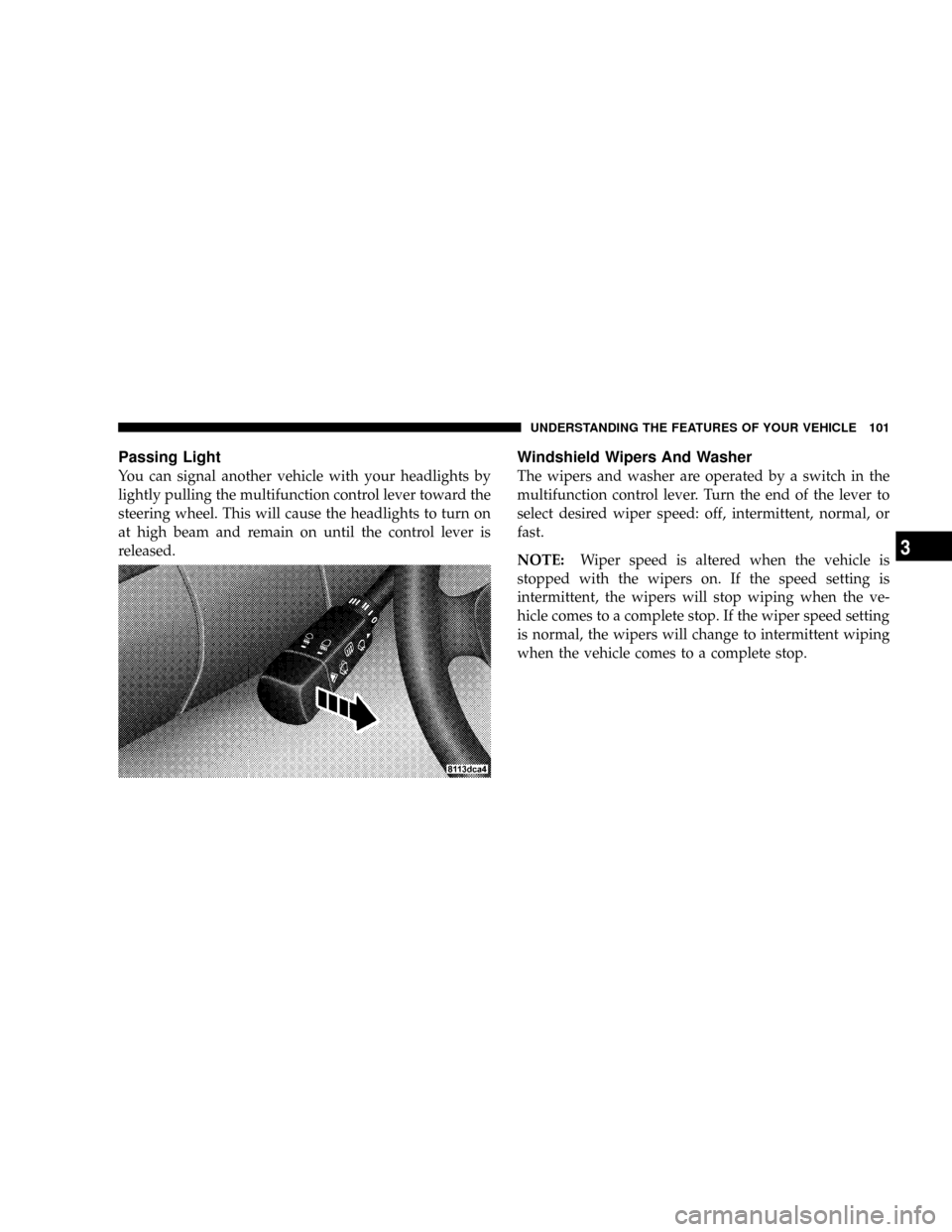
You can signal another vehicle with your headlights by
lightly pulling the multifunction control lever toward the
steering wheel. This will cause the headlights to turn on
at high beam and remain on until the control lever is
released.
Windshield Wipers And Washer
The wipers and washer are operated by a switch in the
multifunction control lever. Turn the end of the lever to
select desired wiper speed: off, intermittent, normal, or
fast.
NOTE:Wiper speed is altered when the vehicle is
stopped with the wipers on. If the speed setting is
intermittent, the wipers will stop wiping when the ve-
hicle comes to a complete stop. If the wiper speed setting
is normal, the wipers will change to intermittent wiping
when the vehicle comes to a complete stop.
UNDERSTANDING THE FEATURES OF YOUR VEHICLE 101
3
Page 114 of 358
With the ESP system switched off, the engine torque
reduction feature is cancelled. Therefore, the enhanced
vehicle stability offered by ESP is unavailable. ESP al-
ways operates under braking, even with the switch in the
OFF position. If one drive wheel loses traction and begins
to spin, the brake is applied by the ESP system until the
wheel regains sufficient traction. The traction control
engages at approximately 24 mph (40 km/h), and
switches off at 50 mph (80 km/h).
If the ESP warning light begins to flash during accelera-
tion, ease up on the accelerator and apply as little throttle
as possible. Be sure to adapt your speed and driving to
the prevailing road conditions. When the ESP warning
light is illuminated continuously, the ESP is switched off.
To return to the enhanced vehicle stability offered by ESP,press the lower half of the switch (the ESP warning light
in the speedometer dial goes out). Avoid spinning one
drive wheel. This may cause serious damage to the drive
train and is not covered by the DaimlerChrysler war-
ranty.
CAUTION!
If the vehicle is towed with the front axle raised, the
engine must be shut off (key in the ignition switch to
the OFF/LOCK or ACC position). Otherwise the ESP
will immediately be engaged and will apply the rear
wheel brakes.
112 UNDERSTANDING THE FEATURES OF YOUR VEHICLE
Page 118 of 358
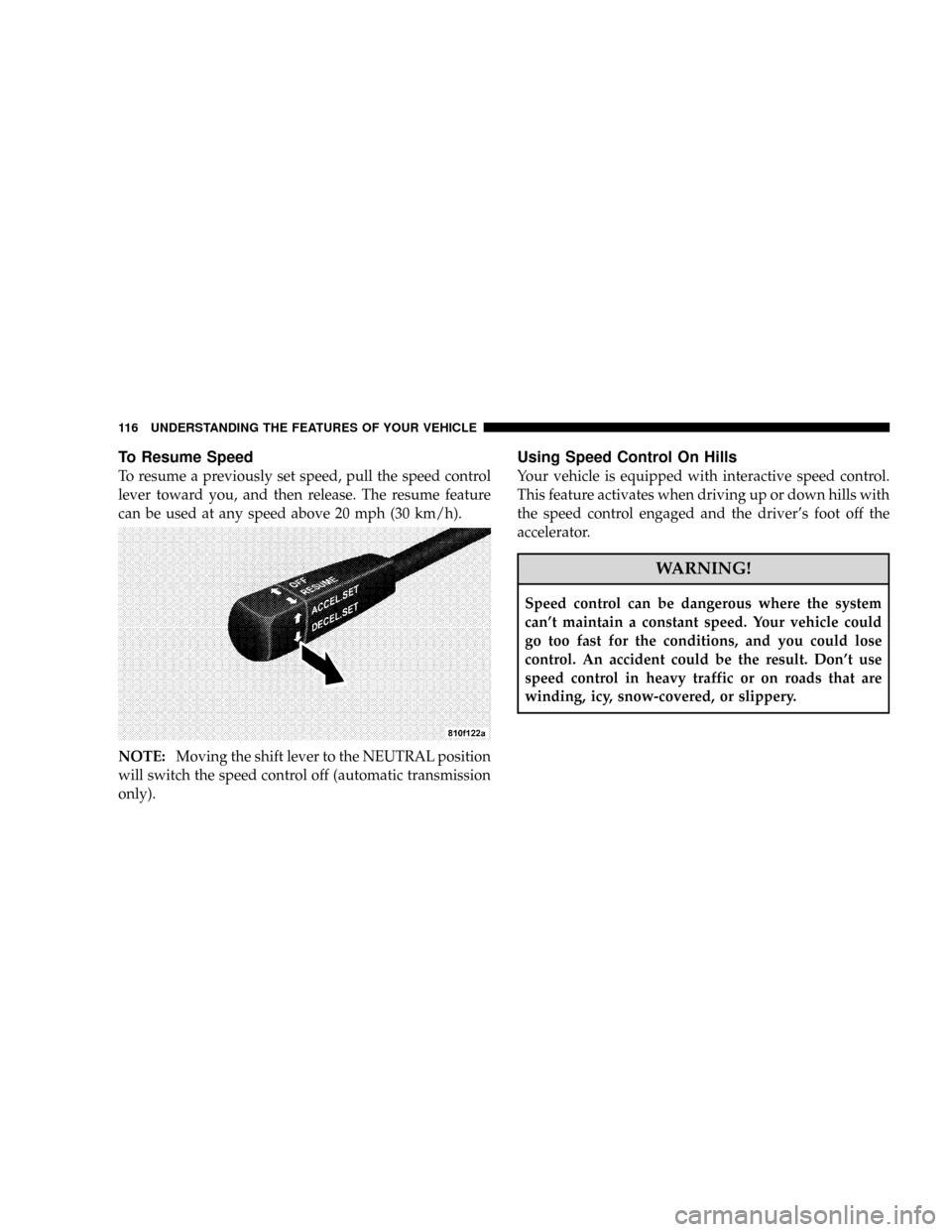
To Resume Speed
To resume a previously set speed, pull the speed control
lever toward you, and then release. The resume feature
can be used at any speed above 20 mph (30 km/h).
NOTE:Moving the shift lever to the NEUTRAL position
will switch the speed control off (automatic transmission
only).
Using Speed Control On Hills
Your vehicle is equipped with interactive speed control.
This feature activates when driving up or down hills with
the speed control engaged and the driver's foot off the
accelerator.
WARNING!
Speed control can be dangerous where the system
can't maintain a constant speed. Your vehicle could
go too fast for the conditions, and you could lose
control. An accident could be the result. Don't use
speed control in heavy traffic or on roads that are
winding, icy, snow-covered, or slippery.
116 UNDERSTANDING THE FEATURES OF YOUR VEHICLE
Page 138 of 358
CAUTION!
The accessory drive belt also drives the water pump.
Operating the vehicle with a failed belt can cause
engine overheating and possible severe engine
damage.
16. High Beam Indicator Light
This indicator will illuminate when the head-
lights are in the high beam setting.
To activate the high beams, push the multifunction
control lever past the point of resistance, toward the
instrument panel.17. Electronic Digital Clock
A digital readout in the instrument cluster shows the
time in hours and minutes whenever the ignition switch
is in the ON/RUN or ACC position.
When the ignition switch is in the OFF/LOCK position,
timekeeping is accurately maintained.
The display can be adjusted with the knob/button lo-
cated to the left of the clock.
18. Gear Indicator
For automatic transmission vehicles, the current gear
shift selector range is indicated in the gear range indica-
tor display.
19. Push Button for Time Setting
To adjust the time display, turn the key in the ignition
switch to the ON/RUN or ACC position. The knob/
button located just to the left of the clock is used to
136 UNDERSTANDING YOUR INSTRUMENT PANEL
Page 144 of 358
If the Check Engine light remains on continuously and
the vehicle is driving normally, you may still drive the
vehicle. In most situations, the vehicle will not require
towing. However, we recommend that you have the
system checked at an authorized dealer as soon as
possible.
If the vehicle is not driving normally, and the Check
Engine light flashes or remains on continuously, it is an
alert to serious conditions that could lead to loss of power
or severe catalytic converter damage. The vehicle should
be serviced at an authorized dealer as soon as possible.
27. Brake Wear Indicator Light
With the key in the ignition and turned to the
ON/RUN position, the brake wear indicator
light comes on. The light goes out when the
engine is running.
If the indicator light comes on during braking, this
indicates the brake pads are worn down.Have the brake system checked at your authorized dealer
as soon as possible.
28. Oil Level Indicator Light
With the key in the ignition switch turned to
the ON/RUN position, the oil level indicator
light comes on. It should go out immediately
when the engine is running. If the light does
not go out, or comes on while driving, the engine oil level
has dropped to approximately the minimum mark on the
dipstick.
CHECKING ENGINE OIL LEVEL
A sensor in the oil pan allows oil level to be checked
without opening the hood. It provides an accurate mea-
surement of oil level, whereas the low engine oil level
indicator warns that oil level is definitely too low. With
the vehicle parked on a level surface, the engine is
warmed up and shut off for approximately five minutes.
When the ignition switch is turned to the ON/RUN
142 UNDERSTANDING YOUR INSTRUMENT PANEL
Page 169 of 358
NReplacement Tires.....................213
NAlignment And Balance.................214
mTire Pressure Monitor System..............214
NGeneral Information...................218
mTire Chains...........................219
mOriginal Equipment Tires.................220
mSnow Tires...........................220
mTire Rotation Recommendations............221
mFuel Requirements......................222
NReformulated Gasoline.................223NGasoline/Oxygenate Blends..............223
NMMT In Gasoline.....................224
NMaterials Added To Fuel................224
NSulfur In Gasoline.....................224
mAdding Fuel..........................225
NFuel Filler Cap (Gas Cap)...............225
mVehicle Loading........................227
NRoof Luggage Rack....................228
mTrailer Towing.........................229
STARTING AND OPERATING 167
5
Page 171 of 358
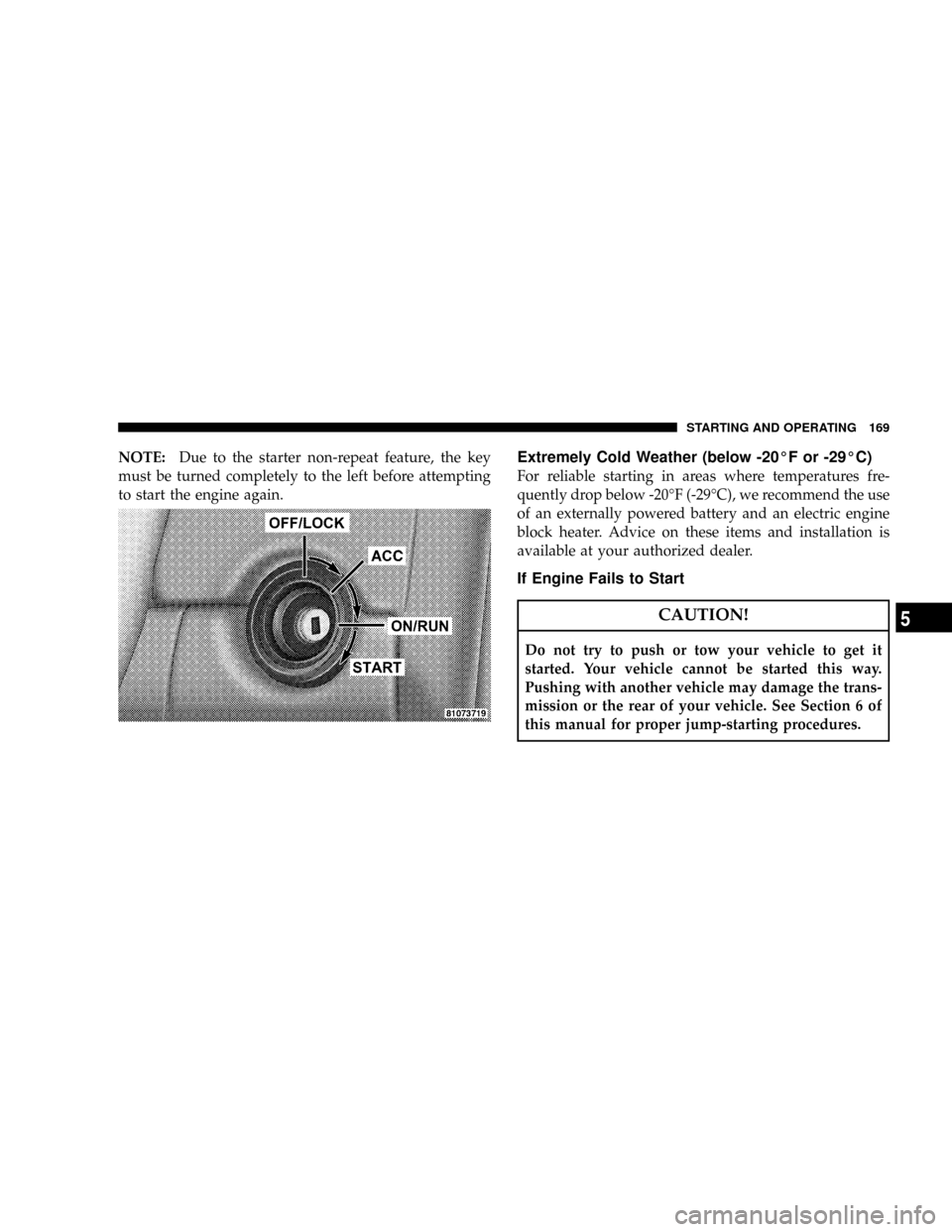
NOTE:Due to the starter non-repeat feature, the key
must be turned completely to the left before attempting
to start the engine again.Extremely Cold Weather (below -20ÉF or -29ÉC)
For reliable starting in areas where temperatures fre-
quently drop below -20ÉF (-29ÉC), we recommend the use
of an externally powered battery and an electric engine
block heater. Advice on these items and installation is
available at your authorized dealer.
If Engine Fails to Start
CAUTION!
Do not try to push or tow your vehicle to get it
started. Your vehicle cannot be started this way.
Pushing with another vehicle may damage the trans-
mission or the rear of your vehicle. See Section 6 of
this manual for proper jump-starting procedures.
STARTING AND OPERATING 169
5
Page 179 of 358
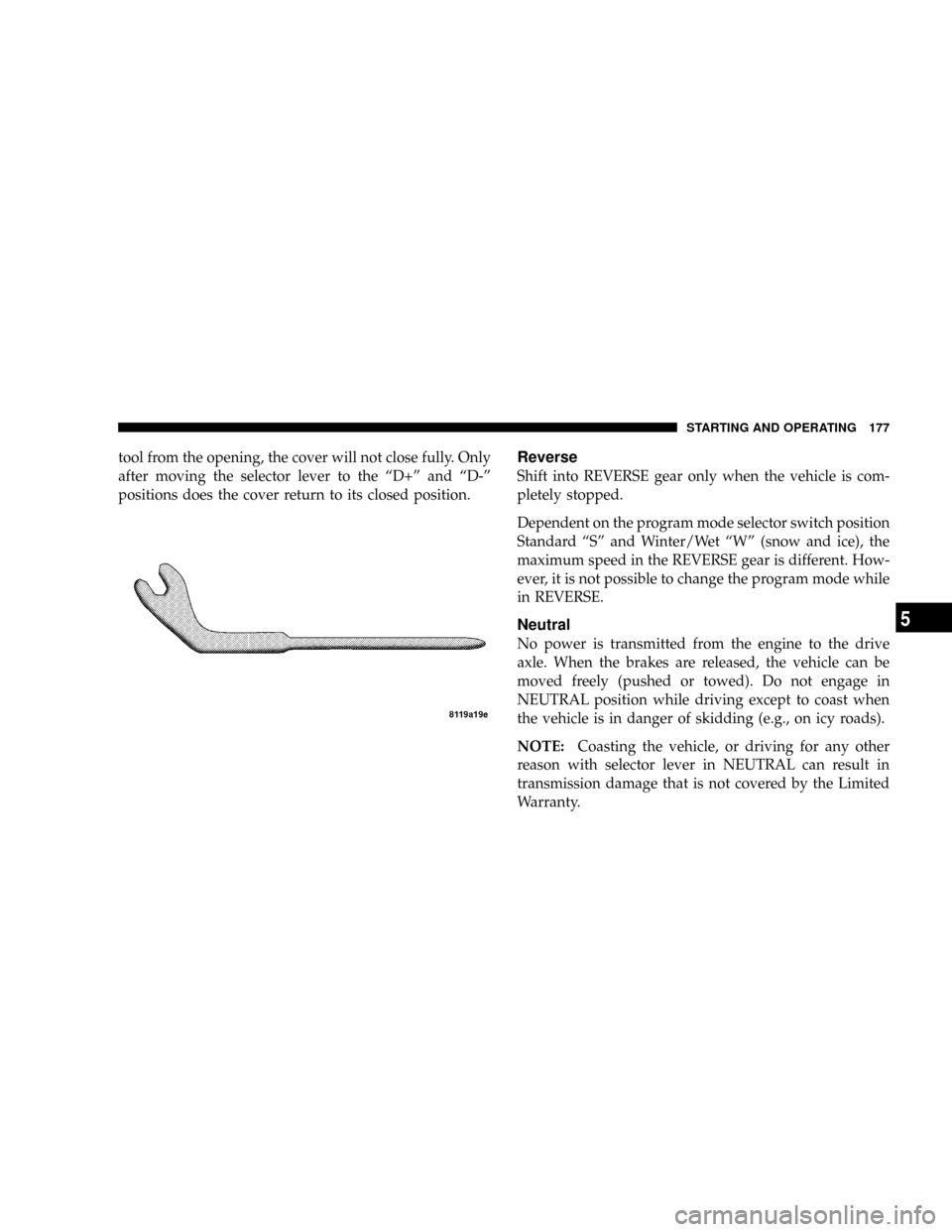
tool from the opening, the cover will not close fully. Only
after moving the selector lever to the ªD+º and ªD-º
positions does the cover return to its closed position.Reverse
Shift into REVERSE gear only when the vehicle is com-
pletely stopped.
Dependent on the program mode selector switch position
Standard ªSº and Winter/Wet ªWº (snow and ice), the
maximum speed in the REVERSE gear is different. How-
ever, it is not possible to change the program mode while
in REVERSE.
Neutral
No power is transmitted from the engine to the drive
axle. When the brakes are released, the vehicle can be
moved freely (pushed or towed). Do not engage in
NEUTRAL position while driving except to coast when
the vehicle is in danger of skidding (e.g., on icy roads).
NOTE:Coasting the vehicle, or driving for any other
reason with selector lever in NEUTRAL can result in
transmission damage that is not covered by the Limited
Warranty.
STARTING AND OPERATING 177
5
Page 182 of 358
NEUTRAL
The engine may be started in this range. Use this range
for starting your vehicle if it is moving or being towed.
OVERDRIVE
This range should be used for most city and highway
driving. It provides the smoothest upshifts and down-
shifts and best fuel economy.
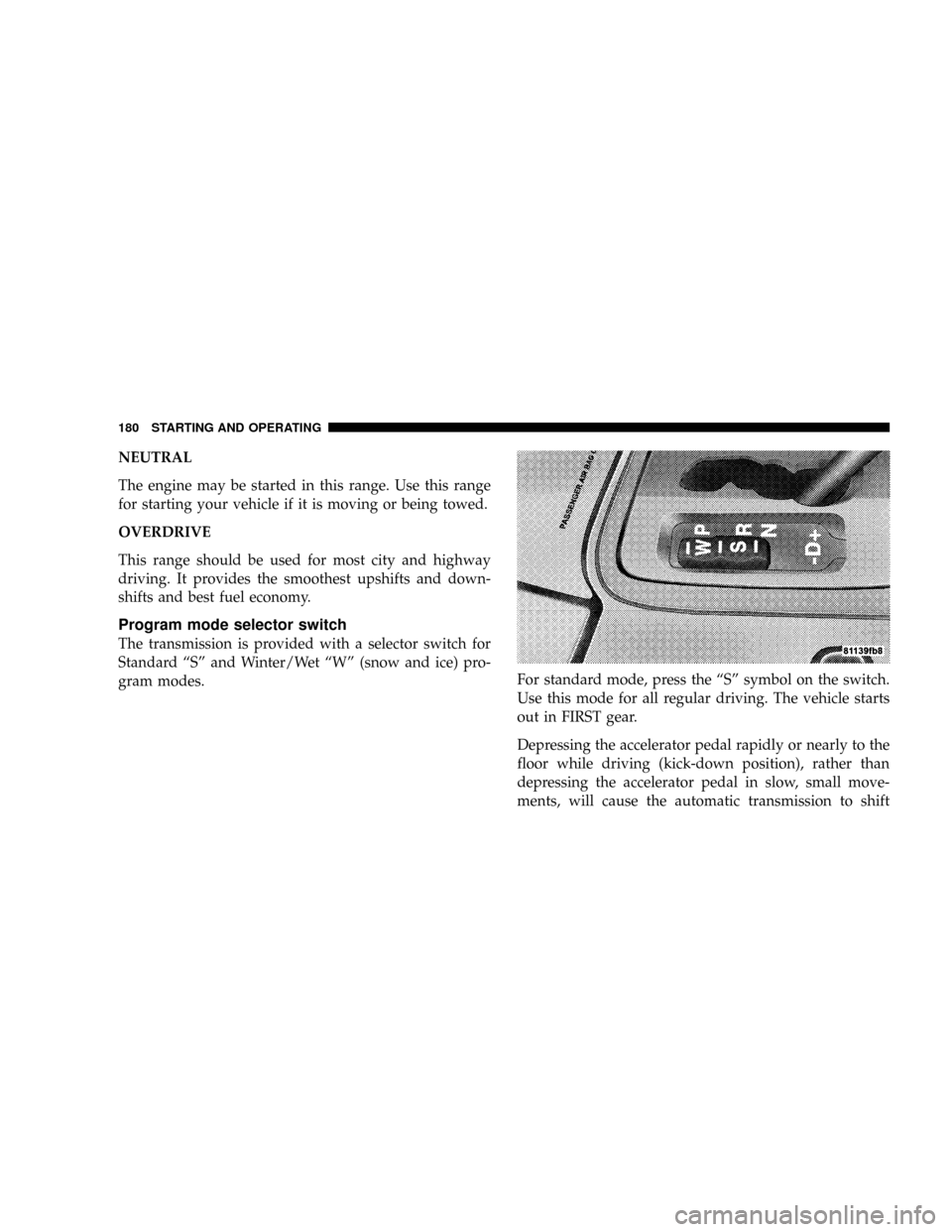
Program mode selector switch
The transmission is provided with a selector switch for
Standard ªSº and Winter/Wet ªWº (snow and ice) pro-
gram modes.For standard mode, press the ªSº symbol on the switch.
Use this mode for all regular driving. The vehicle starts
out in FIRST gear.
Depressing the accelerator pedal rapidly or nearly to the
floor while driving (kick-down position), rather than
depressing the accelerator pedal in slow, small move-
ments, will cause the automatic transmission to shift
180 STARTING AND OPERATING
Page 188 of 358
When parking on a hill, you must set the parking brake
beforeplacing the shift lever in PARK. If you don't, the
load on the transmission locking mechanism may make it
difficult to move the shift lever out of PARK. As an added
precaution, turn the front wheels toward the curb on a
downhill grade and away from the curb on an uphill
grade.
The parking brake should always be applied when the
driver is not in the vehicle.
WARNING!
Be sure the parking brake is fully disengaged before
driving; failure to do so can lead to brake failure and
an accident.
WARNING!
Do not leave children unattended in a vehicle. A
child could be injured, or could injure others, if left
unattended.
BRAKE SYSTEM
Your vehicle is equipped with power brakes as standard
equipment. In the event power assist is lost for any
reason (for example, repeated brake applications with the
engine off), the brakes will still function. The effort
required to brake the vehicle will be much greater than
that required with the power system operating.
If either the front or rear hydraulic system loses normal
capability, the remaining system will still function with
some loss of overall braking effectiveness. This will be
evident by increased pedal travel during application,
186 STARTING AND OPERATING