ignition CHRYSLER CROSSFIRE 2008 1.G Owner's Manual
[x] Cancel search | Manufacturer: CHRYSLER, Model Year: 2008, Model line: CROSSFIRE, Model: CHRYSLER CROSSFIRE 2008 1.GPages: 358, PDF Size: 4.7 MB
Page 77 of 358
CAUTION!
To prevent mildew, the convertible top must be dry
before lowering it into the storage compartment.
Do not lower a frozen convertible top until thawed
and dry. Doing so may result in damage not covered
by the DaimlerChrysler Limited Warranty.
CAUTION!
Do not place anything on the tonneau cover.
The tonneau cover must never be used as a seating
area.
To Raise The Top:
1. Make sure the rear cargo compartment divider is still
secured in the vertical position.
2. Make sure the decklid is closed.
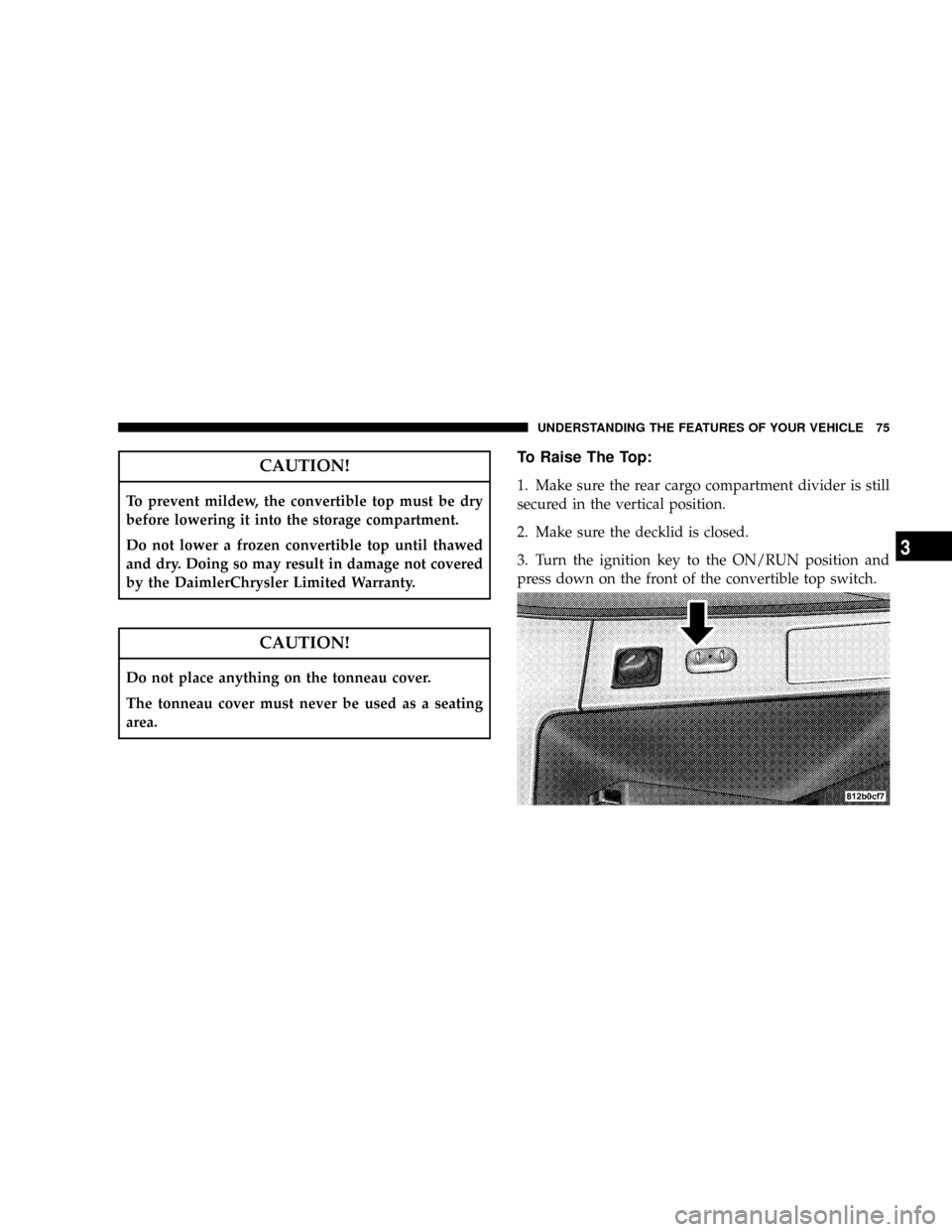
3. Turn the ignition key to the ON/RUN position and
press down on the front of the convertible top switch.
UNDERSTANDING THE FEATURES OF YOUR VEHICLE 75
3
Page 84 of 358
WARNING!
Keep compartment lids closed. This will help to
prevent stored objects from being thrown about and
injuring vehicle occupants during an accident.
Ashtray
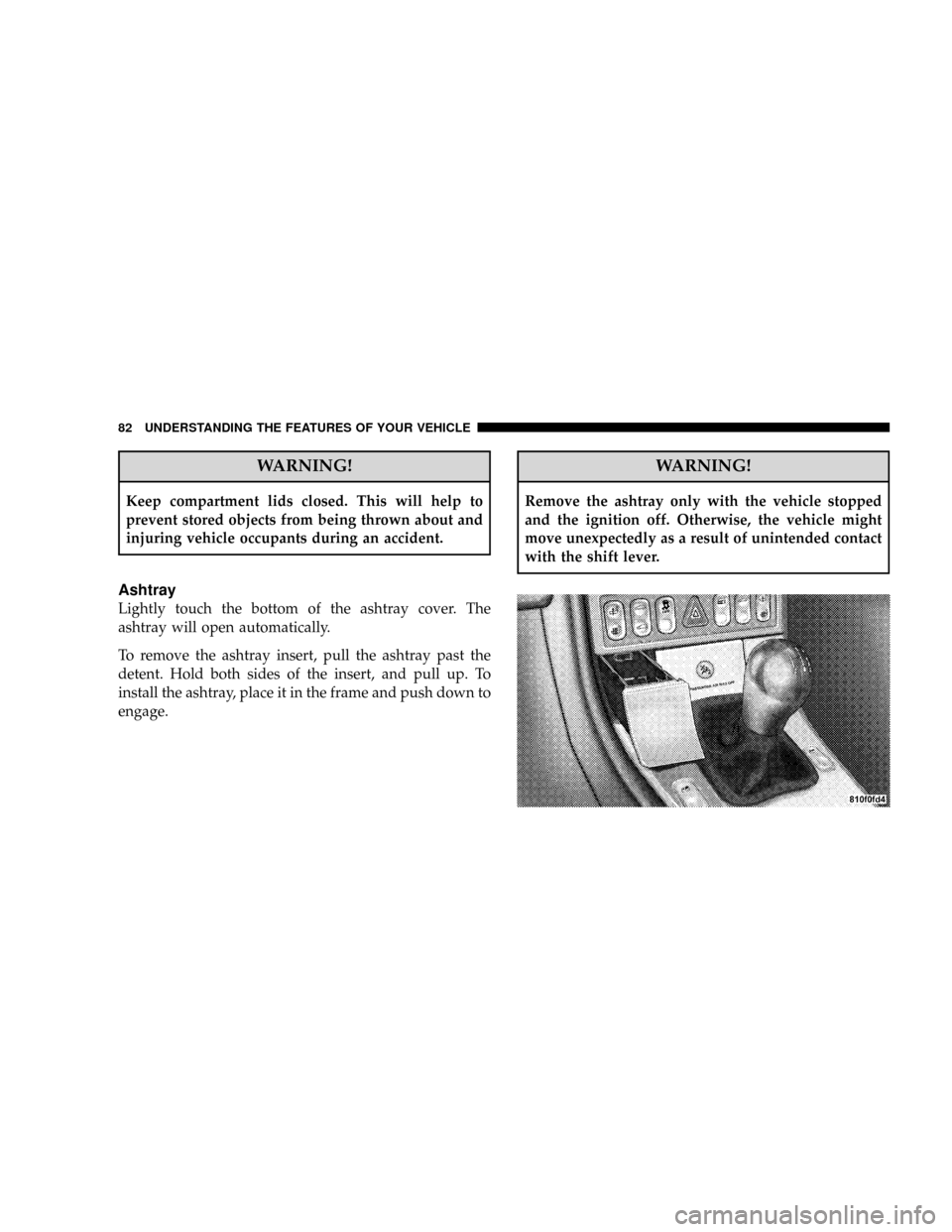
Lightly touch the bottom of the ashtray cover. The
ashtray will open automatically.
To remove the ashtray insert, pull the ashtray past the
detent. Hold both sides of the insert, and pull up. To
install the ashtray, place it in the frame and push down to
engage.
WARNING!
Remove the ashtray only with the vehicle stopped
and the ignition off. Otherwise, the vehicle might
move unexpectedly as a result of unintended contact
with the shift lever.
82 UNDERSTANDING THE FEATURES OF YOUR VEHICLE
Page 86 of 358
The lighter will operate only when the ignition switch is
in the ON/ACC position. It heats up when pushed in and
pops out automatically when ready for use. To preserve
the heating element, do not hold the lighter in the heating
position.
Glove Compartment
To lock the glove compartment, turn the key to the right
and remove. To unlock, turn the key to the left and
remove.
Pull on the handle to open the glove compartment.
CUPHOLDER (If Equipped)
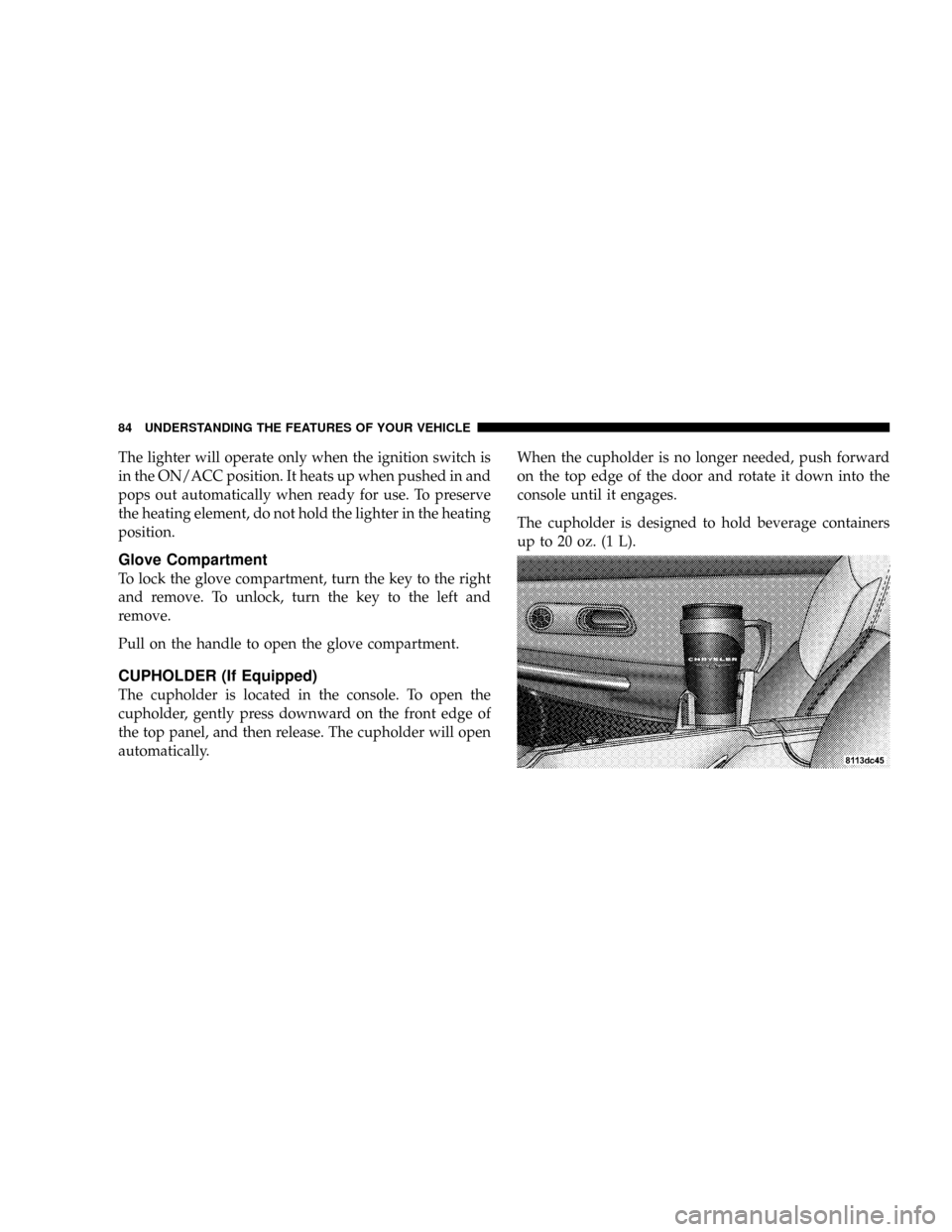
The cupholder is located in the console. To open the
cupholder, gently press downward on the front edge of
the top panel, and then release. The cupholder will open
automatically.When the cupholder is no longer needed, push forward
on the top edge of the door and rotate it down into the
console until it engages.
The cupholder is designed to hold beverage containers
up to 20 oz. (1 L).
84 UNDERSTANDING THE FEATURES OF YOUR VEHICLE
Page 94 of 358
Passenger Four-Way Power Seat (If Equipped)
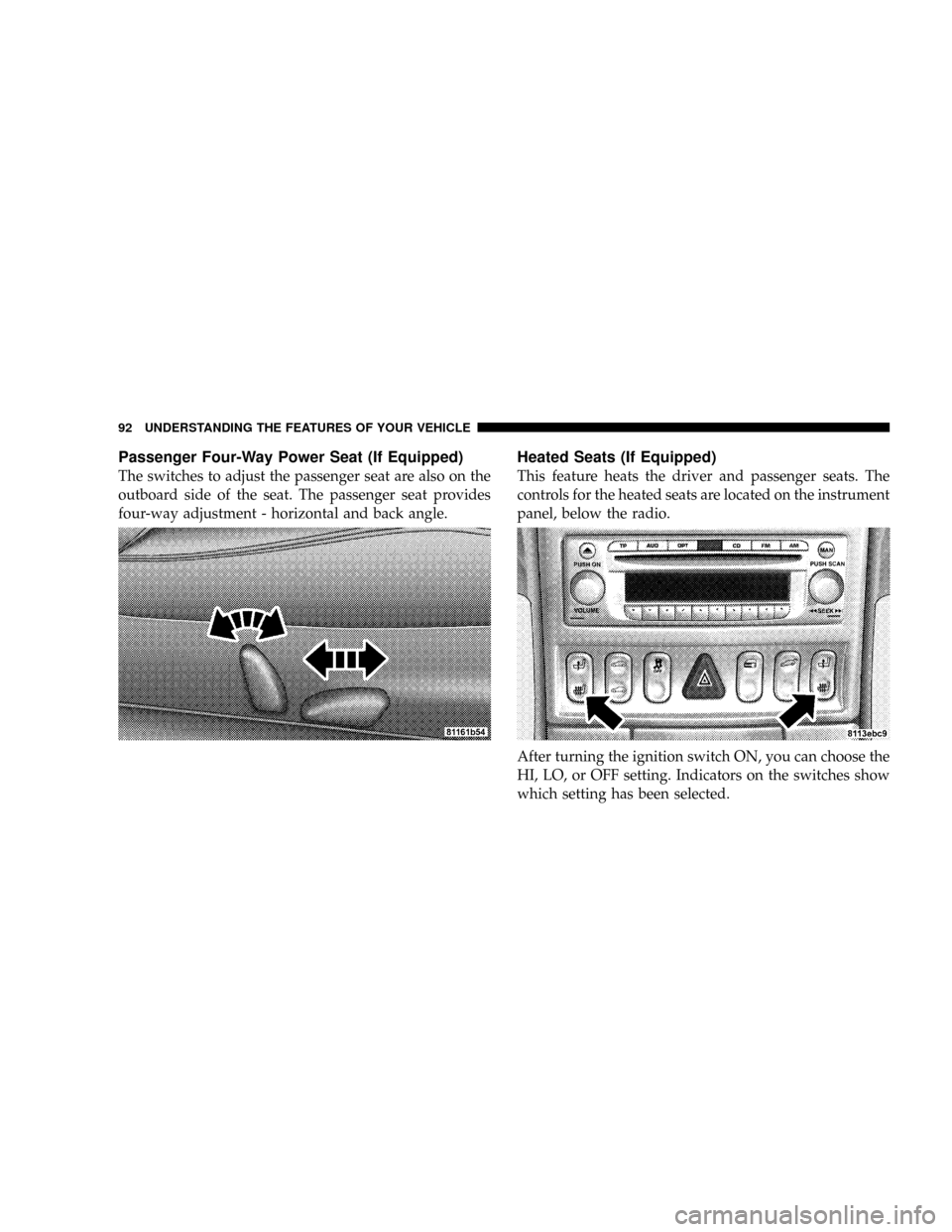
The switches to adjust the passenger seat are also on the
outboard side of the seat. The passenger seat provides
four-way adjustment - horizontal and back angle.
Heated Seats (If Equipped)
This feature heats the driver and passenger seats. The
controls for the heated seats are located on the instrument
panel, below the radio.
After turning the ignition switch ON, you can choose the
HI, LO, or OFF setting. Indicators on the switches show
which setting has been selected.
92 UNDERSTANDING THE FEATURES OF YOUR VEHICLE
Page 99 of 358
EXTERIOR LIGHTS
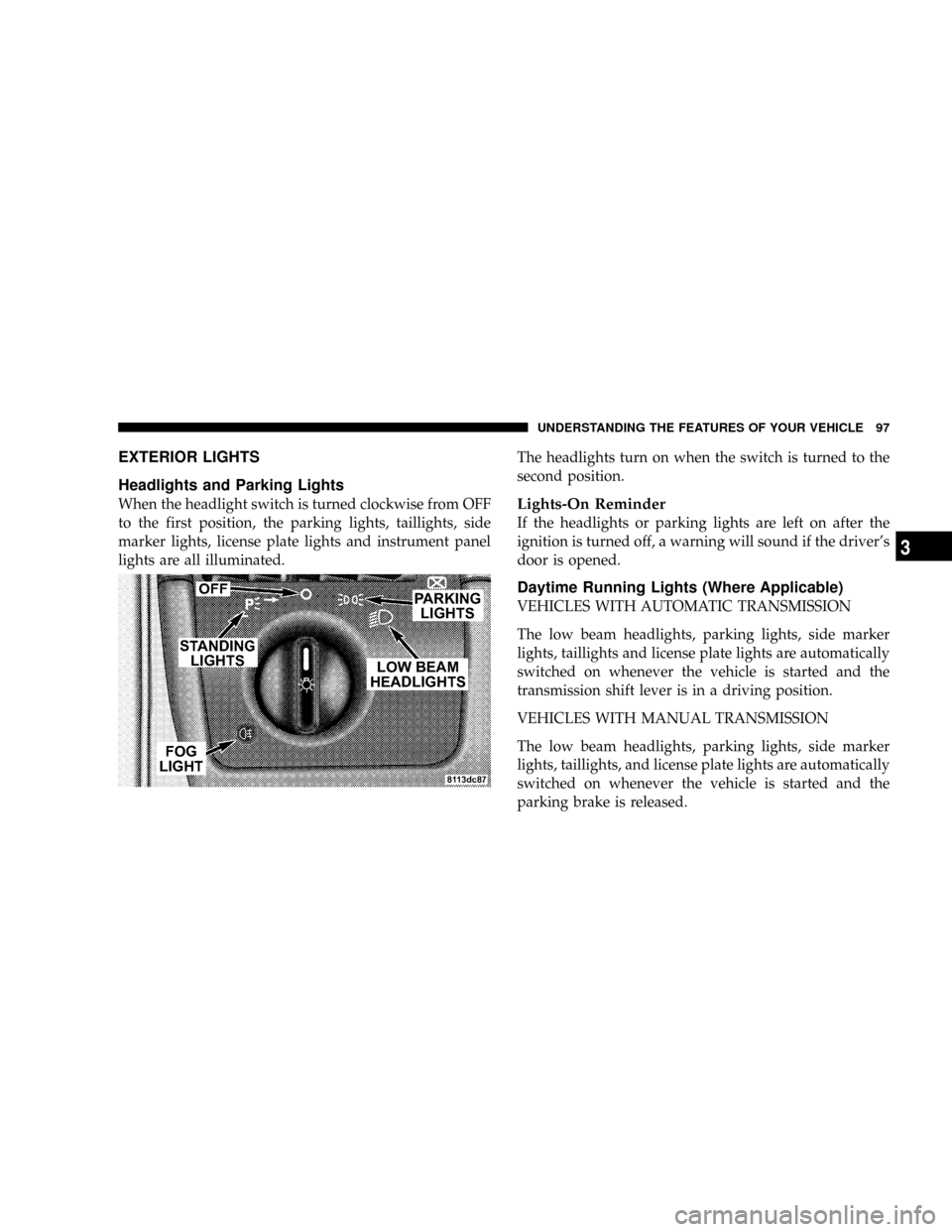
Headlights and Parking Lights
When the headlight switch is turned clockwise from OFF
to the first position, the parking lights, taillights, side
marker lights, license plate lights and instrument panel
lights are all illuminated.The headlights turn on when the switch is turned to the
second position.Lights-On Reminder
If the headlights or parking lights are left on after the
ignition is turned off, a warning will sound if the driver's
door is opened.
Daytime Running Lights (Where Applicable)
VEHICLES WITH AUTOMATIC TRANSMISSION
The low beam headlights, parking lights, side marker
lights, taillights and license plate lights are automatically
switched on whenever the vehicle is started and the
transmission shift lever is in a driving position.
VEHICLES WITH MANUAL TRANSMISSION
The low beam headlights, parking lights, side marker
lights, taillights, and license plate lights are automatically
switched on whenever the vehicle is started and the
parking brake is released.
UNDERSTANDING THE FEATURES OF YOUR VEHICLE 97
3
Page 100 of 358
For nighttime driving, the exterior lights switch should
be in the low beam position to permit activation of the
high beam headlights.
Fog Lights (If Equipped)
To operate the fog lights, pull the headlight
switch out one stop, with the parking lights
and/or low beam headlights on. A light to the
lower left of the headlight switch will illumi-
nate when the fog lights are on.
To turn off the fog lights, push the headlight switch in
fully. Selecting high beam headlights will also turn off the
fog lights.
Standing Lights
When the vehicle is parked on the street, the standing
lights (left or right side parking lights) can be turned on,
making your vehicle more visible to passing vehicles.To operate the standing lights, turn the headlight switch
counterclockwise one stop (right lamps) or two stops (left
lamps) from the OFF position. To turn off the standing
lights, return the headlight switch to the OFF position.
The standing lights cannot be operated when the ignition
switch is in the ON/RUN position.
CAUTION!
Standing lamps are intended for short term use when
parking. If these lights are left on for a long period of
time, your car's battery may drain, causing a possible
starting problem. Assure that the headlamp switch is
in the OFF position when leaving the vehicle.
98 UNDERSTANDING THE FEATURES OF YOUR VEHICLE
Page 112 of 358
The malfunction indicator lamp for the Electronic Stabil-
ity Program (ESP) is combined with the BAS. The yellow
BAS/ESP malfunction indicator light in the instrument
cluster and the yellow ESP warning light in the speed-
ometer dial come on with the key in the ignition switch
turned to the ON/RUN position. They should go out
with the engine running. If the BAS/ESP malfunction
indicator light comes on continuously with the engine
running, a malfunction has been detected in either sys-
tem.
If the malfunction indicator light stays illuminated, have
the BAS and ESP checked at your authorized dealer as
soon as possible.ELECTRONIC STABILITY PROGRAM (ESP)
WARNING!
ESP cannot prevent the natural laws of physics from
acting on the vehicle, nor can it increase the traction
afforded. The ESP cannot prevent accidents, includ-
ing those resulting from excessive speed in turns, or
hydroplaning. Only a safe, attentive, and skillful
driver can prevent accidents. The capabilities of an
ESP-equipped vehicle must never be exploited in a
reckless or dangerous manner which could jeopar-
dize the user's safety or the safety of others.
The ESP enhances directional control and reduces driving
wheel spin of the vehicle under various driving condi-
tions.
110 UNDERSTANDING THE FEATURES OF YOUR VEHICLE
Page 114 of 358
With the ESP system switched off, the engine torque
reduction feature is cancelled. Therefore, the enhanced
vehicle stability offered by ESP is unavailable. ESP al-
ways operates under braking, even with the switch in the
OFF position. If one drive wheel loses traction and begins
to spin, the brake is applied by the ESP system until the
wheel regains sufficient traction. The traction control
engages at approximately 24 mph (40 km/h), and
switches off at 50 mph (80 km/h).
If the ESP warning light begins to flash during accelera-
tion, ease up on the accelerator and apply as little throttle
as possible. Be sure to adapt your speed and driving to
the prevailing road conditions. When the ESP warning
light is illuminated continuously, the ESP is switched off.
To return to the enhanced vehicle stability offered by ESP,press the lower half of the switch (the ESP warning light
in the speedometer dial goes out). Avoid spinning one
drive wheel. This may cause serious damage to the drive
train and is not covered by the DaimlerChrysler war-
ranty.
CAUTION!
If the vehicle is towed with the front axle raised, the
engine must be shut off (key in the ignition switch to
the OFF/LOCK or ACC position). Otherwise the ESP
will immediately be engaged and will apply the rear
wheel brakes.
112 UNDERSTANDING THE FEATURES OF YOUR VEHICLE
Page 115 of 358
Synchronizing ESP
If the power supply was interrupted (battery discon-
nected or discharged), the BAS/ESP malfunction indica-
tor light may be illuminated with the engine running. To
re-synchronize the ESP, and cancel the malfunction indi-
cator light, the steering angle sensor will need to be
recalibrated.
1. Turn the ignition switch to the ON/RUN position.
2. Rotate the steering wheel to the center position.
3. Rotate the steering wheel completely to the left, and
then rotate the steering wheel completely to the right.
4. Bring the steering wheel back to the center position.
5. The BAS/ESP malfunction indicator light will go out.
If the BAS/ESP malfunction indicator light is still illumi-
nated, the vehicle should be serviced at an authorized
dealer.
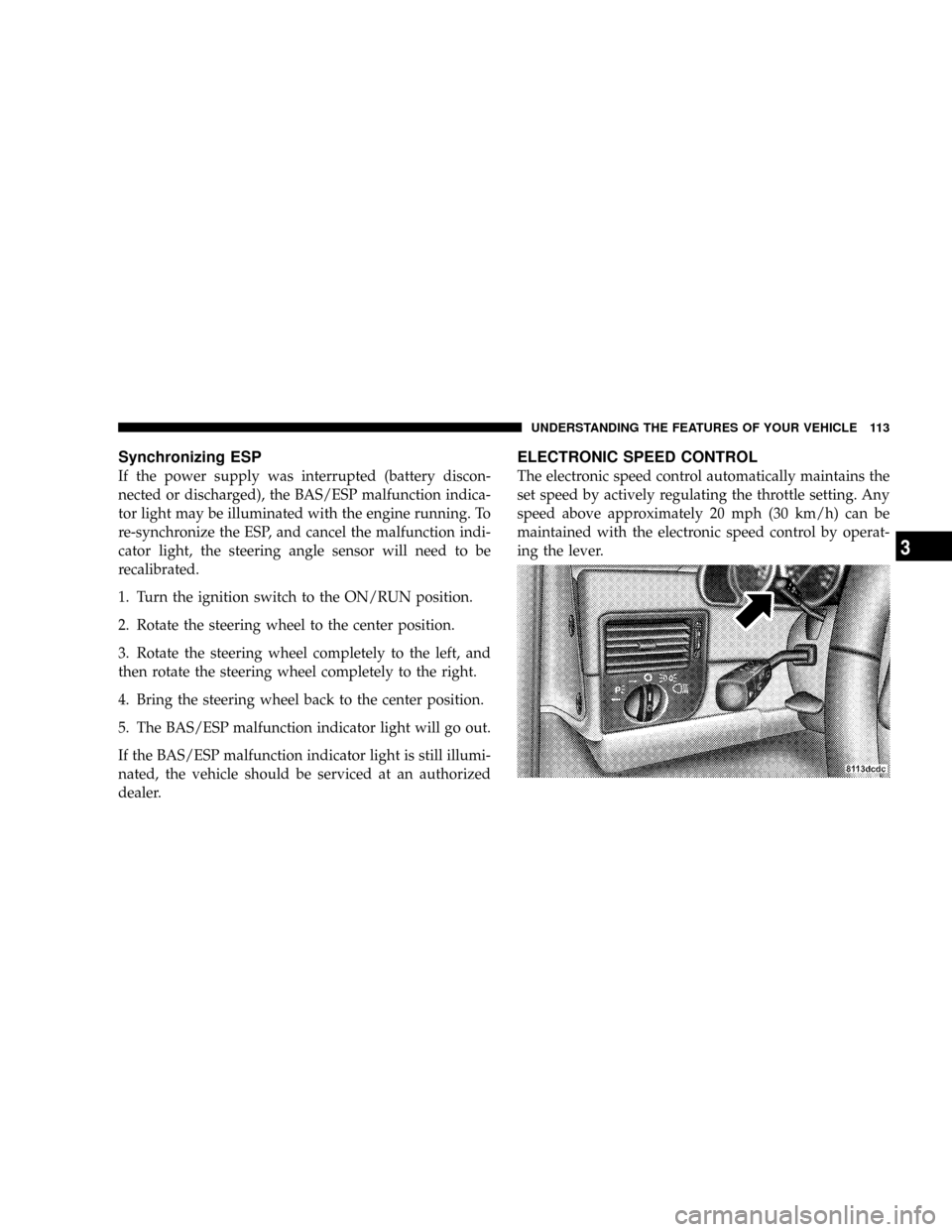
ELECTRONIC SPEED CONTROL
The electronic speed control automatically maintains the
set speed by actively regulating the throttle setting. Any
speed above approximately 20 mph (30 km/h) can be
maintained with the electronic speed control by operat-
ing the lever.
UNDERSTANDING THE FEATURES OF YOUR VEHICLE 113
3
Page 117 of 358
WARNING!
Leaving the electronic speed control system on when
not in use is dangerous. You could accidentally set
the system or cause it to go faster than you want. You
could lose control and have an accident. Always
leave the system OFF when you are not using it.
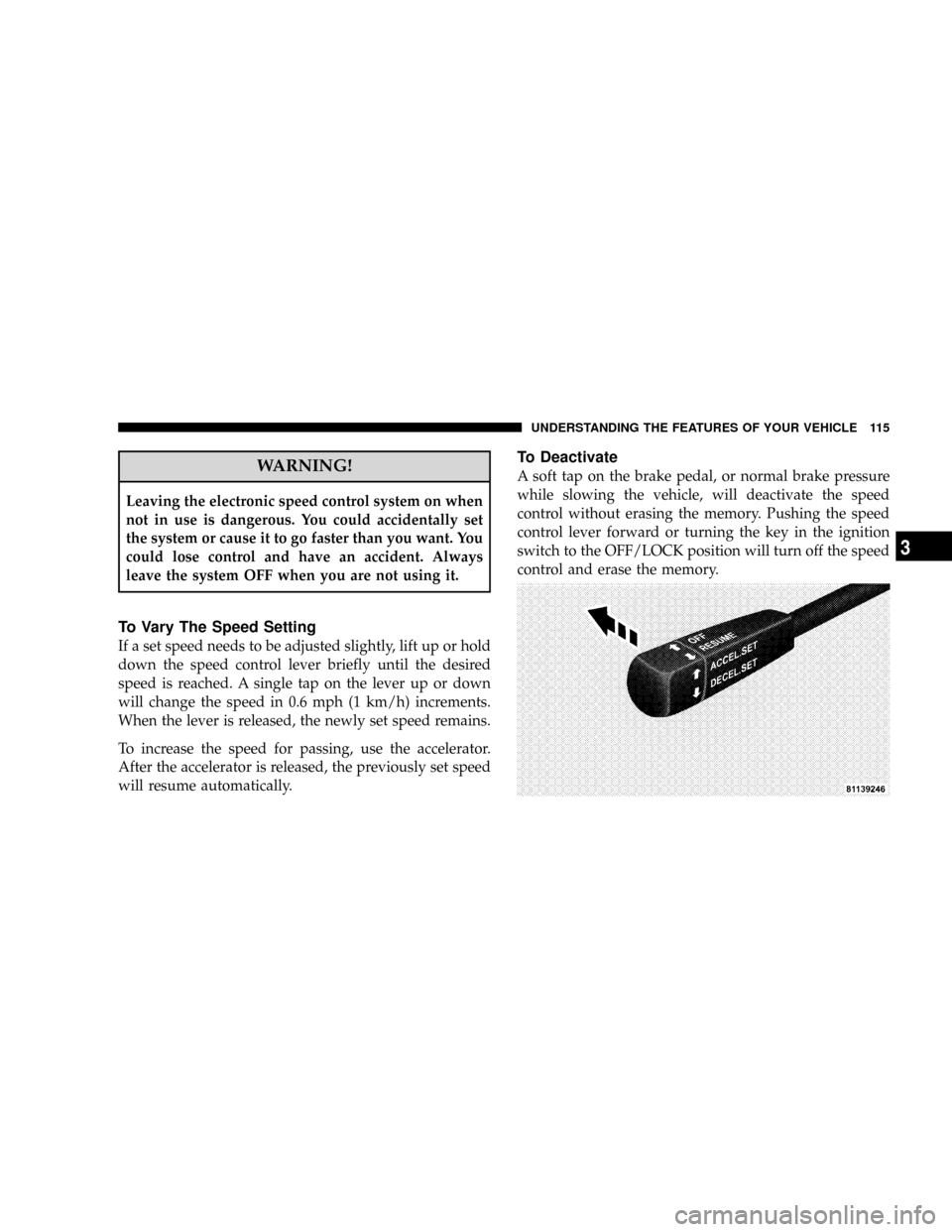
To Vary The Speed Setting
If a set speed needs to be adjusted slightly, lift up or hold
down the speed control lever briefly until the desired
speed is reached. A single tap on the lever up or down
will change the speed in 0.6 mph (1 km/h) increments.
When the lever is released, the newly set speed remains.
To increase the speed for passing, use the accelerator.
After the accelerator is released, the previously set speed
will resume automatically.
To Deactivate
A soft tap on the brake pedal, or normal brake pressure
while slowing the vehicle, will deactivate the speed
control without erasing the memory. Pushing the speed
control lever forward or turning the key in the ignition
switch to the OFF/LOCK position will turn off the speed
control and erase the memory.
UNDERSTANDING THE FEATURES OF YOUR VEHICLE 115
3