cooling CHRYSLER PACIFICA 2004 1.G User Guide
[x] Cancel search | Manufacturer: CHRYSLER, Model Year: 2004, Model line: PACIFICA, Model: CHRYSLER PACIFICA 2004 1.GPages: 361, PDF Size: 5.21 MB
Page 286 of 361

Whenever a change is noticed in the sound of the exhaust
system, when exhaust fumes can be detected inside the
vehicle, or when the underside or rear of the vehicle is
damaged, have a competent mechanic inspect the com-
plete exhaust system and adjacent body areas for broken,
damaged, deteriorated, or mispositioned parts. Open
seams or loose connections could permit exhaust fumes
to seep into the passenger compartment. In addition,
inspect the exhaust system each time the vehicle is raised
for lubrication or oil change. Replace as required.
WARNING!
Exhaust gases can injure or kill. They contain carbon
monoxide (CO) which is colorless and odorless.
Breathing it can make you unconscious and can
eventually poison you. To avoid breathing CO, fol-
low the preceding safety tips.
Cooling System
Inspection
WARNING!
²When working near the radiator cooling fan, turn
the ignition key to the OFF position. The fan is
temperature controlled and can start at any time
when the ignition key is in the ON position.
²You or others can be badly burned by hot coolant
or steam from your radiator. If you see or hear
steam coming from under the hood, don't open
the hood until the radiator has had time to cool.
Never try to open a cooling system pressure cap
when the radiator is hot.
286 MAINTAINING YOUR VEHICLE
Page 287 of 361

Coolant Checks
Coolant protection checks should be made every 12
months (prior to the onset of freezing weather, where
applicable). If coolant is dirty or rusty in appearance, the
system should be drained, flushed and refilled with fresh
coolant. Check the front of the A/C condenser for any
accumulation of bugs, leaves, etc. If dirty, clean by gently
spraying water from a garden hose vertically down the
face of the condenser.
Check the cooling system hoses for brittle rubber, crack-
ing, tears, cuts and tightness of the connection at the
bottle and radiator. Inspect the entire system for leaks.
Cooling System Ð Drain, Flush and Refill
At the intervals shown in the appropriate maintenance
schedule, the system should be drained, flushed and
refilled.
If the solution is dirty or contains a considerable amount
of sediment, clean and flush with a reliable cooling
system cleaner. Follow with a thorough rinsing to remove
all deposits and chemicals. Properly dispose of old
antifreeze solution.
Selection Of Coolant
Use only the manufacturers recommended coolant, refer
to Recommended Fluids, Lubricants and Genuine Parts
for correct coolant type.
MAINTAINING YOUR VEHICLE 287
7
Page 288 of 361
CAUTION!
²Mixing of coolants other than the specified HOAT
coolant may result in decreased corrosion protec-
tion and engine damage that may not be covered
under the new vehicle warranty. If a non-HOAT
coolant is introduced into the cooling system in an
emergency, it should be replaced with the speci-
fied coolant as soon as possible.
²Do not use plain water alone or alcohol base
antifreeze products. Do not use additional rust
inhibitors or antirust products, as they may not be
compatible with the radiator coolant and may
plug the radiator.
²This vehicle has not been designed for use with
Propylene Glycol based coolants. Use of Propy-
lene Glycol based coolants is not recommended.
Adding Coolant
When adding coolant, or refilling the system, a minimum
of 50% solution of ethylene glycol antifreeze coolant in
water should be used. Higher concentrations (not to
exceed 70%) are required if temperatures below237ÉF
(238ÉC) are anticipated.
Use only high purity water such as distilled or deionized
water when mixing the water/antifreeze solution. The
use of lower quality water will reduce the amount of
corrosion protection in the engine cooling system.
Please note that it is the owner's responsibility to main-
tain the proper level of protection against freezing ac-
cording to the temperatures occurring in the area where
the vehicle is operated.
NOTE:Mixing coolant types will decrease the life of the
engine coolant and will require more frequent coolant
changes.
288 MAINTAINING YOUR VEHICLE
Page 289 of 361

Coolant Pressure Cap
The coolant pressure cap must be fully tightened to
prevent loss of coolant, and to insure that coolant will
return to the coolant bottle from the overflow tank. The
coolant pressure cap should be inspected and cleaned if
there is any accumulation of foreign material on the
sealing surfaces.WARNING!
²The warning words ªDO NOT OPEN HOTº on
the coolant pressure cap are a safety precaution.
Never add coolant to the cooling system when the
engine is overheated. Do not loosen or remove the
coolant pressure cap to cool an overheated engine.
Heat causes pressure to build up in the cooling
system. To prevent scalding or injury, do not
remove the coolant pressure cap while the system
is hot or under pressure.
²Do not use a pressure cap other than the one
specified for your vehicle. Personal injury or
engine damage may result.
MAINTAINING YOUR VEHICLE 289
7
Page 290 of 361

Disposal of Used Engine Coolant
Used ethylene glycol based engine coolant is a regulated
substance requiring proper disposal. Check with your
local authorities to determine the disposal rules for your
community. To prevent ingestion by animals or children
do not store ethylene glycol based engine coolant in open
containers or allow it to remain in puddles on the
ground. If ingested by a child, contact a physician
immediately. Clean up any ground spills immediately.
Coolant Level
The coolant bottle provides a quick visual method for
determining that the coolant level is adequate. With the
engine off and cold, the coolant level should be between
the ranges indicated on the bottle. Some darkening of the
coolant bottle will occur over time. This is normal.
When additional coolant is needed to maintain the
proper level, it should be added to the coolant bottle. Do
not overfill. When filling the cooling system, utilize thebleed valve located on the top of the radiator in the
engine compartment on the passengers side. Use the
bleed valve to bleed air when the system is cold and the
pressure cap is removed from the coolant bottle.
Points to Remember
NOTE:When the vehicle is stopped after a few miles of
operation, you may observe vapor coming from the front
of the engine compartment. This is normally a result of
moisture from rain, snow, or high humidity accumulat-
ing on the radiator and being vaporized when the
thermostat opens, allowing hot water to enter the radia-
tor.
If an examination of your engine compartment shows no
evidence of radiator or hose leaks, the vehicle may be
safely driven. The vapor will soon dissipate.
²Do not overfill the coolant bottle.
²Check coolant freeze point in the system.
290 MAINTAINING YOUR VEHICLE
Page 291 of 361

²If frequent coolant additions are required, the cooling
system should be pressure tested for leaks.
²Maintain coolant concentration at 50% ethylene glycol
antifreeze (minimum) in water for proper corrosion
protection of your engine which contains aluminum
components.
²Make sure that the radiator and coolant bottle hoses
are not kinked or obstructed.
²Keep the front of the radiator and the front of the A/C
condenser clean.
²Do not change the thermostat for summer or winter
operation. If replacement is ever necessary, install
ONLY the correct type thermostat. Other designs may
result in unsatisfactory cooling performance.
²Increasing engine speed at idle does not reduce cool-
ant temperature! Put transmission in NEUTRAL and
let engine idle at normal engine idle speed.
Hoses And Vacuum/Vapor Harnesses
Inspect surfaces of hoses and nylon tubing for evidence
of heat and mechanical damage. Hard or soft spots,
brittle rubber, cracking, tears, cuts, abrasions, and exces-
sive swelling indicate deterioration of the rubber.
Pay particular attention to those hoses nearest to high
heat sources such as the exhaust manifold. Inspect hose
routing to be sure hoses do not come in contact with any
heat source or moving component which may cause heat
damage or mechanical wear.
Insure nylon tubing in these areas has not melted or
collapsed.
Inspect all hose connections such as clamps and cou-
plings to make sure they are secure and no leaks are
present.
Components should be replaced immediately if there is
any evidence of wear or damage that could cause failure.
MAINTAINING YOUR VEHICLE 291
7
Page 311 of 361
License Light
1. Place a screwdriver in the slot next to the release tab
and push on the release tab to remove the lens.
2. Unscrew the bulb and remove it from the socket.
Replace the bulb and push on the lens until it snaps into
place.
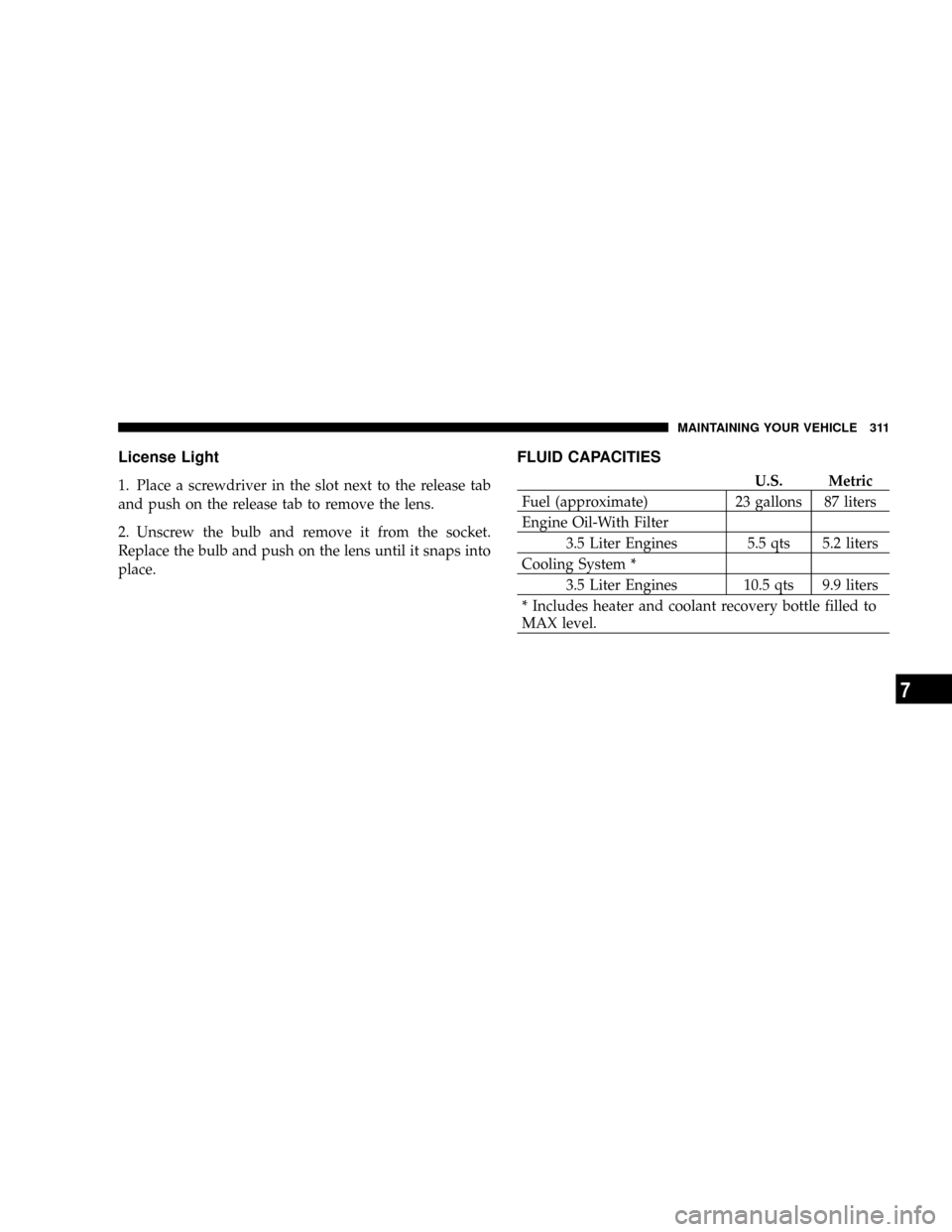
FLUID CAPACITIES
U.S. Metric
Fuel (approximate) 23 gallons 87 liters
Engine Oil-With Filter
3.5 Liter Engines 5.5 qts 5.2 liters
Cooling System *
3.5 Liter Engines 10.5 qts 9.9 liters
* Includes heater and coolant recovery bottle filled to
MAX level.
MAINTAINING YOUR VEHICLE 311
7
Page 348 of 361

Cellular Phone.......................... 73
Chains, Tire............................ 233
Changing A Flat Tire..................... 252
Child Restraint.......................... 53
Child Restraint Tether Anchors.............53,55
Child Safety Locks........................ 18
Child Seat.............................. 59
Clean Air Gasoline....................... 236
Climate Control......................... 183
Clock................................ 154
Compact Disc Maintenance................. 181
Compact Spare Tire...................... 226
Compass.............................. 151
Compass Calibration..................... 152
Compass Variance....................... 152
Computer, Trip/Travel.................... 153
Console.............................. 126
Console, Floor.......................... 126
Console, Overhead....................... 114Contract, Service........................ 338
Coolant Pressure Cap..................... 289
Cooling System......................... 286
Adding Coolant (Antifreeze).............. 288
Coolant Capacity...................... 311
Coolant Level......................... 290
Disposal of Used Coolant................ 290
Drain, Flush, and Refill.................. 287
Inspection........................... 286
Points to Remember.................... 290
Pressure Cap......................... 289
Radiator Cap......................... 289
Selection of Coolant..................287,312
Cruise Control.......................... 111
Cruise Light........................... 143
Cup Holder.........................126,304
Customer Assistance..................... 336
Dealer Service.......................... 271
348 INDEX
Page 349 of 361

Defroster, Rear Window................... 193
Defroster, Windshield...................63,188
Delay Wipers........................... 108
Digital Video Disc Player.................. 170
Dimmer Switch, Headlight................. 107
Dipsticks
Automatic Transaxle.................... 296
Disposal
Antifreeze........................... 290
Door Locks............................. 16
Door Locks, Automatic.................... 17
Door Opener, Garage..................... 115
Drive Belts............................ 276
Drive Shaft Universal Joints................ 283
Driving
On Slippery Surfaces.................... 259
DVD Player............................ 170
Electric Remote Mirrors.................... 72Electrical Power Outlets................... 124
Electronic Speed Control................... 111
Electronic Vehicle Information Center......... 145
Emergency, In Case of
Jacking............................. 252
Overheating.......................... 251
Emission Control System Maintenance......270,316
Engine............................... 268
Air Cleaner.......................... 277
Air Cleaner Filter...................... 277
Block Heater......................... 200
Break-In Recommendations................ 61
Checking Oil Level..................... 272
Compartment......................... 268
Coolant............................. 312
Cooling............................. 286
Exhaust Gas Caution..................29,239
Fails to Start.......................... 199
Fuel Requirements..................... 235
INDEX 349
10