towing CHRYSLER PACIFICA 2004 1.G User Guide
[x] Cancel search | Manufacturer: CHRYSLER, Model Year: 2004, Model line: PACIFICA, Model: CHRYSLER PACIFICA 2004 1.GPages: 361, PDF Size: 5.21 MB
Page 246 of 361
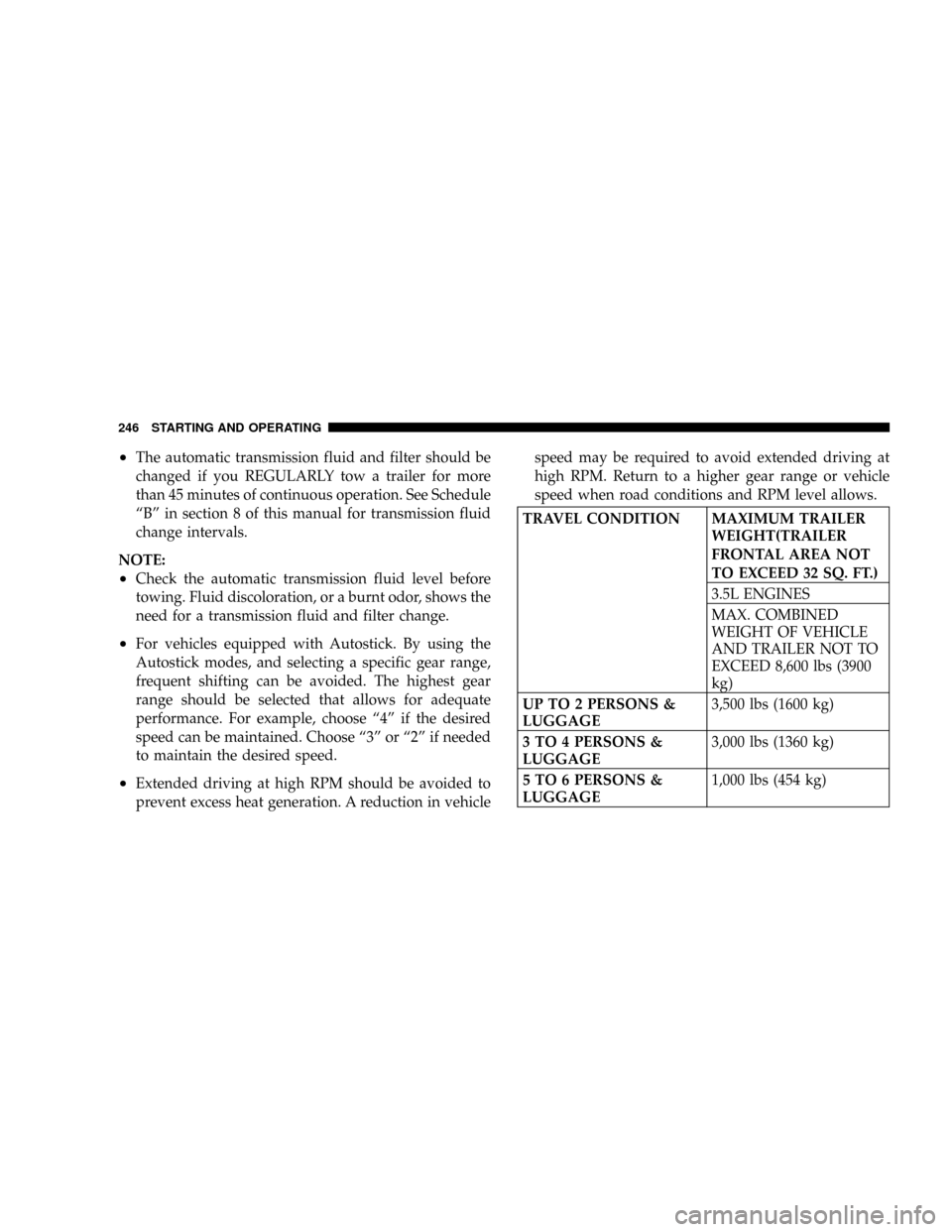
²The automatic transmission fluid and filter should be
changed if you REGULARLY tow a trailer for more
than 45 minutes of continuous operation. See Schedule
ªBº in section 8 of this manual for transmission fluid
change intervals.
NOTE:
²Check the automatic transmission fluid level before
towing. Fluid discoloration, or a burnt odor, shows the
need for a transmission fluid and filter change.
²For vehicles equipped with Autostick. By using the
Autostick modes, and selecting a specific gear range,
frequent shifting can be avoided. The highest gear
range should be selected that allows for adequate
performance. For example, choose ª4º if the desired
speed can be maintained. Choose ª3º or ª2º if needed
to maintain the desired speed.
²Extended driving at high RPM should be avoided to
prevent excess heat generation. A reduction in vehiclespeed may be required to avoid extended driving at
high RPM. Return to a higher gear range or vehicle
speed when road conditions and RPM level allows.
TRAVEL CONDITION MAXIMUM TRAILER
WEIGHT(TRAILER
FRONTAL AREA NOT
TO EXCEED 32 SQ. FT.)
3.5L ENGINES
MAX. COMBINED
WEIGHT OF VEHICLE
AND TRAILER NOT TO
EXCEED 8,600 lbs (3900
kg)
UP TO 2 PERSONS &
LUGGAGE3,500 lbs (1600 kg)
3 TO 4 PERSONS &
LUGGAGE3,000 lbs (1360 kg)
5 TO 6 PERSONS &
LUGGAGE1,000 lbs (454 kg)
246 STARTING AND OPERATING
Page 249 of 361

WHAT TO DO IN EMERGENCIES
CONTENTS
mHazard Warning Flasher..................250
mIf Your Engine Overheats.................251
mJacking And Tire Changing................252
NJack Location........................253
NSpare Tire Stowage....................253
NPreparations For Jacking................254
NJacking Instructions....................255
mJump-Starting Procedures If Battery Is Low....258
mDriving On Slippery Surfaces..............259NAcceleration.........................259
NTraction............................260
mFreeing A Stuck Vehicle..................260
mTowing A Disabled Vehicle................261
NWith Ignition Key.....................261
NWithout The Ignition Key...............263
NTowing This Vehicle Behind Another Vehicle
(Flat Towing With All Four Wheels On The
Ground)............................263
NTowing This Vehicle Behind Another Vehicle
With A Tow Dolley....................263
6
Page 261 of 361
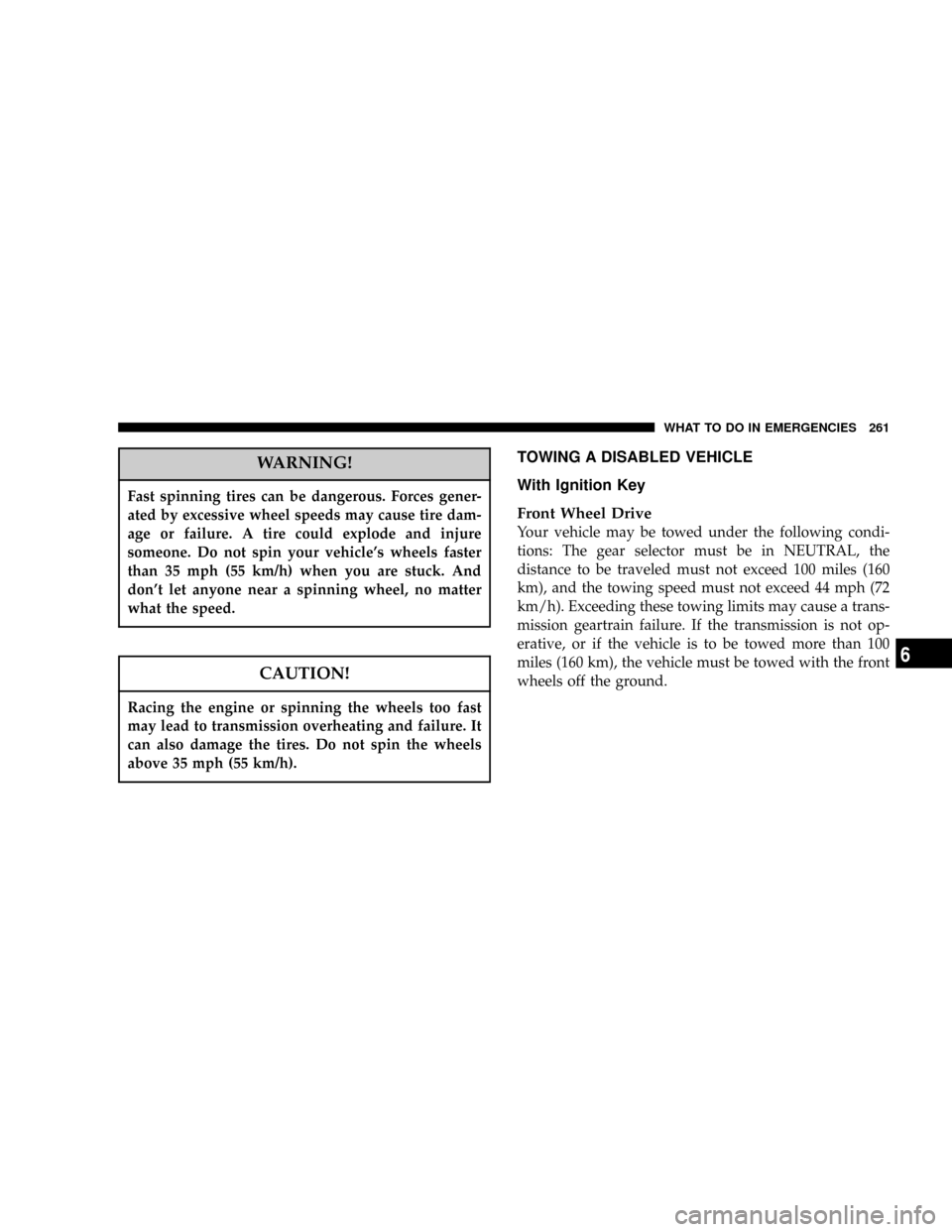
WARNING!
Fast spinning tires can be dangerous. Forces gener-
ated by excessive wheel speeds may cause tire dam-
age or failure. A tire could explode and injure
someone. Do not spin your vehicle's wheels faster
than 35 mph (55 km/h) when you are stuck. And
don't let anyone near a spinning wheel, no matter
what the speed.
CAUTION!
Racing the engine or spinning the wheels too fast
may lead to transmission overheating and failure. It
can also damage the tires. Do not spin the wheels
above 35 mph (55 km/h).
TOWING A DISABLED VEHICLE
With Ignition Key
Front Wheel Drive
Your vehicle may be towed under the following condi-
tions: The gear selector must be in NEUTRAL, the
distance to be traveled must not exceed 100 miles (160
km), and the towing speed must not exceed 44 mph (72
km/h). Exceeding these towing limits may cause a trans-
mission geartrain failure. If the transmission is not op-
erative, or if the vehicle is to be towed more than 100
miles (160 km), the vehicle must be towed with the front
wheels off the ground.
WHAT TO DO IN EMERGENCIES 261
6
Page 262 of 361

All Wheel Drive
Your vehicle may be towed under the following condi-
tions: The gear selector must be in NEUTRAL, the
distance to be traveled must not exceed 100 miles (160
km), the towing speed must not exceed 44 mph (72
km/h), and both front and rear wheels must be on the
ground. If your vehicle must be towed farther or at a
higher rate of speed, it must be transported on a flat bed
truck.
All Transmissions
CAUTION!
²Do not attempt to tow this vehicle from the front
with sling type towing equipment. Damage to the
front fascia will result.
²The only approved method of towing is with a flat
bed truck.
²Do not tow the vehicle from the rear. Damage to
the rear sheet metal, liftgate and fascia will occur.
²Do not push or tow this vehicle with another
vehicle as damage to the bumper fascia and trans-
mission may result.
262 WHAT TO DO IN EMERGENCIES
Page 263 of 361

If it is necessary to use the accessories while being towed
(wipers, defrosters, etc.), the key must be in the ON
position, not the ACCESSORY position. Make certain the
transmission remains in NEUTRAL.
Without The Ignition Key
Special care must be taken when the vehicle is towed
with the ignition in the LOCK position. The only ap-
proved method of towing with out the ignition key is
with a flat bed truck. Proper towing equipment is neces-
sary to prevent damage to the vehicle.
TOWING THIS VEHICLE BEHIND ANOTHER
VEHICLE (Flat towing with all four wheels on the
ground)
Flat towing of vehicles equipped with an automatic
transmission, is only permitted within the limitations
described in this section.
TOWING THIS VEHICLE BEHIND ANOTHER
VEHICLE WITH A TOW DOLLEY
The manufacturedoes not recommendthat you tow an
All-Wheel Drive (AWD) or front wheel drive vehicle on a
tow dolley. Vehicle damage may occur.
WHAT TO DO IN EMERGENCIES 263
6
Page 269 of 361

ONBOARD DIAGNOSTIC SYSTEM Ð OBD II
Your vehicle is equipped with a sophisticated onboard
diagnostic system called OBD II. This system monitors
the performance of the emissions, engine, and automatic
transmission control systems. When these systems are
operating properly, your vehicle will provide excellent
performance and fuel economy, as well as engine emis-
sions well within current government regulations.
If any of these systems require service, the OBD II system
will turn on the ªMalfunction Indicator Light.º It will
also store diagnostic codes and other information to
assist your service technician in making repairs. Al-
though your vehicle will usually be drivable and not
need towing, see your dealer for service as soon as
possible.CAUTION!
Prolonged driving with the ªMalfunction Indicator
Lightº on could cause further damage to the emis-
sion control system. It could also affect fuel economy
and driveability. The vehicle must be serviced before
any emissions tests can be performed.
If the ªMalfunction Indicator Lightº is flashing
while the engine is running, severe catalytic con-
verter damage and power loss will soon occur. Im-
mediate service is required.
MAINTAINING YOUR VEHICLE 269
7
Page 274 of 361

Change Engine Oil
Road conditions and your kind of driving affects the
interval at which your oil should be changed. Check the
following list to see if any apply to you.
²Day or night temperatures are below 32ÉF (0ÉC).
²Stop and Go driving.
²Extensive engine idling.
²Driving in dusty conditions.
²Short trips of less than 10 miles (16 km).
²More than 50% of your driving is at sustained high
speeds during hot weather, above 90ÉF (32ÉC).
²Trailer towing.
²Taxi, Police or delivery service (commercial service).
²Off-Road or desert operation.NOTE:IfANYof these apply to you then change your
engine oil every 3,000 miles (5 000 km) or 3 months,
whichever comes first and follow schedule ªBº of the
9Maintenance Schedules9section of this manual.
If none of these apply to you, then change your engine oil
at every interval shown on schedule9A9of the9Mainte-
nance Schedules9section of this manual.
NOTE:Under no circumstances should oil change in-
tervals exceed 6000 miles (10 000 km) or 6 months
whichever comes first.
Engine Oil Selection
For best performance and maximum protection under all
types of operating conditions, the manufacture only
recommends engine oils that are API certified and meet
the requirements of DaimlerChrysler Material Standard
MS-6395. Use Mopar or an equivalent oil meeting the
specification MS-6395.
274 MAINTAINING YOUR VEHICLE
Page 279 of 361
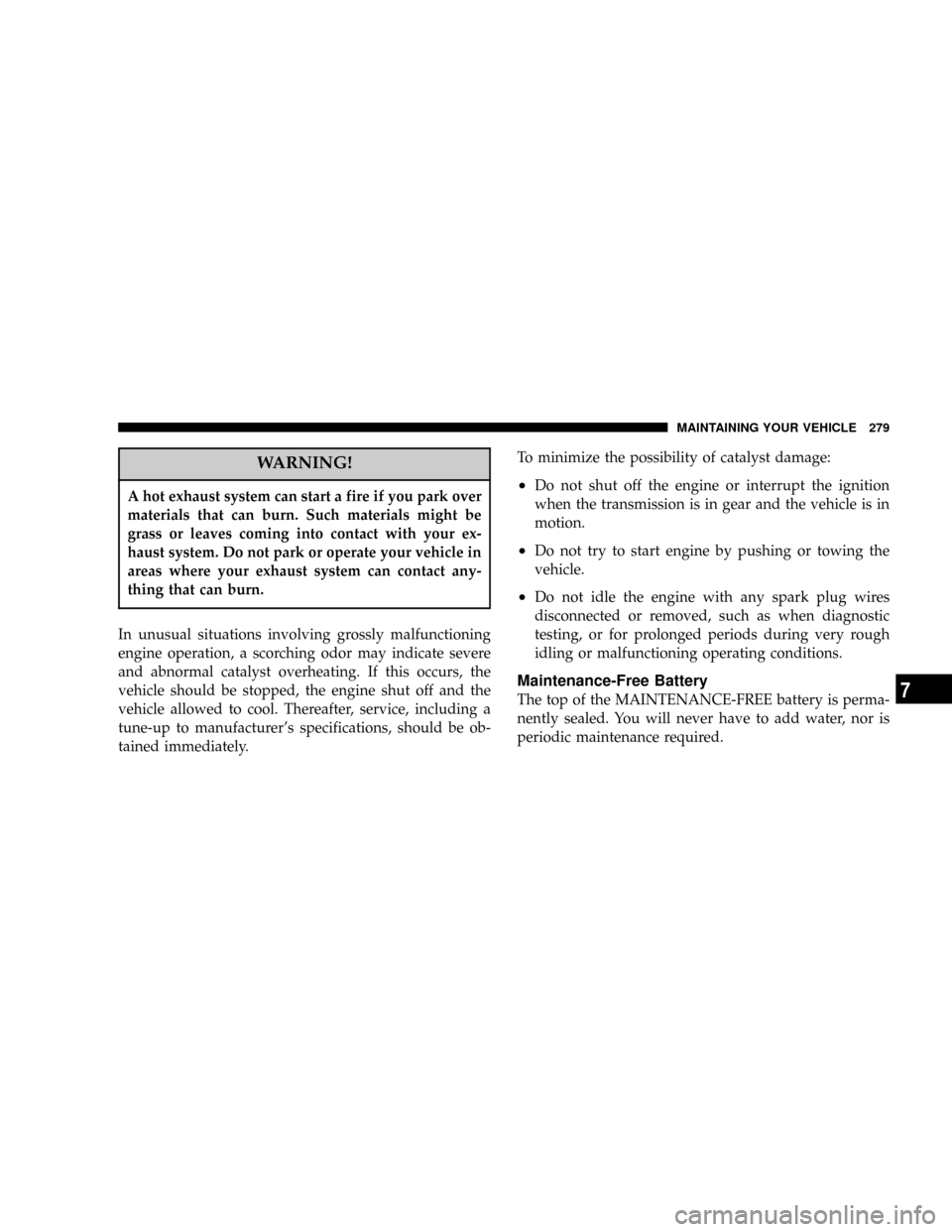
WARNING!
A hot exhaust system can start a fire if you park over
materials that can burn. Such materials might be
grass or leaves coming into contact with your ex-
haust system. Do not park or operate your vehicle in
areas where your exhaust system can contact any-
thing that can burn.
In unusual situations involving grossly malfunctioning
engine operation, a scorching odor may indicate severe
and abnormal catalyst overheating. If this occurs, the
vehicle should be stopped, the engine shut off and the
vehicle allowed to cool. Thereafter, service, including a
tune-up to manufacturer's specifications, should be ob-
tained immediately.To minimize the possibility of catalyst damage:
²Do not shut off the engine or interrupt the ignition
when the transmission is in gear and the vehicle is in
motion.
²Do not try to start engine by pushing or towing the
vehicle.
²Do not idle the engine with any spark plug wires
disconnected or removed, such as when diagnostic
testing, or for prolonged periods during very rough
idling or malfunctioning operating conditions.
Maintenance-Free Battery
The top of the MAINTENANCE-FREE battery is perma-
nently sealed. You will never have to add water, nor is
periodic maintenance required.
MAINTAINING YOUR VEHICLE 279
7
Page 298 of 361

²Police, taxi, limousine, commercial type operation, or
trailer towing where the vehicle driven regularly for
more than 45 minutes of continuous operation.
NOTE:Refer to Section 8 of this manual for Mainte-
nance Schedules.
If the transmission is disassembled for any reason, the
fluid and filter should be changed.
Special Additives
Do not add any fluid additives to the transmission. The
only exception to this policy is the use of special dyes to
aid in detecting fluid leaks. The use of transmission
sealers should be avoided as they may adversely affect
seals.
All Wheel Drive (AWD) Ð If Equipped
Under normal operating conditions, periodic fluid level
checks and lubricant changes for the Power Transfer
Unit, Overrunning Clutch and Rear Carrier, are not
required. However when the vehicle is serviced for other
reasons, the exterior surface of these components should
be inspected for evidence of fluid leaks. Confirmed leaks
should be repaired as soon as possible.
Power Transfer Unit
The fill plug is located on the side of the power transfer
unit housing. The fluid should be maintained at a level
even with the bottom of the fill plug hole when the
vehicle is parked on a level surface. If it becomes neces-
sary to add or replace the fluid, use only the manufac-
turers recommended fluid, refer to Recommended Flu-
ids, Lubricants and Genuine Parts for correct fluid type.
298 MAINTAINING YOUR VEHICLE
Page 299 of 361

Overrunning Clutch
The fill plug is located on the side of the overrunning
clutch housing. The fluid should be maintained at a level
even with the bottom of the fill plug hole when the
vehicle is parked on a level surface. If it becomes neces-
sary to add or replace the fluid, use only the manufac-
turers recommended transmission fluid, refer to Recom-
mended Fluids, Lubricants and Genuine Parts for correct
fluid type. To assure performance, it is important that the
proper lubricant be used.
Rear Carrier
The fill plug is located on the side of the rear carrier
housing. The fluid should be maintained at a level even
with the bottom of the fill plug hole when the vehicle is
parked on a level surface. if it becomes necessary to add
or replace the fluid, use only the manufacturers recom-
mended fluid, refer to Recommended Fluids, Lubricants
and Genuine Parts for correct fluid type.
Fluid Changes
The fluid should be changed as follows:
Normal UsageNo Service Required
Severe Usage
Power Transfer Unit 15,000 miles (24 000 km)
Overrunning Clutch 22,500 miles (36 000 km)
Rear Carrier 22,500 miles (36 000 km)
Severe Usage is defined as:
1. More than 50% of vehicle operation in stop and go
traffic where vehicle is driven regularly for more than 45
minutes of continuous operation, such as in heavy city or
in construction zone traffic,
2. Police, taxi, limousine, commercial type operation, or
trailer towing where the vehicle driven regularly for
more than 45 minutes of continuous operation.
MAINTAINING YOUR VEHICLE 299
7