steering CHRYSLER PACIFICA 2004 1.G Owner's Manual
[x] Cancel search | Manufacturer: CHRYSLER, Model Year: 2004, Model line: PACIFICA, Model: CHRYSLER PACIFICA 2004 1.GPages: 361, PDF Size: 5.21 MB
Page 234 of 361

NOTE:In order to avoid damage to tires, chains, and
your vehicle do not drive for a prolonged period of time
on dry pavement. Observe the tire chain manufacturer's
instructions on method of installation, operating speed,
and conditions for usage.
Always use the lower suggested operating speed if both
the chain manufacturer and vehicle manufacture suggest
a maximum speed. This notice applies to all chain
traction devices, including link and cable (radial) chains.
SNOW TIRES
Some areas of the country require the use of snow tires
during winter. Standard tires are of the all season type
and satisfy this requirement as indicated by the M+S
designation on the tire side wall.
If you need snow tires, select tires equivalent in size and
type to the original equipment tires. Use snow tires only
in sets of 4, failure to do so may adversely affect the
safety and handling of your vehicle.Snow tires generally have lower speed ratings than what
was originally equipped with your vehicle and should
not be operated at sustained speeds over 75 mph (120
km/h).
TIRE ROTATION RECOMMENDATIONS
Tires on the front and rear axles of vehicles operate at
different loads and perform different steering, driving,
and braking functions. For these reasons, they wear at
unequal rates, and tend to develop irregular wear pat-
terns.
These effects can be reduced by timely rotation of tires.
The benefits of rotation are especially worthwhile with
aggressive tread designs such as those on all season type
tires. Rotation will increase tread life, help to maintain
mud, snow, and wet traction levels, and contribute to a
smooth, quiet ride.
Follow the recommended tire rotation frequency for your
type of driving found in the ªMaintenance Schedulesº
234 STARTING AND OPERATING
Page 260 of 361
WARNING!
Rapid acceleration on slippery surfaces is danger-
ous. Unequal traction can cause sudden pulling of
the front wheels. You could lose control of the
vehicle and possibly have an accident. Accelerate
slowly and carefully whenever there is likely to be
poor traction (ice, snow, wet mud, loose sand, etc.).
Traction
When driving on wet or slushy roads, it is possible for a
wedge of water to build up between the tire and road
surface. This is known as hydroplaning and may cause
partial or complete loss of vehicle control and stopping
ability. To reduce this possibility, the following precau-
tions should be observed:
1. Slow down during rainstorms or when roads are
slushy.2. Slow down if road has standing water or puddles.
3. Replace tires when tread wear indicators first become
visible.
4. Keep tires properly inflated.
5. Maintain sufficient distance between your vehicle and
the vehicle in front to avoid a collision in a sudden stop.
FREEING A STUCK VEHICLE
If your vehicle becomes stuck in mud, sand or snow, it
can often be moved by a rocking motion. Turn your
steering wheel right and left to clear the area around the
front wheels. Then shift back and forth between Reverse
and Drive. Usually the least accelerator pedal pressure to
maintain the rocking motion without spinning the
wheels is most effective.
260 WHAT TO DO IN EMERGENCIES
Page 265 of 361

MAINTAINING YOUR VEHICLE
CONTENTS
m3.5L Engine...........................268
mOnboard Diagnostic System Ð OBD II........269
mEmissions Inspection And Maintenance
Programs............................270
mReplacement Parts......................271
mDealer Service.........................271
mMaintenance Procedures..................272
NEngine Oil..........................272
NEngine Oil Filter......................276NDrive Belts Ð Check Condition And Tension . . 276
NSpark Plugs.........................277
NEngine Air Cleaner Filter................277
NFuel Filter..........................277
NCatalytic Converter....................278
NMaintenance-Free Battery................279
NAir Conditioner......................281
NPower Steering Ð Fluid Check............282
NFront & Rear Suspension Ball Joints........283
7
Page 266 of 361

NSteering Shaft Seal....................283
NSteering Linkage......................283
NDrive Shaft Universal Joints..............283
NBody Lubrication.....................284
NWindshield Wiper Blades................284
NWindshield And Rear Window Washers.....285
NExhaust System......................285
NCooling System.......................286
NHoses And Vacuum/Vapor Harnesses.......291
NBrakes.............................292
NMaster Cylinder Ð ABS Brakes Brake Fluid
Level Check.........................293
NFuel System Hoses....................294NAutomatic Transmission................295
NAll Wheel Drive (AWD) Ð If Equipped.....298
NFront And Rear Wheel Bearings...........300
NAppearance Care And Protection From
Corrosion...........................300
NCleaning The Center Console Cup Holders . . . 304
mIntegrated Power Module (IPM)............305
mVehicle Storage........................306
mReplacement Light Bulbs.................306
mBulb Replacement......................307
NStandard Quad Headlights...............307
NHigh Intensity Discharge Headlights (HID)
Ð If Equipped.......................308
266 MAINTAINING YOUR VEHICLE
Page 282 of 361

Refrigerant Recovery And Recycling
The air conditioning system of your vehicle contains
R-134a, a refrigerant that does not deplete the ozone layer
in the upper atmosphere. The manufacture recommends
that air conditioning service be done by facilities using
refrigerant recycling and recovery equipment that meets
SAE standard J1991.
A/C Air Filter
The filter access door is located under the instrument
panel on the passenger side. To replace the filter slide the
lock toward the rear of the vehicle (unlock position).
Remove the access door and pull the filter downward.
When installing a new filter, ensure its proper orienta-
tion. Align the black arrow on the bottom of the filter
frame with the direction of airflow (away from the
blower motor and towards the center of the car).Refer to the ªMaintenance Schedulesº section of this
manual for the recommended air conditioning filter
replacement intervals.
Power Steering Ð Fluid Check
Checking the power steering fluid level at a defined
service interval is not required. The fluid should only be
checked if a leak is suspected, abnormal noises are
apparent, and/or the system is not functioning as antici-
pated. Coordinate inspection efforts through a certified
DaimlerChrysler Dealership.9
282 MAINTAINING YOUR VEHICLE
Page 283 of 361
WARNING!
Fluid level should be checked on a level surface and
with the engine off to prevent injury from moving
parts and to insure accurate fluid level reading. Do
not overfill. Use only manufacturers recommended
power steering fluid.
If necessary, add fluid to restore to the proper indicated
level. With a clean cloth, wipe any spilled fluid from all
surfaces. Refer to Recommended Fluids, Lubricants, and
Genuine Parts for correct fluid type.
Front & Rear Suspension Ball Joints
The suspension ball joints are permanently sealed. No
regular maintenance is required for these components.
Steering Shaft Seal
The steering shaft seal, at the point where the shaft passes
through the bulkhead, is lubricated when it is installed. If
the seal becomes noisy when the steering shaft is turned,
it should be lubricated. Use only manufacturers recom-
mended lubricant, refer to Recommended Fluids, Lubri-
cants and Genuine Parts for correct lubricant type.
Steering Linkage
The tie rod end ball joints are permanently lubricated and
do not require periodic maintenance.
Drive Shaft Universal Joints
Your vehicle has constant velocity universal joints. Peri-
odic lubrication of these joints is not required. However,
the joint boots should be inspected for external leakage or
damage when other maintenance is performed. If leakage
or damage is evident, the universal joint boot and grease
should be replaced immediately.
MAINTAINING YOUR VEHICLE 283
7
Page 292 of 361
Brakes
In order to assure brake system performance, all brake
system components should be inspected periodically.
Suggested service intervals can be found in the Mainte-
nance Schedules.
WARNING!
Riding the brakes can lead to brake failure and
possibly an accident. Driving with your foot resting
or riding on the brake pedal can result in abnormally
high brake temperatures, excessive lining wear, and
possible brake damage. You wouldn't have your full
braking capacity in an emergency.
Brake And Power Steering Hoses
When the vehicle is serviced for scheduled maintenance,
inspect surface of hoses and nylon tubing for evidence of
heat and mechanical damage. Hard and brittle rubber,cracking, tears, cuts, abrasion, and excessive swelling
indicate deterioration of the rubber. Particular attention
should be made to examining those hose surfaces nearest
to high heat sources, such as the exhaust manifold.
Insure nylon tubing in these areas has not melted or
collapsed.
Inspect all hose connections such as clamps and cou-
plings to make sure they are secure and no leaks are
present.
NOTE:Often, fluid such as oil, power steering fluid,
and brake fluid are used during assembly plant opera-
tions to facilitate the assembly of hoses to couplings.
Therefore, oil wetness at the hose-coupling area is not
necessarily an indication of leakage. Actual dripping of
hot fluid when systems are under pressure (during
vehicle operation), should be noted before a hose is
replaced based on leakage.
292 MAINTAINING YOUR VEHICLE
Page 313 of 361
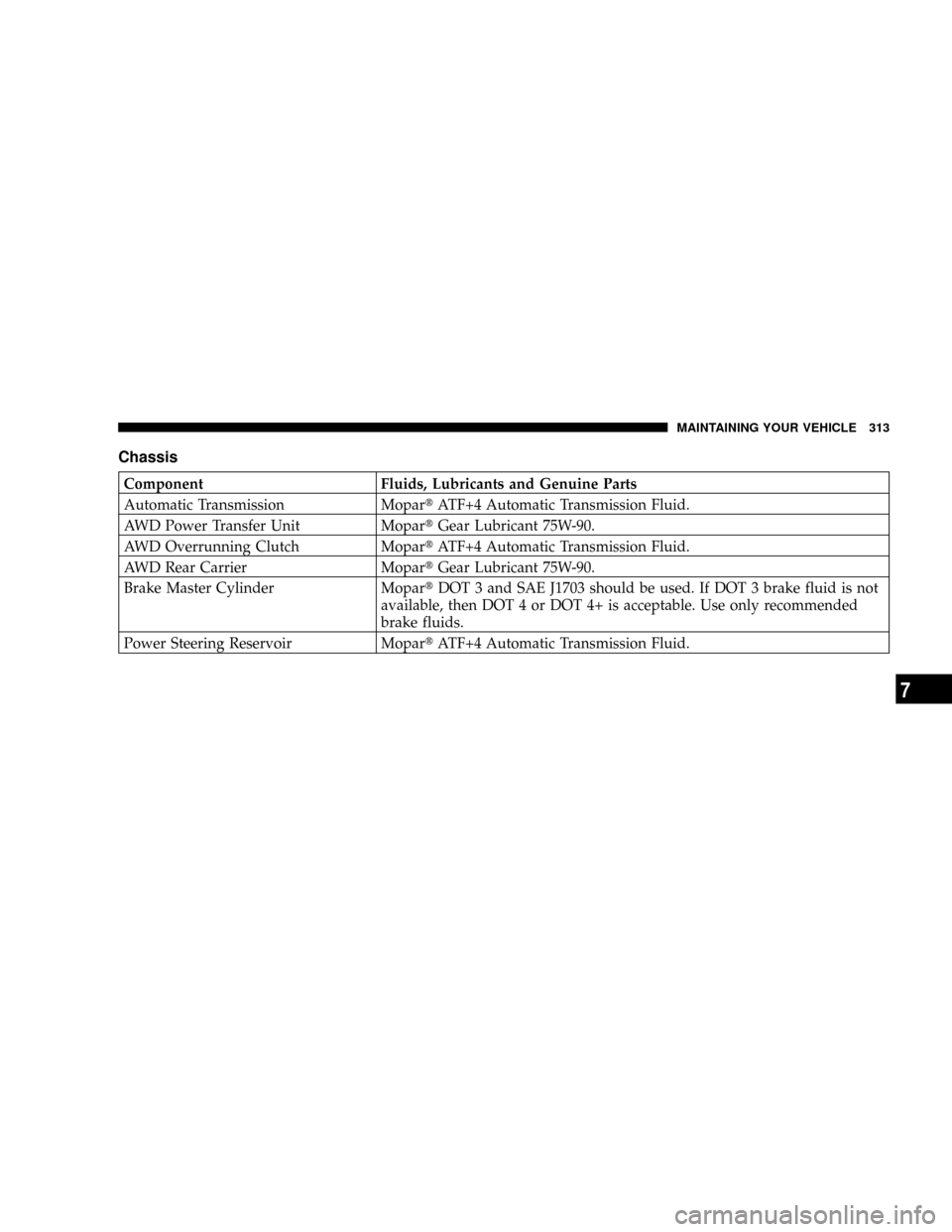
Chassis
Component Fluids, Lubricants and Genuine Parts
Automatic Transmission MopartATF+4 Automatic Transmission Fluid.
AWD Power Transfer Unit MopartGear Lubricant 75W-90.
AWD Overrunning Clutch MopartATF+4 Automatic Transmission Fluid.
AWD Rear Carrier MopartGear Lubricant 75W-90.
Brake Master Cylinder MopartDOT 3 and SAE J1703 should be used. If DOT 3 brake fluid is not
available, then DOT 4 or DOT 4+ is acceptable. Use only recommended
brake fluids.
Power Steering Reservoir MopartATF+4 Automatic Transmission Fluid.
MAINTAINING YOUR VEHICLE 313
7
Page 350 of 361

Oil ..............................272,312
Oil Change Interval.................... 274
Oil Selection.......................... 274
Oil Synthetic......................... 276
Overheating.......................... 251
Temperature Gauge..................... 138
Exhaust Gas Caution..............29,62,239,286
Exhaust System......................... 285
Exterior Folding Mirrors................... 70
Filters
Air Cleaner.......................... 277
Air Conditioning....................192,282
Automatic Transaxle.................... 297
Engine Fuel.......................... 277
Engine Oil........................276,312
Engine Oil Disposal.................... 276
Flashers
Hazard Warning....................... 250Turn Signal.....................139,309,310
Floor Console.......................... 126
Fluid Capacities......................... 311
Fluid Leaks............................. 63
Fluid Level Checks
Automatic Transaxle.................... 296
Brake............................... 313
Power Steering.....................282,313
Fog Light Service........................ 309
Fog Lights.......................106,143,309
Freeing A Stuck Vehicle................... 260
Fuel................................. 235
Adding............................. 240
Additives............................ 238
Clean Air............................ 236
Filler Cap............................ 240
Filter............................... 277
Gasoline............................ 235
Gauge.............................. 139
350 INDEX
Page 356 of 361

Mirrors.............................. 72
Outlet.............................. 124
Seats................................ 85
Steering............................. 211
Steering, Checking..................... 282
Sunroof............................. 121
Windows............................. 30
Pregnant Women and Seat Belts.............. 41
Pretensioners
Seat Belts............................. 40
Programmable Electronic Features...... 116,120,148
Programming Transmitters.............. 116,120
Radial Ply Tires......................... 226
Radiator Cap........................... 289
Radio.............................155,160
Radio Broadcast Signals................... 179
Radio Operation......................160,182
Radio Remote Controls.................172,178Rear Liftgate............................ 26
Rear Seating Flexibility.................... 96
Rear Window Defroster................... 193
Rear Window Features.................... 108
Rear Wiper/Washer...................... 108
Rearview Mirrors........................ 69
Reclining Front Seats...................... 91
Recommended Fluids, Lubricants and Genuine
Parts............................... 312
Reminder, Seat Belt....................... 40
Remote Keyless Entry..................... 19
Remote Sound System Controls.............. 178
Replacement Tires....................228,230
Reporting Safety Defects................... 340
Restraint, Head.......................... 86
Restraints, Child.......................53,59
Restraints, Infant......................... 56
Retractable Cargo Area Cover............... 127
Rocking Vehicle When Stuck................ 260
356 INDEX