parking brake CHRYSLER PACIFICA 2005 1.G User Guide
[x] Cancel search | Manufacturer: CHRYSLER, Model Year: 2005, Model line: PACIFICA, Model: CHRYSLER PACIFICA 2005 1.GPages: 376, PDF Size: 10.32 MB
Page 266 of 376
Spare Tire Removal
Fit the jack-handle over the drive nut. Rotate the nut to
the left until the spare is on the ground with enough slack
cable to allow you to pull the tire out from under the
vehicle.
CAUTION!
The winch mechanism is designed for use with the
jack handle only. Use of an air wrench or other
power tools is not recommended and can damage the
winch.
When the spare is clear, tilt the retainer at the end of the
cable and pull it through the center of the wheel.
Preparations For Jacking
Park the vehicle on a firm level surface, avoid ice or
slippery areas,set the parking brakeand place the gear
selector in PARK. Turn OFF the ignition.
WARNING!
Do not attempt to change a tire on the side of the
vehicle close to moving traffic. Pull far enough off
the road to avoid the danger of being hit when
operating the jack or changing the wheel.
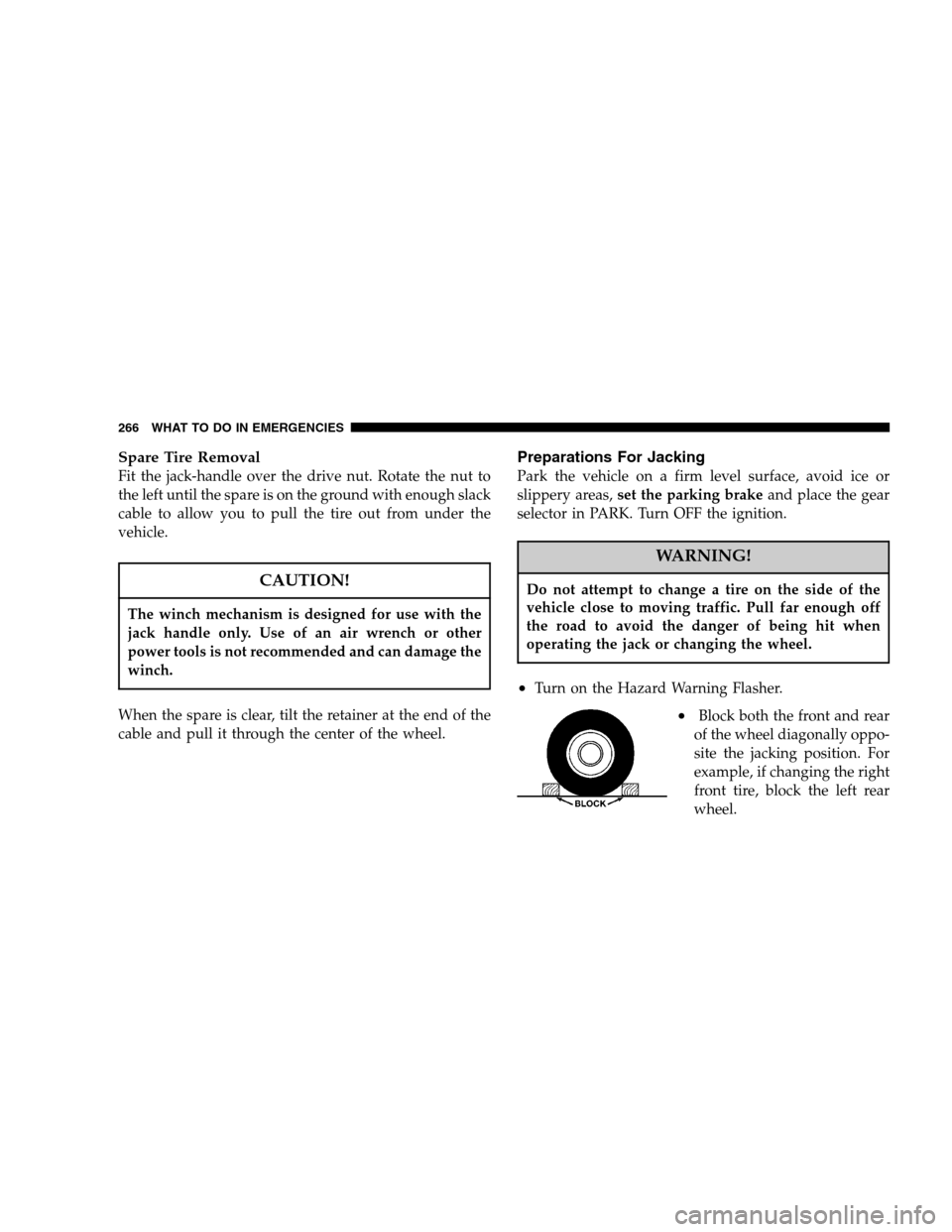
•Turn on the Hazard Warning Flasher.
•Block both the front and rear
of the wheel diagonally oppo-
site the jacking position. For
example, if changing the right
front tire, block the left rear
wheel.
266 WHAT TO DO IN EMERGENCIES
Page 271 of 376

WARNING!
•Do not attempt to push or tow your vehicle to get it
started. Vehicles equipped with an automatic trans-
mission cannot be started this way. Unburned fuel
could enter the catalytic converter and once the
engine has started, ignite and damage the converter
and vehicle. If the vehicle has a discharged battery,
booster cables may be used to obtain a start from
another vehicle. This type of start can be dangerous
if done improperly, so follow this procedure care-
fully.
•Battery fluid is a corrosive acid solution; do not
allow battery fluid to contact eyes, skin or clothing.
Don’t lean over battery when attaching clamps or
allow the clamps to touch each other. If acid splashes
in eyes or on skin, flush contaminated area immedi-
ately with large quantities of water.
•A battery generates hydrogen gas which is flam-
mable and explosive. Keep flame or spark away from
the vent holes. Do not use a booster battery or any
other booster source with an output that exceeds 12
volts.
1. Wear eye protection and remove any metal jewelry
such as watch bands or bracelets that might make an
inadvertent electrical contact.
2. When boost is provided by a battery in another
vehicle, park that vehicle within booster cable reach and
without letting the vehicles touch. Set the parking brake,
place the automatic transmission in PARK and turn the
ignition switch to the OFF position for both vehicles.
3. Turn off the heater, radio and all unnecessary electrical
loads.
4. Connect one end of a jumper cable to the positive
terminal of the discharged battery. Connect the other end
of the same cable to the positive terminal of the booster
battery.
WHAT TO DO IN EMERGENCIES 271
6
Page 308 of 376

Procedure For Checking Fluid Level
The fluid level in the automatic transmission should be
checked whenever the vehicle is serviced. Operation with
an improper fluid level will greatly reduce the life of the
transmission and of the fluid.
To properly check the automatic transmission fluid level,
the following procedure must be used:
1. The vehicle must be on level ground.
2. The engine should be running at curb idle speed for a
minimum of 60 seconds.3. Fully apply parking brake.
4. Place the gear selector momentarily in each gear
position ending with the lever in P (PARK). Wipe the area
around the dipstick clean to eliminate the possibility of
dirt entering the transmission.
5. Remove the dipstick and determine if the fluid is hot
or warm. Hot fluid is approximately 180°F (82°C), which
is the normal operating temperature after the vehicle has
been driven at least 15 miles (24 km). The fluid cannot be
comfortably held between the finger tips. Cold is when
the fluid is below 80°F (27°C).
6. Wipe the dipstick clean and reinsert until seated.
Remove dipstick and note reading.
a. If the fluid is hot, the reading should be in the
crosshatched area marked “HOT” (between the upper
two holes in the dipstick).
308 MAINTAINING YOUR VEHICLE
Page 361 of 376

Selection Of Lubricant................307,327
Shifting............................. 215
Special Additives...................... 309
Autostick........................120,215,216
Ball Joints............................. 295
Battery............................... 291
Jump Starting......................... 270
Keyless Transmitter Replacement............ 23
Bearings.............................. 311
Belts, Drive............................ 288
Body Mechanism Lubrication............... 296
B-Pillar Location........................ 229
Brake, Parking.......................... 218
Brake System........................219,304
Anti-Lock........................... 220
Fluid Check.......................305,327
Hoses.............................. 304
Warning Light........................ 146Brakes.............................219,304
Brake/Transmission Interlock............... 213
Break-In Recommendations, New Vehicle........ 59
Bulb Replacement....................... 321
Bulbs, Light............................ 320
Calibration, Compass..................... 158
Capacities, Fluid........................ 325
Caps, Filler
Fuel................................ 252
Radiator............................ 301
Car Washes............................ 312
Carbon Monoxide Warning................. 251
Cargo Area Cover....................... 134
Cargo Compartment
Luggage Carrier....................... 137
Cargo Tie-Downs........................ 135
Cassette Tape and Player Maintenance......... 192
Cassette Tape Player...................165,170
INDEX 361
10
Page 370 of 376

Overhead Travel Information Center.......... 122
Overheating, Engine...................144,263
Owner’s Manual.......................4,356
Panic Alarm............................ 21
Parking Brake.......................... 218
Parking On Hill......................... 218
Passing Light........................... 113
Pedals, Adjustable....................... 118
Pets.................................. 59
Phone, Cellular.......................... 71
Phone, Hands-Free....................... 71
Placard, Tire and Loading Information......... 229
Power
Brakes.............................. 219
Distribution Center..................... 316
Door Locks........................... 16
Lift Gate............................. 27
Mirrors.............................. 69Outlet.............................. 131
Seats................................ 93
Steering............................. 222
Steering, Checking..................... 294
Sunroof............................. 129
Windows............................. 29
Pregnant Women and Seat Belts.............. 41
Preparation for Jacking.................... 266
Pretensioners
Seat Belts............................. 39
Programmable Electronic Features......124,128,154
Programming Transmitters............21,124,128
Radial Ply Tires......................... 237
Radiator Cap........................... 301
Radio.............................161,165
Radio Broadcast Signals................... 191
Radio Operation......................166,194
Radio Remote Controls.................178,190
370 INDEX