tires CHRYSLER PACIFICA 2005 1.G Owner's Manual
[x] Cancel search | Manufacturer: CHRYSLER, Model Year: 2005, Model line: PACIFICA, Model: CHRYSLER PACIFICA 2005 1.GPages: 376, PDF Size: 10.32 MB
Page 247 of 376

Snow tires generally have lower speed ratings than what
was originally equipped with your vehicle and should
not be operated at sustained speeds over 75 mph (120
km/h).
TIRE ROTATION RECOMMENDATIONS
Tires on the front and rear axles of vehicles operate at
different loads and perform different steering, driving,
and braking functions. For these reasons, they wear at
unequal rates, and tend to develop irregular wear pat-
terns.
These effects can be reduced by timely rotation of tires.
The benefits of rotation are especially worthwhile with
aggressive tread designs such as those on all season type
tires. Rotation will increase tread life, help to maintain
mud, snow, and wet traction levels, and contribute to a
smooth, quiet ride.
Follow the recommended tire rotation frequency for your
type of driving found in the “Maintenance Schedules”Section of this manual. More frequent rotation is permis-
sible if desired. The reasons for any rapid or unusual
wear should be corrected prior to rotation being per-
formed.
NOTE:The Tire Pressure Monitor system must be
retrained following a tire rotation. See your authorized
dealer for service.
The suggested rotation method is the “forward-cross”
shown in the following diagram.
STARTING AND OPERATING 247
5
Page 255 of 376

WARNING!
Because the front wheels drive and steer the vehicle,
it is important that you do not exceed the maximum
front or rear GAWR. A dangerous driving condition
can result if either rating is exceeded. You could lose
control of the vehicle and have an accident.
Overloading
The load carrying components (axle, springs, tires,
wheels, etc.) of your vehicle will provide satisfactory
service as long as you do not exceed the GVWR and front
and rear GAWR.
The best way to figure out the total weight of your
vehicle is to weigh it when it is fully loaded and ready for
operation. Weigh it on a commercial scale to insure that it
is not over the GVWR.Figure out the weight on the front and rear of the vehicle
separately. It is important that you distribute the load
evenly over the front and rear axles.
Overloading can cause potential safety hazards and
shorten useful service life. Heavier axles or suspension
components do not necessarily increase the vehicle’s
GVWR.
Loading
To load your vehicle properly, first figure out its empty
weight, axle by axle and side by side. Store heavier items
down low and be sure you distribute their weight as
evenly as possible. Stow all loose items securely before
driving. If weighing the loaded vehicle shows that you
have exceeded either GAWR, but the total load is within
the specified GVWR, you must redistribute the weight.
Improper weight distribution can have an adverse effect
on the way your vehicle steers and handles and the way
the brakes operate.
STARTING AND OPERATING 255
5
Page 264 of 376

WARNING!
A hot engine cooling system is dangerous. You or
others could be badly burned by steam or boiling
coolant. You may want to call a service center if your
vehicle overheats. If you decide to look under the
hood yourself, see Section 7, Maintenance, of this
manual. Follow the warnings under the Cooling
System Pressure Cap paragraph.
JACKING AND TIRE CHANGING
WARNING!
•Getting under a jacked-up vehicle is dangerous.
The vehicle could slip off the jack and fall on you.
You could be crushed. Never get any part of your
body under a vehicle that is on a jack. If you need
to get under a raised vehicle, take it to a service
center where it can be raised on a lift.
•The jack is designed to use as a tool for changing
tires only. The jack should not be used to lift the
vehicle for service purposes. The vehicle should
be jacked on a firm level surface only. Avoid ice or
slippery areas.
264 WHAT TO DO IN EMERGENCIES
Page 273 of 376

2. Slow down if road has standing water or puddles.
3. Replace tires when tread wear indicators first become
visible.
4. Keep tires properly inflated.
5. Maintain sufficient distance between your vehicle and
the vehicle in front to avoid a collision in a sudden stop.
FREEING A STUCK VEHICLE
If your vehicle becomes stuck in mud, sand or snow, it
can often be moved by a rocking motion. Turn your
steering wheel right and left to clear the area around the
front wheels. Then shift back and forth between Reverse
and Drive. Usually the least accelerator pedal pressure to
maintain the rocking motion without spinning the
wheels is most effective.
WARNING!
Fast spinning tires can be dangerous. Forces gener-
ated by excessive wheel speeds may cause tire dam-
age or failure. A tire could explode and injure
someone. Do not spin your vehicle’s wheels faster
than 35 mph (55 km/h) when you are stuck. And
don’t let anyone near a spinning wheel, no matter
what the speed.
CAUTION!
Racing the engine or spinning the wheels too fast
may lead to transmission overheating and failure. It
can also damage the tires. Do not spin the wheels
above 35 mph (55 km/h).
WHAT TO DO IN EMERGENCIES 273
6
Page 334 of 376
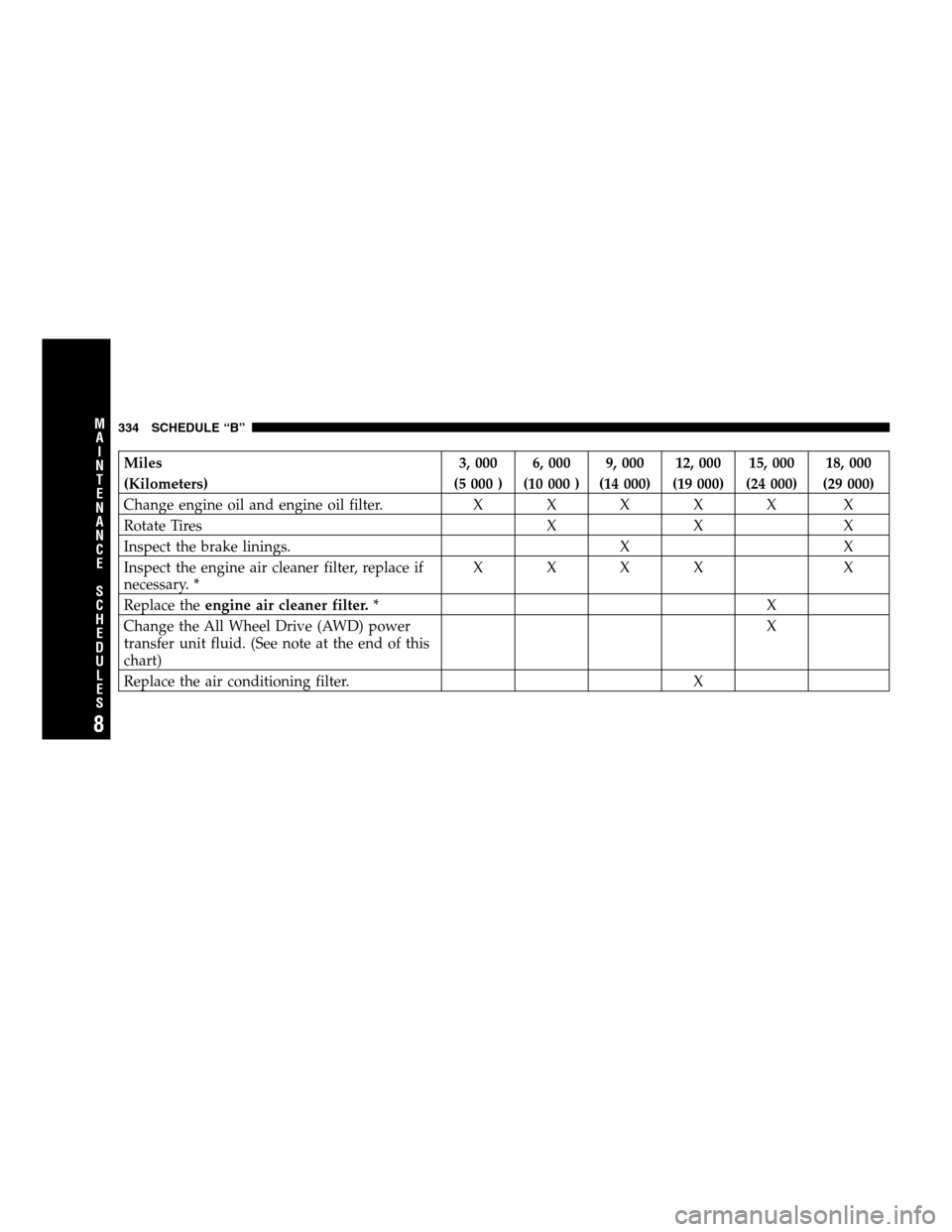
Miles 3, 000 6, 000 9, 000 12, 000 15, 000 18, 000
(Kilometers) (5 000 ) (10 000 ) (14 000) (19 000) (24 000) (29 000)
Change engine oil and engine oil filter.XXXXX X
Rotate Tires X X X
Inspect the brake linings. X X
Inspect the engine air cleaner filter, replace if
necessary. *XXXX X
Replace theengine air cleaner filter.*X
Change the All Wheel Drive (AWD) power
transfer unit fluid. (See note at the end of this
chart)X
Replace the air conditioning filter. X
334 SCHEDULE “B”
8
M
A
I
N
T
E
N
A
N
C
E
S
C
H
E
D
U
L
E
S
Page 335 of 376
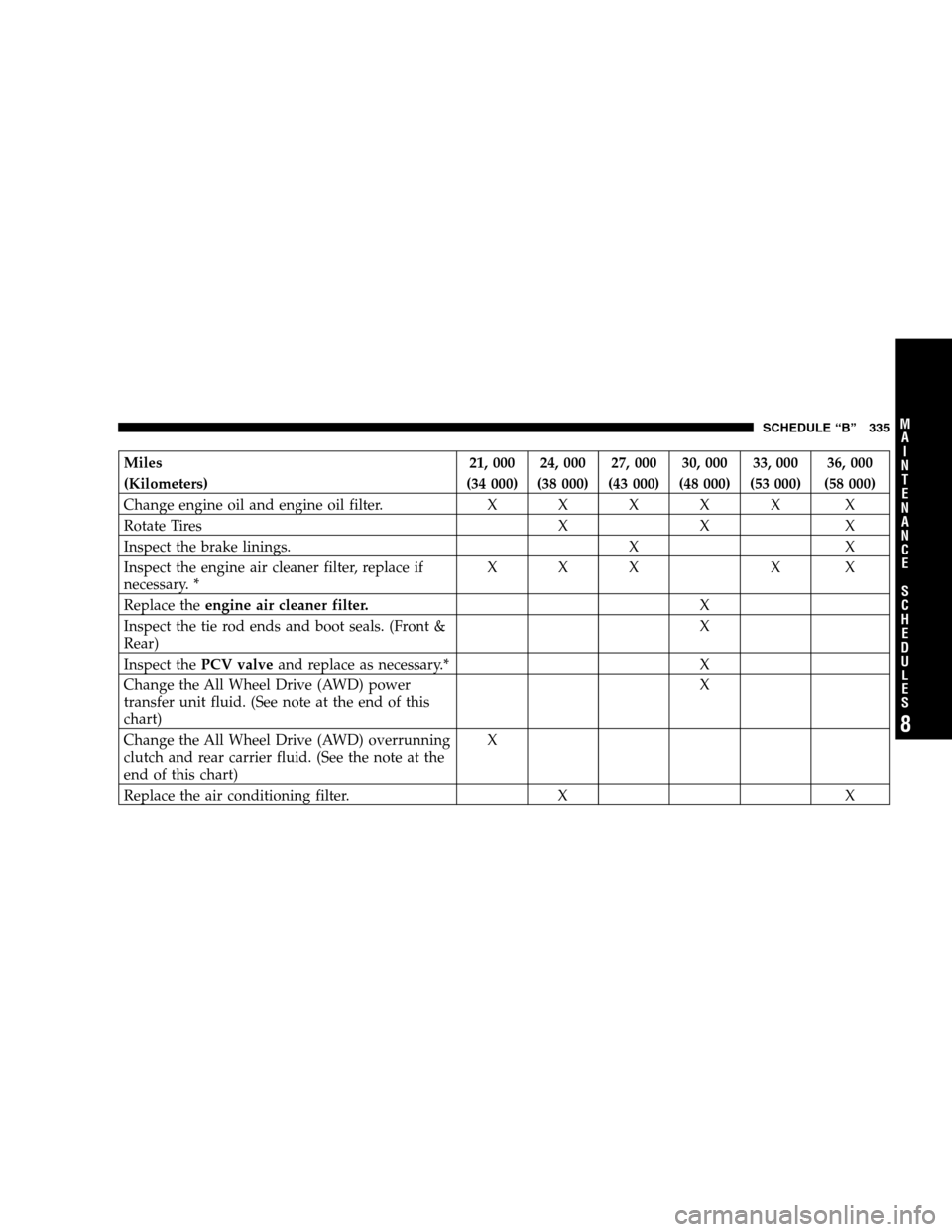
Miles 21, 000 24, 000 27, 000 30, 000 33, 000 36, 000
(Kilometers) (34 000) (38 000) (43 000) (48 000) (53 000) (58 000)
Change engine oil and engine oil filter.XXXXX X
Rotate Tires X X X
Inspect the brake linings. X X
Inspect the engine air cleaner filter, replace if
necessary. *XXX X X
Replace theengine air cleaner filter.X
Inspect the tie rod ends and boot seals. (Front &
Rear)X
Inspect thePCV valveand replace as necessary.* X
Change the All Wheel Drive (AWD) power
transfer unit fluid. (See note at the end of this
chart)X
Change the All Wheel Drive (AWD) overrunning
clutch and rear carrier fluid. (See the note at the
end of this chart)X
Replace the air conditioning filter. X X
SCHEDULE “B” 335
8
M
A
I
N
T
E
N
A
N
C
E
S
C
H
E
D
U
L
E
S
Page 336 of 376
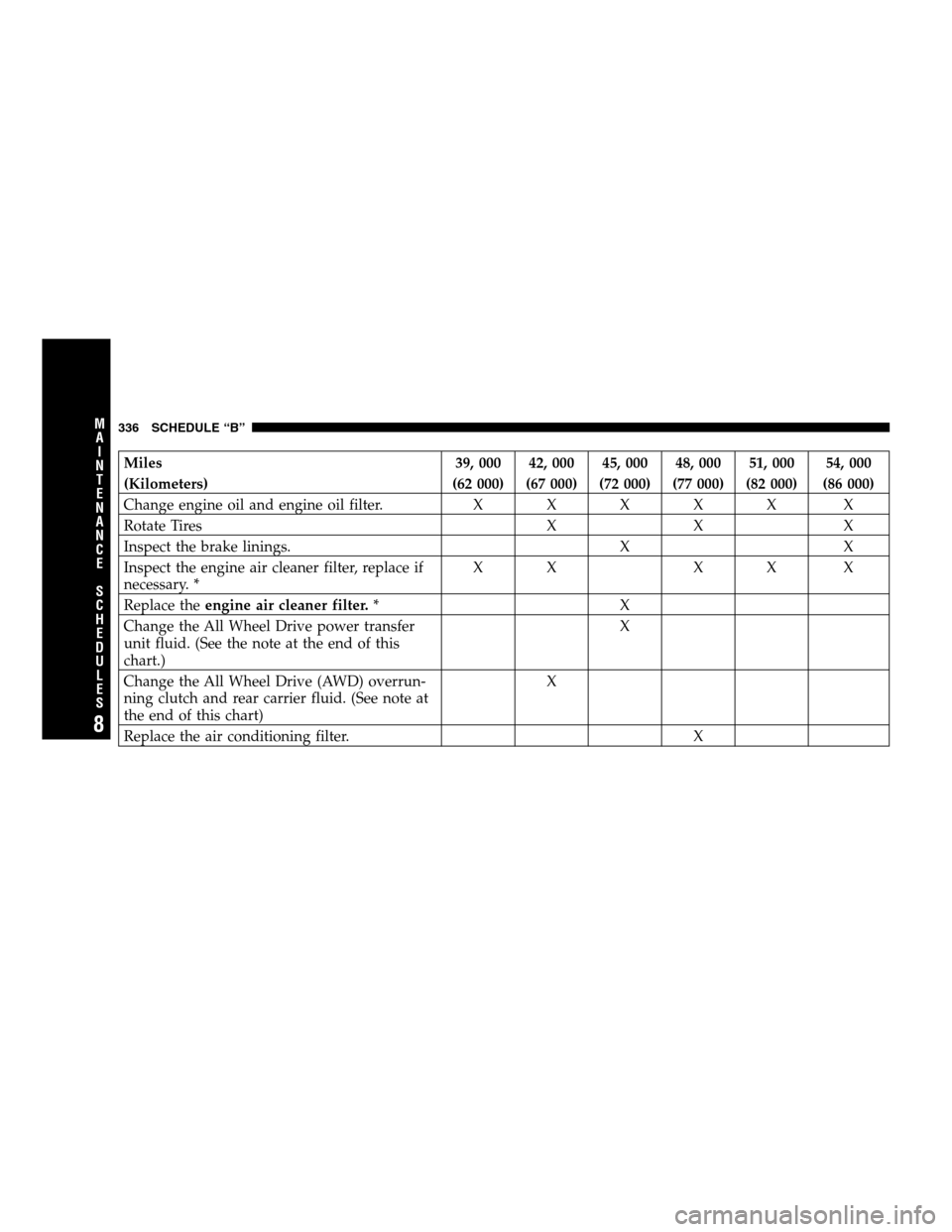
Miles 39, 000 42, 000 45, 000 48, 000 51, 000 54, 000
(Kilometers) (62 000) (67 000) (72 000) (77 000) (82 000) (86 000)
Change engine oil and engine oil filter.XXXXX X
Rotate Tires X X X
Inspect the brake linings. X X
Inspect the engine air cleaner filter, replace if
necessary. *XX XX X
Replace theengine air cleaner filter.*X
Change the All Wheel Drive power transfer
unit fluid. (See the note at the end of this
chart.)X
Change the All Wheel Drive (AWD) overrun-
ning clutch and rear carrier fluid. (See note at
the end of this chart)X
Replace the air conditioning filter. X
336 SCHEDULE “B”
8
M
A
I
N
T
E
N
A
N
C
E
S
C
H
E
D
U
L
E
S
Page 337 of 376
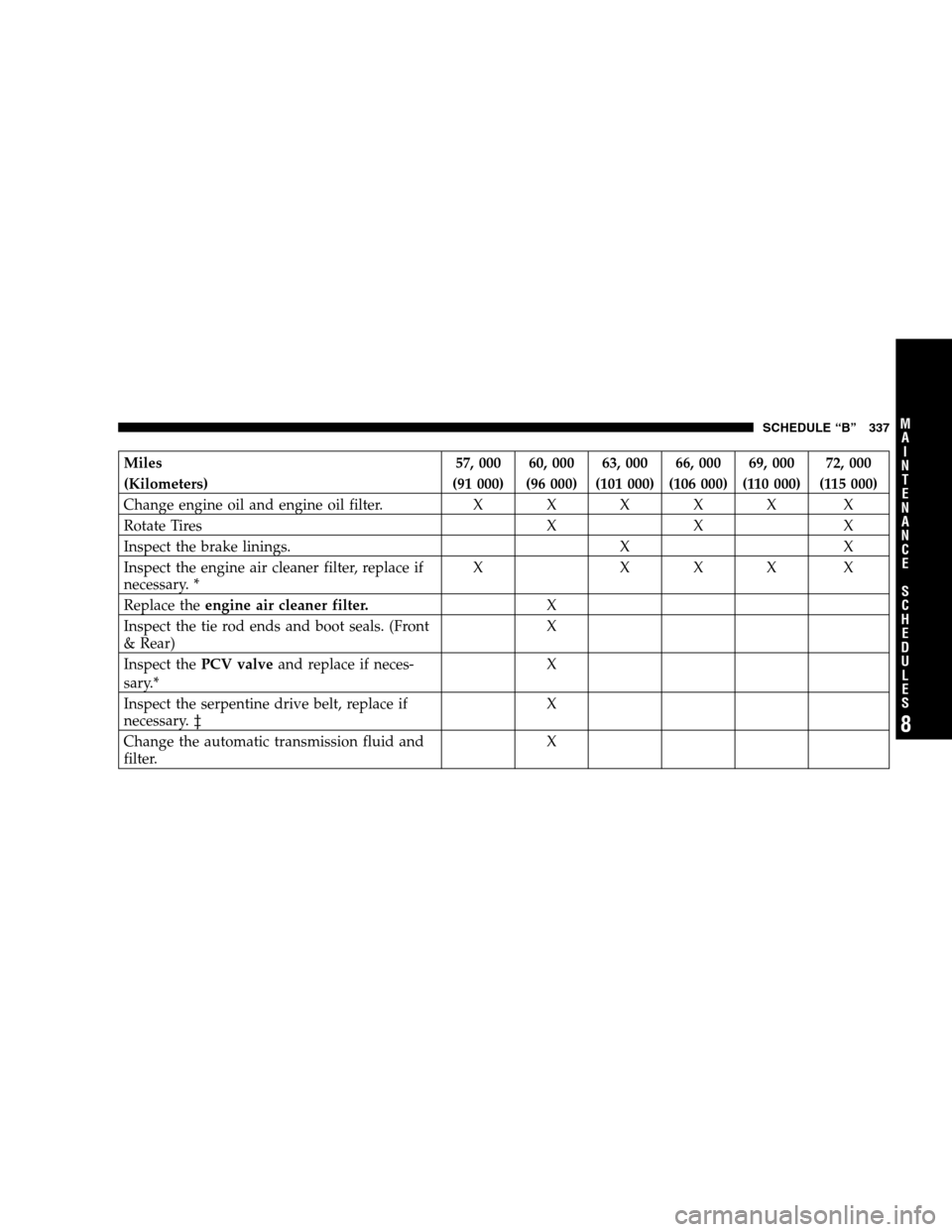
Miles 57, 000 60, 000 63, 000 66, 000 69, 000 72, 000
(Kilometers) (91 000) (96 000) (101 000) (106 000) (110 000) (115 000)
Change engine oil and engine oil filter.XXXXX X
Rotate Tires X X X
Inspect the brake linings. X X
Inspect the engine air cleaner filter, replace if
necessary. *X XXX X
Replace theengine air cleaner filter.X
Inspect the tie rod ends and boot seals. (Front
& Rear)X
Inspect thePCV valveand replace if neces-
sary.*X
Inspect the serpentine drive belt, replace if
necessary. ‡X
Change the automatic transmission fluid and
filter.X
SCHEDULE “B” 337
8
M
A
I
N
T
E
N
A
N
C
E
S
C
H
E
D
U
L
E
S
Page 339 of 376
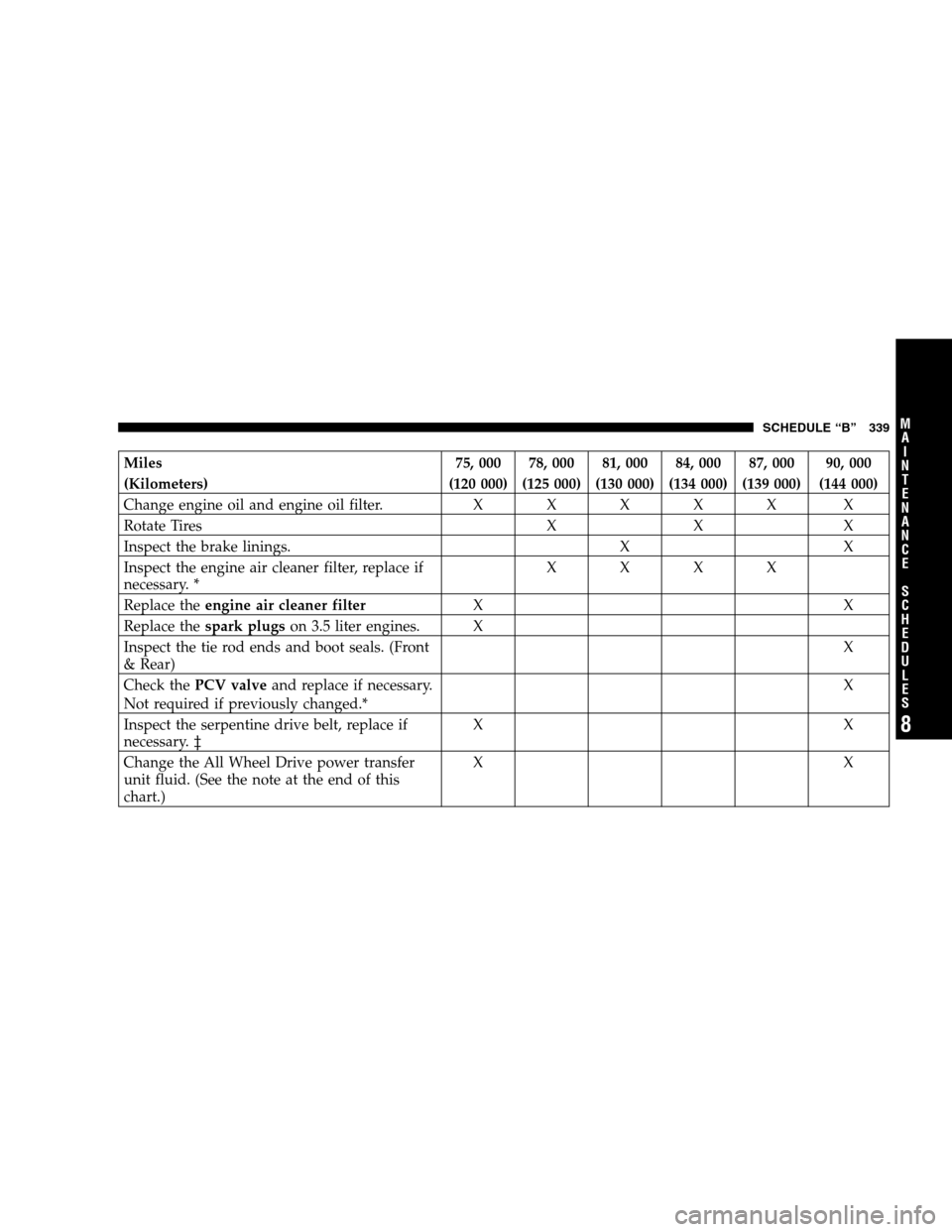
Miles 75, 000 78, 000 81, 000 84, 000 87, 000 90, 000
(Kilometers) (120 000) (125 000) (130 000) (134 000) (139 000) (144 000)
Change engine oil and engine oil filter.XXXXX X
Rotate Tires X X X
Inspect the brake linings. X X
Inspect the engine air cleaner filter, replace if
necessary. *XXXX
Replace theengine air cleaner filterXX
Replace thespark plugson 3.5 liter engines. X
Inspect the tie rod ends and boot seals. (Front
& Rear)X
Check thePCV valveand replace if necessary.
Not required if previously changed.*X
Inspect the serpentine drive belt, replace if
necessary. ‡XX
Change the All Wheel Drive power transfer
unit fluid. (See the note at the end of this
chart.)XX
SCHEDULE “B” 339
8
M
A
I
N
T
E
N
A
N
C
E
S
C
H
E
D
U
L
E
S
Page 341 of 376
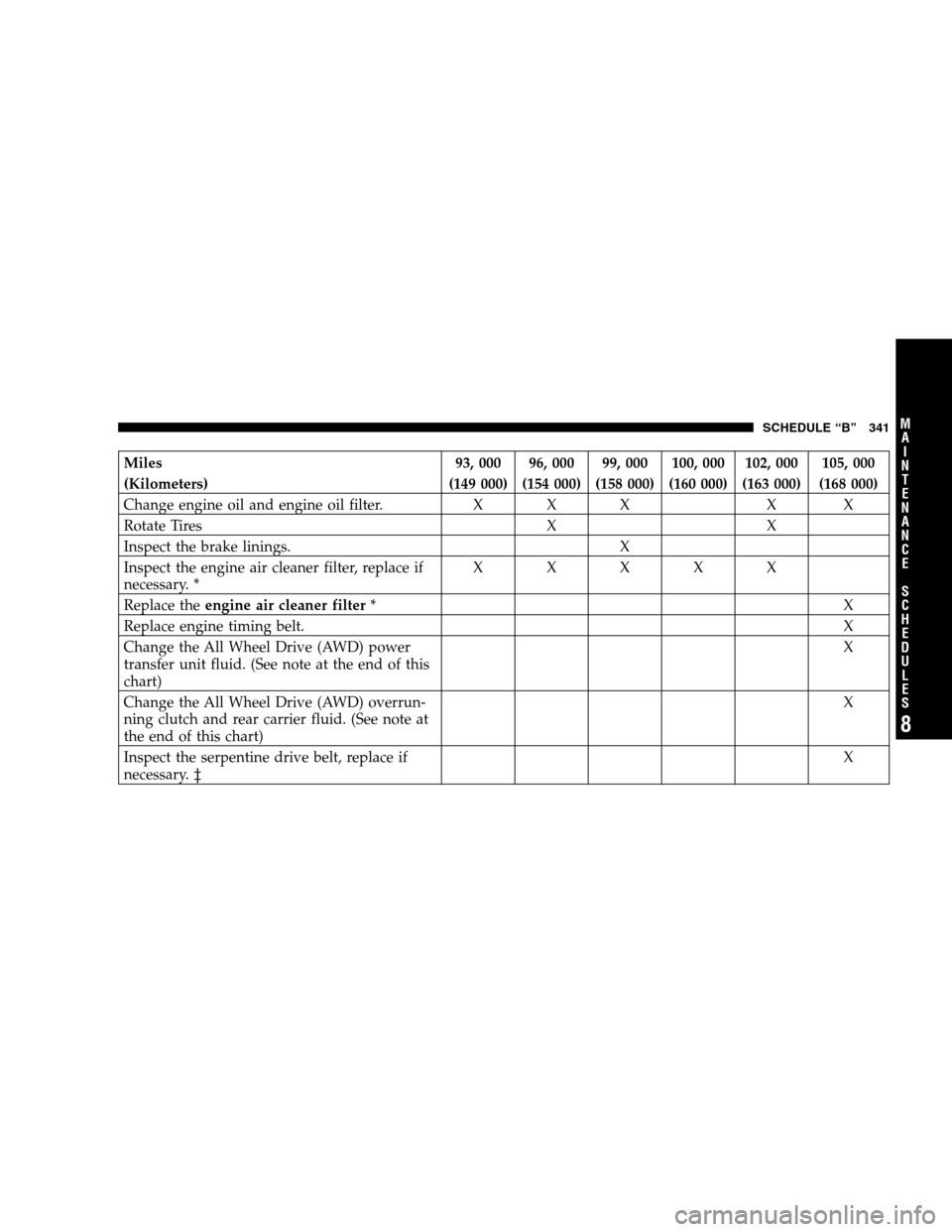
Miles 93, 000 96, 000 99, 000 100, 000 102, 000 105, 000
(Kilometers) (149 000) (154 000) (158 000) (160 000) (163 000) (168 000)
Change engine oil and engine oil filter. X X X X X
Rotate Tires X X
Inspect the brake linings. X
Inspect the engine air cleaner filter, replace if
necessary. *XXXXX
Replace theengine air cleaner filter*X
Replace engine timing belt.X
Change the All Wheel Drive (AWD) power
transfer unit fluid. (See note at the end of this
chart)X
Change the All Wheel Drive (AWD) overrun-
ning clutch and rear carrier fluid. (See note at
the end of this chart)X
Inspect the serpentine drive belt, replace if
necessary. ‡X
SCHEDULE “B” 341
8
M
A
I
N
T
E
N
A
N
C
E
S
C
H
E
D
U
L
E
S