change wheel CHRYSLER PACIFICA 2005 1.G Owners Manual
[x] Cancel search | Manufacturer: CHRYSLER, Model Year: 2005, Model line: PACIFICA, Model: CHRYSLER PACIFICA 2005 1.GPages: 376, PDF Size: 10.32 MB
Page 157 of 376

Reset Service Distance (Displays Only if Service
Interval was Changed)
When this feature is selected the current accumulated
service distance can be reset to the newly selected service
interval. Pressing the STEP button when in this display
will select “Yes” or “No.”
Power Accessory Delay?
When this feature is selected, the power window
switches, radio, hands–free system, DVD video system,
power sunroof, and power outlets will remain active for
up to 45 seconds after the ignition switch has been turned
off. Opening a vehicle door or liftgate will cancel this
feature.
Easy Exit Seat? (Available with Memory Seat Only)
When this feature is selected, the driver’s seat moves
rearward 5 cm (2 inches) or to the farthest rearward
position if this distance is less than 5 cm (2 inches) when
the key is removed from the ignition switch so that thedriver can more easily exit the vehicle. The seat will
return to the memorized seat location (if REMOTE LINK
TO MEMORY is set to YES) when the remote keyless
entry transmitter is used to unlock the door. Pressing the
STEP button when in this display will select “Yes” or
“No.”
Retrain Tire Sensors (Available with Tire Pressure
Monitor System Only)
The Tire Pressure Monitor system must be retrained
following a tire rotation or wheel rim mounted sensor
replacement. See your authorized dealer for service.
Compass Display — If Equipped
This display provides one of eight compass readings to
indicate the direction the vehicle is facing.
UNDERSTANDING YOUR INSTRUMENT PANEL 157
4
Page 190 of 376

REMOTE SOUND SYSTEM CONTROLS
The remote sound system controls are located on the rear
surface of the steering wheel at the 3 and 9 o’clock
positions.
The right hand rocker switch has a push button in the
center and controls the volume and mode of the sound
system. Pressing the top of the rocker switch will increase
the volume and pressing the bottom of the rocker switch
will decrease the volume. Pressing the center button
changes the operation of the radio from AM to FM to
Tape or CD mode depending on which radio is in the
vehicle.
The left hand rocker switch has a push button in the
center. The function of the left hand switch is different
depending on which mode you are in.
The following describes the left hand rocker switch
operation in each mode:
Radio Operation
Pressing the top of the switch will SEEK up for the next
listenable station and pressing the bottom of the switch
will SEEK down for the next listenable station.
The button located in the center of the left hand switch
will tune to the next pre-set station that you have
programmed in the radio pre-set push-button.
Tape Player
Pressing the top of the switch once will go to the next
selection on the cassette. Pressing the bottom of the
switch once will go to the beginning of the current
selection or to the beginning of the previous selection if it
is within the first 5 seconds of the current selection.
If you press the switch up or down twice it plays the
second selection, three times, it will play the third, etc.
The button in the center of the left hand switch has no
function in this mode.
190 UNDERSTANDING YOUR INSTRUMENT PANEL
Page 192 of 376

AM Reception
AM sound is based on wave amplitude, so AM reception
can be disrupted by such things as lightning, power lines
and neon signs.
FM Reception
Because FM transmission is based on frequency varia-
tions, interference that consists of amplitude variations
can be filtered out, leaving the reception relatively clear,
which is the major feature of FM radio.
NOTE:On vehicles so equipped the radio, steering
wheel radio controls and 6 disc CD/DVD changer if
equipped, will remain active for up to 45 seconds after
the ignition switch has been turned off. Opening a
vehicle front door will cancel this feature.
CASSETTE TAPE AND PLAYER MAINTENANCE
To keep the cassette tapes and player in good condition,
take the following precautions:
1. Do not use cassette tapes longer than C-90; otherwise,
sound quality and tape durability will be greatly dimin-
ished.
2. Keep the cassette tape in its case to protect from
slackness and dust when it is not in use.
3. Keep the cassette tape away from direct sunlight, heat
and magnetic fields such as the radio speakers.
4. Before inserting a tape, make sure that the label is
adhering flatly to the cassette.
5. A loose tape should be corrected before use. To rewind
a loose tape, insert the eraser end of a pencil into the tape
drive gear and twist the pencil in the required directions.
192 UNDERSTANDING YOUR INSTRUMENT PANEL
Page 241 of 376
WARNING!
•Do not use a tire, wheel size or rating other than
that specified for your vehicle. Some combinations
of unapproved tires and wheels may change sus-
pension dimensions and performance characteris-
tics, resulting in changes to steering, handling, and
braking of your vehicle. This can cause unpredict-
able handling and stress to steering and suspen-
sion components. You could lose control and have
an accident resulting in serious injury or death.
Use only the tire and wheel sizes with load ratings
approved for your vehicle.
•Never use a tire with a smaller load index or
capacity, other than what was originally equipped
on your vehicle. Using a tire with a smaller load
index could result in tire overloading and failure.
You could lose control and have an accident.
•Failure to equip your vehicle with tires having
adequate speed capability can result in sudden tire
failure and loss of vehicle control.
CAUTION!
Replacing original tires with tires of a different size
may result in false speedometer and odometer read-
ings.
Alignment And Balance
Poor suspension alignment may result in:
•Fast tire wear.
•Uneven tire wear, such as feathering and one-sided
wear.
•Vehicle pull to right or left.
Tires may also cause the vehicle to pull to the left or right.
Alignment will not correct this condition. See your dealer
for proper diagnosis.
STARTING AND OPERATING 241
5
Page 266 of 376
Spare Tire Removal
Fit the jack-handle over the drive nut. Rotate the nut to
the left until the spare is on the ground with enough slack
cable to allow you to pull the tire out from under the
vehicle.
CAUTION!
The winch mechanism is designed for use with the
jack handle only. Use of an air wrench or other
power tools is not recommended and can damage the
winch.
When the spare is clear, tilt the retainer at the end of the
cable and pull it through the center of the wheel.
Preparations For Jacking
Park the vehicle on a firm level surface, avoid ice or
slippery areas,set the parking brakeand place the gear
selector in PARK. Turn OFF the ignition.
WARNING!
Do not attempt to change a tire on the side of the
vehicle close to moving traffic. Pull far enough off
the road to avoid the danger of being hit when
operating the jack or changing the wheel.
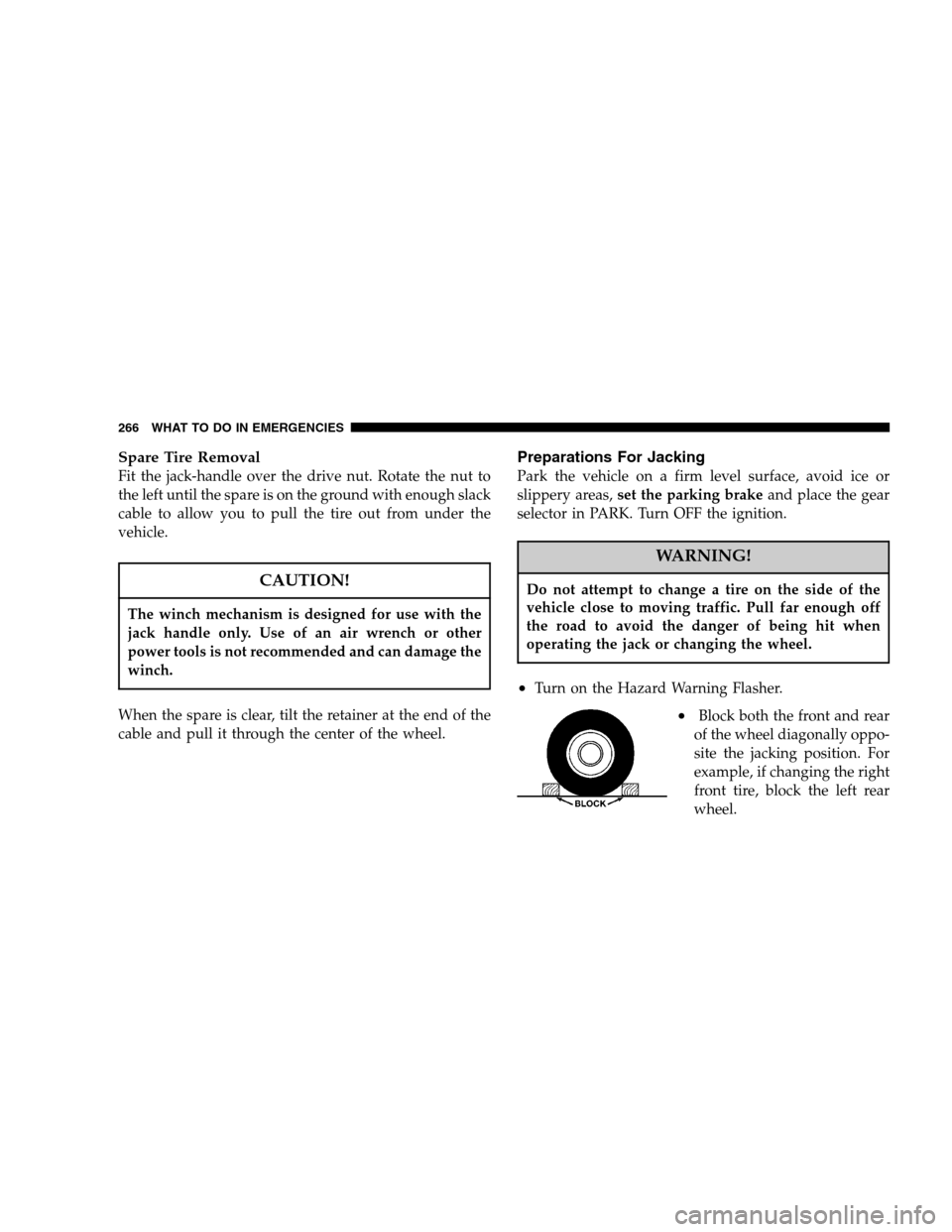
•Turn on the Hazard Warning Flasher.
•Block both the front and rear
of the wheel diagonally oppo-
site the jacking position. For
example, if changing the right
front tire, block the left rear
wheel.
266 WHAT TO DO IN EMERGENCIES
Page 267 of 376

•Passengers should not remain in the vehicle when the
vehicle is being jacked.
Jacking Instructions
1. Remove the spare wheel, scissors jack and jack-handle
from stowage.
2. Carefully pry off the wheel center cap using the tip of
the jack handle.
3. Loosen (but do not remove) the wheel lug nuts by
turning them to the left one turn while the wheel is still
on the ground.
4. There are two jack engagement locations on each side
of the body — see illustration.5. These locations are on the sill flange on the underside
of the body. The jack is to be located, engaging the
flanges, 20 cm (8 inches) inward from the edge of the
wheel opening closest to the wheel to be changed. Place
the wrench on the jack screw and turn to the right until
the jack head is properly engaged in the described
WHAT TO DO IN EMERGENCIES 267
6
Page 310 of 376

All Wheel Drive (AWD) — If Equipped
Under normal operating conditions, periodic fluid level
checks and lubricant changes for the Power Transfer
Unit, Overrunning Clutch and Rear Carrier, are not
required. However when the vehicle is serviced for other
reasons, the exterior surface of these components should
be inspected for evidence of fluid leaks. Confirmed leaks
should be repaired as soon as possible.
Power Transfer Unit
The fill plug is located on the side of the power transfer
unit housing. The fluid should be maintained at a level
even with the bottom of the fill plug hole when the
vehicle is parked on a level surface. If it becomes neces-
sary to add or replace the fluid, use only the manufac-
turers recommended fluid, refer to Recommended Flu-
ids, Lubricants and Genuine Parts for correct fluid type.
Overrunning Clutch
The fill plug is located on the side of the overrunning
clutch housing. The fluid should be maintained at a level
even with the bottom of the fill plug hole when the
vehicle is parked on a level surface. If it becomes neces-
sary to add or replace the fluid, use only the manufac-
turers recommended transmission fluid, refer to Recom-
mended Fluids, Lubricants and Genuine Parts for correct
fluid type. To assure performance, it is important that the
proper lubricant be used.
Rear Carrier
The fill plug is located on the side of the rear carrier
housing. The fluid should be maintained at a level even
with the bottom of the fill plug hole when the vehicle is
parked on a level surface. if it becomes necessary to add
or replace the fluid, use only the manufacturers recom-
mended fluid, refer to Recommended Fluids, Lubricants
and Genuine Parts for correct fluid type.
310 MAINTAINING YOUR VEHICLE
Page 311 of 376

Fluid Changes
The fluid should be changed as follows:
Normal UsageNo Service Required
Severe Usage
Power Transfer Unit 15,000 miles (24 000 km)
Overrunning Clutch 22,500 miles (36 000 km)
Rear Carrier 22,500 miles (36 000 km)
Severe Usage is defined as:
1. More than 50% of vehicle operation in stop and go
traffic where vehicle is driven regularly for more than 45
minutes of continuous operation, such as in heavy city or
in construction zone traffic,
2. Police, taxi, limousine, commercial type operation, or
trailer towing where the vehicle driven regularly for
more than 45 minutes of continuous operation.
Front And Rear Wheel Bearings
Front and rear wheel bearings are permanently sealed.
No regular maintenance is required for these compo-
nents.
Appearance Care and Protection from Corrosion
Protection of Body and Paint from Corrosion
Vehicle body care requirements vary according to geo-
graphic locations and usage. Chemicals that make roads
passable in snow and ice, and those that are sprayed on
trees and road surfaces during other seasons, are highly
corrosive to the metal in your vehicle. Outside parking,
which exposes your vehicle to airborne contaminants,
road surfaces on which the vehicle is operated, extreme
hot or cold weather and other extreme conditions will
have an adverse effect on paint, metal trim, and under-
body protection.
MAINTAINING YOUR VEHICLE 311
7
Page 334 of 376
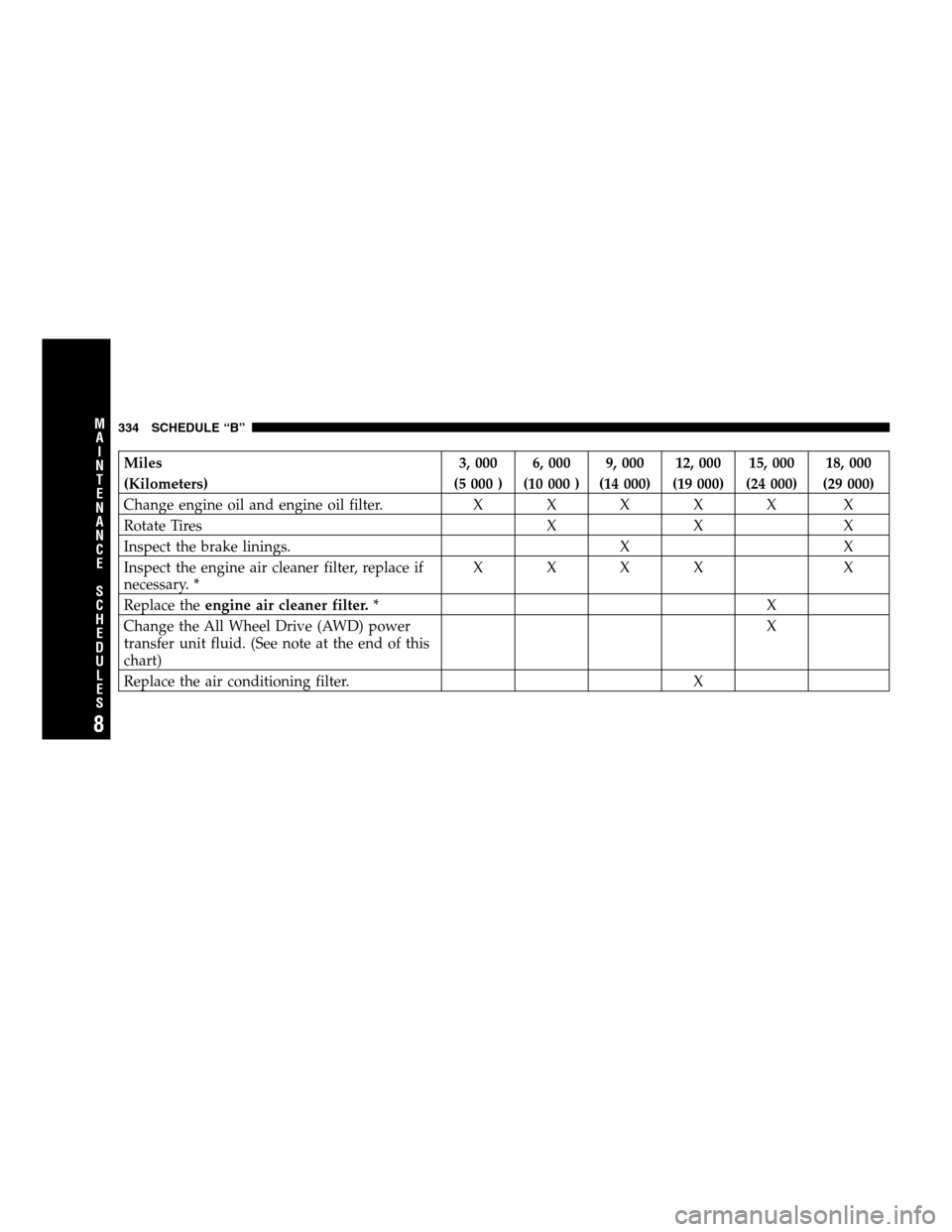
Miles 3, 000 6, 000 9, 000 12, 000 15, 000 18, 000
(Kilometers) (5 000 ) (10 000 ) (14 000) (19 000) (24 000) (29 000)
Change engine oil and engine oil filter.XXXXX X
Rotate Tires X X X
Inspect the brake linings. X X
Inspect the engine air cleaner filter, replace if
necessary. *XXXX X
Replace theengine air cleaner filter.*X
Change the All Wheel Drive (AWD) power
transfer unit fluid. (See note at the end of this
chart)X
Replace the air conditioning filter. X
334 SCHEDULE “B”
8
M
A
I
N
T
E
N
A
N
C
E
S
C
H
E
D
U
L
E
S
Page 335 of 376
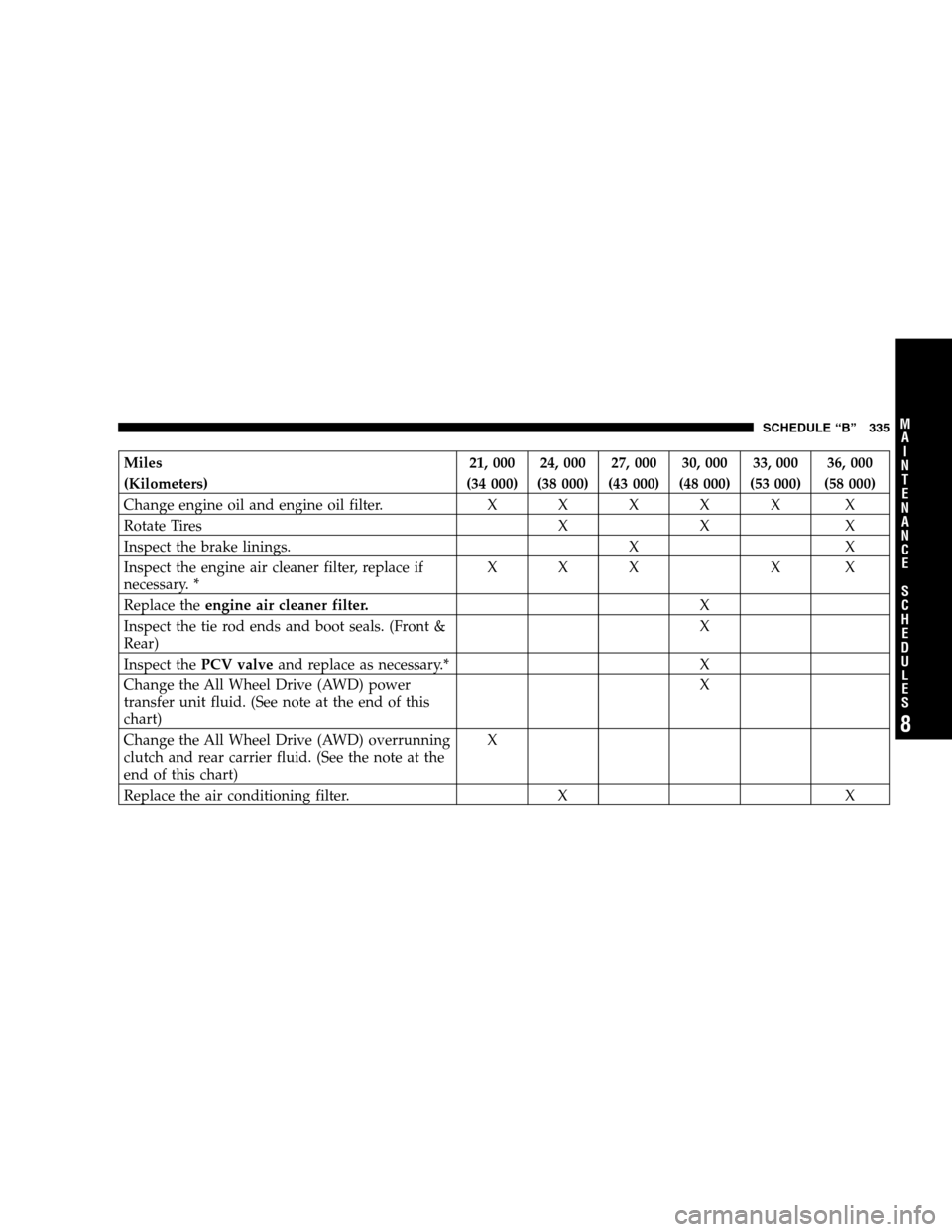
Miles 21, 000 24, 000 27, 000 30, 000 33, 000 36, 000
(Kilometers) (34 000) (38 000) (43 000) (48 000) (53 000) (58 000)
Change engine oil and engine oil filter.XXXXX X
Rotate Tires X X X
Inspect the brake linings. X X
Inspect the engine air cleaner filter, replace if
necessary. *XXX X X
Replace theengine air cleaner filter.X
Inspect the tie rod ends and boot seals. (Front &
Rear)X
Inspect thePCV valveand replace as necessary.* X
Change the All Wheel Drive (AWD) power
transfer unit fluid. (See note at the end of this
chart)X
Change the All Wheel Drive (AWD) overrunning
clutch and rear carrier fluid. (See the note at the
end of this chart)X
Replace the air conditioning filter. X X
SCHEDULE “B” 335
8
M
A
I
N
T
E
N
A
N
C
E
S
C
H
E
D
U
L
E
S