ESP CHRYSLER PACIFICA 2005 1.G Owner's Manual
[x] Cancel search | Manufacturer: CHRYSLER, Model Year: 2005, Model line: PACIFICA, Model: CHRYSLER PACIFICA 2005 1.GPages: 420, PDF Size: 5.83 MB
Page 288 of 420

Gasoline/Oxygenate Blends
Some fuel suppliers blend unleaded gasoline with oxy-
genates such as 10% ethanol, MTBE, and ETBE. Oxygen-
ates are required in some areas of the country during the
winter months to reduce carbon monoxide emissions.
Fuels blended with these oxygenates may be used in
your vehicle.
CAUTION!
DO NOT use gasolines containing Methanol. Use of
these blends may result in starting and driveability
problems and may damage critical fuel system com-
ponents.
Problems that result from using methanol/gasoline
blends are not the responsibility of the manufacturer.
While MTBE is an oxygenate made from Methanol, it
does not have the negative effects of Methanol.
MMT In Gasoline
MMT is a manganese containing metallic additive that is
blended into some gasoline to increase the octane num-
ber. Gasolines blended with MMT offer no performance
advantage beyond gasolines of the same octane number
without MMT. Gasolines blended with MMT have shown
to reduce spark plug life and reduce emission system
performance in some vehicles. The manufacturer recom-
mends using gasolines without MMT. Since the MMT
content of gasoline may not be indicated on the pump,
you should ask your gasoline retailer whether or not
his/her gasoline contains MMT.
It is even more important to look for gasolines without
MMT in Canada, because MMT can be used at levels
higher than those allowed in the United States.
MMT is prohibited in Federal and California reformu-
lated gasolines.
288 STARTING AND OPERATING
Page 289 of 420

Materials Added to Fuel
All gasoline sold in the United States is required to
contain effective detergent additives. Use of additional
detergents or other additives are not needed under
normal conditions and would result in additional cost.
Therefore you should not have to add anything to the
fuel.
Fuel System Cautions
CAUTION!
Follow these guidelines to maintain your vehicle’s
performance:
•The use of leaded gas is prohibited by Federal law.
Using leaded gasoline can impair engine performance,
damage the emission control system.
•An out-of-tune engine, or certain fuel or ignition
malfunctions, can cause the catalytic converter to
overheat. If you notice a pungent burning odor or
some light smoke, your engine may be out of tune or
malfunctioning and may require immediate service.
Contact your dealer for service assistance.
•The use of fuel additives which are now being sold as
octane enhancers is not recommended. Most of these
products contain high concentrations of methanol.
Fuel system damage or vehicle performance problems
resulting from the use of such fuels or additives is not
the responsibility of the manufacturer.
NOTE:Intentional tampering with emissions control
systems can result in civil penalties being assessed
against you.
STARTING AND OPERATING 289
5
Page 343 of 420

The use of lower quality water will reduce the amount of
corrosion protection in the engine cooling system.
Please note that it is the owner’s responsibility to main-
tain the proper level of protection against freezing ac-
cording to the temperatures occurring in the area where
the vehicle is operated.
NOTE:Mixing coolant types will decrease the life of the
engine coolant and will require more frequent coolant
changes.
Cooling System Pressure Cap
The cap must be fully tightened to prevent loss of
coolant, and to insure that coolant will return to the
radiator from the coolant recovery bottle.
The cap should be inspected and cleaned if there is any
accumulation of foreign material on the sealing surfaces.
WARNING!
•The warning words“DO NOT OPEN HOT”on
the cooling system pressure cap are a safety pre-
caution. Never add coolant when the engine is
overheated. Do not loosen or remove the cap to
cool an overheated engine. Heat causes pressure
to build up in the cooling system. To prevent
scalding or injury, do not remove the pressure cap
while the system is hot or under pressure.
•Do not use a pressure cap other than the one
specified for your vehicle. Personal injury or
engine damage may result.
MAINTAINING YOUR VEHICLE 343
7
Page 355 of 420

Washing
•
Wash your vehicle regularly. Always wash your ve-
hicle in the shade using a mild car wash soap, and
rinse the panels completely with clear water.
•If insects, tar or other similar deposits have accumu-
lated on your vehicle, wash it as soon as possible.
•Use Mopar auto polish to remove road film and stains
and to polish your vehicle. Take care never to scratch
the paint.
•Avoid using abrasive compounds and power buffing
that may diminish the gloss or thin out the paint
finish.
CAUTION!
Do not use abrasive or strong cleaning materials
such as steel wool or scouring powder, which will
scratch metal and painted surfaces.
Special Care
•
If you drive on salted or dusty roads or if you drive
near the ocean, hose off the undercarriage at least once
a month.
•It is important that the drain holes in the lower edges
of the doors, rocker panels and liftgate be kept clear
and open.
•If you detect any stone chips or scratches in the paint,
touch them up immediately. The cost of such repairs is
considered the responsibility of the owner.
MAINTAINING YOUR VEHICLE 355
7
Page 356 of 420

•If your vehicle is damaged due to an accident or
similar cause which destroys the paint and protective
coating have your vehicle repaired as soon as possible.
The cost of such repairs is considered the responsibil-
ity of the owner.
•All wheels and wheel trim, especially aluminum and
chrome plated wheels should be cleaned regularly
with mild soap and water to prevent corrosion. To
remove heavy soil, select a nonabrasive, non-acidic
cleaner. Do not use scouring pads, steel wool, a bristle
brush or metal polishes. Only Mopar cleaners are
recommended. Do not use oven cleaner. Avoid auto-
matic car washes that use acidic solutions or harsh
brushes that may damage the wheels’protective fin-
ish.
•If you carry special cargo such as chemicals, fertilizers,
de-icer salt, etc., be sure that such materials are well
packaged and sealed.
•If a lot of driving is done on gravel roads, consider
mud or stone shields behind each wheel.
•Use Mopar touch up paint on scratches as soon as
possible. Your dealer has touch up paint to match the
color of your vehicle.
Interior Care
Use Mopar Fabric Cleaner to clean fabric upholstery and
carpeting.
Use Mopar Vinyl Cleaner to clean vinyl upholstery and
trim.
Mopar Total Clean is specifically recommended for
leather upholstery.
356 MAINTAINING YOUR VEHICLE
Page 357 of 420

Your leather upholstery can be best preserved by regular
cleaning with a damp soft cloth. Small particles of dirt
can act as an abrasive and damage the leather upholstery
and should be removed promptly with a damp cloth.
Stubborn soils can be removed easily with a soft cloth
and Mopar Total Clean. Care should be taken to avoid
soaking your leather upholstery with any liquid. Please
do not use polishes, oils, cleaning fluids, solvents, deter-
gents, or ammonia based cleaners to clean your leather
upholstery. Application of a leather conditioner is not
required to maintain the original condition.
WARNING!
Do not use volatile solvents for cleaning purposes.
Many are potentially flammable, and if used in
closed areas they may cause respiratory harm.
Glass Surfaces
All glass surfaces should be cleaned on a regular basis
with any commercial household-type glass cleaner.
Never use an abrasive type cleaner. Use caution when
cleaning the inside rear window equipped with electric
defrosters or the right rear quarter window equipped
with the radio antenna. Do not use scrapers or other
sharp instruments which may scratch the elements.
When cleaning the rear view mirror, spray cleaner on the
towel or rag that you are using. Do not spray cleaner
directly on the mirror.
Cleaning Plastic Instrument Cluster Lenses
The lenses in front of the instruments in this vehicle are
molded in clear plastic. When cleaning the lenses, care
must be taken to avoid scratching the plastic.
MAINTAINING YOUR VEHICLE 357
7
Page 381 of 420
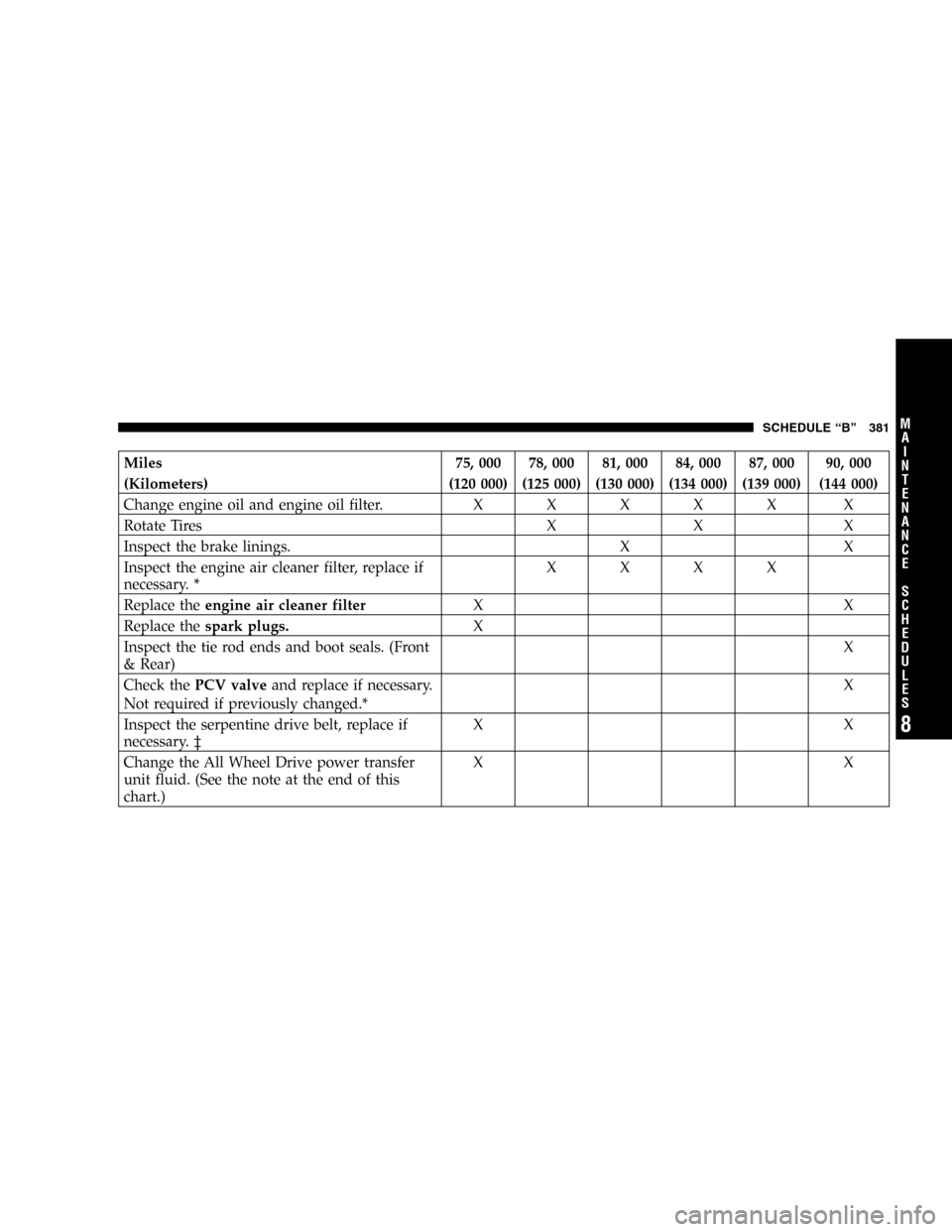
Miles 75, 000 78, 000 81, 000 84, 000 87, 000 90, 000
(Kilometers) (120 000) (125 000) (130 000) (134 000) (139 000) (144 000)
Change engine oil and engine oil filter.XXXXX X
Rotate Tires X X X
Inspect the brake linings. X X
Inspect the engine air cleaner filter, replace if
necessary. *XXXX
Replace theengine air cleaner filterXX
Replace thespark plugs.X
Inspect the tie rod ends and boot seals. (Front
& Rear)X
Check thePCV valveand replace if necessary.
Not required if previously changed.*X
Inspect the serpentine drive belt, replace if
necessary.‡XX
Change the All Wheel Drive power transfer
unit fluid. (See the note at the end of this
chart.)XX
SCHEDULE“B”381
8
M
A
I
N
T
E
N
A
N
C
E
S
C
H
E
D
U
L
E
S
Page 389 of 420
![CHRYSLER PACIFICA 2005 1.G Owners Manual Miles 78, 000 84, 000 90, 000 96, 000 100, 000
(Kilometers) (125 000) (134 000) (144 000) (154 000) (160 000)
[Months] [78] [84] [90] [96]
Change engine oil and engine oil filter. X X X X
Rotate Tires](/img/25/8498/w960_8498-388.png "CHRYSLER PACIFICA 2005 1.G Owners Manual Miles 78, 000 84, 000 90, 000 96, 000 100, 000
(Kilometers) (125 000) (134 000) (144 000) (154 000) (160 000)
[Months] [78] [84] [90] [96]
Change engine oil and engine oil filter. X X X X
Rotate Tires")
Miles 78, 000 84, 000 90, 000 96, 000 100, 000
(Kilometers) (125 000) (134 000) (144 000) (154 000) (160 000)
[Months] [78] [84] [90] [96]
Change engine oil and engine oil filter. X X X X
Rotate Tires X X X X
Inspect the brake linings. X
Inspect the engine air cleaner filter, replace if neces-
sary. *XX XX
Replace theengine air cleaner filter.X
Inspect the tie rod ends and boot seals. (Front &
Rear)X
Check and replace thePCV valve, if necessary.* X
Inspect the serpentine drive belt, replace if neces-
sary.‡X
Replace thespark plugs.X
Flush and replace the engine coolant at 100,000
miles, if not done at 60 months.X
Replace the air conditioning filter. X X
SCHEDULE“A”389
8
M
A
I
N
T
E
N
A
N
C
E
S
C
H
E
D
U
L
E
S
Page 397 of 420

The manufacturer will not stand behind any service
contract that is not the manufacturer’s Service Contract. It
is not responsible for any service contract other than the
manufacturer’s Service Contract. If you purchased a
service contract that is not a manufacturer’s Service
Contract, and you require service after your manufactur-
er’s new vehicle limited warranty expires, please refer to
your contract documents, and contact the person listed in
those documents.
We appreciate that you have made a major investment
when you purchased your new vehicle. Your dealer has
also made a major investment in facilities, tools, and
training to assure that you are absolutely delighted with
your ownership experience. You’ll be pleased with their
sincere efforts to resolve any warranty issues or related
concerns.WARRANTY INFORMATION
See your manufacturer’s Warranty Information Booklet
for information on warranty coverage and transfer of
warranty.
IF YOU NEED CONSUMER ASSISTANCE 397
9
Page 402 of 420

WARNING!
The traction grade is based on braking (straight-
ahead) traction tests and does not include cornering
(turning) performance.
Temperature Grades
The temperature grades are A (highest), B, and C, repre-
senting the tire’s resistance to the generation of heat and
its ability to dissipate heat when tested under controlled
conditions on a specified indoor laboratory test wheel.
Sustained high temperature can cause the material of the
tire to degenerate and reduce tire life, and excessive
temperature can lead to sudden tire failure. The grade C
corresponds to a level of performance which all passen-
ger car tires must meet under the Federal Motor Vehicle
Safety Standard No. 109. Grades B and A represent
higher levels of performance on the laboratory test wheel
than the minimum required by law.
WARNING!
The temperature grade is established for a tire that is
properly inflated and not overloaded. Excessive
speed, underinflation, or excessive loading, either
separately or in combination, can cause heat buildup
and possible tire failure.
402 IF YOU NEED CONSUMER ASSISTANCE