warning CHRYSLER PACIFICA 2006 1.G Owner's Manual
[x] Cancel search | Manufacturer: CHRYSLER, Model Year: 2006, Model line: PACIFICA, Model: CHRYSLER PACIFICA 2006 1.GPages: 440, PDF Size: 13.69 MB
Page 53 of 440

•If your vehicle contains a Passenger Airbag Disable
indicator light, it will be equipped with the Occupant
Classification System (OCS). The OCS system will
classify an occupant into a size category based on
sensor readings from within the seat cushion. Occu-
pants should try to remain in a normally seated
position. If the occupant’s weight is transferred to
another object in the vehicle (i.e. feet on the dash-
board), the OCS may not be able to properly approxi-
mate occupant size. Furthermore, the occupant size
may appear to increase or decrease due to objects
hanging on the seat, other passengers pushing on the
seat, or objects lodged underneath the seat.
If there is a rapid change in temperature or humidity,
the OCS may not be able to properly approximate
occupant size. If your seat including your trim cover and cushion needs to be serviced in any way (includ-
ing removal or loosening/tightening of seat attach-
ment bolts), take the vehicle to your authorized dealer.
Only manufacturer approved seat accessories may be
used.
If there is a fault present in the system, the AIRBAG
warning light will illuminate indicating that you should
take the vehicle to an authorized dealer. In the presence
of an occupant in the passenger seat, if both the PAD
indicator light and AIRBAG warning light are illumi-
nated the airbag will be disabled.
The ORC will not allow front airbag deployment in the
event of a collision for occupants classified into the
empty or child size categories. The PAD indicator light
will illuminate indicating that the Passenger Airbag is
OFF when the OCS has determined that the occupant size
category is a child. Also, when the seat is empty or an
object that weighs less than a predetermined threshold is
THINGS TO KNOW BEFORE STARTING YOUR VEHICLE 53
2
Page 55 of 440

child, and adult. The OCM sends the Occupant Clas-
sification to the ORC to identify if a front passenger
airbag is allowed. If a fault is present, the AIRBAG
warning light is illuminated.
•The Passenger Airbag Disabled (PAD) Indicator
Light indicates to the driver and passenger when the
airbag is turned OFF in the presence of a properly
seated occupant. When the PAD indicator light is
illuminated, the airbag is OFF. Also, when the Occu-
pant Classification System (OCS) detects either an
empty seat of a weight less than the predetermined
occupant threshold, the ORC will not illuminate the
PAD indicator light even though the airbag is turned
off. When the OCS detects an adult the PAD indicator
light will be off, and the airbag will be enabled.
•The Belt Tension Sensor (BTS) is located at the
outboard passenger lap belt anchor. The BTS generates
a signal based on outboard lap belt tension. This signal is sent to the OCM to ensure that the resultant bladder
pressure increase due to applied lap belt tension does
not cause a small occupant to be classified as a larger
occupant.
•The
Bladder Assembly is located beneath the seat
cushion foam. The pressure sensor sends a signal to
the OCM.
The front passenger seat assembly contains critical com-
ponents that affect the front passenger airbag deploy-
ment. Correctly functioning front passenger seat compo-
nents are critical for the Occupant Classification System
(OCS) to properly classify the front passenger and calcu-
late the proper airbag deployment. Do not make any
modifications to the front passenger seat components,
assembly, or to the seat cover.
THINGS TO KNOW BEFORE STARTING YOUR VEHICLE 55
2
Page 56 of 440

WARNING!
Unapproved modifications or service procedures to
the front passenger seat assembly, its related compo-
nents, or seat cover may inadvertently change the
airbag deployment in case of a frontal crash. This
could result in death or serious injury to the front
seat passenger if the vehicle is involved in an acci-
dent. A modified vehicle may not comply with
required Federal Motor Vehicle Safety Standards
(FMVSS).
The following requirements must be strictly adhered to:
•Do not modify the front passenger seat assembly or
components in any way.
•Do not modify the front seat center console or center
position seat in any way.
•Do not use prior or future model year seat covers not
designated for the specific model being repaired. Al-
ways use the correct seat cover specified for the
vehicle.
•Do not replace the seat cover with an aftermarket seat
cover.
•Do not add a secondary seat cover other than those
approved by DaimlerChrysler/Mopar.
•At no time should any supplemental restraint system
(SRS) component or SRS related component or fas-
tener be modified or replaced with any part except
those which are approved by DaimlerChrysler/
Mopar.
56 THINGS TO KNOW BEFORE STARTING YOUR VEHICLE
Page 58 of 440
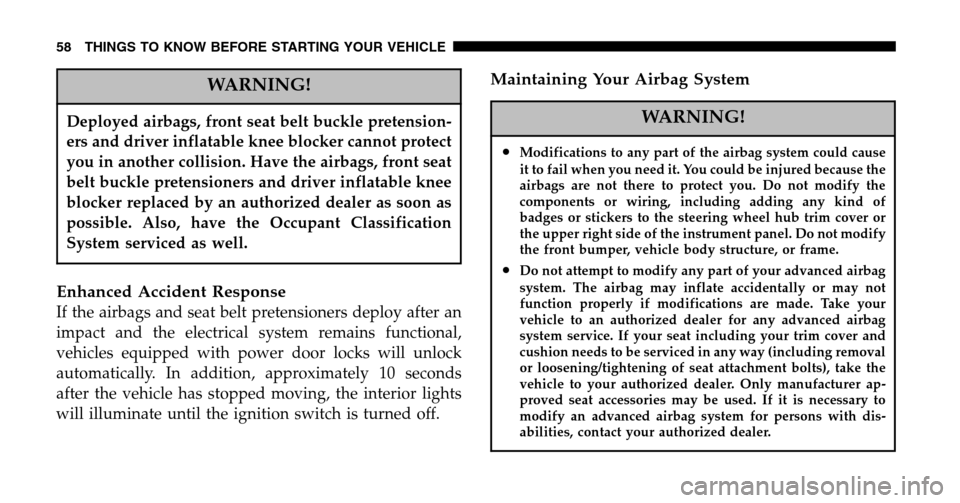
WARNING!
Deployed airbags, front seat belt buckle pretension-
ers and driver inflatable knee blocker cannot protect
you in another collision. Have the airbags, front seat
belt buckle pretensioners and driver inflatable knee
blocker replaced by an authorized dealer as soon as
possible. Also, have the Occupant Classification
System serviced as well.
Enhanced Accident Response
If the airbags and seat belt pretensioners deploy after an
impact and the electrical system remains functional,
vehicles equipped with power door locks will unlock
automatically. In addition, approximately 10 seconds
after the vehicle has stopped moving, the interior lights
will illuminate until the ignition switch is turned off.
Maintaining Your Airbag System
WARNING!
•Modifications to any part of the airbag system could cause
it to fail when you need it. You could be injured because the
airbags are not there to protect you. Do not modify the
components or wiring, including adding any kind of
badges or stickers to the steering wheel hub trim cover or
the upper right side of the instrument panel. Do not modify
the front bumper, vehicle body structure, or frame.
•Do not attempt to modify any part of your advanced airbag
system. The airbag may inflate accidentally or may not
function properly if modifications are made. Take your
vehicle to an authorized dealer for any advanced airbag
system service. If your seat including your trim cover and
cushion needs to be serviced in any way (including removal
or loosening/tightening of seat attachment bolts), take the
vehicle to your authorized dealer. Only manufacturer ap-
proved seat accessories may be used. If it is necessary to
modify an advanced airbag system for persons with dis-
abilities, contact your authorized dealer.
58 THINGS TO KNOW BEFORE STARTING YOUR VEHICLE
Page 59 of 440

WARNING!
•You need proper knee impact protection in a
collision. Do not mount or locate any aftermarket
equipment on or behind the knee bolsters.
•It is dangerous to try to repair any part of the
airbag system yourself. Be sure to tell anyone who
works on your vehicle that it has airbags.
Airbag Light
You will want to have the airbags ready to
inflate for your protection in a collision. While
the airbag system is designed to be mainte-
nance free, if any of the following occurs, have
an authorized dealer service the system immediately.
•The AIRBAG light does not come on or flickers during
the 6 to 8 seconds when the ignition switch is first
turned on.
•The light remains on or flickers after the 6 to 8 second
interval.
•The light flickers or comes on and remains on while
driving.
THINGS TO KNOW BEFORE STARTING YOUR VEHICLE 59
2
Page 60 of 440

Child Restraint
Everyone in your vehicle needs to be buckled up at all
times — babies and children, too. Every state in the
United States and all Canadian provinces require that
small children ride in proper restraint systems. This is the
law, and you can be prosecuted for ignoring it.
Children 12 years and under should ride properly buck-
led up in a seat appropriate for their age and size.
According to crash statistics, children are safer when
properly restrained in the rear seats, rather than in the
front.WARNING!
In a collision, an unrestrained child, even a tiny
baby, can become a missile inside the vehicle. The
force required to hold even an infant on your lap
could become so great that you could not hold the
child, no matter how strong you are. The child and
others could be badly injured. Any child riding in
your vehicle should be in a proper restraint for the
child’s size.
60 THINGS TO KNOW BEFORE STARTING YOUR VEHICLE
Page 66 of 440

•The belt-positioning booster seat is for children weigh-
ing more than 18 kg (40 lbs), but who are still too small
to fit the vehicle’s seat belts properly. If the child can
not sit with knees bent over the vehicles seat cushion
while the child’s back is against the seat back, they
should use a belt-positioning booster seat. The child
and booster seat are held in the vehicle by the lap/
shoulder belt. (Some booster seats are equipped with a
front shield and are held in the vehicle by the lap
portion.)
NOTE: For additional information, refer to
www.seatcheck.org or call 1-866-SEATCHECK .WARNING!
•Improper installation can lead to failure of an
infant or child restraint. It could come loose in a
collision. The child could be badly injured or
killed. Follow the manufacturer’s directions ex-
actly when installing an infant or child restraint.
•A rearward facing child restraint should only be
used in a rear seat. A rearward facing child re-
straint in the front seat may be struck by a
deploying passenger airbag which may cause se-
vere or fatal injury to the infant.
66 THINGS TO KNOW BEFORE STARTING YOUR VEHICLE
Page 70 of 440

WARNING!
Improper installation of a child restraint to the
LATCH anchorages can lead to failure of an infant or
child restraint. The child could be badly injured or
killed. Follow the manufacturer’s directions exactly
when installing an infant or child restraint.
Children Too Large For Booster Seats
Children who are large enough to wear the shoulder belt
comfortably, and whose legs are long enough to bend
over the front of the seat when their back is against the
seatback, should use the lap/shoulder belt in a rear seat.
•Make sure that the child is upright in the seat.
•The lap portion should be low on the hips and as snug
as possible.
•Check belt fit periodically. A child’s squirming or
slouching can move the belt out of position.
•If the shoulder belt contacts the face or neck, move the
child closer to the center of the vehicle. Never allow a
child to put the shoulder belt under an arm or behind
their back.
Transporting Pets
Airbags deploying in the front seat could harm your pet.
An unrestrained pet could be thrown about and possibly
injured, or injure a passenger during panic braking or in
a collision.
Pets should be restrained in the rear seat in pet harnesses
or pet carriers that are secured by seat belts.
70 THINGS TO KNOW BEFORE STARTING YOUR VEHICLE
Page 71 of 440

ENGINE BREAK-IN RECOMMENDATIONS
A long break-in period is not required for the engine in
your new vehicle.
Drive moderately during the first 300 miles (500 km).
After the initial 60 miles (100 km), speeds up to 50 or 55
mph (80 or 90 km/h) are desirable.
While cruising, brief full-throttle acceleration, within the
limits of local traffic laws, contributes to a good break-in.
Wide open throttle acceleration in low gear can be
detrimental and should be avoided.
The engine oil installed in the engine at the factory is a
high quality energy conserving type lubricant. Oil
changes should be consistent with anticipated climate
conditions under which vehicle operations will occur.
The recommended viscosity and quality grades are
shown in Section 7 of this manual. NON-DETERGENT
OR STRAIGHT MINERAL OILS MUST NEVER BE
USED. A new engine may consume some oil during its first few
thousand miles (kilometers) of operation. This should be
considered as a normal part of the break-in and not
interpreted as an indication of difficulty.
SAFETY TIPS
Exhaust Gas
WARNING!
Exhaust gases can injure or kill. They contain carbon
monoxide (CO) which is colorless and odorless.
Breathing it can make you unconscious and can
eventually poison you. To avoid breathing (CO)
follow the safety tips below.
Do not run the engine in a closed garage or in confined
areas any longer than needed to move your vehicle in or
out of the area.
THINGS TO KNOW BEFORE STARTING YOUR VEHICLE 71
2
Page 72 of 440

If it is necessary to sit in a parked vehicle with the engine
running, adjust your heating or cooling controls to force
outside air into the vehicle. Set the blower at high speed.
WARNING!
If you are required to drive with the deck lid/liftgate
open, make sure that all windows are closed, and the
climate control blower switch is set at high speed.
DO NOT use the recirculation mode.
Safety Checks You Should Make Inside The
Vehicle
Seat Belts
Inspect the belt system periodically, checking for cuts,
frays and loose parts. Damaged parts must be replaced
immediately. Do not disassemble or modify the system. Front seat belt buckle pretensioners must be replaced
after a collision. Rear seat belt assemblies must be re-
placed after a collision if they have been damaged (bent
retractor, torn webbing, etc. If there is any question
regarding belt or retractor condition, replace the belt.
Airbag Light
The light should come on and remain on for 6
to 8 seconds as a bulb check when the ignition
switch is first turned ON. If the LED is not lit
during starting, have it checked. If the light
stays on or comes on while driving, have the system
checked by an authorized dealer.
Defroster
Check operation by selecting the defrost mode and place
the blower control on high speed. You should be able to
feel the air directed against the windshield.
72 THINGS TO KNOW BEFORE STARTING YOUR VEHICLE