air conditioning CHRYSLER PACIFICA 2008 1.G User Guide
[x] Cancel search | Manufacturer: CHRYSLER, Model Year: 2008, Model line: PACIFICA, Model: CHRYSLER PACIFICA 2008 1.GPages: 457, PDF Size: 6.7 MB
Page 384 of 457
WARNING!
²Use only refrigerants and compressor lubricants
approved by the manufacturer for your air condi-
tioning system. Some unapproved refrigerants are
flammable and can explode, injuring you. Other
unapproved refrigerants or lubricants can cause
the system to fail, requiring costly repairs. Refer to
Section 3 of the Warranty Information book for
further warranty information.
²The air conditioning system contains refrigerant
under high pressure. To avoid risk of personal
injury or damage to the system, adding refrigerant
or any repair requiring lines to be disconnected
should be done by an experienced repairman.
Refrigerant Recovery And Recycling
R-134a Air Conditioning Refrigerant is a hydrofluorocar-
bon (HFC) that is endorsed by the Environmental Pro-
tection Agency and is an ozone-saving product. How-
ever, the manufacturer recommends that air conditioning
service be performed by dealers or other service facilities
using recovery and recycling equipment.
NOTE:Use only manufacturer approved A/C System
Sealers, Stop Leak Products, Seal Conditioners, Compres-
sor Oil, or Refrigerants.
A/C Air Filter
The filter access door is located under the instrument
panel on the passenger side. To replace the filter slide the
lock toward the rear of the vehicle (unlock position).
Remove the access door and pull the filter downward.
When installing a new filter, ensure its proper orienta-
tion. Align the black arrow on the bottom of the filter
frame with the direction of airflow (away from the
blower motor and towards the center of the car).
384 MAINTAINING YOUR VEHICLE
Page 385 of 457
Refer to the ªMaintenance Scheduleº section of this
manual for the recommended air conditioning filter
replacement intervals.
Power Steering Ð Fluid Check
Checking the power steering fluid level at a defined
service interval is not required. The fluid should only be
checked if a leak is suspected, abnormal noises are
apparent, and/or the system is not functioning as antici-
pated. Coordinate inspection efforts through a certified
DaimlerChrysler Dealership.9
WARNING!
Fluid level should be checked on a level surface and
with the engine off to prevent injury from moving
parts and to insure accurate fluid level reading. Do
not overfill. Use only manufacturers recommended
power steering fluid.If necessary, add fluid to restore to the proper indicated
level. With a clean cloth, wipe any spilled fluid from all
surfaces. Refer to Fluids, Lubricants, and Genuine Parts
for correct fluid type.
Front & Rear Suspension Ball Joints
The suspension ball joints are permanently sealed. No
regular maintenance is required for these components.
Steering Shaft Seal
The steering shaft seal, at the point where the shaft passes
through the bulkhead, is lubricated when it is installed. If
the seal becomes noisy when the steering shaft is turned,
it should be lubricated with a multi-purpose grease.
Mopar multi-purpose lubricant is recommended.
MAINTAINING YOUR VEHICLE 385
7
Page 393 of 457

When additional coolant is needed to maintain the
proper level, it should be added to the coolant bottle. Do
not overfill.
Points To Remember
NOTE:When the vehicle is stopped after a few miles (a
few kilometers) of operation, you may observe vapor
coming from the front of the engine compartment. This is
normally a result of moisture from rain, snow, or high
humidity accumulating on the radiator and being vapor-
ized when the thermostat opens, allowing hot coolant to
enter the radiator.
If an examination of your engine compartment shows no
evidence of radiator or hose leaks, the vehicle may be
safely driven. The vapor will soon dissipate.
²Do not overfill the coolant recovery bottle.
²Check coolant freeze point in the radiator and in the
coolant recovery bottle. If antifreeze needs to be
added, contents of coolant recovery bottle must also be
protected against freezing.
²If frequent coolant additions are required, or if the
level in the coolant recovery bottle does not drop when
the engine cools, the cooling system should be pres-
sure tested for leaks.
²Maintain coolant concentration at 50% HOAT engine
coolant (minimum) and distilled water for proper
corrosion protection of your engine which contains
aluminum components.
²Make sure that the radiator and coolant recovery
bottle overflow hoses are not kinked or obstructed.
²Keep the front of the radiator clean. If your vehicle is
equipped with air conditioning, keep the front of the
condenser clean, also.
MAINTAINING YOUR VEHICLE 393
7
Page 410 of 457

CAUTION!
²When installing the Integrated Power Module
cover, it is important to ensure the cover is prop-
erly positioned and fully latched. Failure to do so
may allow water to get into the Integrated Power
Module, and possibly result in a electrical system
failure.
²When replacing a blown fuse, it is important to
use only a fuse having the correct amperage rating.
The use of a fuse with a rating other than indicated
may result in a dangerous electrical system over-
load. If a properly rated fuse continues to blow, it
indicates a problem in the circuit that must be
corrected.
VEHICLE STORAGE
If you are leaving your vehicle dormant for more than 21
days you may want to take steps to protect your battery.
You may:
²Disconnect the negative cable from the battery.
²Anytime you store your vehicle, or keep it out of
service (i.e. vacation) for two weeks or more, run the
air conditioning system at idle for about five minutes
in the fresh air and high blower setting. This will
insure adequate system lubrication to minimize the
possibility of compressor damage when the system is
started again.
410 MAINTAINING YOUR VEHICLE
Page 423 of 457
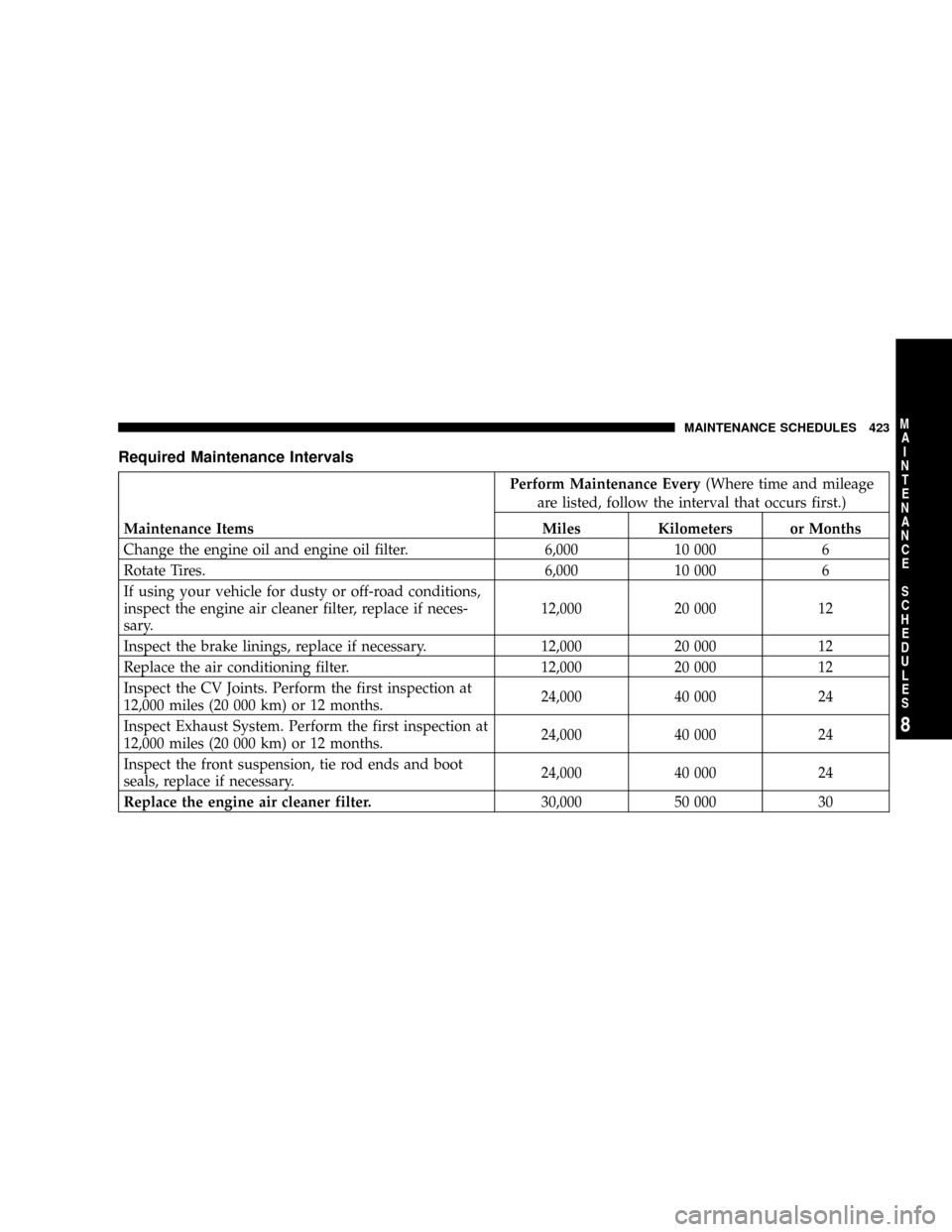
Required Maintenance Intervals
Perform Maintenance Every(Where time and mileage
are listed, follow the interval that occurs first.)
Maintenance Items Miles Kilometers or Months
Change the engine oil and engine oil filter. 6,000 10 000 6
Rotate Tires. 6,000 10 000 6
If using your vehicle for dusty or off-road conditions,
inspect the engine air cleaner filter, replace if neces-
sary.12,000 20 000 12
Inspect the brake linings, replace if necessary. 12,000 20 000 12
Replace the air conditioning filter. 12,000 20 000 12
Inspect the CV Joints. Perform the first inspection at
12,000 miles (20 000 km) or 12 months.24,000 40 000 24
Inspect Exhaust System. Perform the first inspection at
12,000 miles (20 000 km) or 12 months.24,000 40 000 24
Inspect the front suspension, tie rod ends and boot
seals, replace if necessary.24,000 40 000 24
Replace the engine air cleaner filter.30,000 50 000 30
MAINTENANCE SCHEDULES 423
8
M
A
I
N
T
E
N
A
N
C
E
S
C
H
E
D
U
L
E
S
Page 438 of 457

Adding Fuel........................... 329
Adding Washer Fluid..................142,387
Additives, Fuel......................... 327
Adjustable Pedals....................... 159
Air Conditioner Maintenance............... 383
Air Conditioning.....................251,256
Air Conditioning Controls................. 251
Air Conditioning Filter.................269,384
Air Conditioning Refrigerant............... 383
Air Conditioning System..........251,256,259,383
Air Conditioning System, Zone Control........ 252
Air Pressure, Tires....................... 304
Airbag................................ 50
Airbag Deployment....................... 62
Airbag Light...................54,55,64,79,197
Airbag Maintenance....................... 64
Airbag, Window (Side Curtain)............... 51
Alarm (Security Alarm).................... 18
Alignment and Balance.................... 311All Wheel Drive (AWD)................284,400
Alterations/Modifications, Vehicle............. 7
Antenna, Satellite Radio................... 248
Antifreeze (Engine Coolant)...........390,391,416
Disposal............................ 392
Anti-Lock Brake System (ABS)............153,288
Anti-Lock Warning Light.................. 188
Anti-Theft System........................ 18
Appearance Care........................ 401
Auto Down Power Windows................ 32
Auto Up Power Windows.................. 33
Automatic Dimming Mirror................. 86
Automatic Door Locks...................27,28
Automatic Headlights.................... 137
Automatic Oil Change Indicator..........192,202
Automatic Temperature Control (ATC)......... 259
Automatic Transaxle....................12,278
Adding Fluid......................... 418
Interlock System.....................15,280
438 INDEX
Page 443 of 457

Oil Change Interval...............192,202,377
Oil Disposal.......................... 379
Oil Filler Cap......................... 378
Oil Filter Disposal...................... 379
Oil Selection.......................377,416
Oil Synthetic......................... 378
Operation............................ 77
Overheating.......................... 351
Temperature Gauge..................... 187
Event Data Recorder...................... 65
Exhaust Gas Caution..............37,78,328,388
Exhaust System......................... 388
Extender, Seat Belt........................ 49
Exterior Folding Mirrors................... 87
Fabric Care.........................404,405
Filters
Air Cleaner.......................... 380
Air Conditioning....................269,384Automatic Transaxle.................... 400
Engine Oil........................379,417
Engine Oil Disposal.................... 379
Flashers
Hazard Warning....................... 350
Turn Signal..................139,188,413,415
Flooded Engine Starting................... 277
Floor Console.......................... 175
Fluid Capacities......................... 416
Fluid Leaks............................. 80
Fluid Level Checks
Automatic Transmission................. 399
Brake............................396,418
Power Steering.....................385,418
Fluids................................ 417
Fluids, Lubricants and Genuine Parts.......... 417
Fog Light Service........................ 414
Fog Lights.......................138,194,414
Folding Rear Seat........................ 126
INDEX 443
10
Page 457 of 457
INTRODUCTION INTRODUCTION HOW TO USE THIS MANUAL WARNINGS AND CAUTIONS VEHICLE IDENTIFICATION NUMBER VEHICLE MODIFICATIONS/ALTERATIONS THINGS TO KNOW BEFORE STARTING YOUR VEHICLE A WORD ABOUT YOUR KEYS
Ignition Key RemovalKey-In-Ignition ReminderLocking Doors With The KeySTEERING WHEEL LOCK - IF EQUIPPED If You Wish To Manually Lock The Steering WheelTo Release The Steering Wheel LockAutomatic Transaxle Ignition Interlock SystemSENTRY KEY - IF
EQUIPPED Replacement KeysCustomer Key ProgrammingGeneral InformationSECURITY ALARM SYSTEM - IF EQUIPPED Rearming of the System - If EquippedTo Arm the SystemTo Disarm the SystemSecurity System Manual OverrideILLUMINATED ENTRY SYSTEM
REMOTE KEYLESS ENTRY To unlock the doors and liftgateTo lock the doors and liftgateTo Open/Close Power Liftgate - If EquippedFlash Lights On Lock/UnlockUsing The Panic AlarmProgramming Additional TransmittersBattery ReplacementDOOR LOCKS Manual Door
LocksPower Door LocksChild Protection Door LockWINDOWS Power WindowsLIFTGATE Power Liftgate - If EquippedOCCUPANT RESTRAINTS Lap/Shoulder BeltsLap/Shoulder Belt Untwisting ProcedureSeat Belt PretensionersEnhanced Seat Belt Use Reminder System
(BeltAlert)Seat Belts and Pregnant WomenAutomatic-Locking Retractor (ALR)Seat Belts and Pregnant WomenSeat Belt ExtenderDriver and Front Passenger Supplemental Restraint System - AirbagEvent Data Recorder (EDR)Child RestraintENGINE BREAK-IN
RECOMMENDATIONS SAFETY TIPS Exhaust GasSafety Checks You Should Make Inside The VehiclePeriodic Safety Checks You Should Make Outside The VehicleUNDERSTANDING THE FEATURES OF YOUR VEHICLE MIRRORS Inside Day / Night MirrorAutomatic
Dimming Mirror - If EquippedDrivers Side Outside Mirror Auto Dimmer - If EquippedExterior Mirrors Folding FeatureOutside Mirror - Drivers SideOutside Mirror - Passengers SidePower Remote-Control MirrorsHeated Remote Control Mirrors - If EquippedIlluminated Vanity
MirrorsHANDS-FREE COMMUNICATION (UConnect) - IF EQUIPPED OperationsPhone Call FeaturesUConnect System FeaturesAdvanced Phone ConnectivityThings You Should Know About Your UConnect SystemGeneral InformationSEATS 10-Way Drivers Power Seat
- If Equipped8-Way Drivers Power Seat - If Equipped4-Way Passengers Power SeatAdjustable Head RestraintsHeated Seats - If EquippedSecond Row Manual Seat Recliner - If EquippedSecond Row Manual Seat Adjuster - If EquippedSecond Row Bench Seating - If
EquippedSecond Row Fold and Tumble Seats - If EquippedThird Row Easy Exit - If EquippedThird Row Seating - If EquippedLoad Floor - If EquippedPlastic Grocery Bag RetainerDRIVER MEMORY SEAT - IF EQUIPPED Easy Exit Seat (Available with Memory Seat Only)
Tilt Mirrors in Reverse (Available with Memory Seat Only) - If EquippedTO OPEN AND CLOSE THE HOOD LIGHTS Overhead Console Map/Reading LightsInteriorLightsMulti-Function LeverHeadlights, Parking Lights, Instrument Panel LightsAutomatic HeadlightsDaytime
Running Lights (Canada Only)Lights-on ReminderHeadlight Time DelayFog Lights - If EquippedTurn SignalsHighbeam/Lowbeam Select SwitchPassing LightWINDSHIELD WIPERS AND WASHERS Windshield WashersMist FeatureWindshield Wiper OperationIntermittent
Wiper SystemRear Window Wiper/WasherTILT STEERING COLUMN ELECTRONIC SPEED CONTROL To ActivateTo Set a Desired SpeedTo DeactivateTo Resume SpeedTo Vary the Speed SettingTo Accelerate For PassingGARAGE DOOR OPENER - IF EQUIPPED
Programming HomeLinkCanadian Programming/Gate ProgrammingUsing HomeLinkReprogramming a Single HomeLink ButtonsSecurityTroubleshooting TipsGeneral InformationANTI-LOCK BRAKE SYSTEM (ABS) ELECTRONIC BRAKE CONTROL SYSTEM -
ABS/TCS/BAS/ESP Traction Control System (TCS)Brake Assist System (BAS)ESP (Electronic Stability Program)ADJUSTABLE PEDALS - IF EQUIPPED REAR PARK SENSE SYSTEM - IF EQUIPPED Rear Park Assist SensorsRear Park Assist Warning Display
Enable/Disable the Rear Park Assist System - If EquippedService the Rear Park Assist SystemCleaning the Rear Park Assist SystemREAR CAMERA - IF EQUIPPED OVERHEAD CONSOLE - IF EQUIPPED Courtesy/Reading LightsSunglasses StoragePOWER SUNROOF
- IF EQUIPPED Express Open FeatureWind BuffetingSunroof Comfort Position - If EquippedSunroof MaintenanceELECTRICAL POWER OUTLETS Electrical Outlet Use With Engine OffCUPHOLDERS Front Seat CupholdersSecond Row Seat CupholdersThird Row Seat Cupholders - If EquippedSTORAGE Console FeaturesRear Cargo Storage Bin - If EquippedRetractable Cargo Area Cover - If EquippedCargo Tie-Down HooksROOF LUGGAGE RACK - IF EQUIPPED LOAD LEVELING SYSTEM UNDERSTANDING YOUR INSTRUMENT
PANEL INSTRUMENT PANEL AND CONTROLS BASE INSTRUMENT CLUSTER PREMIUM INSTRUMENT CLUSTER INSTRUMENT CLUSTER DESCRIPTIONS ELECTRONIC VEHICLE INFORMATION CENTER (EVIC) - IF EQUIPPED Oil Change RequiredCustomer
Programmable Features - If EquippedCompass Display - If EquippedMini-Trip Functions - If EquippedSETTING THE ANALOG CLOCK ELECTRONIC DIGITAL CLOCK Clock Setting ProcedureRADIO GENERAL INFORMATION Radio Broadcast SignalsTwo Types of Signals
Electrical DisturbancesAM ReceptionFM ReceptionSALES CODE RAH - AM AND FM STEREO RADIO WITH CD PLAYER AND CD/DVD CHANGER CONTROLS Radio OperationCDPlayer OperationCD/DVD Changer OperationNotes On Playing MP3 FilesOperation
Instructions - (CD Mode For MP3 Audio Play)SALES CODE REV - AM AND FM STEREO RADIO WITH CD PLAYER AND CD/DVD CHANGER CONTROLS Radio OperationCD Player OperationCD/DVD Changer OperationNotes On Playing MP3 FilesOperation Instructions
- (CD Mode For MP3 Audio Play)Operating Instructions - MP3 Player, Portable WalkmanOperating Instructions - Video Games/Camcorders6 DISC CD/DVD CHANGER (RDV) - IF EQUIPPED Operating Instructions - CD/DVD ChangerEJECT (EJT) ButtonOperating
Instructions - Remote ControlOperating Instructions - Video ScreenOperating Instructions - Headphones Operating Instructions - Auxiliary InputNAVIGATION SYSTEM - IF EQUIPPED SATELLITE RADIO - IF EQUIPPED System ActivationElectronic Serial Number/Sirius
Identification Number (ENS/SID)Selecting Satellite Mode in RBB, RAH, REV and RBK RadiosSelecting Satellite Mode in RBP, RBU, RAZ, RB1 and RBQ RadiosSelecting a ChannelStoring and Selecting Pre-Set ChannelsUsing the PTY (Program Type) Button (If Equipped)
PTY Button SCANPTY Button SEEKSatellite AntennaReception QualityREMOTE SOUND SYSTEM CONTROLS Radio OperationCD PlayerCD/DVD DISC MAINTENANCE RADIO OPERATION AND CELLULAR PHONES CLIMATE CONTROLS Manual Air Conditioning
and Heating System Mode ControlManual Air Conditioning OperationDual-Zone Automatic Temperature ControlElectric Rear Window DefrosterSTARTING AND OPERATING STARTING PROCEDURES Automatic TransmissionNormal Starting (Above 32 degreesF/0
degrees C)Extremely Cold Weather Starting (Below -20 degrees F / -29 degrees C)High Altitude Starting (Above 4,000 ft. / 1 219 m)If Engine Fails To StartAfter StartingENGINE BLOCK HEATER - IF EQUIPPED AUTOMATIC TRANSMISSION Brake/Transmission Interlock
SystemAutomatic Transmission Ignition Interlock SystemReset Mode - Electronic TransmissionAUTOSTICK AutoStick OperationAutoStick General InformationALL WHEEL DRIVE - IF EQUIPPED PARKING BRAKE BRAKE SYSTEM Anti-Lock Brake SystemPOWER
STEERING DRIVING ON SLIPPERY SURFACES AccelerationTractionDRIVING THROUGH WATER Flowing/Rising WaterShallow Standing WaterTIRE SAFETY INFORMATION Tire Markings Tire Identification Number (TIN)Tire Loading and Tire PressureTIRES - GENERAL
INFORMATION Tire PressureTire Inflation PressuresRadial-Ply TiresCompact Spare Tire - If EquippedLimited Use Spare - If EquippedTire SpinningTread Wear IndicatorsLife of TireReplacement TiresAlignment And BalanceTIRE CHAINS SNOW TIRES TIRE ROTATION
TIRE PRESSURE MONITOR SYSTEM (TPMS) Basic TPMS without EVIC - If EquippedBasic TPMS with EVIC - If EquippedPremium TPMS - If EquippedTire Pressure Monitoring Low Pressure WarningsService Tire System SoonGeneral InformationFUEL REQUIREMENTS
3.8L GASOLINE ENGINES4.0L GASOLINE ENGINESReformulated GasolineGasoline/Oxygenate BlendsMMT In GasolineMaterials Added to FuelFuel System CautionsCarbon Monoxide WarningsADDING FUEL Fuel Filler Cap (Gas Cap)Loose Fuel Filler Cap Message
VEHICLE LOADING Vehicle Certification LabelGross Vehicle Weight Rating (GVWR)Gross Axle Weight Rating (GAWR)OverloadingLoadingTRAILER TOWINGCommon Towing DefinitionsTrailer Hitch ClassificationTrailer Towing Weights (Maximum Trailer Weight Ratings)
Trailer and Tongue WeightTowing RequirementsTowing TipsRECREATIONAL TOWING (BEHIND MOTORHOME, ETC.) TOWING THIS VEHICLE BEHIND ANOTHER VEHICLE(Flat towing with all four wheels on the ground)WHAT TO DO IN EMERGENCIES HAZARD
WARNING FLASHER IF YOUR ENGINE OVERHEATS JACKING AND TIRE CHANGING Jack LocationSpare Tire StowagePreparations For JackingJacking InstructionsJUMP-STARTING PROCEDURE FREEING A STUCK VEHICLE TOWING A DISABLED VEHICLE With Ignition KeyWithout The Ignition KeyTOWING THIS VEHICLE BEHIND ANOTHER VEHICLE (Flat towing with all four wheels on the ground)TOWING THIS VEHICLE BEHIND ANOTHER VEHICLE WITH A TOW DOLLYMAINTAINING YOUR VEHICLE 3.8L ENGINES 4.0L
ENGINES ONBOARD DIAGNOSTIC SYSTEM - OBD II Loose Fuel Filler Cap MessageEMISSIONS INSPECTION AND MAINTENANCE PROGRAMS REPLACEMENT PARTS DEALER SERVICE MAINTENANCE PROCEDURES Engine OilEngine Oil FilterDrive BeltSpark
PlugsEngine Air Cleaner FilterCatalytic ConverterMaintenance-Free BatteryAir Conditioner MaintenancePower Steering - Fluid CheckFront and Rear Suspension Ball JointsSteering Shaft SealSteering LinkageDrive Shaft Universal JointsBody LubricationWindshield Wiper
BladesWindshield and Rear Window WashersExhaust SystemCooling SystemHoses And Vacuum/Vapor HarnessesBrakesMaster Cylinder - Brake Fluid LevelCheckFuel System HosesAutomatic TransmissionAll Wheel Drive (AWD) - If EquippedFront And Rear Wheel
BearingsAppearance Care and Protection from CorrosionCleaning The Center Console Cup HoldersFUSES (INTEGRATED POWER MODULE) VEHICLE STORAGE REPLACEMENT LIGHT BULBS BULB REPLACEMENT HeadlightsHigh Intensity Discharge Headlights
(HID) - If EquippedFront Park/Turn Signal and Sidemarker LightsFront Fog LightRear Tail, Stop, Turn Signal, Side Marker and Back-up LightsLicense LightFLUIDS AND CAPACITIES FLUIDS, LUBRICANTS AND GENUINE PARTS EngineChassisMAINTENANCE
SCHEDULES EMISSION CONTROL SYSTEM MAINTENANCE MAINTENANCE SCHEDULE Required Maintenance IntervalsIF YOU NEED CONSUMER ASSISTANCE SUGGESTIONS FOR OBTAINING SERVICE FOR YOUR VEHICLE Prepare For The Appointment
Prepare A ListBe Reasonable With RequestsIF YOU NEED ASSISTANCE WARRANTY INFORMATION (U.S. Vehicles Only) MOPAR PARTS REPORTING SAFETY DEFECTS In CanadaPUBLICATION ORDER FORMS DEPARTMENT OF TRANSPORTATION UNIFORM
TIRE QUALITY GRADES TreadwearTraction GradesTemperature GradesINDEX