automatic transmission CHRYSLER PACIFICA 2008 1.G User Guide
[x] Cancel search | Manufacturer: CHRYSLER, Model Year: 2008, Model line: PACIFICA, Model: CHRYSLER PACIFICA 2008 1.GPages: 457, PDF Size: 6.7 MB
Page 282 of 457

AUTOSTICK
AutoStick is a driver-interactive transmission that offers
manual gear shifting capability to provide you with more
control. AutoStick allows you to maximize engine brak-
ing, eliminate undesirable upshifts and downshifts, and
improve overall vehicle performance. This system can
also provide you with more control during passing, city
driving, cold slippery conditions, mountain driving,
trailer towing, and many other situations.
AutoStickTOperation
By placing the selector lever one shift-level below the9D9
position, it can be moved from side to side. This allows
the driver to select a higher or lower range of gears.
Moving the selector lever to the Left (-) triggers a
downshift and to the Right (+) an upshift. The gear
position will display in the instrument cluster on the
transaxle range indicator.NOTE:In Autosticktmode, the transaxle will only shift
up or down when the driver moves the selector lever to
the Right (+) for shifting up or to the Left (-) when
shifting down.
AutoStickTGeneral Information
²
You can start out in first or second gear. The system
will ignore attempts to upshift at too low of a vehicle
speed.
²If a ratio other than 1st is selected, and the vehicle is
brought to a stop, the transaxle control logic will
automatically select the 1st gear ratio.
²Starting out in second gear is helpful in snowy or icy
conditions.
²Avoid using speed control when Autosticktis engaged.
²The transaxle will automatically shift up when maxi-
mum engine speed is reached while Autosticktis
engaged.
282 STARTING AND OPERATING
Page 283 of 457

²Transaxle shifting will be more noticeable when Auto-
sticktis engaged.
²If a low range is selected and the engine accelerates to
the rev limit, the transaxle will automatically select the
next higher ratio.
²If a downshift would cause the engine to over-speed,
that shift will not occur until it is safe for the engine.
Mostly the transaxle will stay in the manually selected
ratio, however.
²If the system detects powertrain overheating, the
transaxle will revert to the automatic shift mode and
remain in that mode until the powertrain cools off.
²If the system detects a problem, it will disable the
AutoSticktmode and the transaxle will return to the
automatic mode until the problem is corrected.
CAUTION!
Damage to the transmission may occur if the follow-
ing precautions are not observed:
²Shift into PARK only after the vehicle has come to
a complete stop.
²Shift into or out of REVERSE only after the
vehicle has come to a complete stop and the engine
is at idle speed.
²Do not shift from REVERSE, PARK, or NEUTRAL
into any forward gear when the engine is above
idle speed.
²Before shifting into any gear, make sure your foot
is firmly on the brake pedal.
STARTING AND OPERATING 283
5
Page 286 of 457

added precaution, turn the front wheels toward the curb
on a downhill grade and away from the curb on a uphill
grade.
The parking brake should always be applied when the
driver is not in the vehicle.WARNING!
²Always fully apply the parking brake when leav-
ing your vehicle, or it may roll and cause damage
or injury. Also be certain to leave an automatic
transmission in Park, a manual transmission in
Reverse or first gear. Failure to do so may allow the
vehicle to roll and cause damage or injury.
²NEVER leave children alone in a vehicle. Leaving
children in a vehicle unattended is dangerous for a
number of reasons. A child or others could be
seriously or fatally injured. Don't leave the keys in
the ignition. A child could operate power win-
dows, other controls, or move the vehicle
²Be sure the parking brake is fully disengaged
before driving, failure to do so can lead to brake
problems due to excessive heating of the rear
brakes.
286 STARTING AND OPERATING
Page 339 of 457
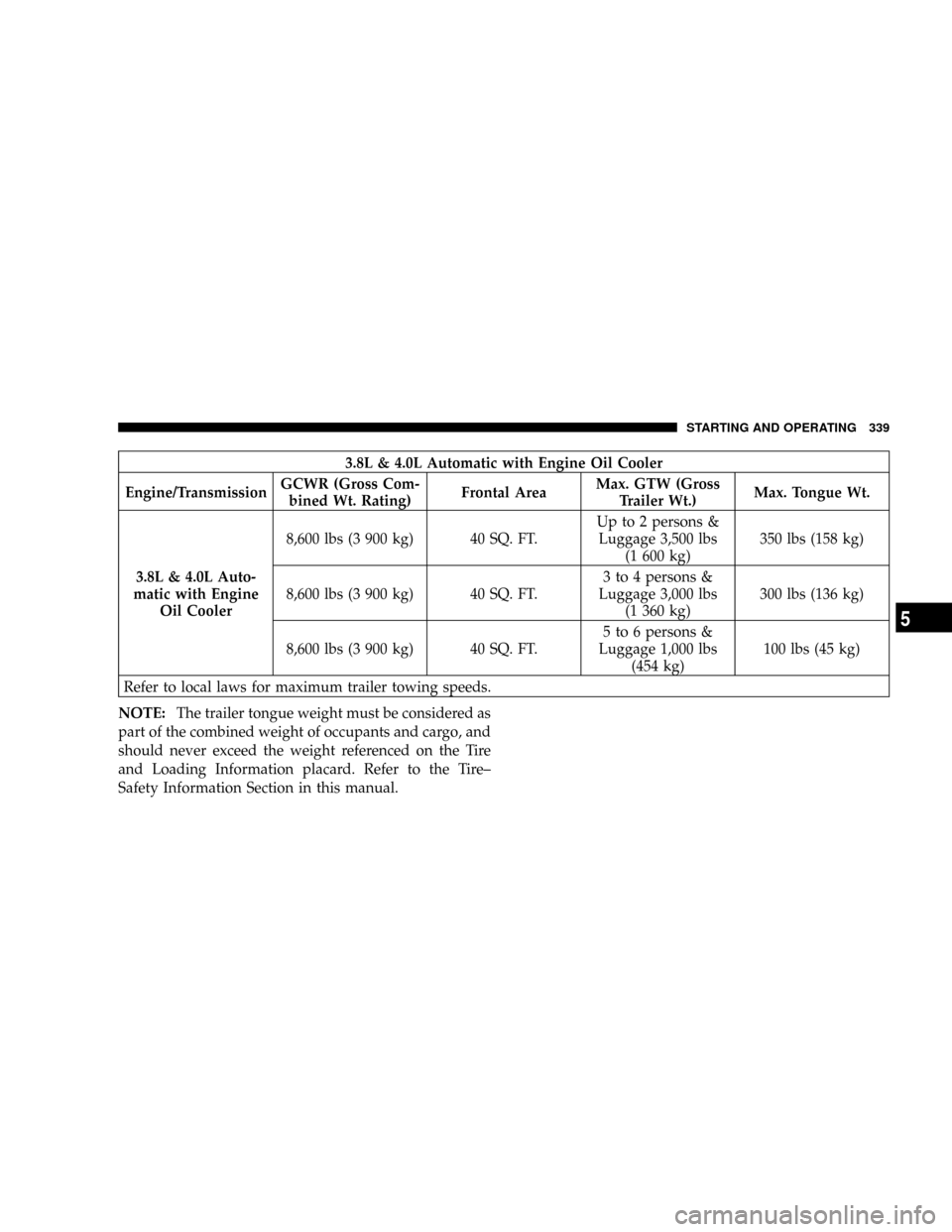
3.8L & 4.0L Automatic with Engine Oil Cooler
Engine/TransmissionGCWR (Gross Com-
bined Wt. Rating)Frontal AreaMax. GTW (Gross
Trailer Wt.)Max. Tongue Wt.
3.8L & 4.0L Auto-
matic with Engine
Oil Cooler8,600 lbs (3 900 kg) 40 SQ. FT.Up to 2 persons &
Luggage 3,500 lbs
(1 600 kg)350 lbs (158 kg)
8,600 lbs (3 900 kg) 40 SQ. FT.3 to 4 persons &
Luggage 3,000 lbs
(1 360 kg)300 lbs (136 kg)
8,600 lbs (3 900 kg) 40 SQ. FT.5 to 6 persons &
Luggage 1,000 lbs
(454 kg)100 lbs (45 kg)
Refer to local laws for maximum trailer towing speeds.
NOTE:The trailer tongue weight must be considered as
part of the combined weight of occupants and cargo, and
should never exceed the weight referenced on the Tire
and Loading Information placard. Refer to the Tire±
Safety Information Section in this manual.
STARTING AND OPERATING 339
5
Page 340 of 457
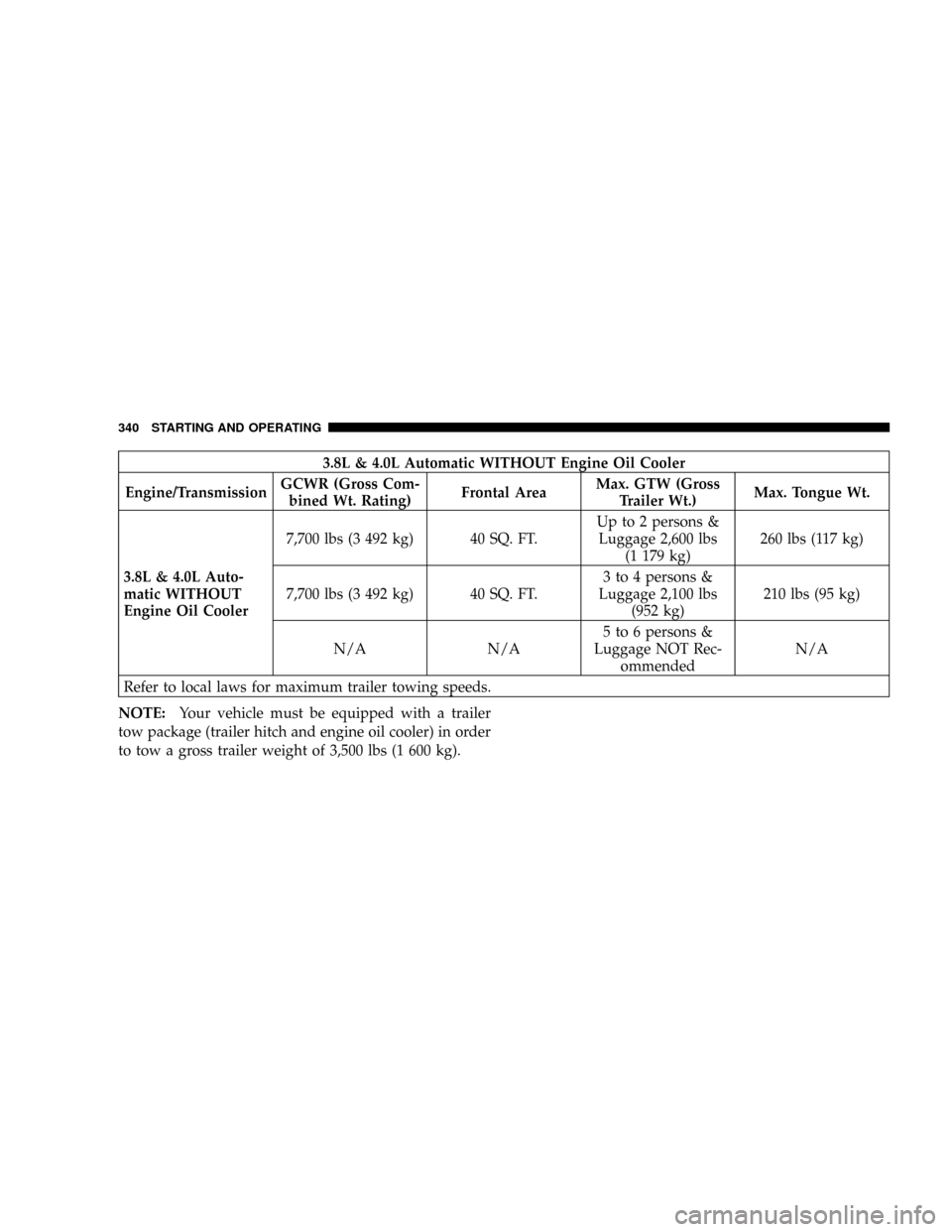
3.8L & 4.0L Automatic WITHOUT Engine Oil Cooler
Engine/TransmissionGCWR (Gross Com-
bined Wt. Rating)Frontal AreaMax. GTW (Gross
Trailer Wt.)Max. Tongue Wt.
3.8L & 4.0L Auto-
matic WITHOUT
Engine Oil Cooler7,700 lbs (3 492 kg) 40 SQ. FT.Up to 2 persons &
Luggage 2,600 lbs
(1 179 kg)260 lbs (117 kg)
7,700 lbs (3 492 kg) 40 SQ. FT.3 to 4 persons &
Luggage 2,100 lbs
(952 kg)210 lbs (95 kg)
N/A N/A5 to 6 persons &
Luggage NOT Rec-
ommendedN/A
Refer to local laws for maximum trailer towing speeds.
NOTE:Your vehicle must be equipped with a trailer
tow package (trailer hitch and engine oil cooler) in order
to tow a gross trailer weight of 3,500 lbs (1 600 kg).
340 STARTING AND OPERATING
Page 343 of 457

WARNING!
Improper towing can lead to an injury accident.
Follow these guidelines to make your trailer towing
as safe as possible:
Make certain that the load is secured in the trailer
and will not shift during travel. When trailering
cargo that is not fully secured, dynamic load shifts
can occur that may be difficult for the driver to
control. You could lose control of your vehicle and
have an accident.
²When hauling cargo or towing a trailer, do not over-
load your vehicle or trailer. Overloading can cause a
loss of control, poor performance or damage to brakes,
axle, engine, transmission, steering, suspension, chas-
sis structure or tires.
²Safety chains must always be used between your
vehicle and trailer. Always connect the chains to the
frame or hook retainers of the vehicle hitch. Cross the
chains under the trailer tongue and allow enough
slack for turning corners.
²Vehicles with trailers should not be parked on a grade.
When parking, apply the parking brake on the tow
vehicle. Put the tow vehicle automatic transmission in
P for Park. Always, block or9chock9the trailer wheels.
²GCWR must not be exceeded.
²Total weight must be distributed between the tow
vehicle and the trailer such that the following four
ratings are not exceeded:
1. GVWR
2. GTW
3. GAWR
STARTING AND OPERATING 343
5
Page 347 of 457

Towing Tips
Before setting out on a trip, practice turning, stopping
and backing the trailer in an area away from heavy
traffic.
Towing Tips Ð Automatic Transmission
The ªDº range can be selected when towing. However, if
frequent shifting occurs while in this range, the ª3º range
should be selected.
NOTE:Using the ª3º range while operating the vehicle
under heavy operating conditions will improve perfor-
mance and extend transmission life by reducing exces-
sive shifting and heat build up. This action will also
provide better engine braking.
The automatic transmission fluid and filter should be
changed if you REGULARLY tow a trailer for more than
45 minutes of continuous operation. See Maintaining
Your Vehicle in Section 7 Maintenance Schedule in Sec-
tion 8 of this manual for transmission fluid change
information and intervals.
NOTE:Check the automatic transmission fluid level
before towing.
7- Pin Connector
STARTING AND OPERATING 347
5
Page 360 of 457

NOTE:When reinstalling the wheel center cap, insure
that the valve stem symbol on the back of the cap is
pointed toward the wheel valve stem. Install the center
cap using hand pressure only. Do not use a hammer.
Wheel Nuts
All wheel nuts should be tightened occasionally to elimi-
nate the possibility of wheel studs being sheared or the
bolt holes in the wheels becoming elongated. This is
especially important during the first few hundred miles
of operation, and after each time a tire is changed, to
allow the wheel nuts to become properly set. All nuts
should first be firmly seated against the wheel. The nuts
should then be tightened to recommended torque.
Tighten the nuts to final torque in increments. Progress
around the bolt circle, tightening the nut opposite to the
nut just previously tightened until final torque is
achieved. Recommended torque is 130 N´m (95 ft. lbs).
JUMP-STARTING PROCEDURE
WARNING!
²Do not attempt to push or tow your vehicle to get it started.
Vehicles equipped with an automatic transmission cannot
be started this way. Unburned fuel could enter the catalytic
converter and once the engine has started, ignite and
damage the converter and vehicle. If the vehicle has a
discharged battery, booster cables may be used to obtain a
start from another vehicle. This type of start can be danger-
ous if done improperly, so follow this procedure carefully.
²Battery fluid is a corrosive acid solution; do not allow
battery fluid to contact eyes, skin or clothing. Don't lean
over battery when attaching clamps or allow the clamps to
touch each other. If acid splashes in eyes or on skin, flush
contaminated area immediately with large quantities of
water.
²A battery generates hydrogen gas which is flammable and
explosive. Keep flame or spark away from the vent holes.
Do not use a booster battery or any other booster source
with an output that exceeds 12 volts.
²Take care to avoid the radiator cooling fan whenever the
hood is raised. It can start anytime the ignition switch is on.
You can be hurt by the fan.
360 WHAT TO DO IN EMERGENCIES
Page 361 of 457

When jump starting, proceed as follows:
1. Wear eye protection and remove any metal jewelry
such as watch bands or bracelets that might make an
inadvertent electrical contact.
2. When boost is provided by a battery in another
vehicle, park that vehicle within booster cable reach and
without letting the vehicles touch. Set the parking brake,
place the automatic transmission in PARK and turn the
ignition switch to the OFF position for both vehicles.
3. Turn off the heater, radio and all unnecessary electrical
loads.
4. Connect one end of a jumper cable to the positive
terminal of the discharged battery. Connect the other end
of the same cable to the positive terminal of the booster
battery.WARNING!
Do not permit vehicles to touch each other as this
could establish a ground connection and personal
injury could result.
5. Connect the other cable, first to the negative terminal
of the booster battery andthen to the engine of the
vehicle with the discharged battery.Make sure you have
a good contact on the engine.
WHAT TO DO IN EMERGENCIES 361
6
Page 365 of 457

If it is necessary to use the accessories while being towed
(wipers, defrosters, etc.), the key must be in the ON
position, not the ACCESSORY position. Make certain the
transmission remains in NEUTRAL.
Without The Ignition Key
Special care must be taken when the vehicle is towed
with the ignition in the LOCK position. The only ap-
proved method of towing with out the ignition key is
with a flat bed truck. Proper towing equipment is neces-
sary to prevent damage to the vehicle.
TOWING THIS VEHICLE BEHIND ANOTHER
VEHICLE (Flat towing with all four wheels on the
ground)
Flat towing of vehicles equipped with an automatic
transmission, is only permitted within the limitations
described in this section.
TOWING THIS VEHICLE BEHIND ANOTHER
VEHICLE WITH A TOW DOLLY
The manufacturerdoes not recommendthat you tow an
All-Wheel Drive (AWD) or front wheel drive vehicle on a
tow dolly. Vehicle damage may occur.
WHAT TO DO IN EMERGENCIES 365
6