brake CHRYSLER PACIFICA 2008 1.G User Guide
[x] Cancel search | Manufacturer: CHRYSLER, Model Year: 2008, Model line: PACIFICA, Model: CHRYSLER PACIFICA 2008 1.GPages: 457, PDF Size: 6.7 MB
Page 188 of 457

WARNING!
A hot engine cooling system is dangerous. You or
others could be badly burned by steam or boiling
coolant. You may want to call a service center if your
vehicle overheats. If you decide to look under the
hood yourself, see Section 7 of this manual. Follow
the warnings under the Cooling System Pressure Cap
paragraph.
3. Fuel Gauge
The pointer shows the level of fuel in the fuel tank when
the ignition switch is in the ON position.
The Low Fuel Light will turn on when the fuel level
reaches approximately 2 to 4 gallons (7 to 15 liters)
this light will remain on until fuel is added.4. Turn Signal Indicators
The arrow will flash with the exterior turn signal
when the turn signal lever is operated.
If the vehicle electronics sense that the vehicle has
traveled about one mile with the turn signals on, a chime
will sound to alert you to turn the signals off. If either
indicator flashes at a rapid rate, check for a defective
outside light bulb.
5. Speedometer
Indicates vehicle speed.
6. Anti-Lock Brake Light
This light monitors the Anti-Lock Brake Sys-
tem. The light will turn on when the ignition
switch is turned to the ON position and may
stay on for as long as four seconds.
If the ABS light remains on or turns on while driving, it
indicates that the Anti-Lock portion of the brake system
188 UNDERSTANDING YOUR INSTRUMENT PANEL
Page 189 of 457

is not functioning and that service is required. However,
the conventional brake system will continue to operate
normally if the BRAKE warning light is not on.
If the ABS light is on, the brake system should be serviced
as soon as possible to restore the benefits of Anti-Lock
brakes. If the ABS light does not turn on when the
Ignition switch is turned to the ON position, have the
light inspected by an authorized dealer.
7. Brake System Warning Light
This light monitors various brake functions,
including brake fluid level and parking brake
application. If the brake light turns on, it may
indicate that the parking brake is applied, there
is a low brake fluid level or there is a problem with the
anti-lock brake system.
The dual brake system provides a reserve braking capac-
ity in the event of a failure to a portion of the hydraulic
system. Failure of either half of the dual brake system isindicated by the Brake Warning Light which will turn on
when the brake fluid level in the master cylinder has
dropped below a specified level.
The light will remain on until the cause is corrected.
NOTE:The light may flash momentarily during sharp
cornering maneuvers which change fluid level condi-
tions. The vehicle should have service performed.
If brake failure is indicated, immediate repair is neces-
sary.
WARNING!
Driving a vehicle with the brake light on is danger-
ous. Part of the brake system may have failed. It will
take longer to stop the vehicle. You could have an
accident. Have the vehicle checked immediately.
UNDERSTANDING YOUR INSTRUMENT PANEL 189
4
Page 190 of 457

Vehicles equipped with Anti-Lock brakes (ABS), are also
equipped with Electronic Brake Force Distribution (EBD).
In the event of an EBD failure, the Brake Warning Light
will turn on along with the ABS Light. Immediate repair
to the ABS system is required.
The operation of the Brake Warning Light can be checked
by turning the ignition switch from the OFF position to
the ON position. The light should illuminate for approxi-
mately two seconds. The light should then turn off unless
the parking brake is applied or a brake fault is detected.
If the light does not illuminate, have the light inspected
by an authorized dealer.
The light also will turn on when the parking brake is
applied with the ignition switch in the ON position.
NOTE:This light shows only that the parking brake is
applied. It does not show the degree of brake application.8. Electronic Stability Program (ESP) Indicator
Light/Traction Control System (TCS) Indicator Light
If this indicator light flashes during accelera-
tion, apply as little throttle as possible. While
driving, ease up on the accelerator. Adapt your
speed and driving to the prevailing road con-
ditions, and do not switch off the ESP, or TCS.
NOTE:Extended heavy use of Traction Control may
cause the system to deactivate and turn on the Traction
Control Light. This is to prevent overheating of the brake
system and is a normal condition. The system will remain
disabled for about 4 minutes until the brakes have
cooled. The system will automatically reactivate and turn
off the Traction Control Light.
190 UNDERSTANDING YOUR INSTRUMENT PANEL
Page 198 of 457

28. Electronic Stability Program (ESP) Warning
Light/Brake Assist System (BAS) Warning Light Ð If
Equipped
The malfunction lamp for the ESP is combined
with BAS. The yellow ªESP/BAS Warning
Lampº comes on when the ignition switch is
turned to the ªONº position. They should go
out with the engine running. If the ªESP/BAS Warning
Lampº comes on continuously with the engine running,
a malfunction has been detected in either the ESP or the
BAS system. If this light remains on after several ignition
cycles, and the vehicle has been driven several miles at
speeds greater than 30 mph (48 km/h), see your autho-
rized dealer as soon as possible.
29. Electronic Throttle Control (ETC.) Light
This light informs you of a problem with the
Electronic Throttle Control system. If a prob-
lem is detected the light will come on while the
engine is running. Cycle the ignition key whenthe vehicle has completely stopped and the gear selector
is placed in the PARK position. The light should turn off.
If the light remains lit with the engine running your
vehicle will usually be drivable, however, see your dealer
for service as soon as possible. If the light is flashing
when the engine is running, immediate service is re-
quired and you may experience reduced performance, an
elevated/rough idle or engine stall and your vehicle may
require towing. The light will come on when the ignition
is first turned on and remain on briefly as a bulb check.
If the light does not come on during starting, have the
system checked by an authorized dealer.
30. All-Wheel-Drive Failure Indicator Light Ð If AWD
equipped
This light monitors the All-Wheel-Drive
(AWD) system. The light will come on, for a
bulb check, when the ignition key is turned to
the ON position and may stay on for as long as
3 seconds.
198 UNDERSTANDING YOUR INSTRUMENT PANEL
Page 200 of 457

²PROGRAM KEY & FOB
²MEMORY #1/#2 POSITION SET (with a single chime)
²MEMORY #1/#2 POS SELECTED
²MEMORY SYSTEM DISABLED VEHICLE NOT IN
PARK (with a single chime)
²SET INHIBITED DUE TO MOTION (with a single
chime)
²FOB LINKED (with a single chime)
²FOB UNLINKED (with a single chime)
²PARK BRAKE ENGAGED (with a single chime)
²LOW BRAKE FLUID (with a single chime)
²LOW FUEL (with a single chime)
²MENU IN PARK ONLY
²LIST # ALERT MESSAGES
²UNLOCK TO OPEN LIFTGATE (with a single chime)
²PUT IN PARK FOR LIFTGATE (with a single chime)
²TOO COLD FOR PWR LIFTGATE (with a single
chime)
²TOO HOT FOR PWR LIFTGATE (with a single chime)
²PERFORM SERVICE (with a single chime)
²LEFT/RIGHT FRONT DOOR AJAR (one or more,
with a single chime if speed is above 1 mph)
²LEFT/RIGHT REAR DOOR AJAR (one or more, with
a single chime if speed is above 1 mph)
²DOOR(S) AJAR (with a single chime)
²DOOR(S) AND GATE AJAR (with a single chime)
²LIFT GATE AJAR (with a single chime if speed is
above 1 mph)
200 UNDERSTANDING YOUR INSTRUMENT PANEL
Page 271 of 457

STARTING AND OPERATING
CONTENTS
mStarting Procedures.....................275
NAutomatic Transmission................276
NNormal Starting (Above 32ÉF / 0ÉC)........276
NExtremely Cold Weather Starting (Below220ÉF /
±29ÉC).............................276
NHigh Altitude Starting (Above 4,000 Ft. /
1219m)............................276
NIf Engine Fails To Start.................277
NAfter Starting........................278
mEngine Block Heater Ð If Equipped.........278mAutomatic Transmission..................278
NBrake/Transmission Interlock System.......279
NAutomatic Transmission Ignition Interlock
System.............................280
NReset Mode - Electronic Transmission.......280
mAutoStick............................282
NAutoSticktOperation..................282
NAutoSticktGeneral Information...........282
mAll Wheel Drive Ð If Equipped............284
5
Page 272 of 457

mParking Brake.........................285
mBrake System..........................287
NAnti-Lock Brake System................288
mPower Steering........................290
mDriving On Slippery Surfaces..............291
NAcceleration.........................291
NTraction............................292
mDriving Through Water..................292
NFlowing/Rising Water..................292
NShallow Standing Water.................293
mTire Safety Information...................294
NTire Markings........................294
NTire Identification Number (TIN)..........298NTire Loading And Tire Pressure...........299
mTires Ð General Information...............303
NTire Pressure.........................303
NTire Inflation Pressures.................304
NRadial-Ply Tires......................306
NCompact Spare Tire Ð If Equipped.........307
NLimited Use Spare Ð If Equipped.........307
NTire Spinning........................308
NTread Wear Indicators..................309
NLife Of Tire.........................309
NReplacement Tires.....................310
NAlignment And Balance.................311
mTire Chains...........................312
272 STARTING AND OPERATING
Page 276 of 457

Automatic Transmission
The gear selector must be in the NEUTRAL or PARK
position before you can start the engine. Depress the
brake pedal before shifting into any driving gear.
Normal Starting (Above 32ÉF / 0ÉC)
1. Do not depress the accelerator.
2. Turn and hold the ignition key in the START position
and release when engine starts.
3. If engine does not start after 3 seconds, depress the
accelerator lightly (while still cranking the engine).
4. If engine does not start after 15 seconds, turn the
ignition key off.
5. Wait 10 to 15 seconds, and repeat steps1Ð5.
NOTE: This vehicle is equipped with a transmission
shift interlocking system. The brake pedal must be
depressed to shift out of Park (P).
Extremely Cold Weather Starting (Below220ÉF /
±29ÉC)
Follow the same instructions in the ªNormal Startingº
procedure.
To insure reliable starting at these temperatures, use of an
externally powered electric engine block heater (available
from your dealer) is recommended.
High Altitude Starting (Above 4,000 ft. / 1 219 m)
Follow the same instructions in the ªNormal Startingº
procedure.
To insure reliable starting at these temperatures, use of an
externally powered electric engine block heater (available
from your dealer) is recommended.
276 STARTING AND OPERATING
Page 279 of 457
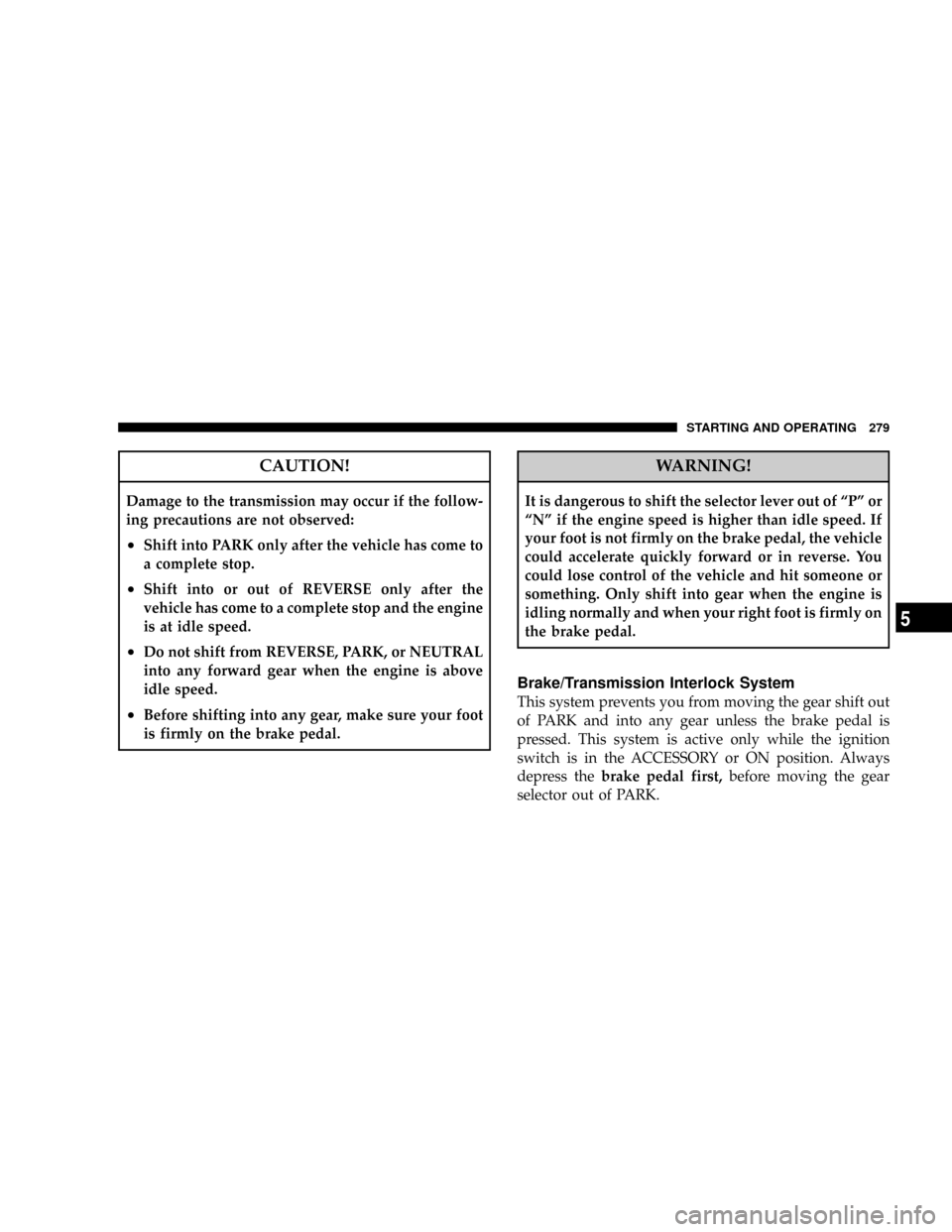
CAUTION!
Damage to the transmission may occur if the follow-
ing precautions are not observed:
²Shift into PARK only after the vehicle has come to
a complete stop.
²Shift into or out of REVERSE only after the
vehicle has come to a complete stop and the engine
is at idle speed.
²Do not shift from REVERSE, PARK, or NEUTRAL
into any forward gear when the engine is above
idle speed.
²Before shifting into any gear, make sure your foot
is firmly on the brake pedal.
WARNING!
It is dangerous to shift the selector lever out of ªPº or
ªNº if the engine speed is higher than idle speed. If
your foot is not firmly on the brake pedal, the vehicle
could accelerate quickly forward or in reverse. You
could lose control of the vehicle and hit someone or
something. Only shift into gear when the engine is
idling normally and when your right foot is firmly on
the brake pedal.
Brake/Transmission Interlock System
This system prevents you from moving the gear shift out
of PARK and into any gear unless the brake pedal is
pressed. This system is active only while the ignition
switch is in the ACCESSORY or ON position. Always
depress thebrake pedal first,before moving the gear
selector out of PARK.
STARTING AND OPERATING 279
5
Page 280 of 457

Automatic Transmission Ignition Interlock System
This system prevents the key from being removed unless
the shift lever is in PARK. It also prevents shifting out of
PARK unless the key is in the ACCESSORY or ON
position.
NOTE:If a malfunction occurs, the system will trap the
key in the ignition cylinder to warn you that this safety
feature is inoperable. The engine can be started and
stopped but the key cannot be removed until you obtain
service.
Reset Mode - Electronic Transmission
For electrical system malfunctions there is an override for
the interlock system. In order to override this system the
key must be in the ignition with the switch in the ACC or
ON positions. Pull up and rearward on the shifter bezel
ring.
The override can be activated by pressing the pink-
colored tab, which can be accessed through the lowerright corner of the shifter bezel ring. While the override is
pressed, the shifter can be moved out of the park position
without pressing the brake. After operation return the
shifter bezel ring to its original position.
NOTE:Even if the transmission can be reset, it is
recommended that you visit a dealer at your earliest
Brake Interlock Override
280 STARTING AND OPERATING