parking brake CHRYSLER PACIFICA 2008 1.G User Guide
[x] Cancel search | Manufacturer: CHRYSLER, Model Year: 2008, Model line: PACIFICA, Model: CHRYSLER PACIFICA 2008 1.GPages: 457, PDF Size: 6.7 MB
Page 343 of 457
WARNING!
Improper towing can lead to an injury accident.
Follow these guidelines to make your trailer towing
as safe as possible:
Make certain that the load is secured in the trailer
and will not shift during travel. When trailering
cargo that is not fully secured, dynamic load shifts
can occur that may be difficult for the driver to
control. You could lose control of your vehicle and
have an accident.
²When hauling cargo or towing a trailer, do not over-
load your vehicle or trailer. Overloading can cause a
loss of control, poor performance or damage to brakes,
axle, engine, transmission, steering, suspension, chas-
sis structure or tires.
²Safety chains must always be used between your
vehicle and trailer. Always connect the chains to the
frame or hook retainers of the vehicle hitch. Cross the
chains under the trailer tongue and allow enough
slack for turning corners.
²Vehicles with trailers should not be parked on a grade.
When parking, apply the parking brake on the tow
vehicle. Put the tow vehicle automatic transmission in
P for Park. Always, block or9chock9the trailer wheels.
²GCWR must not be exceeded.
²Total weight must be distributed between the tow
vehicle and the trailer such that the following four
ratings are not exceeded:
1. GVWR
2. GTW
3. GAWR
STARTING AND OPERATING 343
5
Page 355 of 457
CAUTION!
The winch mechanism is designed for use with the
jack handle only. Use of an air wrench or other power
tools is not recommended and can damage the winch.
When the spare is clear, tilt the retainer at the end of the
cable and pull it through the center of the wheel.
Preparations For Jacking
Park the vehicle on a firm level surface, avoid ice or
slippery areas,set the parking brakeand place the gear
selector in PARK. Turn OFF the ignition.
WARNING!
Do not attempt to change a tire on the side of the
vehicle close to moving traffic. Pull far enough off
the road to avoid the danger of being hit when
operating the jack or changing the wheel.
²Turn on the Hazard Warning Flasher.
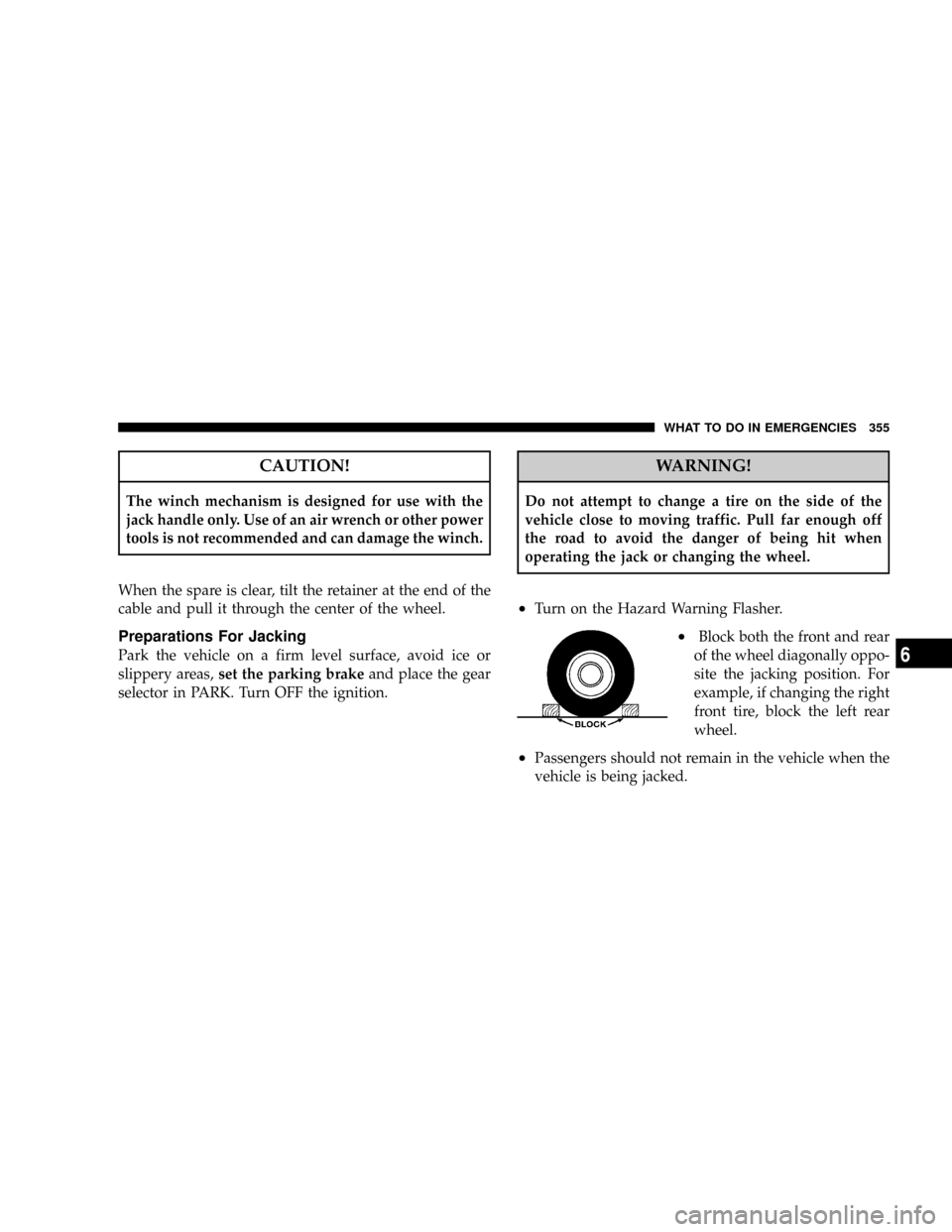
²Block both the front and rear
of the wheel diagonally oppo-
site the jacking position. For
example, if changing the right
front tire, block the left rear
wheel.
²Passengers should not remain in the vehicle when the
vehicle is being jacked.
WHAT TO DO IN EMERGENCIES 355
6
Page 356 of 457
Jacking Instructions
WARNING!
²Getting under a jacked-up vehicle is dangerous.
The vehicle could slip off the jack and fall on you.
You could be crushed. Never get any part of your
body under a vehicle that is on a jack. Never start
or run the engine while the vehicle is on a jack. If
you need to get under a raised vehicle, take it to a
service center where it can be raised on a lift.
²The jack is designed to use as a tool for changing
tires only. The jack should not be used to lift the
vehicle for service purposes. The vehicle should
be jacked on a firm level surface only. Avoid ice or
slippery areas.
WARNING!
Carefully follow these tire changing warnings to help pre-
vent personal injury or damage to your vehicle:
²Always park on a firm, level surface as far from the edge
of the roadway as possible before raising the vehicle.
²Block the wheel diagonally opposite the wheel to be
raised.
²Apply the parking brake firmly before jacking.
²Never start the engine with the vehicle on a jack.
²Do not let anyone sit in the vehicle when it is on a jack.
²Do not get under the vehicle when it is on a jack.
²Only use the jack in the positions indicated.
²If working on or near a roadway, be extremely careful of
motor traffic.
²To assure that spare tires, flat or inflated are securely
stowed, spares must be stowed with the value stem
facing the ground.
356 WHAT TO DO IN EMERGENCIES
Page 361 of 457
When jump starting, proceed as follows:
1. Wear eye protection and remove any metal jewelry
such as watch bands or bracelets that might make an
inadvertent electrical contact.
2. When boost is provided by a battery in another
vehicle, park that vehicle within booster cable reach and
without letting the vehicles touch. Set the parking brake,
place the automatic transmission in PARK and turn the
ignition switch to the OFF position for both vehicles.
3. Turn off the heater, radio and all unnecessary electrical
loads.
4. Connect one end of a jumper cable to the positive
terminal of the discharged battery. Connect the other end
of the same cable to the positive terminal of the booster
battery.WARNING!
Do not permit vehicles to touch each other as this
could establish a ground connection and personal
injury could result.
5. Connect the other cable, first to the negative terminal
of the booster battery andthen to the engine of the
vehicle with the discharged battery.Make sure you have
a good contact on the engine.
WHAT TO DO IN EMERGENCIES 361
6
Page 399 of 457

Procedure For Checking Fluid Level
The fluid level in the automatic transmission should be
checked whenever the vehicle is serviced. Operation with
an improper fluid level will greatly reduce the life of the
transmission and of the fluid.
To properly check the automatic transmission fluid level,
the following procedure must be used:
1. The vehicle must be on level ground.
2. The engine should be running at curb idle speed for a
minimum of 60 seconds.
3. Fully apply parking brake.4. Place the gear selector momentarily in each gear
position ending with the lever in P (PARK). Wipe the area
around the dipstick clean to eliminate the possibility of
dirt entering the transmission.
5. Remove the dipstick and determine if the fluid is hot
or warm. Hot fluid is approximately 180ÉF (82ÉC), which
is the normal operating temperature after the vehicle has
been driven at least 15 miles (24 km). The fluid cannot be
comfortably held between the finger tips. Cold is when
the fluid is below 80ÉF (27ÉC).
6. Wipe the dipstick clean and reinsert until seated.
Remove dipstick and note reading.
a. If the fluid is hot, the reading should be in the
crosshatched area marked ªHOTº (between the upper
two holes in the dipstick).
b. If the fluid is cold, the fluid level should be between
the lower two holes in the area marked ªCOLDº.
MAINTAINING YOUR VEHICLE 399
7
Page 439 of 457

Reset Mode.......................... 280
Selection Of Lubricant................398,418
Shifting............................. 281
Special Additives...................... 400
Automatic Transmission................398,400
Adding Fluid......................399,400
Fluid and Filter Changes................. 400
Fluid Change......................... 400
Fluid Level Check...................... 399
Fluid Type........................... 398
Autostick........................145,281,282
Ball Joints............................. 385
Battery............................... 382
Gas Caution.......................... 382
Jump Starting......................... 360
Keyless Transmitter Replacement (RKE)....... 24
Bearings.............................. 401
Belts, Drive............................ 379Body Mechanism Lubrication............... 386
B-Pillar Location........................ 299
Brake Assist System...................... 154
Brake Control System, Electronic............. 154
Brake, Parking.......................... 285
Brake System........................287,394
Anti-Lock (ABS)....................153,288
Fluid Check.......................396,418
Hoses.............................. 395
Warning Light........................ 189
Brakes.............................287,394
Brake/Transmission Interlock............... 279
Break-In Recommendations, New Vehicle........ 77
Bulb Replacement....................... 412
Bulbs, Light............................ 411
Calibration, Compass..................... 207
Camera, Rear........................... 166
Capacities, Fluid........................ 416
INDEX 439
10
Page 449 of 457

Filter............................379,417
Filter Disposal........................ 379
Identification Logo..................... 378
Materials Added to..................... 379
Recommendation...................377,416
Synthetic............................ 378
Viscosity..........................378,416
Onboard Diagnostic System..............372,373
Opener, Garage Door (HomeLinkt) ........... 146
Overdrive............................. 281
Overhead Console....................... 168
Overhead Travel Information Center.......... 168
Overheating, Engine...................187,351
Owner's Manual (Operator Manual).......... 432
Panic Alarm............................ 24
Park Sense System, Rear................... 160
Parking Brake.......................... 285
Parking On Hill......................... 285Passing Light........................... 139
Pedals, Adjustable....................... 159
Pets, Transporting........................ 77
Phone, Cellular.......................... 89
Phone, Hands-Free (UConnectŸ)............. 89
Placard, Tire and Loading Information......... 299
Power
Brakes.............................. 287
Distribution Center (Fuses)............... 407
Door Locks........................... 27
Lift Gate............................. 35
Mirrors.............................. 88
Outlet (Auxiliary Electrical Outlet).......... 172
Seats............................ 115,116
Steering............................. 290
Steering, Checking..................... 385
Sunroof............................. 169
Windows............................. 32
Pregnant Women and Seat Belts............48,49
INDEX 449
10
Page 457 of 457
INTRODUCTION INTRODUCTION HOW TO USE THIS MANUAL WARNINGS AND CAUTIONS VEHICLE IDENTIFICATION NUMBER VEHICLE MODIFICATIONS/ALTERATIONS THINGS TO KNOW BEFORE STARTING YOUR VEHICLE A WORD ABOUT YOUR KEYS
Ignition Key RemovalKey-In-Ignition ReminderLocking Doors With The KeySTEERING WHEEL LOCK - IF EQUIPPED If You Wish To Manually Lock The Steering WheelTo Release The Steering Wheel LockAutomatic Transaxle Ignition Interlock SystemSENTRY KEY - IF
EQUIPPED Replacement KeysCustomer Key ProgrammingGeneral InformationSECURITY ALARM SYSTEM - IF EQUIPPED Rearming of the System - If EquippedTo Arm the SystemTo Disarm the SystemSecurity System Manual OverrideILLUMINATED ENTRY SYSTEM
REMOTE KEYLESS ENTRY To unlock the doors and liftgateTo lock the doors and liftgateTo Open/Close Power Liftgate - If EquippedFlash Lights On Lock/UnlockUsing The Panic AlarmProgramming Additional TransmittersBattery ReplacementDOOR LOCKS Manual Door
LocksPower Door LocksChild Protection Door LockWINDOWS Power WindowsLIFTGATE Power Liftgate - If EquippedOCCUPANT RESTRAINTS Lap/Shoulder BeltsLap/Shoulder Belt Untwisting ProcedureSeat Belt PretensionersEnhanced Seat Belt Use Reminder System
(BeltAlert)Seat Belts and Pregnant WomenAutomatic-Locking Retractor (ALR)Seat Belts and Pregnant WomenSeat Belt ExtenderDriver and Front Passenger Supplemental Restraint System - AirbagEvent Data Recorder (EDR)Child RestraintENGINE BREAK-IN
RECOMMENDATIONS SAFETY TIPS Exhaust GasSafety Checks You Should Make Inside The VehiclePeriodic Safety Checks You Should Make Outside The VehicleUNDERSTANDING THE FEATURES OF YOUR VEHICLE MIRRORS Inside Day / Night MirrorAutomatic
Dimming Mirror - If EquippedDrivers Side Outside Mirror Auto Dimmer - If EquippedExterior Mirrors Folding FeatureOutside Mirror - Drivers SideOutside Mirror - Passengers SidePower Remote-Control MirrorsHeated Remote Control Mirrors - If EquippedIlluminated Vanity
MirrorsHANDS-FREE COMMUNICATION (UConnect) - IF EQUIPPED OperationsPhone Call FeaturesUConnect System FeaturesAdvanced Phone ConnectivityThings You Should Know About Your UConnect SystemGeneral InformationSEATS 10-Way Drivers Power Seat
- If Equipped8-Way Drivers Power Seat - If Equipped4-Way Passengers Power SeatAdjustable Head RestraintsHeated Seats - If EquippedSecond Row Manual Seat Recliner - If EquippedSecond Row Manual Seat Adjuster - If EquippedSecond Row Bench Seating - If
EquippedSecond Row Fold and Tumble Seats - If EquippedThird Row Easy Exit - If EquippedThird Row Seating - If EquippedLoad Floor - If EquippedPlastic Grocery Bag RetainerDRIVER MEMORY SEAT - IF EQUIPPED Easy Exit Seat (Available with Memory Seat Only)
Tilt Mirrors in Reverse (Available with Memory Seat Only) - If EquippedTO OPEN AND CLOSE THE HOOD LIGHTS Overhead Console Map/Reading LightsInteriorLightsMulti-Function LeverHeadlights, Parking Lights, Instrument Panel LightsAutomatic HeadlightsDaytime
Running Lights (Canada Only)Lights-on ReminderHeadlight Time DelayFog Lights - If EquippedTurn SignalsHighbeam/Lowbeam Select SwitchPassing LightWINDSHIELD WIPERS AND WASHERS Windshield WashersMist FeatureWindshield Wiper OperationIntermittent
Wiper SystemRear Window Wiper/WasherTILT STEERING COLUMN ELECTRONIC SPEED CONTROL To ActivateTo Set a Desired SpeedTo DeactivateTo Resume SpeedTo Vary the Speed SettingTo Accelerate For PassingGARAGE DOOR OPENER - IF EQUIPPED
Programming HomeLinkCanadian Programming/Gate ProgrammingUsing HomeLinkReprogramming a Single HomeLink ButtonsSecurityTroubleshooting TipsGeneral InformationANTI-LOCK BRAKE SYSTEM (ABS) ELECTRONIC BRAKE CONTROL SYSTEM -
ABS/TCS/BAS/ESP Traction Control System (TCS)Brake Assist System (BAS)ESP (Electronic Stability Program)ADJUSTABLE PEDALS - IF EQUIPPED REAR PARK SENSE SYSTEM - IF EQUIPPED Rear Park Assist SensorsRear Park Assist Warning Display
Enable/Disable the Rear Park Assist System - If EquippedService the Rear Park Assist SystemCleaning the Rear Park Assist SystemREAR CAMERA - IF EQUIPPED OVERHEAD CONSOLE - IF EQUIPPED Courtesy/Reading LightsSunglasses StoragePOWER SUNROOF
- IF EQUIPPED Express Open FeatureWind BuffetingSunroof Comfort Position - If EquippedSunroof MaintenanceELECTRICAL POWER OUTLETS Electrical Outlet Use With Engine OffCUPHOLDERS Front Seat CupholdersSecond Row Seat CupholdersThird Row Seat Cupholders - If EquippedSTORAGE Console FeaturesRear Cargo Storage Bin - If EquippedRetractable Cargo Area Cover - If EquippedCargo Tie-Down HooksROOF LUGGAGE RACK - IF EQUIPPED LOAD LEVELING SYSTEM UNDERSTANDING YOUR INSTRUMENT
PANEL INSTRUMENT PANEL AND CONTROLS BASE INSTRUMENT CLUSTER PREMIUM INSTRUMENT CLUSTER INSTRUMENT CLUSTER DESCRIPTIONS ELECTRONIC VEHICLE INFORMATION CENTER (EVIC) - IF EQUIPPED Oil Change RequiredCustomer
Programmable Features - If EquippedCompass Display - If EquippedMini-Trip Functions - If EquippedSETTING THE ANALOG CLOCK ELECTRONIC DIGITAL CLOCK Clock Setting ProcedureRADIO GENERAL INFORMATION Radio Broadcast SignalsTwo Types of Signals
Electrical DisturbancesAM ReceptionFM ReceptionSALES CODE RAH - AM AND FM STEREO RADIO WITH CD PLAYER AND CD/DVD CHANGER CONTROLS Radio OperationCDPlayer OperationCD/DVD Changer OperationNotes On Playing MP3 FilesOperation
Instructions - (CD Mode For MP3 Audio Play)SALES CODE REV - AM AND FM STEREO RADIO WITH CD PLAYER AND CD/DVD CHANGER CONTROLS Radio OperationCD Player OperationCD/DVD Changer OperationNotes On Playing MP3 FilesOperation Instructions
- (CD Mode For MP3 Audio Play)Operating Instructions - MP3 Player, Portable WalkmanOperating Instructions - Video Games/Camcorders6 DISC CD/DVD CHANGER (RDV) - IF EQUIPPED Operating Instructions - CD/DVD ChangerEJECT (EJT) ButtonOperating
Instructions - Remote ControlOperating Instructions - Video ScreenOperating Instructions - Headphones Operating Instructions - Auxiliary InputNAVIGATION SYSTEM - IF EQUIPPED SATELLITE RADIO - IF EQUIPPED System ActivationElectronic Serial Number/Sirius
Identification Number (ENS/SID)Selecting Satellite Mode in RBB, RAH, REV and RBK RadiosSelecting Satellite Mode in RBP, RBU, RAZ, RB1 and RBQ RadiosSelecting a ChannelStoring and Selecting Pre-Set ChannelsUsing the PTY (Program Type) Button (If Equipped)
PTY Button SCANPTY Button SEEKSatellite AntennaReception QualityREMOTE SOUND SYSTEM CONTROLS Radio OperationCD PlayerCD/DVD DISC MAINTENANCE RADIO OPERATION AND CELLULAR PHONES CLIMATE CONTROLS Manual Air Conditioning
and Heating System Mode ControlManual Air Conditioning OperationDual-Zone Automatic Temperature ControlElectric Rear Window DefrosterSTARTING AND OPERATING STARTING PROCEDURES Automatic TransmissionNormal Starting (Above 32 degreesF/0
degrees C)Extremely Cold Weather Starting (Below -20 degrees F / -29 degrees C)High Altitude Starting (Above 4,000 ft. / 1 219 m)If Engine Fails To StartAfter StartingENGINE BLOCK HEATER - IF EQUIPPED AUTOMATIC TRANSMISSION Brake/Transmission Interlock
SystemAutomatic Transmission Ignition Interlock SystemReset Mode - Electronic TransmissionAUTOSTICK AutoStick OperationAutoStick General InformationALL WHEEL DRIVE - IF EQUIPPED PARKING BRAKE BRAKE SYSTEM Anti-Lock Brake SystemPOWER
STEERING DRIVING ON SLIPPERY SURFACES AccelerationTractionDRIVING THROUGH WATER Flowing/Rising WaterShallow Standing WaterTIRE SAFETY INFORMATION Tire Markings Tire Identification Number (TIN)Tire Loading and Tire PressureTIRES - GENERAL
INFORMATION Tire PressureTire Inflation PressuresRadial-Ply TiresCompact Spare Tire - If EquippedLimited Use Spare - If EquippedTire SpinningTread Wear IndicatorsLife of TireReplacement TiresAlignment And BalanceTIRE CHAINS SNOW TIRES TIRE ROTATION
TIRE PRESSURE MONITOR SYSTEM (TPMS) Basic TPMS without EVIC - If EquippedBasic TPMS with EVIC - If EquippedPremium TPMS - If EquippedTire Pressure Monitoring Low Pressure WarningsService Tire System SoonGeneral InformationFUEL REQUIREMENTS
3.8L GASOLINE ENGINES4.0L GASOLINE ENGINESReformulated GasolineGasoline/Oxygenate BlendsMMT In GasolineMaterials Added to FuelFuel System CautionsCarbon Monoxide WarningsADDING FUEL Fuel Filler Cap (Gas Cap)Loose Fuel Filler Cap Message
VEHICLE LOADING Vehicle Certification LabelGross Vehicle Weight Rating (GVWR)Gross Axle Weight Rating (GAWR)OverloadingLoadingTRAILER TOWINGCommon Towing DefinitionsTrailer Hitch ClassificationTrailer Towing Weights (Maximum Trailer Weight Ratings)
Trailer and Tongue WeightTowing RequirementsTowing TipsRECREATIONAL TOWING (BEHIND MOTORHOME, ETC.) TOWING THIS VEHICLE BEHIND ANOTHER VEHICLE(Flat towing with all four wheels on the ground)WHAT TO DO IN EMERGENCIES HAZARD
WARNING FLASHER IF YOUR ENGINE OVERHEATS JACKING AND TIRE CHANGING Jack LocationSpare Tire StowagePreparations For JackingJacking InstructionsJUMP-STARTING PROCEDURE FREEING A STUCK VEHICLE TOWING A DISABLED VEHICLE With Ignition KeyWithout The Ignition KeyTOWING THIS VEHICLE BEHIND ANOTHER VEHICLE (Flat towing with all four wheels on the ground)TOWING THIS VEHICLE BEHIND ANOTHER VEHICLE WITH A TOW DOLLYMAINTAINING YOUR VEHICLE 3.8L ENGINES 4.0L
ENGINES ONBOARD DIAGNOSTIC SYSTEM - OBD II Loose Fuel Filler Cap MessageEMISSIONS INSPECTION AND MAINTENANCE PROGRAMS REPLACEMENT PARTS DEALER SERVICE MAINTENANCE PROCEDURES Engine OilEngine Oil FilterDrive BeltSpark
PlugsEngine Air Cleaner FilterCatalytic ConverterMaintenance-Free BatteryAir Conditioner MaintenancePower Steering - Fluid CheckFront and Rear Suspension Ball JointsSteering Shaft SealSteering LinkageDrive Shaft Universal JointsBody LubricationWindshield Wiper
BladesWindshield and Rear Window WashersExhaust SystemCooling SystemHoses And Vacuum/Vapor HarnessesBrakesMaster Cylinder - Brake Fluid LevelCheckFuel System HosesAutomatic TransmissionAll Wheel Drive (AWD) - If EquippedFront And Rear Wheel
BearingsAppearance Care and Protection from CorrosionCleaning The Center Console Cup HoldersFUSES (INTEGRATED POWER MODULE) VEHICLE STORAGE REPLACEMENT LIGHT BULBS BULB REPLACEMENT HeadlightsHigh Intensity Discharge Headlights
(HID) - If EquippedFront Park/Turn Signal and Sidemarker LightsFront Fog LightRear Tail, Stop, Turn Signal, Side Marker and Back-up LightsLicense LightFLUIDS AND CAPACITIES FLUIDS, LUBRICANTS AND GENUINE PARTS EngineChassisMAINTENANCE
SCHEDULES EMISSION CONTROL SYSTEM MAINTENANCE MAINTENANCE SCHEDULE Required Maintenance IntervalsIF YOU NEED CONSUMER ASSISTANCE SUGGESTIONS FOR OBTAINING SERVICE FOR YOUR VEHICLE Prepare For The Appointment
Prepare A ListBe Reasonable With RequestsIF YOU NEED ASSISTANCE WARRANTY INFORMATION (U.S. Vehicles Only) MOPAR PARTS REPORTING SAFETY DEFECTS In CanadaPUBLICATION ORDER FORMS DEPARTMENT OF TRANSPORTATION UNIFORM
TIRE QUALITY GRADES TreadwearTraction GradesTemperature GradesINDEX