catalytic converter CHRYSLER PACIFICA 2008 1.G Owners Manual
[x] Cancel search | Manufacturer: CHRYSLER, Model Year: 2008, Model line: PACIFICA, Model: CHRYSLER PACIFICA 2008 1.GPages: 457, PDF Size: 6.7 MB
Page 193 of 457

2. Fully depress the accelerator pedal slowly three
times within 10 seconds.
3. Turn the ignition switch to the LOCK position.
NOTE:If the indicator message illuminates when you
start the vehicle, the oil change indicator system did not
reset. If necessary repeat this procedure.
14. Cruise Indicator
This indicator shows that the Speed Control
System is ON.
15. Malfunction Indicator Light
This light is part of an onboard diagnostic system
called OBD that monitors engine and automatic
transmission control systems. The light will illu-
minate when the key is in the ON position before engine
start. If the bulb does not come on when turning the key
from OFF to ON, have the condition checked promptly.Certain conditions such as a loose or missing gas cap,
poor fuel quality, etc. may illuminate the light after
engine start. The vehicle should be serviced if the light
stays on through several of your typical driving cycles. In
most situations the vehicle will drive normally and will
not require towing.
The Malfunction Indicator Light flashes to alert you to
serious conditions that could lead to immediate loss of
power or severe catalytic converter damage. The vehicle
should be serviced as soon as possible if this occurs.
16. High Beam Light
This light shows that the headlights are on high
beam. Pull the Multi-Function lever towards the
steering wheel to switch the headlights from high or low
beam.
UNDERSTANDING YOUR INSTRUMENT PANEL 193
4
Page 277 of 457
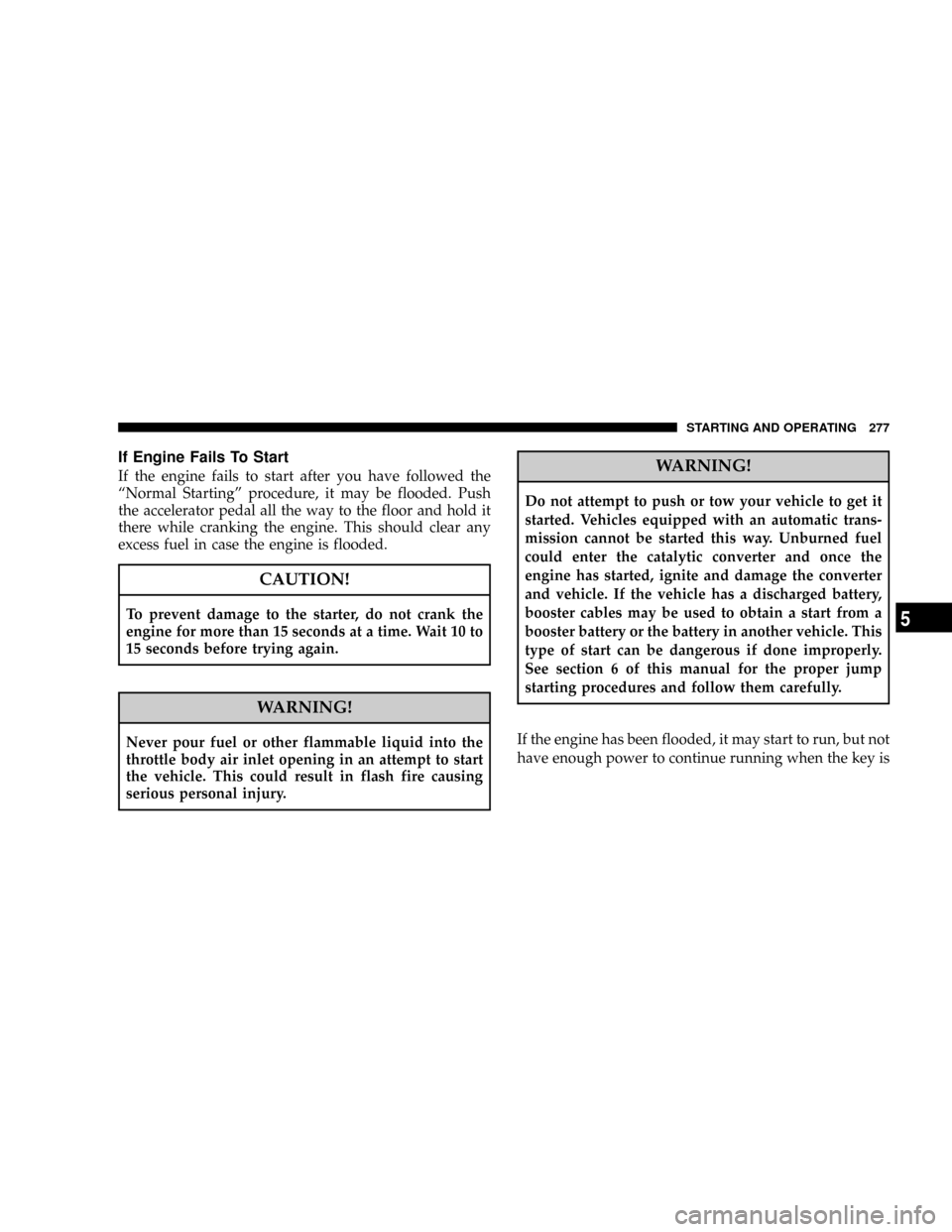
If Engine Fails To Start
If the engine fails to start after you have followed the
ªNormal Startingº procedure, it may be flooded. Push
the accelerator pedal all the way to the floor and hold it
there while cranking the engine. This should clear any
excess fuel in case the engine is flooded.
CAUTION!
To prevent damage to the starter, do not crank the
engine for more than 15 seconds at a time. Wait 10 to
15 seconds before trying again.
WARNING!
Never pour fuel or other flammable liquid into the
throttle body air inlet opening in an attempt to start
the vehicle. This could result in flash fire causing
serious personal injury.
WARNING!
Do not attempt to push or tow your vehicle to get it
started. Vehicles equipped with an automatic trans-
mission cannot be started this way. Unburned fuel
could enter the catalytic converter and once the
engine has started, ignite and damage the converter
and vehicle. If the vehicle has a discharged battery,
booster cables may be used to obtain a start from a
booster battery or the battery in another vehicle. This
type of start can be dangerous if done improperly.
See section 6 of this manual for the proper jump
starting procedures and follow them carefully.
If the engine has been flooded, it may start to run, but not
have enough power to continue running when the key is
STARTING AND OPERATING 277
5
Page 328 of 457
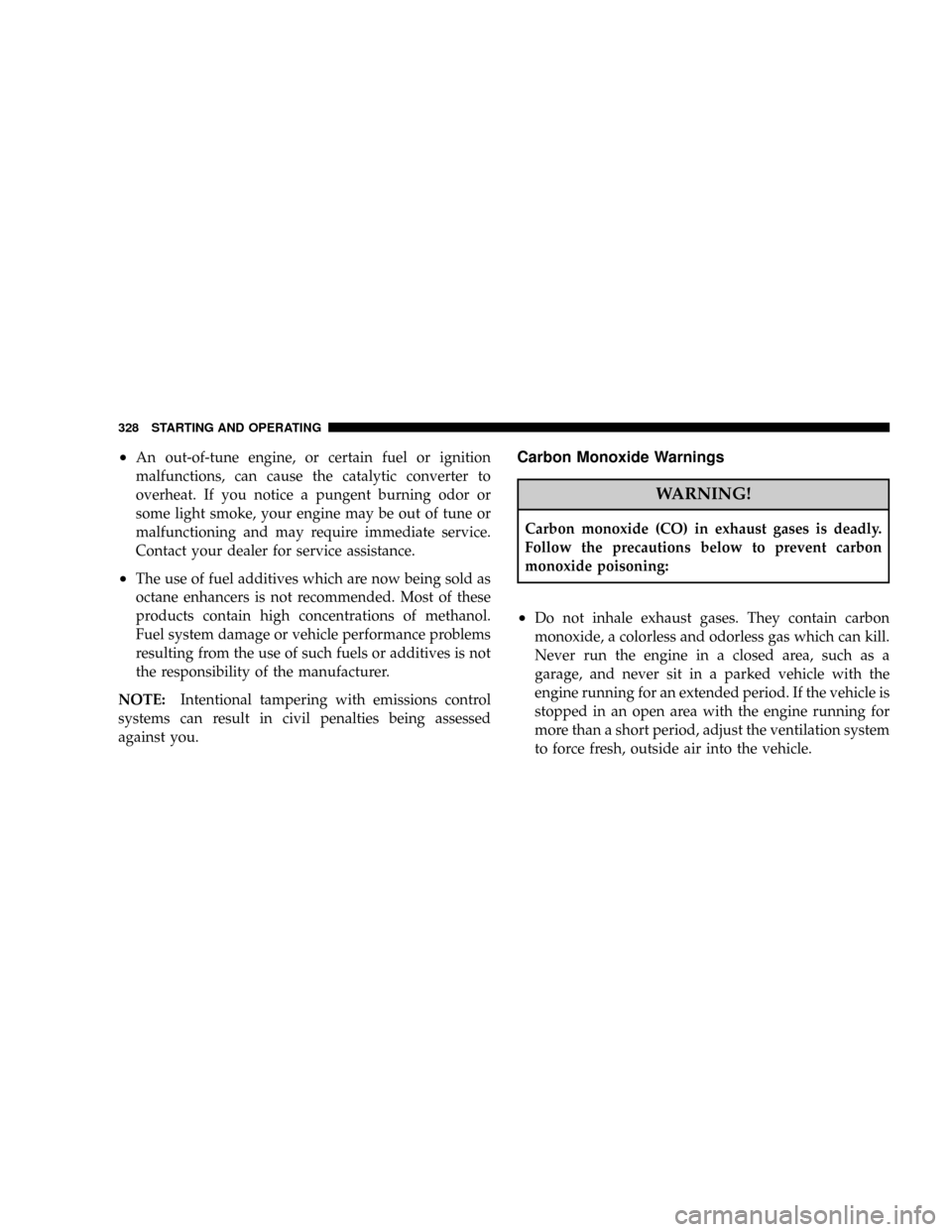
²An out-of-tune engine, or certain fuel or ignition
malfunctions, can cause the catalytic converter to
overheat. If you notice a pungent burning odor or
some light smoke, your engine may be out of tune or
malfunctioning and may require immediate service.
Contact your dealer for service assistance.
²The use of fuel additives which are now being sold as
octane enhancers is not recommended. Most of these
products contain high concentrations of methanol.
Fuel system damage or vehicle performance problems
resulting from the use of such fuels or additives is not
the responsibility of the manufacturer.
NOTE:Intentional tampering with emissions control
systems can result in civil penalties being assessed
against you.
Carbon Monoxide Warnings
WARNING!
Carbon monoxide (CO) in exhaust gases is deadly.
Follow the precautions below to prevent carbon
monoxide poisoning:
²Do not inhale exhaust gases. They contain carbon
monoxide, a colorless and odorless gas which can kill.
Never run the engine in a closed area, such as a
garage, and never sit in a parked vehicle with the
engine running for an extended period. If the vehicle is
stopped in an open area with the engine running for
more than a short period, adjust the ventilation system
to force fresh, outside air into the vehicle.
328 STARTING AND OPERATING
Page 360 of 457

NOTE:When reinstalling the wheel center cap, insure
that the valve stem symbol on the back of the cap is
pointed toward the wheel valve stem. Install the center
cap using hand pressure only. Do not use a hammer.
Wheel Nuts
All wheel nuts should be tightened occasionally to elimi-
nate the possibility of wheel studs being sheared or the
bolt holes in the wheels becoming elongated. This is
especially important during the first few hundred miles
of operation, and after each time a tire is changed, to
allow the wheel nuts to become properly set. All nuts
should first be firmly seated against the wheel. The nuts
should then be tightened to recommended torque.
Tighten the nuts to final torque in increments. Progress
around the bolt circle, tightening the nut opposite to the
nut just previously tightened until final torque is
achieved. Recommended torque is 130 N´m (95 ft. lbs).
JUMP-STARTING PROCEDURE
WARNING!
²Do not attempt to push or tow your vehicle to get it started.
Vehicles equipped with an automatic transmission cannot
be started this way. Unburned fuel could enter the catalytic
converter and once the engine has started, ignite and
damage the converter and vehicle. If the vehicle has a
discharged battery, booster cables may be used to obtain a
start from another vehicle. This type of start can be danger-
ous if done improperly, so follow this procedure carefully.
²Battery fluid is a corrosive acid solution; do not allow
battery fluid to contact eyes, skin or clothing. Don't lean
over battery when attaching clamps or allow the clamps to
touch each other. If acid splashes in eyes or on skin, flush
contaminated area immediately with large quantities of
water.
²A battery generates hydrogen gas which is flammable and
explosive. Keep flame or spark away from the vent holes.
Do not use a booster battery or any other booster source
with an output that exceeds 12 volts.
²Take care to avoid the radiator cooling fan whenever the
hood is raised. It can start anytime the ignition switch is on.
You can be hurt by the fan.
360 WHAT TO DO IN EMERGENCIES
Page 367 of 457

MAINTAINING YOUR VEHICLE
CONTENTS
m3.8L Engines..........................370
m4.0L Engines..........................371
mOnboard Diagnostic System Ð OBD II........372
NLoose Fuel Filler Cap Message............373
mEmissions Inspection And Maintenance
Programs............................373
mReplacement Parts......................375
mDealer Service.........................375
mMaintenance Procedures..................376NEngine Oil..........................376
NEngine Oil Filter......................379
NDrive Belt...........................379
NSpark Plugs.........................379
NEngine Air Cleaner Filter................380
NCatalytic Converter....................380
NMaintenance-Free Battery................382
NAir Conditioner Maintenance.............383
NPower Steering Ð Fluid Check............385
7
Page 380 of 457

plug. Malfunctioning spark plugs can damage the cata-
lytic converter. For proper type of replacement spark
plugs, refer to the ªVehicle Emission Control Informa-
tionº label in the engine compartment.
Engine Air Cleaner Filter
Refer to the ªMaintenance Scheduleº in Section 8 of this
manual for engine air cleaner filter maintenance inter-
vals.
NOTE:Be sure to follow the ªdusty or off-road condi-
tionsº maintenance interval if applicable.
WARNING!
The air induction system (air cleaner, hoses, etc.) can
provide a measure of protection in the case of engine
backfire. Do not remove the air induction system (air
cleaner, hoses, etc.) unless such removal is necessary
for repair or maintenance. Make sure that no one is
near the engine compartment before starting the
vehicle with the air induction system (air cleaner,
hoses, etc.) removed. Failure to do so can result in
serious personal injury.
Catalytic Converter
The catalytic converter requires the use of unleaded fuel
only. Leaded gasoline will destroy the effectiveness of the
catalyst as an emission control device.
380 MAINTAINING YOUR VEHICLE
Page 381 of 457

Under normal operating conditions, the catalytic con-
verter will not require maintenance. However, it is im-
portant to keep the engine properly tuned to assure
proper catalyst operation and prevent possible catalyst
damage.
CAUTION!
Damage to the catalytic converter can result if your
vehicle is not kept in proper operating condition. In
the event of engine malfunction, particularly involv-
ing engine misfire or other apparent loss of perfor-
mance, have your vehicle serviced promptly. Contin-
ued operation of your vehicle with a severe
malfunction could cause the converter to overheat,
resulting in possible damage to the converter and the
vehicle.NOTE:Intentional tampering with emissions control
systems can result in civil penalties being assessed
against you.
WARNING!
A hot exhaust system can start a fire if you park over
materials that can burn. Such materials might be grass
or leaves coming into contact with your exhaust system.
Do not park or operate your vehicle in areas where your
exhaust system can contact anything that can burn.
In unusual situations involving grossly malfunctioning
engine operation, a scorching odor may indicate severe
and abnormal catalyst overheating. If this occurs, the
vehicle should be stopped, the engine shut off and the
vehicle allowed to cool. Thereafter, service, including a
tune-up to manufacturer's specifications, should be ob-
tained immediately.
MAINTAINING YOUR VEHICLE 381
7
Page 440 of 457

Caps, Filler
Fuel................................ 329
Oil (Engine).......................... 378
Radiator (Coolant Pressure)............... 391
Car Washes............................ 402
Carbon Monoxide Warning................. 328
Cargo Area Cover....................... 176
Cargo Compartment
Luggage Carrier....................... 178
Cargo Tie-Downs........................ 177
Catalytic Converter...................... 380
Caution, Exhaust Gas...................78,388
CD (Compact Disc) Changer..........218,228,232
CD (Compact Disc) Player......212,216,222,226,232
CD (Compact Disc) Player Maintenance........ 250
Cellular Phone........................89,250
Chains, Tire............................ 312
Changing A Flat Tire..................... 352
Chart, Tire Sizing........................ 296Check Engine Light (Malfunction Indicator
Light).............................193,373
Child Restraint........................67,69
Child Restraint Tether Anchors.............71,74
Child Safety Locks........................ 30
Child Seat.............................. 75
Clean Air Gasoline....................... 326
Cleaning
Wheels............................. 403
Climate Control......................... 250
Clock................................ 209
Compact Disc (CD) Maintenance............. 250
Compact Spare Tire...................... 307
Compass.............................. 207
Compass Calibration..................... 207
Compass Variance....................... 207
Computer, Trip/Travel.................... 208
Console.............................. 175
Console, Floor.......................... 175
440 INDEX
Page 457 of 457
INTRODUCTION INTRODUCTION HOW TO USE THIS MANUAL WARNINGS AND CAUTIONS VEHICLE IDENTIFICATION NUMBER VEHICLE MODIFICATIONS/ALTERATIONS THINGS TO KNOW BEFORE STARTING YOUR VEHICLE A WORD ABOUT YOUR KEYS
Ignition Key RemovalKey-In-Ignition ReminderLocking Doors With The KeySTEERING WHEEL LOCK - IF EQUIPPED If You Wish To Manually Lock The Steering WheelTo Release The Steering Wheel LockAutomatic Transaxle Ignition Interlock SystemSENTRY KEY - IF
EQUIPPED Replacement KeysCustomer Key ProgrammingGeneral InformationSECURITY ALARM SYSTEM - IF EQUIPPED Rearming of the System - If EquippedTo Arm the SystemTo Disarm the SystemSecurity System Manual OverrideILLUMINATED ENTRY SYSTEM
REMOTE KEYLESS ENTRY To unlock the doors and liftgateTo lock the doors and liftgateTo Open/Close Power Liftgate - If EquippedFlash Lights On Lock/UnlockUsing The Panic AlarmProgramming Additional TransmittersBattery ReplacementDOOR LOCKS Manual Door
LocksPower Door LocksChild Protection Door LockWINDOWS Power WindowsLIFTGATE Power Liftgate - If EquippedOCCUPANT RESTRAINTS Lap/Shoulder BeltsLap/Shoulder Belt Untwisting ProcedureSeat Belt PretensionersEnhanced Seat Belt Use Reminder System
(BeltAlert)Seat Belts and Pregnant WomenAutomatic-Locking Retractor (ALR)Seat Belts and Pregnant WomenSeat Belt ExtenderDriver and Front Passenger Supplemental Restraint System - AirbagEvent Data Recorder (EDR)Child RestraintENGINE BREAK-IN
RECOMMENDATIONS SAFETY TIPS Exhaust GasSafety Checks You Should Make Inside The VehiclePeriodic Safety Checks You Should Make Outside The VehicleUNDERSTANDING THE FEATURES OF YOUR VEHICLE MIRRORS Inside Day / Night MirrorAutomatic
Dimming Mirror - If EquippedDrivers Side Outside Mirror Auto Dimmer - If EquippedExterior Mirrors Folding FeatureOutside Mirror - Drivers SideOutside Mirror - Passengers SidePower Remote-Control MirrorsHeated Remote Control Mirrors - If EquippedIlluminated Vanity
MirrorsHANDS-FREE COMMUNICATION (UConnect) - IF EQUIPPED OperationsPhone Call FeaturesUConnect System FeaturesAdvanced Phone ConnectivityThings You Should Know About Your UConnect SystemGeneral InformationSEATS 10-Way Drivers Power Seat
- If Equipped8-Way Drivers Power Seat - If Equipped4-Way Passengers Power SeatAdjustable Head RestraintsHeated Seats - If EquippedSecond Row Manual Seat Recliner - If EquippedSecond Row Manual Seat Adjuster - If EquippedSecond Row Bench Seating - If
EquippedSecond Row Fold and Tumble Seats - If EquippedThird Row Easy Exit - If EquippedThird Row Seating - If EquippedLoad Floor - If EquippedPlastic Grocery Bag RetainerDRIVER MEMORY SEAT - IF EQUIPPED Easy Exit Seat (Available with Memory Seat Only)
Tilt Mirrors in Reverse (Available with Memory Seat Only) - If EquippedTO OPEN AND CLOSE THE HOOD LIGHTS Overhead Console Map/Reading LightsInteriorLightsMulti-Function LeverHeadlights, Parking Lights, Instrument Panel LightsAutomatic HeadlightsDaytime
Running Lights (Canada Only)Lights-on ReminderHeadlight Time DelayFog Lights - If EquippedTurn SignalsHighbeam/Lowbeam Select SwitchPassing LightWINDSHIELD WIPERS AND WASHERS Windshield WashersMist FeatureWindshield Wiper OperationIntermittent
Wiper SystemRear Window Wiper/WasherTILT STEERING COLUMN ELECTRONIC SPEED CONTROL To ActivateTo Set a Desired SpeedTo DeactivateTo Resume SpeedTo Vary the Speed SettingTo Accelerate For PassingGARAGE DOOR OPENER - IF EQUIPPED
Programming HomeLinkCanadian Programming/Gate ProgrammingUsing HomeLinkReprogramming a Single HomeLink ButtonsSecurityTroubleshooting TipsGeneral InformationANTI-LOCK BRAKE SYSTEM (ABS) ELECTRONIC BRAKE CONTROL SYSTEM -
ABS/TCS/BAS/ESP Traction Control System (TCS)Brake Assist System (BAS)ESP (Electronic Stability Program)ADJUSTABLE PEDALS - IF EQUIPPED REAR PARK SENSE SYSTEM - IF EQUIPPED Rear Park Assist SensorsRear Park Assist Warning Display
Enable/Disable the Rear Park Assist System - If EquippedService the Rear Park Assist SystemCleaning the Rear Park Assist SystemREAR CAMERA - IF EQUIPPED OVERHEAD CONSOLE - IF EQUIPPED Courtesy/Reading LightsSunglasses StoragePOWER SUNROOF
- IF EQUIPPED Express Open FeatureWind BuffetingSunroof Comfort Position - If EquippedSunroof MaintenanceELECTRICAL POWER OUTLETS Electrical Outlet Use With Engine OffCUPHOLDERS Front Seat CupholdersSecond Row Seat CupholdersThird Row Seat Cupholders - If EquippedSTORAGE Console FeaturesRear Cargo Storage Bin - If EquippedRetractable Cargo Area Cover - If EquippedCargo Tie-Down HooksROOF LUGGAGE RACK - IF EQUIPPED LOAD LEVELING SYSTEM UNDERSTANDING YOUR INSTRUMENT
PANEL INSTRUMENT PANEL AND CONTROLS BASE INSTRUMENT CLUSTER PREMIUM INSTRUMENT CLUSTER INSTRUMENT CLUSTER DESCRIPTIONS ELECTRONIC VEHICLE INFORMATION CENTER (EVIC) - IF EQUIPPED Oil Change RequiredCustomer
Programmable Features - If EquippedCompass Display - If EquippedMini-Trip Functions - If EquippedSETTING THE ANALOG CLOCK ELECTRONIC DIGITAL CLOCK Clock Setting ProcedureRADIO GENERAL INFORMATION Radio Broadcast SignalsTwo Types of Signals
Electrical DisturbancesAM ReceptionFM ReceptionSALES CODE RAH - AM AND FM STEREO RADIO WITH CD PLAYER AND CD/DVD CHANGER CONTROLS Radio OperationCDPlayer OperationCD/DVD Changer OperationNotes On Playing MP3 FilesOperation
Instructions - (CD Mode For MP3 Audio Play)SALES CODE REV - AM AND FM STEREO RADIO WITH CD PLAYER AND CD/DVD CHANGER CONTROLS Radio OperationCD Player OperationCD/DVD Changer OperationNotes On Playing MP3 FilesOperation Instructions
- (CD Mode For MP3 Audio Play)Operating Instructions - MP3 Player, Portable WalkmanOperating Instructions - Video Games/Camcorders6 DISC CD/DVD CHANGER (RDV) - IF EQUIPPED Operating Instructions - CD/DVD ChangerEJECT (EJT) ButtonOperating
Instructions - Remote ControlOperating Instructions - Video ScreenOperating Instructions - Headphones Operating Instructions - Auxiliary InputNAVIGATION SYSTEM - IF EQUIPPED SATELLITE RADIO - IF EQUIPPED System ActivationElectronic Serial Number/Sirius
Identification Number (ENS/SID)Selecting Satellite Mode in RBB, RAH, REV and RBK RadiosSelecting Satellite Mode in RBP, RBU, RAZ, RB1 and RBQ RadiosSelecting a ChannelStoring and Selecting Pre-Set ChannelsUsing the PTY (Program Type) Button (If Equipped)
PTY Button SCANPTY Button SEEKSatellite AntennaReception QualityREMOTE SOUND SYSTEM CONTROLS Radio OperationCD PlayerCD/DVD DISC MAINTENANCE RADIO OPERATION AND CELLULAR PHONES CLIMATE CONTROLS Manual Air Conditioning
and Heating System Mode ControlManual Air Conditioning OperationDual-Zone Automatic Temperature ControlElectric Rear Window DefrosterSTARTING AND OPERATING STARTING PROCEDURES Automatic TransmissionNormal Starting (Above 32 degreesF/0
degrees C)Extremely Cold Weather Starting (Below -20 degrees F / -29 degrees C)High Altitude Starting (Above 4,000 ft. / 1 219 m)If Engine Fails To StartAfter StartingENGINE BLOCK HEATER - IF EQUIPPED AUTOMATIC TRANSMISSION Brake/Transmission Interlock
SystemAutomatic Transmission Ignition Interlock SystemReset Mode - Electronic TransmissionAUTOSTICK AutoStick OperationAutoStick General InformationALL WHEEL DRIVE - IF EQUIPPED PARKING BRAKE BRAKE SYSTEM Anti-Lock Brake SystemPOWER
STEERING DRIVING ON SLIPPERY SURFACES AccelerationTractionDRIVING THROUGH WATER Flowing/Rising WaterShallow Standing WaterTIRE SAFETY INFORMATION Tire Markings Tire Identification Number (TIN)Tire Loading and Tire PressureTIRES - GENERAL
INFORMATION Tire PressureTire Inflation PressuresRadial-Ply TiresCompact Spare Tire - If EquippedLimited Use Spare - If EquippedTire SpinningTread Wear IndicatorsLife of TireReplacement TiresAlignment And BalanceTIRE CHAINS SNOW TIRES TIRE ROTATION
TIRE PRESSURE MONITOR SYSTEM (TPMS) Basic TPMS without EVIC - If EquippedBasic TPMS with EVIC - If EquippedPremium TPMS - If EquippedTire Pressure Monitoring Low Pressure WarningsService Tire System SoonGeneral InformationFUEL REQUIREMENTS
3.8L GASOLINE ENGINES4.0L GASOLINE ENGINESReformulated GasolineGasoline/Oxygenate BlendsMMT In GasolineMaterials Added to FuelFuel System CautionsCarbon Monoxide WarningsADDING FUEL Fuel Filler Cap (Gas Cap)Loose Fuel Filler Cap Message
VEHICLE LOADING Vehicle Certification LabelGross Vehicle Weight Rating (GVWR)Gross Axle Weight Rating (GAWR)OverloadingLoadingTRAILER TOWINGCommon Towing DefinitionsTrailer Hitch ClassificationTrailer Towing Weights (Maximum Trailer Weight Ratings)
Trailer and Tongue WeightTowing RequirementsTowing TipsRECREATIONAL TOWING (BEHIND MOTORHOME, ETC.) TOWING THIS VEHICLE BEHIND ANOTHER VEHICLE(Flat towing with all four wheels on the ground)WHAT TO DO IN EMERGENCIES HAZARD
WARNING FLASHER IF YOUR ENGINE OVERHEATS JACKING AND TIRE CHANGING Jack LocationSpare Tire StowagePreparations For JackingJacking InstructionsJUMP-STARTING PROCEDURE FREEING A STUCK VEHICLE TOWING A DISABLED VEHICLE With Ignition KeyWithout The Ignition KeyTOWING THIS VEHICLE BEHIND ANOTHER VEHICLE (Flat towing with all four wheels on the ground)TOWING THIS VEHICLE BEHIND ANOTHER VEHICLE WITH A TOW DOLLYMAINTAINING YOUR VEHICLE 3.8L ENGINES 4.0L
ENGINES ONBOARD DIAGNOSTIC SYSTEM - OBD II Loose Fuel Filler Cap MessageEMISSIONS INSPECTION AND MAINTENANCE PROGRAMS REPLACEMENT PARTS DEALER SERVICE MAINTENANCE PROCEDURES Engine OilEngine Oil FilterDrive BeltSpark
PlugsEngine Air Cleaner FilterCatalytic ConverterMaintenance-Free BatteryAir Conditioner MaintenancePower Steering - Fluid CheckFront and Rear Suspension Ball JointsSteering Shaft SealSteering LinkageDrive Shaft Universal JointsBody LubricationWindshield Wiper
BladesWindshield and Rear Window WashersExhaust SystemCooling SystemHoses And Vacuum/Vapor HarnessesBrakesMaster Cylinder - Brake Fluid LevelCheckFuel System HosesAutomatic TransmissionAll Wheel Drive (AWD) - If EquippedFront And Rear Wheel
BearingsAppearance Care and Protection from CorrosionCleaning The Center Console Cup HoldersFUSES (INTEGRATED POWER MODULE) VEHICLE STORAGE REPLACEMENT LIGHT BULBS BULB REPLACEMENT HeadlightsHigh Intensity Discharge Headlights
(HID) - If EquippedFront Park/Turn Signal and Sidemarker LightsFront Fog LightRear Tail, Stop, Turn Signal, Side Marker and Back-up LightsLicense LightFLUIDS AND CAPACITIES FLUIDS, LUBRICANTS AND GENUINE PARTS EngineChassisMAINTENANCE
SCHEDULES EMISSION CONTROL SYSTEM MAINTENANCE MAINTENANCE SCHEDULE Required Maintenance IntervalsIF YOU NEED CONSUMER ASSISTANCE SUGGESTIONS FOR OBTAINING SERVICE FOR YOUR VEHICLE Prepare For The Appointment
Prepare A ListBe Reasonable With RequestsIF YOU NEED ASSISTANCE WARRANTY INFORMATION (U.S. Vehicles Only) MOPAR PARTS REPORTING SAFETY DEFECTS In CanadaPUBLICATION ORDER FORMS DEPARTMENT OF TRANSPORTATION UNIFORM
TIRE QUALITY GRADES TreadwearTraction GradesTemperature GradesINDEX