engine CHRYSLER PACIFICA 2017 2.G User Guide
[x] Cancel search | Manufacturer: CHRYSLER, Model Year: 2017, Model line: PACIFICA, Model: CHRYSLER PACIFICA 2017 2.GPages: 828, PDF Size: 7.58 MB
Page 99 of 828
Push the switch once to select HI-level heating. Push the
switch a second time to select LO-level heating. Push the
switch a third time to shut the heating elements OFF.
NOTE:Once a heat setting is selected, heat will be felt
within two to five minutes.
When the HI-level setting is selected, the heater will
provide a boosted heat level during the initial stages of
operation. Then, the heat output will drop to the normal
HI-level. If the HI-level setting is selected, the system will
automatically switch to LO-level after approximately 60
minutes of continuous operation. At that time, the dis-
play will change from HI to LO, indicating the change.
The LO-level setting will turn OFF automatically after
approximately 45 minutes.
Ventilated Seats — If Equipped
Located in the first row seat cushions are small fans that
draw the air from the passenger compartment and move air through fine perforations in the seat cover to help
keep the driver and front passenger cooler in higher
ambient temperatures. The fans operate at two speeds,
HI and LO.
The front ventilated seats control buttons are located
within the climate or controls screen of the touchscreen.
•
Press the ventilated seat button
once to choose HI.
•Press the ventilated seat buttona second time to
choose LO.
• Press the ventilated seat buttona third time to
turn the ventilated seat OFF.
NOTE: The engine must be running for the ventilated
seats to operate.
3
GETTING TO KNOW YOUR VEHICLE 97
Page 105 of 828
The heated steering wheel control button is located
within the Uconnect controls screen.
•Press the heated steering wheel button
once to
turn the heating element ON.
• Press the heated steering wheel buttona second
time to turn the heating element OFF.
NOTE: The engine must be running for the heated
steering wheel to operate.
Vehicles Equipped With Remote Start
On models that are equipped with remote start, the
heated steering wheel can be programed to come on
during a remote start. Refer to “Uconnect Settings” in
“Multimedia” for further information.
WARNING!
• Persons who are unable to feel pain to the skin
because of advanced age, chronic illness, diabetes,
spinal cord injury, medication, alcohol use, exhaus-
tion, or other physical conditions must exercise
care when using the steering wheel heater. It may
cause burns even at low temperatures, especially if
used for long periods.
• Do not place anything on the steering wheel that
insulates against heat, such as a blanket or steering
wheel covers of any type and material. This may
cause the steering wheel heater to overheat.
3
GETTING TO KNOW YOUR VEHICLE 103
Page 113 of 828
Rotate the headlight switch clockwise to the second
detent for parking light and instrument panel light
operation. Rotate the headlight switch to the third detent
for headlight, parking light and instrument panel opera-
tion.
Automatic Headlights — If Equipped
This system automatically turns your headlights on or off
based on ambient light levels. To turn the system on, turn
the headlight switch to the extreme clockwise position
aligning the indicator with the AUTO on the headlight
switch. When the system is on, the Headlight Time Delay
feature is also on. This means your headlights will stay
on for up to 90 seconds after you turn the ignition switch
OFF. To turn the Automatic System off, turn the headlight
switch counterclockwise to the O (OFF) position.
NOTE:The engine must be running before the headlights
will come on in the Automatic mode.
Headlight Switch
1 — Rotate Headlight Switch
2 — Ambient Dimmer Control
3 — Instrument Panel Dimmer
4 — Fog Lamps Button
3
GETTING TO KNOW YOUR VEHICLE 111
Page 114 of 828

Headlights On With Wipers — If Equipped
When your headlights are in the AUTO mode and the
engine is running, the headlights will automatically turn
on when the wiper system is also turned on. Headlights
on when windshield wipers are on may be found on
vehicles equipped with an automatic headlight system.
NOTE:The Headlights with Wipers feature can be
turned on or off through the Uconnect system. Refer to
“Uconnect Settings” in “Multimedia” for further infor-
mation.
Headlight Delay — If Equipped
This feature provides the safety of headlight illumination
for up to 90 seconds after exiting your vehicle.
To activate the delay feature, turn OFF the ignition switch
while the headlights are still on. The 90 second delay
interval begins when headlight switch is turned off. If the headlights or parking lights are turned back on or the
ignition switch is turned ON, the delay will be cancelled.
When exiting the vehicle the driver can choose to have
the headlights remain on for 30, 60 or 90 seconds or not
remain on. To change the timer setting, select the proper
setting through the Uconnect System.
Refer to “Uconnect Settings” in “Multimedia” for further
information.
If the headlights are turned off before the ignition, they
will turn off in the normal manner.
NOTE:
The headlights must be turned off within 45
seconds of turning the ignition OFF to activate this
feature.
Lights-On Reminder
If the headlights or the parking lights are left on after the
ignition switch is turned OFF, a chime will sound when
the driver’s door is opened.
112 GETTING TO KNOW YOUR VEHICLE
Page 115 of 828
Daytime Running Lights — If Equipped
The headlights or LED light bars on your vehicle will
illuminate when the engine is started. This provides a
constant lights on condition until the ignition is turned
OFF. If the parking brake is applied, the Daytime Run-
ning Lights (DRL) will turn off. Also, if a turn signal is
activated, the DRL lamp on the same side of the vehicle
will turn off for the duration of the turn signal activation.
Once the turn signal is no longer active, the DRL lamp
will illuminate.
Front Fog Lights — If Equipped
To activate the front fog lights, turn on the parking lights
or the low beam headlights and push in the headlight
switch control knob. Pushing the headlight switch con-
trol knob in a second time will turn the front fog lights
off.Multifunction Lever
The multifunction lever is located on the left side of the
steering column. The multifunction lever controls the
turn signals, headlight beams and flash-to-pass func-
tions.
Fog Lights Switch
3
GETTING TO KNOW YOUR VEHICLE 113
Page 143 of 828
Automatic Temperature Control (ATC)
Automatic Operation
1. Push the AUTO button on the front ATC Panel and theword “AUTO” will illuminate in the front ATC dis-
play, along with two temperatures for the driver and
front passenger. The system will then automatically
regulate the amount of airflow.
2. Adjust the temperature you would like the system to maintain, by adjusting the driver, passenger, and rear
temperatures. Once the desired temperature is dis-
played, the system will achieve and automatically
maintain that comfort level.
3. When the system is set up for your comfort level, it is not necessary to change the settings. You will experi-
ence the greatest efficiency by simply allowing the
system to function automatically. NOTE:
•
It is not necessary to move the temperature settings.
The system automatically adjusts the temperature,
mode and fan speed to provide comfort as quickly as
possible.
To provide you with maximum comfort in the automatic
mode, during cold start-ups, the blower fan will remain
on low until the engine warms up. The fan will engage
immediately if the Defrost mode is selected, or by chang-
ing the front blower knob setting.
Manual Operation Override
This system offers a full complement of manual override
features. The AUTO symbol in the front ATC display will
be turned off when the system is being used in the
manual mode.
3
GETTING TO KNOW YOUR VEHICLE 141
Page 148 of 828
Headliner ModeAir comes from the outlets in the headliner. Each
of these outlets can be individually adjusted to
direct the flow of air. Moving the air vanes of the outlets
to one side will shut off the airflow.
Bi-Level Mode
Air comes from both the headliner outlets and the
floor outlets.
NOTE: In many temperature positions, the Bi-Level
mode is designed to provide cooler air out of the head-
liner outlets and warmer air from the floor outlets.
Floor Mode
Air comes from the floor outlets.Operating Tips
NOTE: Refer to the chart at the end of this section for
suggested control settings for various weather condi-
tions.
Summer Operation
The engine cooling system must be protected with a
high-quality antifreeze coolant to provide proper corro-
sion protection and to protect against engine overheating.
OAT coolant (conforming to MS.90032) is recommended.
Refer to “Fluids Aand Lubricants” in “Technical Data”
for proper coolant selection.
Winter Operation
To ensure the best possible heater and defroster perfor-
mance, make sure the engine cooling system is function-
ing properly and the proper amount, type, and concen-
tration of coolant is used. Refer to “Fluids Aand
146 GETTING TO KNOW YOUR VEHICLE
Page 161 of 828
4. Remove the support rod from the locking tab andinsert it into the seat located on the underside of the
hood. NOTE:
•
Before lifting the hood, check that the wiper arms are
not in motion and not in the lifted position.
• While lifting the hood, use both hands.
• Vehicle must be at a stop and the automatic transmis-
sion must be in park. Manual transmission vehicles
must have the electric park brake engaged.
Closing
1. Hold up the hood with one hand and with the other hand remove the support rod from its seat and reinsert
it into the locking tab.
2. Lower the hood to approximately 12 inches (30 cm) from the engine compartment and drop it. Make sure
that the hood is completely closed.
Safety Latch Location
3
GETTING TO KNOW YOUR VEHICLE 159
Page 171 of 828
Stow n’ VAC Integrated Vacuum — If Equipped
Your vehicle may be equipped with an integrated
vacuum system. The system can clean up dry spills and
debris within the vehicle.
1. Make sure the vehicle is in Park (P) and the ignition isset to Run/Accessory mode.
NOTE: •The vacuum system will run for 10 minutes off
battery power. At 10 minutes, the vacuum will shut
down and a low battery indication light will come on
one minute before shutdown.
• When the vehicle engine is running, the vacuum will
be capable of continuous operation.
WARNING!
Carbon monoxide (CO) in exhaust gases is deadly.
Follow the precautions below to prevent carbon
monoxide poisoning:
• Do not inhale exhaust gases. They contain carbon
monoxide, a colorless and odorless gas, which can
kill. Never run the engine in a closed area, such as
a garage, and never sit in a parked vehicle with the
engine running for an extended period. If the
vehicle is stopped in an open area with the engine
running for more than a short period, adjust the
ventilation system to force fresh, outside air into
the vehicle.
• Guard against carbon monoxide with proper main-
tenance. Have the exhaust system inspected every
time the vehicle is raised. Have any abnormal
conditions repaired promptly. Until repaired, drive
with all side windows fully open.
3
GETTING TO KNOW YOUR VEHICLE 169
Page 176 of 828
WARNING!
Flammable liquids and vapors can be ignited by
heat, sparks, or flames. Vapors from flammable liq-
uids may form an explosive mixture with the air.
Vapors may travel to source of ignition and cause an
explosion. Any disregard of this warning could result
in injury or death.
WARNING!
Do not leave the vacuum running while unattended.
Do not use with a missing or damage filter, as it will
allow debris to pass through the motor and possibly
damage it. Frequently check the filter to insure it is in
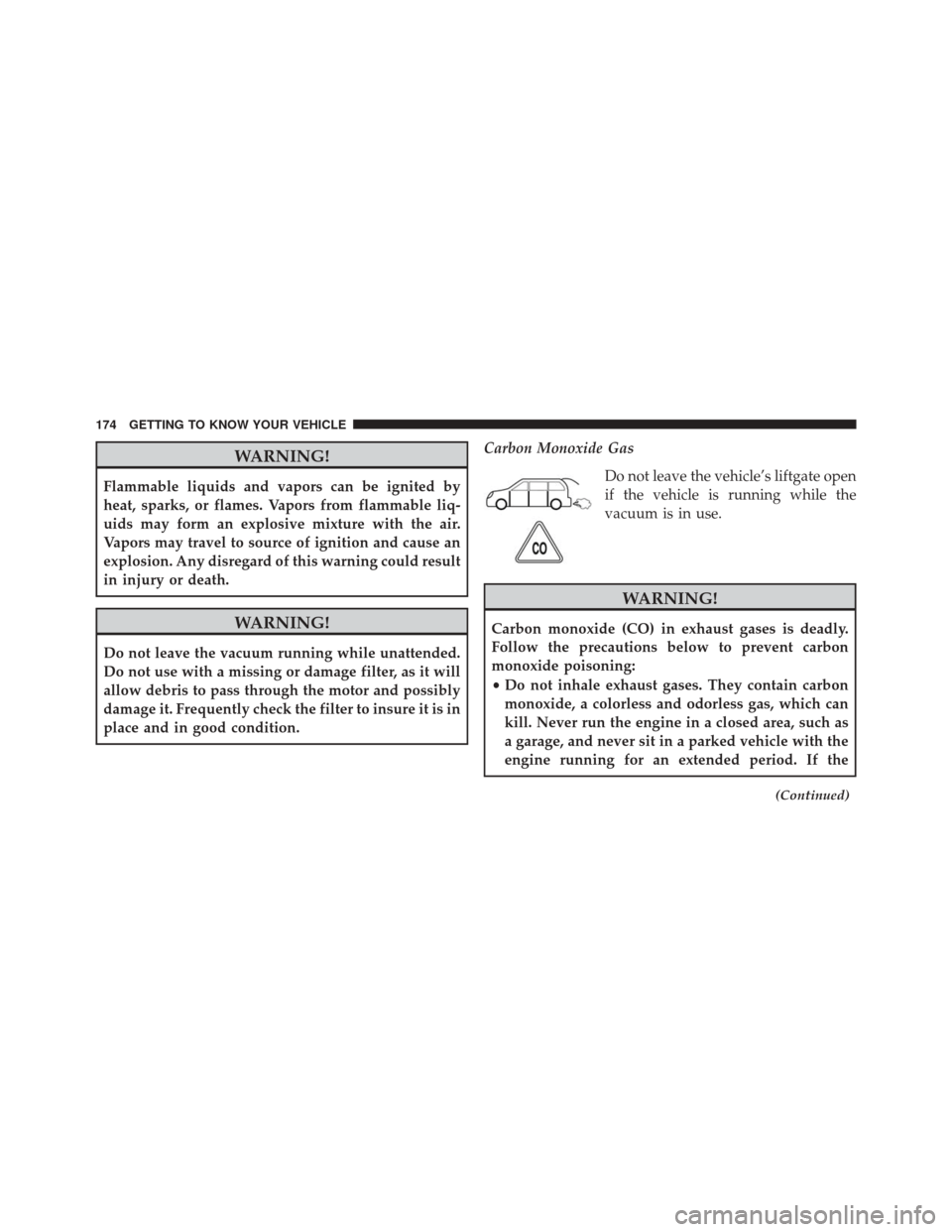
place and in good condition.Carbon Monoxide Gas
Do not leave the vehicle’s liftgate open
if the vehicle is running while the
vacuum is in use.
WARNING!
Carbon monoxide (CO) in exhaust gases is deadly.
Follow the precautions below to prevent carbon
monoxide poisoning:
•Do not inhale exhaust gases. They contain carbon
monoxide, a colorless and odorless gas, which can
kill. Never run the engine in a closed area, such as
a garage, and never sit in a parked vehicle with the
engine running for an extended period. If the
(Continued)
174 GETTING TO KNOW YOUR VEHICLE